Olekranon-Bursitis
Schülerellenbogen
Begutachtet von Dr Hayley Willacy, FRCGP Zuletzt aktualisiert von Dr Doug McKechnie, MRCGPZuletzt aktualisiert 2. Jan 2024
Erfüllt die Anforderungen des Patienten redaktionellen Richtlinien
- HerunterladenHerunterladen
- Teilen
- Language
- Diskussion
- Audio-Version
- Zu bevorzugten Quellen bei Google hinzufügen
Olecranon-Bursitis ist eine Erkrankung, bei der es zu Entzündungen und weichem Schwellung an der Rückseite Ihres Ellenbogens kommt. Das Olecranon ist die knöcherne Spitze Ihres Ellenbogens. Eine Bursa ist eine weiche Flüssigkeitsblase, die über einem Gelenk im Körper liegt. '-itis' bedeutet Entzündung.
Auf einen Blick
Olekranon-Bursitis ist eine Entzündung des mit Flüssigkeit gefüllten Sacks hinter dem Ellbogen.
Zu den Symptomen gehört eine Schwellung hinter dem Ellbogen, manchmal wie ein weicher Ball.
Nicht-infektiöse Bursitis ist oft schmerzlos; infizierte Bursitis verursacht Schmerzen, Rötung und Fieber.
Häufige Ursachen sind wiederholte leichte Verletzungen oder ein einmaliger Schlag auf den Ellbogen.
Die Behandlung umfasst Ruhe, Eis, das Vermeiden von Druck und manchmal entzündungshemmende Medikamente.
Antibiotika sind erforderlich, wenn die Bursitis durch eine Infektion verursacht wird.
Das Schützen Ihres Ellbogens durch die Verwendung von Polstern kann helfen, ein Wiederauftreten zu verhindern.
Ellbogen mit Olekranon-Bursitis
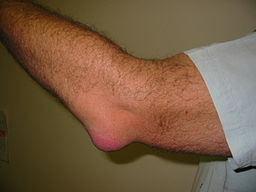
© Benutzer:NJC123, über Wikimedia Commons
Was ist Olekranonbursitis?
Olekranon-Bursitis, auch bekannt als Ellenbogen-Bursitis, ist eine Entzündung, Schwellung und Schmerzen im mit Flüssigkeit gefüllten Schleimbeutel hinter dem Ellenbogen, dem Olekranon-Bursae.
Was ist eine Bursa?
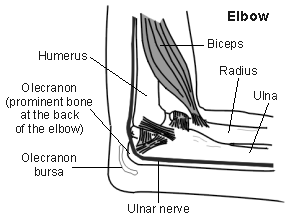
Eine Bursa ist ein kleiner Sack, der eine geringe Menge an Flüssigkeit enthält. Die Flüssigkeit ähnelt der in den Gelenken (Gelenkflüssigkeit). Im Körper gibt es mehrere Bursa, darunter eine direkt über dem Olekranon. Bursae helfen, die Bewegungen zwischen Knochen, die hervortreten, und der darüber liegenden Haut reibungslos zu gestalten.
Normalerweise kann die Bursa nicht ertastet werden, aber wenn sie sich entzündet, wird sie größer, sodass man die Beule sehen und eine weiche Beule auf der Rückseite des Ellenbogens fühlen kann. Man sagt manchmal, sie ähnelt der Form eines Gänseeies oder eines Golfballs, obwohl sie in verschiedenen Formen und Größen auftreten kann.
Diagramm: Ellenbogen mit Olecranon-Bursa
Was sind die Symptome einer Olekranon-Bursitis?
Normalerweise können Sie eine Bursa nicht fühlen oder sehen. Wenn die Olekranon-Bursa entzündet ist, führt dies zu einer Verdickung und Schwellung auf der Rückseite des Ellenbogens. Die Bursa kann sich auch mit Flüssigkeit füllen und sieht dann aus wie eine kleine weiche Kugel.
Es gibt zwei Arten von Olekranon-Bursitis:
Infiziert (septisch).
Nicht infiziert (aseptisch).
Es ist nicht immer offensichtlich, welcher Typ es ist, aber die Symptome sind tendenziell leicht unterschiedlich. Der nicht-infizierte Typ ist der häufigste.
Symptome des aseptischen Schleimbeutelentzündung
Die meisten Fälle von aseptischer Olecranonbursitis sind schmerzfrei oder nur leicht schmerzhaft. Die Beweglichkeit des Ellenbogengelenks ist nicht beeinträchtigt. Es kann schmerzen, Druck auf die Ellenbogen auszuüben – zum Beispiel, wenn Sie Ihren Ellenbogen auf eine harte Oberfläche stützen. Es kann auch ein wenig schmerzen, wenn Sie Ihren Ellenbogen beugen.
Das Anschwellen hat die gleiche Farbe wie der Rest Ihrer Haut oder ist leicht rosa. Es kann die gleiche Temperatur wie die restliche Haut haben oder leicht warm sein. Das Anschwellen ist beim Berühren weich anstatt hart, und Sie können möglicherweise die flüssigkeit darin bewegen spüren, wenn Sie darauf drücken.
A bursitis associated with another condition such as Arthritis may not be painful itself but you will have other symptoms related to the arthritis, such as joint pains.
Symptome der septischen Olekranonbursitis
Wenn die Bursa infiziert ist, entwickeln Sie in der Regel:
Schmerzen.
Rötung und Empfindlichkeit hinter dem Ellenbogen.
Rötung und Schwellung, die sich vom Ellenbogen aus ausbreiten.
Eine hohe Temperatur (Fieber).
Eine Schürfwunde oder Verletzung auf der Haut über der Schwellung, durch die die Keime (Bakterien) eingedrungen sind.
Was sind die Ursachen der Olekranon-Bursitis?
Es gibt eine Reihe möglicher Ursachen für die Olekranonbursitis:
Leichte, aber wiederholte Verletzung is thought to be the common cause of olecranon bursitis. For example, people who lean on their elbows a lot cause friction and repeated mild injury over the olecranon.
Wiederholte Ellbogenbewegungen may be a cause in certain athletes. For example, those whose sports involve throwing by raising the arm above the head (such as cricket or baseball players, javelin throwers) or weightlifters.
Einmalige Verletzung such as a blow to the back of the elbow may set off inflammation.
Arthritis. Eine oder mehrere Schleimbeutel können im Rahmen einer generalisierten Arthritis entzündet sein. (Hinweis: most cases of olecranon bursitis are not associated with arthritis.) Types of arthritis which can be associated with bursitis include rheumatoide Arthritis, Gicht und ankylosierende Spondylitis.
Infektion of a bursa. This may occur if there is a cut in the skin over a bursa, which allows in germs (bacteria). Some illnesses may make infection more likely - for example, Diabetes or conditions where the immune system does not work as well as normal. There is not always an obvious cause for the infection.
Unbekannt (idiopathisch). Viele Fälle treten ohne ersichtlichen Grund auf. Es ist jedoch möglich, dass einige davon auf eine leichte Verletzung zurückzuführen sind, die vergessen wurde.
Wie wird Olekranon-Bursitis diagnostiziert?
Wenn Sie einen unkomplizierten Fall von Olekranon-Bursitis haben, kann der Arzt ihn möglicherweise ohne Tests diagnostizieren. Die Schwellung ist sehr typisch und da der Ellbogen so nah an der Haut liegt, ist sie in der Regel ziemlich leicht zu ertasten.
Allerdings sind manchmal weitere Tests erforderlich, um andere Ursachen für die Schwellung des Ellenbogens auszuschließen, wie z.B. Infektionen (septische Arthritis), Gicht oder rheumatoide Arthritis.
Tests which might be needed include Bluttests und ein Ultraschall-Scan. If you have had a significant injury, an Röntgenbild might be needed to make sure there is no break (fracture). Also, sometimes people who have had repeated episodes of olecranon bursitis develop an olecranon spur - a bony growth - which can be seen on an X-ray.
Wenn eine Infektion ('septische Olekranonbursitis') vermutet wird, kann der Arzt die bursale Flüssigkeit im Schwellung absaugen (aspirieren). In einigen Fällen kann dies auch von Ihrem Hausarzt in der Praxis durchgeführt werden.
Ein Proben werden dann ins Labor geschickt, um festzustellen, welche Keime (Bakterien) die Infektion verursachen. Dies kann dann bei der Auswahl der richtigen Behandlung für Sie helfen.
Muss ich einen Spezialisten wegen Olekranonbursitis aufsuchen?
Ihr Hausarzt kann Sie oft diagnostizieren und behandeln, ohne dass Sie an einen Facharzt überwiesen werden müssen. Wenn jedoch Zweifel an der Diagnose bestehen oder Sie eine begleitende Erkrankung wie rheumatoide Arthritis haben, kann eine Überweisung erfolgen.
Wenn Ihr Hausarzt nicht darin geübt ist, diese Schwellungen zu punktieren, kann er oder sie Sie an jemanden mit viel Erfahrung überweisen.
Was ist die Behandlung der Olekranon-Bursitis?
In vielen Fällen heilt die Olekranonbursitis von selbst ab, wenn man einfache Maßnahmen ergreift, wie das Ruhigstellen des Ellenbogens, Druck darauf zu vermeiden und Eisbeutel anzuwenden. Manche Menschen empfinden eine Kompressionsbandage am Ellenbogen als angenehmer.
.
Andere in einigen Fällen empfohlene Behandlungen sind:
Entzündungshemmende Medikamente (wie zum Beispiel Ibuprofen, Naproxen, Diclofenac, etc) may be prescribed to reduce inflammation and swelling. Paracetamol is another option if the elbow is painful.
Abfluss der Flüssigkeit (Absaugung) can be done by a healthcare professional with a sterile needle and syringe if a lot of fluid builds up. However, the fluid tends to build up again after being drained. Therefore, you may be advised to wear a tight pressure bandage for a while after the fluid has been drained, to prevent it building up again.
A Steroidinjektion into the bursa may cure the problem. Steroids are good at reducing inflammation. However, steroid injections sometimes cause infection in the bursa.
Operation to remove the bursa is an option if the above do not work.
Antibiotika are needed if the cause of the bursitis is an infection. Normally an antibiotic such as Flucloxacillin oder Erythromycin is used until the results of the tests on the aspirated fluid are available. Then the choice of treatment can be changed if necessary and directed at the exact germs (bacteria) causing the infection. Flucloxacillin and erythromycin treat the most common types of germs which cause olecranon bursitis.
Wenn Sie den Ellbogen vor übermäßiger Reibung und Reiben schützen, können weitere Episoden von Olekranon-Bursitis verhindert werden. Das kann bedeuten, Ellbogenschützer zu verwenden, wenn Sie beim Arbeiten auf den Ellbogen stützen müssen.
Wird die Olekranon-Bursitis nach der Behandlung wiederkommen?
In der Regel nicht. Wenn Sie dazu neigen, sich auf die Ellbogen zu stützen, kann das Vermeiden dieser Haltung dazu beitragen, dass eine Olekranon-Bursitis nicht wieder auftritt. Versuchen Sie, diese Position zu vermeiden, oder verwenden Sie ein Kissen oder eine Polsterung, damit Ihre Ellbogen nicht auf einer harten Oberfläche ruhen.
Patientenauswahl für Gelenkschmerzen
/og.png)
Knochen, Gelenke und Muskeln
Temporomandibuläre Gelenkstörung (TMD)
Temporomandibuläre Störungen sind Probleme, die das Kiefergelenk sowie die Muskeln und andere Gewebe um das Kiefergelenk betreffen. Diese Störungen verursachen normalerweise Schmerzen oder eine eingeschränkte Beweglichkeit des Kiefers und manchmal Geräusche wie Klicken oder Knirschen des Kiefergelenks. Es gibt verschiedene Ursachen, aber im Allgemeinen sind temporomandibuläre Störungen nicht ernsthaft und verbessern sich oft mit einfachen Behandlungen.
von Dr. Rosalyn Adleman, MRCGP

Knochen, Gelenke und Muskeln
Hüftprobleme
Hüftprobleme sind ziemlich häufig. Die Ursache kann offensichtlich sein, wie eine Verletzung, die plötzlich beim Sport auftritt. Manchmal ist die Ursache nicht so klar, und Sie sollten von einem Arzt oder Physiotherapeuten untersucht werden.
von Dr. Rachel Hudson, MRCGP
Häufig gestellte Fragen
Was ist eine weiche Beule am Ellbogen?
Eine weiche Schwellung am Ellbogen, insbesondere auf der Rückseite, ist oft ein Zeichen für eine Olekranon-Bursitis. Diese Erkrankung tritt auf, wenn der mit Flüssigkeit gefüllte Sack (Bursa) hinter Ihrem Ellbogen sich entzündet und anschwillt. Wenn dies geschieht, kann es wie ein weicher Ball aussehen und sich anfühlen, manchmal verglichen mit einem Gänseei oder einem Golfball.
Wie erkennt man, ob eine Schleimbeutelentzündung im Ellenbogen infiziert ist?
Sie könnten eine Infektion vermuten, wenn Sie verstärkte Schmerzen, Rötungen und Empfindlichkeit verspüren, die sich vom Ellbogen ausbreiten, zusammen mit einer hohen Temperatur (Fieber). Es könnte auch eine sichtbare Schürfwunde oder Wunde auf der Haut über der Schwellung vorhanden sein, wo Bakterien eingedrungen sein könnten.
Ist das Ablassen einer Ellbogenbursitis schmerzhaft?
Der Artikel erwähnt nicht speziell das Schmerzlevel während des Ablassverfahrens selbst, aber er gibt an, dass die Aspiration (das Ablassen der Flüssigkeit) von einem Gesundheitsfachmann mit einer sterilen Nadel und Spritze durchgeführt wird. Nach dem Ablassen könnte ein straffer Druckverband empfohlen werden, um zu verhindern, dass sich erneut Flüssigkeit ansammelt, was Unbehagen verursachen könnte.
Was ist ein Schleimbeutel und warum entzündet er sich im Ellbogen?
Eine Bursa ist ein kleiner, mit Flüssigkeit gefüllter Sack, der hilft, eine reibungslose Bewegung zwischen Knochen und darüberliegender Haut zu ermöglichen. Im Ellbogen kann die Olekranon-Bursa durch wiederholte leichte Verletzungen entzündet werden, wie häufiges Abstützen auf den Ellbogen, wiederholte Ellbogenbewegungen in bestimmten Sportarten, ein einzelner Schlag auf den Ellbogen oder als Teil einer generalisierten Arthritis-Erkrankung. Sie kann auch durch eine Infektion oder ohne ersichtlichen Grund entzündet werden.
Kann ich eine Schleimbeutelentzündung am Ellenbogen zu Hause behandeln, ohne einen Arzt aufzusuchen?
In vielen Fällen kann sich eine Olekranon-Bursitis mit einfacher häuslicher Pflege bessern, insbesondere wenn sie nicht infiziert ist. Dazu gehört, den Ellenbogen zu schonen, Druck darauf zu vermeiden und Eisbeutel aufzulegen. Einige Menschen finden einen Kompressionsverband hilfreich. Schmerzmittel oder entzündungshemmende Medikamente, die rezeptfrei erhältlich sind, können bei Schmerzen helfen. Wenn Sie jedoch eine Infektion vermuten oder sich die Symptome verschlimmern, sollten Sie einen Arzt aufsuchen.
Weiterführende Lektüre und Referenzen
- Blackwell JR, Hay BA, Bolt AM, et al; Olekranonbursitis: ein systematischer Überblick. Schulter Ellbogen. 2014 Jul;6(3):182-90. doi: 10.1177/1758573214532787. Epub 2014 Mai 6.
- Olekranon-Bursitis; NICE CKS, Mai 2021 (nur in Großbritannien zugänglich)
- Pangia J, Rizvi TJ; Olekranon-Bursitis. StatPearls, Juli 2021.
- O'Shea NE, Tadi P; Olekranon-Bursaspiration. StatPearls, Sept 2021.
Über den AutorVollständige Biografie anzeigen

Dr Doug McKechnie, MRCGP
Medizinischer Autor
MA, MBBS, MSc, DRCOG, MRCP(UK), MRCGP(2021), FHEA
Dr. Doug McKechnie ist ein NHS-Hausarzt, der in London arbeitet. Er arbeitet klinisch in Vollzeit und ist außerdem stellvertretender Leiter des Moduls für klinische und berufliche Praxis an der University College London Medical School.
Über den RezensentenVollständige Biografie anzeigen

Dr Hayley Willacy, FRCGP
Allgemeinmediziner, Medizinischer Autor
MBChB (1992), DRCOG, DFFP, MRCOG (Part 1) MRCGP (2007), DFSRH (2013), MSc - medical education (2020)
Dr. Hayley Willacy war eine NHS-Hausärztin, die in Nordwestengland arbeitete und 2022 nach 30 Jahren aus der klinischen Praxis ausschied.
Artikelverlauf
Die Informationen auf dieser Seite wurden von qualifizierten Klinikern verfasst und begutachtet.
Artikel auch verfügbar in Englisch, Deutsch, Spanisch, Französisch, Italienisch, Portugiesisch, Hindi, Hebräisch, Arabisch, und Schwedisch.
Nächste Überprüfung fällig: 31. Dez. 2028
2. Jan 2024 | Neueste Version

Fragen, teilen, verbinden.
Durchsuchen Sie Diskussionen, stellen Sie Fragen und teilen Sie Erfahrungen zu Hunderten von Gesundheitsthemen.

Fühlen Sie sich unwohl?
Bewerten Sie Ihre Symptome online kostenlos
Abonnieren Sie den Patienten-Newsletter
Ihre wöchentliche Dosis klarer, vertrauenswürdiger Gesundheitsberatung - geschrieben, um Ihnen zu helfen, sich informiert, selbstbewusst und in Kontrolle zu fühlen.
Durch das Abonnieren akzeptieren Sie unsere Datenschutzrichtlinie. Sie können sich jederzeit abmelden. Wir verkaufen Ihre Daten niemals.
Mehr über Knochen, Gelenke und Muskeln
- Axiale Spondyloarthritis
- Gebrochene oder geprellte Rippen
- Oberarmbruch
- Halsrippe
- Fibromyalgie
- Kniegelenkersatz
- Multiple Sklerose
- Muskelschwäche
- Nackenschmerzen
- Osteoarthritis
- Osteomyelitis
- Vorbeugung von steroidinduzierter Osteoporose
- Psoriasis-Arthritis
- Rheumatoide Arthritis
- Septische Arthritis
- Schienbeinkantensyndrom
- Spinalanästhesie
- Wirbelscheibenprobleme
- Temporomandibuläre Gelenkstörung (TMD)
- Tennisarm