Rotator cuff injuries and disorders
Peer reviewed by Dr Toni Hazell, FRCGPLast updated by Dr Philippa Vincent, MRCGPLast updated 24 May 2023
Meets Patient’s editorial guidelines
- DownloadDownload
- Share
- Language
- Discussion
- Audio Version
- Add to preferred sources on Google
Rotator cuff injuries and disorders are the most common causes of shoulder pain. There are three common conditions that can affect the rotator cuff: rotator cuff tears, subacromial impingement and calcific tendonitis. Most people with rotator cuff problems can be successfully treated by a combination of exercises (avoiding overhead activities), painkillers, physiotherapy and occasionally steroid injections. Surgery is sometimes an option.
At a glance
A rotator cuff injury causes shoulder pain due to a tear, inflammation, or narrowing within the joint.
The rotator cuff is a group of four muscles that stabilise and move the shoulder joint.
Common symptoms include pain around the shoulder, painful arm movement, and weakness.
You can reduce your risk of injury by strengthening shoulder muscles and warming up before exercise.
Treatment may involve avoiding aggravating activities, painkillers, physiotherapy exercises, or steroid injections.
Full recovery can take at least six months and often longer.
What is a rotator cuff injury?
A rotator cuff injury is an event that causes pain in the area of the rotator cuff of the shoulder. This can be due to a tear, inflammation or narrowing of the space within the shoulder joint.
What is the rotator cuff?
The rotator cuff is a group of four muscles that are positioned around the shoulder joint. The muscles are named:
Supraspinatus.
Infraspinatus.
Subscapularis.
Teres minor.
The shoulder joint
There are three bones in the shoulder region: the collarbone (clavicle), the shoulder blade (scapula) and the upper arm bone (humerus). The scapula is a triangular-shaped bone that has two important parts to it: the acromion and the glenoid. The three bones in the shoulder region form part of two main joints:
The acromioclavicular joint between the acromion of the scapula and the clavicle.
The glenohumeral joint between the glenoid of the scapula and the humerus.
There are also a number of ligaments, muscles and tendons around the shoulder. Ligaments are fibres that link bones together at a joint. Tendons are fibres that attach muscle to bone.
What does the rotator cuff do?
The rotator cuff muscles interlock to work as a unit. They help to stabilise the shoulder joint and also help with shoulder joint movement. The four tendons of the rotator cuff muscles join together to form one larger tendon, called the rotator cuff tendon. This tendon attaches to the bony surface at the top of the upper arm bone (the head of the humerus).
There is a space underneath the acromion of the scapula, called the subacromial space. The rotator cuff tendon passes through here. The subacromial space is filled by the subacromial bursa. This is a fluid-filled sac which helps the rotator cuff to move smoothly. It has a large number of pain sensors.
Rotator cuff
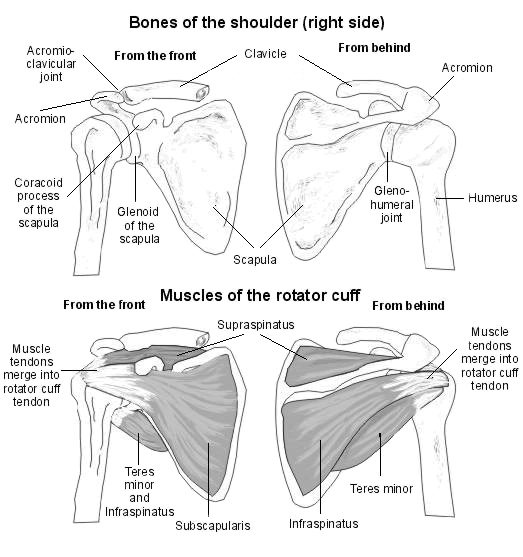
Rotator cuff injuries and disorders usually cause subacromial pain, and the term subacromial pain is now often used to cover all causes of rotator cuff disorders. It is the most common cause of shoulder problems.
What causes rotator cuff injuries and disorders?
There are a number of types of rotator cuff disorders. The most common problems include:
Rotator cuff tears.
Subacromial impingement.
Calcific tendonitis.
Rotator cuff tears
The rotator cuff is very vulnerable to being damaged within the subacromial space. This can lead to a tear that is not only painful but also makes the shoulder weak. It can happen suddenly after a single injury or can develop gradually due to long-term wear and tear.
Torn rotator cuffs can be due to a minor/partial tear or full/complete tear, depending on the degree of damage to the tendon. Minor tears to the rotator cuff are very common and may not cause any symptoms at all; however, it is possible for small tears to be very painful and larger ones less so. A tear can be seen on an ultrasound or an MRI scan but not on an X-ray.
Subacromial impingement
Also known as subacromial pain syndrome, tendinitis, tendonitis, bursitis, trapped tendon.
As the arm moves upward, the rotator cuff pushes the top of the upper arm bone (humeral head) under the acromion. Anything that affects the cuff, such as minor tears or overuse after a period of inactivity, can lead to the humeral head not being pushed down properly. It therefore moves too close to the acromion and this causes pain. It can also happen due to problems with the bone of the acromion. These can include arthritis and bone spurs (protrusions).
Calcific tendonitis
Calcific tendonitis is the name given when calcium builds up in the rotator cuff tendon. It can cause an increase in pressure in the tendon and a chemical irritation. It can be very painful. The cause is not known but it can eventually go away without any treatment. It tends to be more common in people between 30 and 60 years of age.
The calcium deposit may affect the way the rotator cuff works, causing subacromial impingement, but calcium deposits are also seen in people with no symptoms.
How common are rotator cuff injuries?
Rotator cuff injuries are extremely common and can happen to anyone. Sometimes they are caused by falling on to the affected arm; this is more likely to be the cause in someone aged under 40. Overuse, either through sport or profession, may be a cause but they can also occur without any obvious cause.
Rotator cuff injury symptoms
The main symptoms of rotator cuff injury are:
Pain in and around the shoulder joint.
Painful movement of the shoulder.
Pain that is worse when using the arm above shoulder level.
Weakness in the shoulder or arm.
Clicking or catching when moving the shoulder.
If there has been an injury, the pain may come on suddenly. The pain can affect the ability to lift your arm up - for example, to comb hair or dress oneself. Swimming, basketball and painting can be painful but writing and typing may produce little in the way of pain. Pain may also be worse at night and affect sleep.
Rotator cuff injury diagnosis
A doctor, or other professional such as a physiotherapist, may be able to find out what is causing a rotator cuff disorder just by talking about symptoms (for example, when the problems started, whether there was an initial injury and what aggravates the problem) and examining the shoulder.
They will then perform an examination of the shoulders which usually involves moving the shoulder in various positions and comparing it with the unaffected side. They may also examine the neck, as neck pain can sometimes cause pain in the shoulder.
Sometimes a clinician may suggest an X-ray of your shoulder to rule out other causes of shoulder pain. A clinician may request an ultrasound scan which is a good way of looking at the shoulder joint or, very occasionally, a magnetic resonance imaging (MRI) scan.
Frozen shoulder is a different relatively common cause of shoulder pain. .
Rotator cuff injury treatment
Activities that aggravate the pain should be avoided, for example, overhead activities, such as that performed by plasterers or painters and decorators. This may mean that work activities need to be modified or changed. However, the shoulder should not be completely rested. Strengthening the shoulder is good but it is important not to try to work or play through the pain.
A physiotherapist or a referral to a specialist in orthopaedics or sports medicine may be needed for further assessment and treatment.
Pain relief
Painkillers such as paracetamol are usually helpful.
Anti-inflammatories are painkillers too but they also reduce any inflammation and are commonly prescribed. They include ibuprofen, diclofenac and naproxen. Side-effects sometimes occur with anti-inflammatories. Always read the leaflet that comes with the medicine packet for a full list of cautions and possible side-effects. If they don't help fairly quickly stop taking them. Over the age of 40, it is usual to have a "stomach protector" such as omeprazole or lansoprazole prescribed with anti-inflammatory medication.
Stronger painkillers: these may occasionally be needed for a short time.
Ice packs: these can also help to reduce pain, especially if there has been a sudden injury. A bag of frozen peas is an easy ice pack to use in the home.
Physiotherapy
It is really important to keep the shoulder strong and mobile. It can be very useful to see a physiotherapist for advice and to be prescribed an exercise programme to do at home if the symptoms aren't settling quickly.
Steroid injection
This can help to reduce the pain, allowing exercises to be done more easily. It may reduce the inflammation in the subacromial space. A second steroid injection can be given if the response to the first one was good. More than two steroid injections are
not recommended.
Surgery
Rotator cuff tears - rotator cuff surgery may be required if the tear followed a sudden injury and when pain and weakness have not improved with steroid injections and physiotherapy.
Subacromial impingement - surgery is rarely required. If necessary an arthroscopic subacromial decompression (ASD) can be performed. This is done to increase the amount of space between the acromion and the rotator cuff by surgically removing bone and other tissue from part of the shoulder blade. However, recent research suggests that this operation is not as effective as previously thought:
In a study of over 300 people with subacromial shoulder pain, a third had no treatment, a third had 'sham' surgery (that is they had an operation but didn't have any tissue removed) and a third had an ASD.
The two surgical groups, whether tissue was removed or not, did a bit better than no treatment but not enough to consider surgery to be more effective.
It has been suggested that the slight benefit of both ASD and 'sham' surgery might be due to the physiotherapy following the operation or to a placebo effect.
Calcific tendonitis - 'ultrasound-guided barbotage' may be performed. This involves injecting the calcium deposit with salt water and sucking it out through a syringe. The calcium deposit may also be removed by surgery if the pain is extremely severe. An ASD will be carried out at the same time.
How long does a rotator cuff injury take to heal?
If rotator cuff injuries are adequately treated, there can be complete recovery. This will involve daily exercises to strengthen the shoulder and to keep it strong. Full recovery can take at least six months and often takes longer than this.
How to avoid rotator cuff injury
The risk of a rotator cuff injury can be reduced by:
Strengthening the muscles and tendons in the shoulder. Shoulder exercises also improve flexibility as well as reducing the risk of rotator cuff injury.
Doing simple shoulder stretches, with or without using resistance bands. This can improve flexibility and endurance.
Always warming up properly before any sport activity.
Having physiotherapy or chiropractic treatment. These treatments can help to promote function, mobility, and range of motion.
Patient picks for Joint pain

Bones, joints and muscles
Tennis elbow
Tennis elbow is a condition where there is pain on the outer side of the elbow. It is often caused by overuse strain, causing damage to tendons around the elbow. In many people, symptoms improve over time just by stopping activities that bring on the symptoms. Studies have not yet confirmed the best way to treat tennis elbow. Painkillers may help to ease the pain until the condition improves. A steroid injection may also ease pain in the short term. However, the pain often returns. Physiotherapy is another treatment option. Other treatments are sometimes used if symptoms persist.
by Dr Philippa Vincent, MRCGP

Bones, joints and muscles
Mallet finger
A finger that bends down at the end joint and cannot be straightened is called a mallet finger. It is caused by an injury to the tendon that straightens (extends) the finger. A splint worn day and night for 6-8 weeks will cure the problem in most cases.
by Dr Hayley Willacy, FRCGP
Frequently asked questions
What is subacromial pain?
Subacromial pain is a term often used to describe pain originating from rotator cuff disorders. It primarily affects the area beneath the acromion of the shoulder. This type of pain is the most common cause of shoulder problems, indicating issues with the structures in this specific region of the shoulder joint.
Can I prevent a rotator cuff injury?
Yes, you can take steps to reduce your risk of a rotator cuff injury. This includes strengthening the muscles and tendons in your shoulder and performing simple shoulder stretches, possibly using resistance bands, to improve flexibility and endurance. It's also important to warm up properly before any sport activity to prepare your muscles. Additionally, physiotherapy or chiropractic treatment can help promote function, mobility, and range of motion in the shoulder, further reducing the risk.
Are there different types of medication for rotator cuff pain?
Yes, several options are available. Over-the-counter painkillers like paracetamol can be helpful. Anti-inflammatory medications such as ibuprofen, diclofenac, and naproxen are also used to reduce both pain and inflammation. If these aren't sufficient, stronger painkillers might be prescribed for a short period. Along with medication, ice packs can help reduce pain, especially after a sudden injury.
What is the purpose of a steroid injection for a rotator cuff injury?
A steroid injection can help reduce pain and inflammation in the subacromial space, making it easier to perform recommended exercises. If the first injection is effective, a second one may be given, but generally more than two are not recommended. This treatment is often used to facilitate other therapies like physiotherapy.
Is surgery always necessary for a rotator cuff injury?
No, surgery is not always necessary. For rotator cuff tears, it might be considered if the injury followed a sudden event and if pain and weakness haven't improved with physiotherapy and steroid injections. For subacromial impingement, surgery is rarely required. In cases of calcific tendonitis, a procedure called 'ultrasound-guided barbotage' can be performed to remove calcium deposits, or surgery may be an option if the pain is extremely severe.
Further reading and references
- Beard DJ, Rees JL, Cook JA, et al; Arthroscopic subacromial decompression for subacromial shoulder pain (CSAW): a multicentre, pragmatic, parallel group, placebo-controlled, three-group, randomised surgical trial. Lancet. 2018 Jan 27;391(10118):329-338. doi: 10.1016/S0140-6736(17)32457-1. Epub 2017 Nov 20.
- Kulkarni R, Gibson J, Brownson P, et al; Subacromial shoulder pain. Shoulder Elbow. 2015 Apr;7(2):135-43. doi: 10.1177/1758573215576456. Epub 2015 Mar 31.
- Shoulder pain; NICE CKS, November 2022 (UK access only)
- Rotator Cuff Tears; Ortho Info
- Rotator Cuff and Shoulder Conditioning Program; Ortho Info
About the authorView full bio

Dr Philippa Vincent, MRCGP
General Practitioner, Medical Author
MB BS, Bsc, MRCGP (2000), DCH, DFSRH, DRCOG
Dr Philippa Vincent is an NHS GP working in North London.
About the reviewerView full bio

Dr Toni Hazell, FRCGP
MBBS, BSc, FRCGP, DFSRH, Dip GU med, DRCOG, DCH (London, UK, 2000)
Dr. Toni Hazell qualified from St. Mary’s Hospital Medical School and did her VTS at Northwick Park Hospital.
Article history
The information on this page is written and peer reviewed by qualified clinicians.
Article also available in English, German, Spanish, French, Italian, Portuguese, Hindi, Hebrew, Arabic, and Swedish.
Next review due: 12 May 2028
24 May 2023 | Latest version
Join the conversation
Share your thoughts or experiences with others in our patient communities.

Ask, share, connect.
Browse discussions, ask questions, and share experiences across hundreds of health topics.

Feeling unwell?
Assess your symptoms online for free
Sign up to the Patient newsletter
Your weekly dose of clear, trustworthy health advice - written to help you feel informed, confident and in control.
By subscribing you accept our Privacy Policy. You can unsubscribe at any time. We never sell your data.
More in bones, joints and muscles
- Back pain in children
- Broken or bruised ribs
- Compartment syndrome
- Disease-modifying antirheumatic drugs
- Dislocation
- Fibromyalgia
- Ganglion
- Guillain-Barré syndrome
- Housemaid's knee
- Mallet finger
- Marfan syndrome
- Meralgia paraesthetica
- Osgood-Schlatter disease
- Osteomyelitis
- Preventing steroid-induced osteoporosis
- Reactive arthritis
- Septic arthritis
- Sports injuries
- Thoracic back pain
- Trigger finger