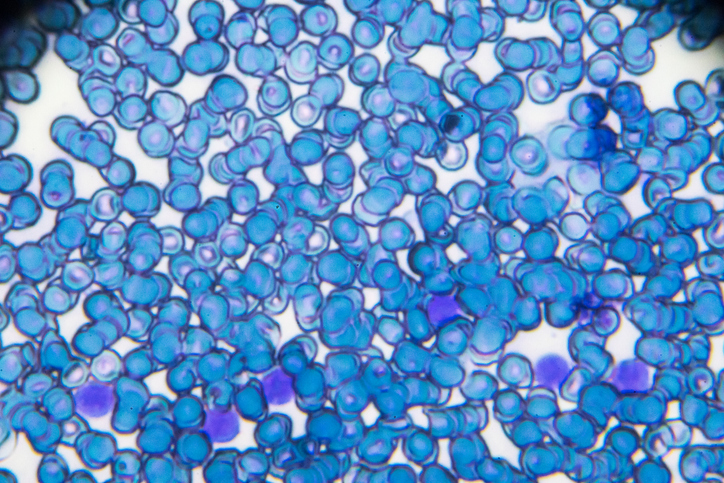
Leukämie
Begutachtet von Dr Toni Hazell, FRCGPZuletzt aktualisiert von Dr Hayley Willacy, FRCGP Zuletzt aktualisiert 21. Feb 2023
Erfüllt die redaktionelle Richtlinien
- HerunterladenHerunterladen
- Teilen
- Language
- Diskussion
- Audio-Version
- Zu bevorzugten Quellen bei Google hinzufügen
In dieser Serie:Akute lymphoblastische LeukämieChronische lymphatische LeukämieAkute myeloische LeukämieChronische myeloische Leukämie
Leukämie ist eine Krebsart der blutbildenden Zellen. Es gibt verschiedene Arten von Leukämie. Wenn bei Ihnen Leukämie diagnostiziert wird, ist es wichtig, den Typ zu kennen. Dies liegt daran, dass die Prognose und die Behandlung je nach Typ variieren.
Auf einen Blick
Leukämie ist eine Krebserkrankung der Zellen im Knochenmark, die sich zu weißen Blutkörperchen entwickeln.
Die Haupttypen sind akute lymphoblastische, chronische lymphatische, akute myeloische und chronische myeloische Leukämie.
Symptome können Müdigkeit, Atemnot, leichte Blutergüsse, Blutungen und schwere Infektionen umfassen.
Akute Leukämiesymptome entwickeln sich schnell, während chronische Formen langsam fortschreiten.
Leukämie wird durch Bluttests und eine Knochenmarkprobeanalyse diagnostiziert.
Die Behandlung hängt von der Art und dem Stadium der Leukämie ab und kann eine Chemotherapie umfassen.
Was ist Leukämie?
Leukämie ist eine Krebserkrankung der Zellen im Knochenmark (aus diesen Zellen entwickeln sich weiße Blutkörperchen).
Cancer is a disease of the cells in the body. There are many Krebsarten which arise from different types of cell. What all cancers have in common is that the cancer cells are abnormal and do not respond to normal control mechanisms. Large numbers of cancer cells build up because they multiply 'out of control', or because they live much longer than normal cells, or both.
Bei Leukämie gelangen die Krebszellen im Knochenmark in den Blutkreislauf. Es gibt verschiedene Arten von Leukämie. Die meisten entstehen aus Zellen, die sich normalerweise zu weißen Blutkörperchen entwickeln. (Das Wort Leukämie stammt aus dem Griechischen und bedeutet „weißes Blut“.)
If you develop leukaemia it is important to know exactly what type it is. This is because the outlook (prognosis) and treatments vary for the different types. Before discussing the different types of leukaemia it may help to know some Grundlagen zu normalen Blutzellen und ihrer Entstehung.
Die wichtigsten Leukämiearten
Akute lymphatische Leukämie (ALL).
Chronische lymphatische Leukämie (CLL).
Akute myeloische Leukämie (AML).
Chronische myeloische Leukämie (CML).
Von jeder dieser Formen gibt es verschiedene „Untertypen“. Außerdem gibt es einige andere seltene Arten von Leukämie. Das Wort:
'„Akut“ bedeutet, dass sich die Krankheit recht schnell entwickelt und fortschreitet.
'„Chronisch“ bedeutet anhaltend oder dauerhaft. Im Zusammenhang mit Leukämie bedeutet das Wort „chronisch“ außerdem, dass sich die Krankheit langsam entwickelt und fortschreitet (auch ohne Behandlung).
'„Lymphoblastisch“ und „lymphozytisch“ bedeuten, dass eine abnorme Krebszelle aus einer lymphatischen Stammzelle hervorgegangen ist.
'„Myeloid“ bedeutet, dass es sich bei einer abnormalen Krebszelle um eine Zelle handelt, die aus einer myeloischen Stammzelle hervorgegangen ist.
Was verursacht Leukämie?
Man geht davon aus, dass eine Leukämie zunächst von einer einzigen abnormalen Zelle ausgeht. Offenbar werden dabei bestimmte wichtige Gene beschädigt oder verändert, die steuern, wie sich Zellen teilen, vermehren und absterben. Dadurch wird die Zelle abnormal. Überlebt sie, kann sie sich „unkontrolliert“ vermehren oder lange Zeit überleben und sich zu einer Leukämie entwickeln.
In den meisten Fällen von Leukämie ist nicht bekannt, warum eine Zelle abnormal wird. Es gibt bestimmte „Risikofaktoren“, die die Wahrscheinlichkeit erhöhen, dass sich bestimmte Leukämiearten entwickeln. Sie sind jedoch nur für eine geringe Zahl der Fälle verantwortlich.
Risikofaktoren für einige Leukämiearten
Strahlenexposition ist als Risikofaktor bekannt, zum Beispiel eine frühere Strahlentherapie wegen einer anderen Erkrankung. Außerdem erkrankten viele Überlebende des Atombombenabwurfs im Zweiten Weltkrieg aufgrund der radioaktiven Strahlung an Leukämie.
Frühere Behandlung mit Chemotherapie oder anderen Medikamenten, die das Immunsystem schwächen.
Certain genetic disorders, of which the most common is Down-Syndrom.
Exposition gegenüber bestimmten Chemikalien, wie Benzol.
Leukämiesymptome
Da große Mengen abnormaler Blutzellen gebildet werden, füllt sich ein Großteil des Knochenmarks mit diesen abnormalen Zellen. Dadurch wird es für die normalen Zellen im Knochenmark schwierig, zu überleben und genügend normale, reife Blutzellen zu bilden. Außerdem gelangen die abnormalen Zellen in den Blutkreislauf. Daher können sich vor allem folgende Probleme entwickeln:
Anämie
Dies tritt auf, wenn die Anzahl der roten Blutkörperchen im Blutkreislauf abnimmt. Dies kann zu Müdigkeit, Kurzatmigkeit und anderen Symptomen führen. Möglicherweise sehen Sie auch blass aus.
Probleme mit der Blutgerinnung
Dies ist auf eine niedrige Anzahl von Blutplättchen im Blut zurückzuführen. Dadurch kann es leicht zu Blutergüssen, Zahnfleischbluten und anderen blutungsbedingten Problemen kommen.
Schwere Infektionen
Die abnormalen weißen Blutkörperchen schützen nicht vor Infektionen. Außerdem ist die Zahl der normalen weißen Blutkörperchen, die Infektionen normalerweise bekämpfen, verringert. Daher ist die Wahrscheinlichkeit für schwere Infektionen erhöht. Je nach Art und Ort der Infektion können die Symptome sehr unterschiedlich sein.
Wie lange dauert es, bis sich Leukämiesymptome entwickeln?
Wie lange es nach Krankheitsbeginn dauert, bis diese Symptome auftreten, ist unterschiedlich. Bei ALL oder AML entwickeln sie sich typischerweise innerhalb weniger Wochen. Bei CLL oder CML kann es Monate oder Jahre dauern, bis Symptome auftreten, da diese Leukämien langsam fortschreiten.
Die abnormalen Zellen können sich auch in den Lymphknoten und in der Milz ansammeln. Daher können Ihre Lymphknoten an verschiedenen Stellen des Körpers anschwellen und Ihre Milz kann sich vergrößern.
Other symptoms which may develop include pain in the bones or joints (mainly with ALL), persistent erhöhte Temperatur (Fieber), und Gewichtsverlust.
Wie wird Leukämie diagnostiziert und beurteilt?
Bluttest
Ein Bluttest kann häufig auf die Diagnose Leukämie hindeuten, da bei der Blutuntersuchung häufig abnorme Zellen festgestellt werden. Zur Bestätigung der Diagnose werden in der Regel weitere Untersuchungen durchgeführt.
Eine Knochenmarkprobe
For this test, a small amount of bone marrow is removed by inserting a needle into the pelvic bone (or sometimes the breastbone (sternum)). Local anaesthetic is used to numb the area. A small sample of bone may also be taken. The samples are put under the microscope to look for abnormal cells and are also tested in other ways. This can confirm the diagnosis. (See the separate leaflet called Knochenmarkbiopsie und -aspiration for more detail.) A bone marrow test may not be needed to confirm the diagnosis of CLL.
Zell- und Chromosomenanalyse
Mit den aus einer Knochenmarkprobe oder einer Blutuntersuchung gewonnenen abnormalen Zellen werden häufig detaillierte Tests durchgeführt. Damit lässt sich der genaue Typ oder Subtyp der abnormalen Zelle bestimmen.
Lumbalpunktion
This test collects a small amount of fluid from around the spinal cord - cerebrospinal fluid (CSF). It is done by inserting a needle between the bones (vertebrae) in the lower (lumbar) region of the back. (See the separate leaflet called Lumbalpunktion (Rückenmarkspunktion) for more detail.) By examining the fluid for leukaemia cells, it helps to find out if the leukaemia has spread to the brain and spinal cord. This is mainly done when assessing ALL and sometimes AML.
Verschiedene andere Tests
A Röntgenbild des Brustkorbs, Blutuntersuchungen und andere Tests werden in der Regel durchgeführt, um Ihren allgemeinen Gesundheitszustand zu beurteilen.
Behandlung von Leukämie
Die empfohlene Behandlung hängt von der genauen Art der Leukämie und ihrem Stadium ab. ALL wird beispielsweise in der Regel so schnell wie möglich mit einer intensiven Chemotherapie behandelt. Menschen im Frühstadium einer CLL benötigen dagegen möglicherweise keine Behandlung. Das liegt daran, dass CLL oft sehr langsam fortschreitet und möglicherweise mehrere Jahre lang keine Behandlung erforderlich ist.
Weitere Informationen zu den Behandlungsmöglichkeiten der einzelnen Leukämiearten finden Sie hier:
Akute lymphatische Leukämie.
Akute myeloische Leukämie.
Chronische lymphatische Leukämie.
Chronische myeloische Leukämie.
Wie ist die Prognose bei Leukämie?
Die Prognose ist bei den verschiedenen Leukämiearten unterschiedlich. Insgesamt kann sie jedoch besser sein, als viele Menschen vermuten. So hat sich beispielsweise die Prognose bei ALL in den letzten etwa 20 Jahren deutlich verbessert. Die meisten Kinder mit ALL können heute geheilt werden.
Auch die chronischen Leukämien (CLL und CML) schreiten oft langsam voran – häufig über mehrere Jahre. Selbst wenn keine Heilung möglich ist, kann eine Behandlung mit Chemotherapie und anderen Therapien das Überleben oft noch längere Zeit verlängern.
Einige Chemotherapeutika können die Fruchtbarkeit von Männern und Frauen beeinträchtigen. Manchmal ist dies vorübergehend, manchmal dauerhaft. Außerdem besteht ein sehr geringes Risiko, dass einige Medikamente zur Behandlung von Leukämie viele Jahre später eine andere Krebsart verursachen.
Die Behandlung von Krebs und Leukämie ist ein sich stetig weiterentwickelnder Bereich der Medizin. Es werden laufend neue Behandlungsmethoden entwickelt, und die obigen Informationen zur Prognose sind sehr allgemein gehalten. In den letzten Jahren wurden einige neuere Medikamente eingeführt, die vielversprechend sind und die Prognose verbessern könnten. Die Fachärztin oder der Facharzt, die bzw. der Ihren Fall kennt, kann Ihnen genauere Informationen zur Behandlung und Prognose in Ihrer individuellen Situation geben.
Patientenauswahl für Blutkrebserkrankungen

Krebs
Akute myeloische Leukämie
Akute myeloische Leukämie ist eine Erkrankung, bei der das Knochenmark große Mengen an abnormalen unreifen weißen Blutkörperchen produziert, die von einer myeloischen Stammzelle abstammen.
von Dr. Laurence Knott

Krebs
Stammzelltransplantation
Eine Stammzelltransplantation ist eine Behandlung, bei der Blutstammzellen (die Zellen, die vom Knochenmark produziert werden, um verschiedene Arten von Blutzellen zu bilden) wieder in Ihren Körper eingebracht werden, wenn Ihr Knochenmark zerstört wurde und keine eigenen Stammzellen mehr produzieren kann. Das Knochenmark kann durch Krankheiten wie Krebs, Chemotherapie oder Strahlentherapie zerstört werden. Ziel ist es, die Chance auf Heilung oder Remission zu erhöhen, wenn Sie eine bestimmte Krebsart oder Bluterkrankung haben. In der Regel ist eine intensive Chemotherapie erforderlich, gefolgt von einer Infusion von Stammzellen. Die Behandlung erfordert eine enge medizinische und pflegerische Betreuung über mehrere Wochen. Ihr Facharzt wird Sie darüber informieren, wann die voraussichtlichen Vorteile dieses Verfahrens die Risiken überwiegen.
von Dr. Philippa Vincent, MRCGP
Häufig gestellte Fragen
Kann Leukämie an Kinder oder andere Familienmitglieder weitergegeben werden?
Leukämie ist weder ansteckend noch wird sie direkt vererbt wie einige genetische Erkrankungen. Während bestimmte genetische Störungen das Risiko erhöhen können und einige Risikofaktoren umweltbedingt sind, wird Leukämie selbst nicht von Person zu Person oder direkt von Eltern auf Kinder durch Gene weitergegeben.
Wie unterscheiden sich die verschiedenen Arten von Leukämie voneinander?
Die spezifische Art der Leukämie wird durch detaillierte Tests an abnormalen Zellen identifiziert, die normalerweise aus einer Knochenmarkprobe oder einem Bluttest gewonnen werden. Diese Analysen bestimmen den genauen Typ oder Subtyp der abnormalen Zelle, was zu einer präzisen Diagnose führt.
Ist es möglich, dass sich Leukämie auf andere Teile des Körpers ausbreitet?
Ja, Leukämiezellen können sich ausbreiten. Der Artikel erwähnt speziell, dass eine Lumbalpunktion verwendet werden kann, um zu überprüfen, ob sich die Leukämie auf das Gehirn und das Rückenmark ausgebreitet hat, was hauptsächlich bei der Beurteilung der Akuten Lymphoblastischen Leukämie (ALL) und manchmal der Akuten Myeloischen Leukämie (AML) durchgeführt wird.
Wenn bei mir Leukämie diagnostiziert wird, benötige ich immer sofortige Behandlung?
Nicht immer. Während einige Arten, wie die akute lymphoblastische Leukämie (ALL), in der Regel so schnell wie möglich mit intensiver Chemotherapie behandelt werden, benötigen Menschen in den frühen Stadien der chronischen lymphatischen Leukämie (CLL) möglicherweise nicht sofort eine Behandlung. Dies liegt daran, dass CLL oft sehr langsam fortschreitet und eine Behandlung möglicherweise über mehrere Jahre nicht erforderlich ist.
Können Lebensstiländerungen helfen, Leukämie vorzubeugen?
Der Artikel besagt, dass in den meisten Fällen der Grund, warum eine Zelle abnormal wird und sich zu Leukämie entwickelt, nicht bekannt ist. Während bestimmte Risikofaktoren wie Strahlenexposition oder der Kontakt mit bestimmten Chemikalien erwähnt werden, werden Lebensstiländerungen als vorbeugende Maßnahme gegen Leukämie nicht diskutiert.
Weiterführende Lektüre und Referenzen
- Akute lymphatische Leukämie bei erwachsenen Patienten: ESMO-Leitlinien für die klinische Praxis zu Diagnose, Behandlung und Nachsorge; Europäische Gesellschaft für Medizinische Onkologie (2016)
- Eichhorst B, Robak T, Montserrat E, et al; Chronische lymphatische Leukämie: ESMO-Leitlinien für die klinische Praxis zu Diagnose, Behandlung und Nachsorge. Ann Oncol. 2015 Sep;26 Suppl 5:v78-84. doi: 10.1093/annonc/mdv303.
- Chronische myeloische Leukämie: ESMO-Leitlinien für die klinische Praxis zu Diagnose, Behandlung und Nachsorge; Europäische Gesellschaft für Medizinische Onkologie (2017)
- Heuser M, Ofran Y, Boissel N, et al; Akute myeloische Leukämie bei erwachsenen Patienten: ESMO-Leitlinien für die klinische Praxis zu Diagnose, Behandlung und Nachsorge. Ann Oncol. 2020 Jun;31(6):697-712. doi: 10.1016/j.annonc.2020.02.018. Epub 2020 Mar 17.
Über den AutorVollständige Biografie anzeigen
Aktualisiert von

Dr Hayley Willacy, FRCGP
Allgemeinmediziner, Medizinischer Autor
MBChB (1992), DRCOG, DFFP, MRCOG (Part 1) MRCGP (2007), DFSRH (2013), MSc - medical education (2020)
Dr. Hayley Willacy war eine NHS-Hausärztin, die in Nordwestengland arbeitete und 2022 nach 30 Jahren aus der klinischen Praxis ausschied.
Über den RezensentenVollständige Biografie anzeigen

Dr Toni Hazell, FRCGP
MBBS, BSc, FRCGP, DFSRH, Dip GU med, DRCOG, DCH (London, UK, 2000)
Dr. Toni Hazell hat ihren Abschluss an der St. Mary’s Hospital Medical School gemacht und ihr VTS am Northwick Park Hospital absolviert.
Artikelverlauf
Artikel auch verfügbar in Englisch, Deutsch, Spanisch, Französisch, Italienisch, Portugiesisch, Hindi, Hebräisch, Arabisch, und Schwedisch.
Nächste Überprüfung fällig: 20. Feb 2028
21. Feb 2023 | Neueste Version
Nehmen Sie an der Diskussion teil
Teilen Sie Ihre Gedanken oder Erfahrungen mit anderen in unserem Patientengemeinschaften.

Fragen, teilen, verbinden.
Durchsuchen Sie Diskussionen, stellen Sie Fragen und teilen Sie Erfahrungen zu Hunderten von Gesundheitsthemen.

Fühlen Sie sich unwohl?
Bewerten Sie Ihre Symptome online kostenlos
Abonnieren Sie den Patienten-Newsletter
Ihre wöchentliche Dosis klarer, vertrauenswürdiger Gesundheitsberatung - geschrieben, um Ihnen zu helfen, sich informiert, selbstbewusst und in Kontrolle zu fühlen.
Durch das Abonnieren akzeptieren Sie unsere Datenschutzrichtlinie. Sie können sich jederzeit abmelden. Wir verkaufen Ihre Daten niemals.