Skin tags
Peer reviewed by Dr Colin Tidy, MRCGPLast updated by Dr Toni Hazell, FRCGPLast updated 15 Dec 2022
Meets Patient’s editorial guidelines
- DownloadDownload
- Share
- Language
- Discussion
- Audio Version
- Add to preferred sources on Google
Medical Professionals
Professional Reference articles are designed for health professionals to use. They are written by UK doctors and based on research evidence, UK and European Guidelines. You may find the Liquid nitrogen treatment article more useful, or one of our other health articles.
Synonyms: acrochordon, soft fibromas, fibroepithelial polyps, fibroma pendulans
What are skin tags?
Skin tags are small, often pedunculated, skin-coloured or brown papules that occur most frequently where there are skin folds. Common sites are the neck, axillae, groin and eyelids. They are also known as acrochordons. They are usually 0.2 to 0.5 cm in diameter.
How common are skin tags? (Epidemiology)1
Skin tags are very common and may occur in up to half of the population.
They occur in men and in women and incidence increases with age.
They occur more commonly in pregnancy.
The most common sites for skin tags are the neck, the axillae and the groin.
They are more common in patients with type 2 diabetes and those with obesity and they appear to have an association with the metabolic syndrome.2
Skin tag causes (aetiology)3
It may be that skin tags are caused by irritation and chaffing as skin folds rub together.
They may be more common at sites where rubbing of clothing over skin occurs.
Insulin resistance may play a part.4
Human papillomavirus (HPV) may possibly play a role in pathogenesis.5
Diagnosis
Diagnosis is usually apparent from the typical appearance. Skin tags are usually pedunculated and have been described as looking as though they hang from the skin. They may also be sessile.
Skin tags on neck
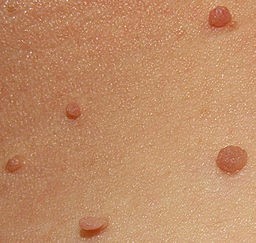
© Jmarchn, CC BY-SA 3.0, via Wikimedia Commons
Differential diagnosis
Filiform warts have fine finger-like projections on the surface and tend to be firmer on palpation.
Melanocytic naevi can also be pedunculated but have a broader base.
Molluscum contagiosum lesions tend to have broader bases, be dome-shaped, and have a dimpled centre.
Seborrhoeic keratoses have a broad base.
Multiple skin tags are seen in Birt-Hogg-Dubé (BHD) syndrome - a rare, autosomal dominant inherited dermatosis characterised by multiple skin lesions developing in adulthood, mainly on the face, neck and upper body. As well as skin tags, those affected have fibrofolliculomas and trichodiscomas - benign skin tumours forming around hair follicles.6
Primary care management
Skin tags do not have malignant potential but can be removed due to irritation or for cosmetic reasons, although this usually has to be done privately rather than by the NHS.
Small skin tags may be removed by snipping off with a pair of sharp scissors or by applying a ligature round the base. If the base is fine no anaesthetic is needed and little bleeding occurs. Cryotherapy is sometimes also used.
Larger ones will need local anaesthetic and can be removed by shave and cautery, or by cutting cautery alone.
Exclusive updates for healthcare professionals
Stay informed with the latest clinical updates, professional insights, and evidence-based guidance. The Patient Pro newsletter curates essential content for healthcare professionals—delivered straight to your inbox.
By subscribing you accept our Privacy Policy. You can unsubscribe at any time. We never sell your data.
Further reading and references
- Skin tags; Primary Care Dermatology Society (PCDS)
- Higgins JC, Maher MH, Douglas MS; Diagnosing Common Benign Skin Tumors. Am Fam Physician. 2015 Oct 1;92(7):601-7.
- Wali V, Wali VV; Assessment of Various Biochemical Parameters and BMI in Patients with Skin Tags. J Clin Diagn Res. 2016 Jan;10(1):BC09-11. doi: 10.7860/JCDR/2016/15994.7062. Epub 2016 Jan 1.
- Skin Tags; DermNet NZ
- Barbato MT, Criado PR, Silva AK, et al; Association of acanthosis nigricans and skin tags with insulin resistance. An Bras Dermatol. 2012 Jan-Feb;87(1):97-104.
- Gupta S, Aggarwal R, Gupta S, et al; Human papillomavirus and skin tags: is there any association? Indian J Dermatol Venereol Leprol. 2008 May-Jun;74(3):222-5.
- Birt-Hogg-Dubé syndrome; DermNet NZ
About the authorView full bio

Dr Toni Hazell, FRCGP
MBBS, BSc, FRCGP, DFSRH, Dip GU med, DRCOG, DCH (London, UK, 2000)
Dr. Toni Hazell qualified from St. Mary’s Hospital Medical School and did her VTS at Northwick Park Hospital.
About the reviewerView full bio

Dr Colin Tidy, MRCGP
General Practitioner, Medical Author
MBBS, MRCGP, MRCP (Paediatrics), DCH
Dr Colin Tidy is an NHS Doctor, based in Oxfordshire.
Article history
The information on this page is written and peer reviewed by qualified clinicians.
Article also available in English, German, Spanish, French, Italian, Portuguese, Hindi, Hebrew, Arabic, and Swedish.
Next review due: 14 Dec 2027
15 Dec 2022 | Latest version

Ask, share, connect.
Browse discussions, ask questions, and share experiences across hundreds of health topics.

Feeling unwell?
Assess your symptoms online for free
More in dermatology
- Bowen's disease
- Campbell de Morgan spot
- Cicatricial pemphigoid
- Dermatofibroma
- Epidermal naevus and its syndromes
- Genital herpes in pregnancy
- Junctional naevus
- Keratoacanthoma
- Leg ulcers
- Leukoplakia
- Myositis - polymyositis and dermatomyositis
- Necrobiosis lipoidica
- Pilar cysts
- Pityriasis rosea
- Prurigo nodularis
- Psoriasis of hands and feet
- Skin and subcutaneous nodules
- Skin manifestations of systemic disease
- Varicose eczema