Virale Warzen
Excluding verrucae
Begutachtet von Dr Colin Tidy, MRCGPZuletzt aktualisiert von Dr Hayley Willacy, FRCGP Zuletzt aktualisiert 29. Dez 2022
Erfüllt die redaktionelle Richtlinien
- HerunterladenHerunterladen
- Teilen
- Language
- Diskussion
- Audio-Version
- Zu bevorzugten Quellen bei Google hinzufügen
Medizinische Fachkräfte
Fachartikel sind für die Nutzung durch Gesundheitsfachkräfte konzipiert. Sie werden von britischen Ärzten verfasst und basieren auf Forschungsergebnissen sowie britischen und europäischen Richtlinien. Sie finden möglicherweise die Warzen und Verrucas Artikel nützlicher oder einer unserer anderen Gesundheitsartikel.
Warts are common and usually harmless. They are caused by the human papillomavirus (HPV). Treatment is often not required or appropriate as the majority resolve spontaneously. Studies into the efficacy of the numerous possible treatment options continue to give conflicting results.
How common are warts? (Epidemiology)
Warts are very common and thought to affect 7-12% of the population.1 No large studies are available; however, small studies suggest up to 30% of children and young adults may have warts.2
Incidence is thought to be higher in children of school age than in preschool children and to peak in teenage years.3
Causes of viral warts (aetiology)3
Warts are caused by HPV. There are well over one hundred types of HPV. Types 1, 2, 3, 4, 10, 27 and 57 are most often implicated in the aetiology of cutaneous warts. Infection of keratinocytes causes hyperkeratinisation and epidermal thickening.
HPV infection is acquired from direct contact with an affected individual or from the environment (eg, from contaminated floors or surfaces). It appears the virus can survive outside the body for a significant length of time, probably months or even years.
Trauma and wetness are contributory in contracting warts. The virus is more likely to spread around other parts of the body if the wart is damaged by trauma or scratching.
Erscheinungsbild2
Warts are classified according to their appearance or site. The British Association of Dermatologists (BAD) guidelines recognise the following four subtypes:
Common wart (verruca vulgaris)
Common wart
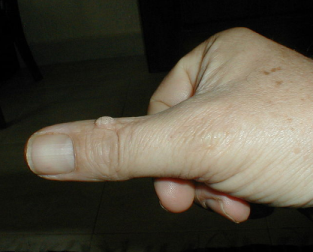
These appear as papules and nodules with a keratotic and papillomatous surface. They occur anywhere but are most common on the hands in young people and children.
Plane wart, or flat wart (verruca plana)
Plane warts on chin
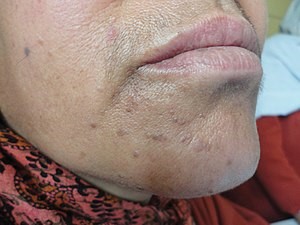
These are slightly elevated, flat-topped warts which may occur singly or in a group of many lesions.
Plantar wart, or verruca (verruca plantaris)
These are warts on the sole of the foot and are discussed in the separate Verrucae (Plantar Warts and Myrmecia Verrucae) Artikel.
Genital wart (condyloma acuminatum)
These are discussed in the separate Anogenital Warts Artikel
Other descriptions in common use include:1 4
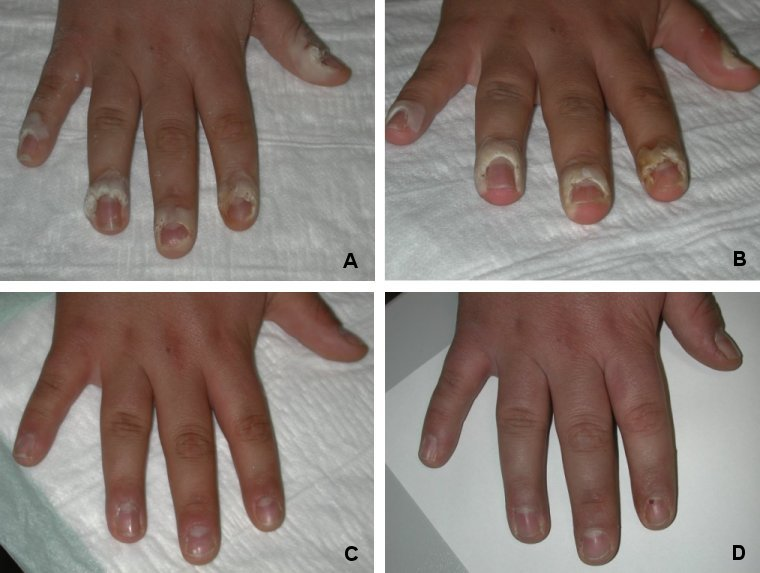
Periungual wart
These are warts around the nails. They are more common in people who bite their nails. The image shows the progress of the treatment programme:
A. Before treatment.
B. Before second treatment.
C. Before third treatment.
D. 18 weeks after first treatment.
Periungual warts undergoing treatment
Filiform wart (verruca filiformis)
Filiform wart on eyelid
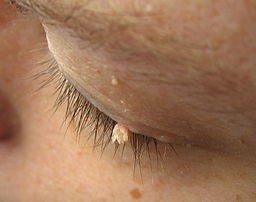
These are small finger-like warts consisting of hyperkeratotic projections. They arise most often on the face or neck.
Mosaic warts
These are groups or clusters of plantar, or occasionally palmar, warts.
Diagnose2
This is usually obvious clinically but, if necessary, paring down will produce pinpoint bleeding of the capillaries in the roots of the wart.
Differentialdiagnose1
Cutaneous horn.
Lichen nitidus.
Corns and calluses.
Angiokeratom.
Viral warts treatment and management2 5
Keine Behandlung
Warts eventually resolve without therapy, so if they are asymptomatic and the individual is not immunocompromised, they do not necessarily need treatment. Treatment is time-consuming and may have side-effects so should only be recommended if the wart is symptomatic or the person requests it.
Salicylsäure
Topical salicylic acid has the best evidence base and is normally first-line treatment. There is no evidence for one preparation being more effective than another. The wart should be pared down prior to application. Daily treatment for at least 12 weeks is required.
Kryotherapie
Cryotherapy with liquid nitrogen every two weeks until the wart has gone (up to four months) may be effective. Clinicians vary in how long they freeze the wart for; usually liquid nitrogen is applied until a ring of frozen tissue is visible around the wart, typically 5-30 seconds. There is no evidence that there is any difference in effectiveness between a spray and a cotton bud. Over-the-counter preparations do not reach such low temperatures and are probably not as effective. Reported cure rates vary hugely. Cryotherapy may be painful, may cause blistering and should be avoided in young children.
Combination treatment
Applying salicylic acid (once the blistering from the cryotherapy has resolved) in between cryotherapy sessions may be beneficial. Again, the evidence is equivocal.
Other treatments used in secondary care3
A whole host of other treatments is used. These have been subject to trials of varying quality. BAD guidelines include the following potential options in their recommendations:
Physical removal by surgery, curettage, laser, or photodynamic treatment.
Puncturing with a needle (barbotage).6
Antimitotic agents such as:
Podophyllotoxin - topical.
Retinoids - topical or oral.
Bleomycin - intralesional.
Virucidal agents such as:
Formaldehyde.
Glutaraldehyde.
Immunomodulatory agent, including:
Imiquimod 5% - topical.
Interferon - intralesional.
Dinitrochlorobenzene - topical.
Diphencyprone - topical.
5- fluorouracil (5-FU) - topical.
Cantharidin.
Acupuncture (for plane warts).
Of these, the best evidence of efficacy is for bleomycin, 5-FU, laser and topical immunotherapy agents; however, all evidence is weaker than that for salicylic acid and cryotherapy.
Treatments used in the past but found by BAD to have insufficient evidence to recommend their use include:
Occlusion with duct tape.
Hypnosis.
Dithranol.
H2-receptor antagonists
Herbal treatments.
Homeopathy.
Wann überweisen3
Reasons to consider referral to secondary care include:
Unklare Diagnose.
Persistent symptomatic warts unresponsive to primary care treatment.
Multiple warts in immunocompromised individuals.
Facial warts. Facial warts should not be treated in primary care.
Extensive coverage (eg, mosaic warts).
Prognose
Warts tend to resolve more quickly in younger age groups and in non-white skins.7 Resolution has been shown to occur in just over half of college students within two years.8 This was either with or without active treatment. Older adults may take longer.9
Complications are rare but include local infection or spread and malignant change. Such events are more common in immunocompromised people.
Prevention of viral warts
The risk of auto-inoculation can be reduced by avoiding biting the area (eg, nail biting), picking at the wart, trauma and maceration of the involved skin. Advise keeping nail files and pumice stones used for filing warts separate and not using for other areas of skin.
Exklusive Updates für medizinisches Fachpersonal
Bleiben Sie informiert mit den neuesten klinischen Updates, professionellen Einblicken und evidenzbasierten Leitlinien. Der Patient Pro-Newsletter stellt wesentliche Inhalte für Gesundheitsfachkräfte zusammen – direkt in Ihren Posteingang geliefert.
Durch das Abonnieren akzeptieren Sie unsere Datenschutzrichtlinie. Sie können sich jederzeit abmelden. Wir verkaufen Ihre Daten niemals.
Weiterführende Lektüre und Referenzen
- Fay DL; Is Cutaneous Cryosurgery the Best Treatment Option for Cutaneous Warts? Am Fam Physician. 2020 Dec 1;102(11):648.
- Kaur A, Brar BK, Kumar S, et al; A Randomized Comparative Study of MIP and MMR Vaccine for the Treatment of Cutaneous Warts. Indian J Dermatol. 2021 Mar-Apr;66(2):151-158. doi: 10.4103/ijd.IJD_700_20.
- Lynch MD, Cliffe J, Morris-Jones R; Management of cutaneous viral warts. BMJ. 2014 May 27;348:g3339. doi: 10.1136/bmj.g3339.
- British Association of Dermatologists Guidelines for the management of cutaneous warts; British Journal of Dermatology (2014)
- Warts and verrucae; NICE CKS, Oktober 2024 (nur für UK-Zugang)
- Virale Warzen; DermNet NZ
- Truong K, Joseph J, Manago B, et al; Destructive therapies for cutaneous warts: A review of the evidence. Aust J Gen Pract. 2022 Oct;51(10):799-803. doi: 10.31128/AJGP-01-22-6305.
- Mclaughlin JS, Fischer TJ, Merrell GA; Treatment of Cutaneous Warts With Multiple Puncture Technique. Hand (N Y). 2019 Sep;14(5):689-690. doi: 10.1177/1558944718771389. Epub 2018 May 15.
- Bruggink SC, Eekhof JA, Egberts PF, et al; Natural course of cutaneous warts among primary schoolchildren: a prospective cohort study. Ann Fam Med. 2013 Sep-Oct;11(5):437-41. doi: 10.1370/afm.1508.
- Liu J, Li H, Yang F, et al; Epidemiology and Clinical Profile of Cutaneous Warts in Chinese College Students: A Cross-Sectional and Follow-Up Study. Sci Rep. 2018 Oct 18;8(1):15450. doi: 10.1038/s41598-018-33511-x.
- Al Aboud AM, Nigam PK; Wart.
Über den AutorVollständige Biografie anzeigen
Aktualisiert von

Dr Hayley Willacy, FRCGP
Allgemeinmediziner, Medizinischer Autor
MBChB (1992), DRCOG, DFFP, MRCOG (Part 1) MRCGP (2007), DFSRH (2013), MSc - medical education (2020)
Dr. Hayley Willacy war eine NHS-Hausärztin, die in Nordwestengland arbeitete und 2022 nach 30 Jahren aus der klinischen Praxis ausschied.
Über den RezensentenVollständige Biografie anzeigen

Dr Colin Tidy, MRCGP
Allgemeinmediziner, Medizinischer Autor
MBBS, MRCGP, MRCP (Paediatrics), DCH
Dr. Colin Tidy ist ein NHS-Arzt mit Sitz in Oxfordshire.
Artikelverlauf
Artikel auch verfügbar in Englisch, Deutsch, Spanisch, Französisch, Italienisch, Portugiesisch, Hindi, Hebräisch, Arabisch, und Schwedisch.
Nächste Überprüfung fällig: 16. Dez. 2027
29. Dez 2022 | Neueste Version

Fragen, teilen, verbinden.
Durchsuchen Sie Diskussionen, stellen Sie Fragen und teilen Sie Erfahrungen zu Hunderten von Gesundheitsthemen.

Fühlen Sie sich unwohl?
Bewerten Sie Ihre Symptome online kostenlos
Mehr in der Dermatologie
- Acne conglobata und seltenere Formen von Akne
- Aktinische Keratose
- Bettwanzen
- Blauer Nävus
- Windpocken
- Zikatrizieller Pemphigoid
- Kälteschaden
- Häufige Hautausschläge im Kindesalter
- Kontakt- und Berufsdermatitis
- Dermatologische Beschreibungsbegriffe
- Hirsutismus
- Lentigo
- Lichen sclerosus
- Milien
- Pemphigus
- Kleienpilzflechte
- Psoriasis-Arthritis
- Purpurische Ausschläge
- Thrombotisch-thrombozytopenische Purpura
- Werner-Syndrom