Hagelkorn
Eyelid cyst
Begutachtet von Dr Colin Tidy, MRCGPZuletzt aktualisiert von Dr Philippa Vincent, MRCGPZuletzt aktualisiert 4 Sept 2024
Erfüllt die Anforderungen des Patienten Richtlinien des Patienten
- HerunterladenHerunterladen
- Teilen
- Language
- Diskussion
- Audio-Version
In dieser Serie:Geschwollenes AugenlidGerstenkornBlepharitisEktropiumLokalanästhesie für Ihre Augenoperation
A chalazion is a small cyst that forms on the eyelid when an oil gland becomes blocked or inflamed. It is usually painless and mainly affects the upper eyelid.
In diesem Artikel:
Videoauswahl für Lidprobleme
Wichtige Punkte
A chalazion is a small, painless lump (cyst) on the upper eyelid that forms when an oil gland gets blocked. It is not an infection, however it can become infected.
Most clear up on their own over a few weeks or months. Using a warm compress for 5-10 minutes, 3-4 times a day, and gently massaging the eyelid can help it heal faster.
If the chalazion doesn’t go away or keeps coming back, an eye specialist can treat it with a small steroid injection or minor surgery to remove it.
Lesen Sie unten weiter
What is a chalazion?
Eye with upper eyelid chalazion
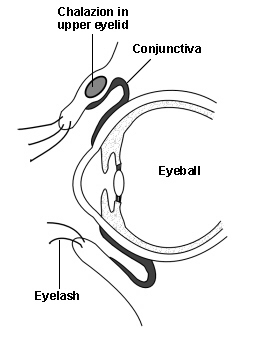
A chalazion is a small (2-8 mm) swelling in the eyelid. It arises due to inflammation causing a reaction known as a "granuloma" - this is a swelling filled with white blood cells and other tissue. It is common and sometimes called a meibomian cyst or tarsal cyst. A chalazion is more common on the upper eyelid. It is possible to have several at once, in more than one eyelid. It is not the same as a stye.
Hagelkorn
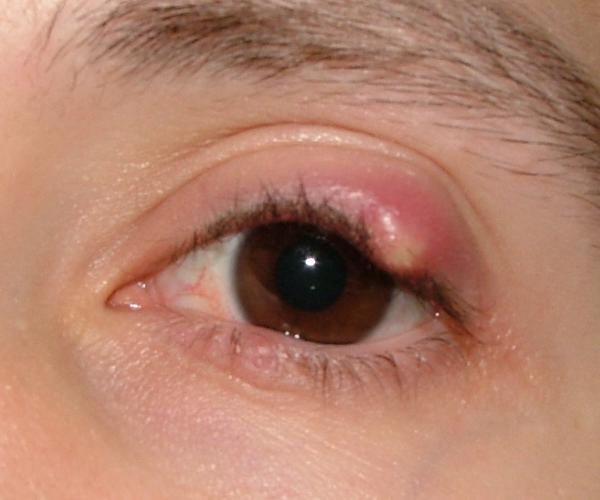
© Kotek1986. Tsca.bot, CC BY-SA 3.0, via Wikimedia Commons
Chalazion vs Stye
A chalazion is caused by a blockage of a gland in the eyelid, whereas a stye is due to an infected eyelash follicle.
What is a chalazion?
Stye vs Chalazion vs Hordeolum
A hordoleum is another word for a stye. These can be internal (an infection of the Meibomian gland) or external (an infection of the eyelash follicle) A chalazion is not an infection but is an inflammation. Sometimes it can be difficult to tell the difference between an internal hodoleum (stye) and an inflamed chalazion but the treatment for them both is the same.
Chalazion causes
Zurück zum InhaltThere are tiny glands just under the inner surface of the eyelid, called meibomian glands. These make an oily fluid called meibum to help lubricate the eye.
If the gland becomes blocked then the meibum cannot escape into the tears. It may expand into a swelling and leak into the eyelid tissue. This becomes inflamed. Over time, inflammation causes a lump (or granuloma) to form in the eyelid. This is a firm, solid lump that remains for a long time. This lump is the chalazion.
Chalazion is more common in people who have an eye condition known as blepharitis, or skin conditions such as Ekzem, because in these conditions the meibum tends to be thicker so the gland is more easily blocked.
It is most commonly found in adults between the ages of 30 and 50.
Siehe die separaten Broschüren mit dem Titel Gerstenkorn und Blepharitis für weitere Details.
Lesen Sie unten weiter
Chalazion symptoms
Zurück zum InhaltThe usual symptom is a small lump which develops on an eyelid.
It often is red and the surrounding area might be a little swollen.
Sometimes it causes mild pain or irritation, particularly if it has just started - this usually settles.
It sometimes gets infected and then becomes more swollen, red and painful.
Sight is not affected, although very occasionally it can be big enough to be noticeable at the edge of the vision.
Chalazion treatment
Zurück zum InhaltNo treatment may be necessary as up to half of people get better without any treatment. This can take between two and six months but if the chalazion is not causing any problems, it is best just to watch and wait. Further treatment options include:
Warm compresses can help to reduce discomfort and also may disperse the chalazion. A clean flannel that has been in hot water should be held gently but firmly against the closed eye for 5-10 minutes, 3-4 times a day. The flannel cools quickly so should be warmed again regularly. This warmth and slight pressure may be enough to soften the contents of the fluid-filled swelling (cyst), helping it drain more easily. (The water should be hot but comfortable and not scalding.)
Antibiotic ointments, drops and medicines are not recommended as they do not make any difference - the contents of the cyst are infection-free. If the chalazion does become infected, antibiotic drops can sometimes be helpful.
Massage of the cyst after using a hot compress can encourage the cyst to drain. To do this, gently massage with a clean finger or cotton bud, in the direction of the eyelashes.
Cleaning the eyelid twice per day removes grease and dead skin cells that may contribute to cysts forming. A weak solution of baby shampoo in warm water is ideal and a cotton bud can be used to clean the eyelids with this.
A small operation is an option if it is troublesome or persistent. A referral to an ophthalmologist is needed and the operation is usually done under local anaesthetic, although children and some adults may not tolerate this and may require general anaesthetic. The eyelid is numbed. A small cut is then made on the inside of the eyelid to release the contents of the cyst and it is scraped out. After surgery antibiotic drops or ointment are commonly prescribed.
An injection of a steroid directly into the chalazion is another type of treatment which is less invasive and can be successful.
Lesen Sie unten weiter
Gibt es irgendwelche Komplikationen?
Zurück zum InhaltMost chalazia cause no problems. A cyst can become infected.
Rarely, this infection can spread to involve the whole eyelid and tissues surrounding the eye. The eyelid may be very swollen and red. It might be difficult to open the eye and there may be a lot of pain and a hohe Temperatur (Fieber). This type of complication is called orbital cellulitis and it is important to seek urgent medical advice, usually in an emergency department of a hospital. Treatment of orbital cellulitis is with antibiotics, usually into a vein (intravenously) via a drip, in hospital.
Wird es wieder passieren?
Zurück zum InhaltA chalazion usually only occurs once. However, some people are prone to developing them and they may recur. It is sometimes possible to prevent a chalazion developing by using a hot compress on the eyelids (described above) and massaging the eyelids each morning.
Häufig gestellte Fragen
Zurück zum InhaltWhat triggers a chalazion?
A chalazion is often triggered by a blocked oil gland in the eyelid. This can happen after a stye or due to conditions like blepharitis, oily skin, or poor eyelid hygiene.
Are chalazia contagious?
No, chalazia are not contagious. They form when an oil gland in the eyelid becomes blocked, not from an infection that can spread to others.
Can a chalazion be dangerous?
A chalazion is not usually dangerous and often clears on its own. However, if it becomes very large, painful, or affects your vision, it’s best to see a doctor for advice.
Will the NHS remove a chalazion?
Yes, the NHS can remove a chalazion if it doesn’t go away on its own or keeps coming back. Minor surgery may be offered if warm compresses and other treatments haven’t worked.
Patientenempfehlungen für Lidprobleme
Augengesundheit
Blepharospasmus
Blepharospasmus ist eine Erkrankung, bei der das Blinzeln oder krampfartige Schließen der Augen in erhöhter Frequenz auftritt. Es reicht von einer milden, peinlichen Bedingung des Zuckens oder Flatterns eines Augenlids bis hin zu schweren Krämpfen des Augenschlusses, die das nützliche Sehen unterbrechen. Sekundärer Blepharospasmus ist eine häufige Reaktion auf viele häufige Augenerkrankungen und kann durch einige Erkrankungen des Nervensystems verursacht werden. Dieses Merkblatt befasst sich hauptsächlich mit primärem Blepharospasmus, auch als benigner essentieller Blepharospasmus (BEB) bezeichnet. BEB kann nicht geheilt werden, wird jedoch in der Regel erfolgreich mit Botulinumtoxin-Injektionen behandelt, die in Intervallen wiederholt werden. In Großbritannien müssen Sie, wenn Sie an Blepharospasmus leiden, die Driver and Vehicle Licensing Agency (DVLA) benachrichtigen.
von Dr. Hayley Willacy, FRCGP

Augengesundheit
Entropion
An entropion occurs where your eyelid turns towards the eye. The eyelashes then rub against the front of your eye (cornea). Irritation, pain and watering of the eye are the main symptoms. Taping the eyelid to your cheek, lubricant eye ointment and sometimes botulinum toxin injections help to control symptoms. People often require surgery if the problem persists.
von Dr. Hayley Willacy, FRCGP
Weiterführende Lektüre und Referenzen
- Meibomian cyst (chalazion); NICE CKS, April 2024 (nur in Großbritannien zugänglich)
- Carlisle RT, Digiovanni J; Differential Diagnosis of the Swollen Red Eyelid. Am Fam Physician. 2015 Jul 15;92(2):106-12.
Lesen Sie unten weiter
Artikelverlauf
Die Informationen auf dieser Seite wurden von qualifizierten Klinikern verfasst und begutachtet.
Next review due: 3 Sept 2027
4 Sept 2024 | Neueste Version

Fragen, teilen, verbinden.
Durchsuchen Sie Diskussionen, stellen Sie Fragen und teilen Sie Erfahrungen zu Hunderten von Gesundheitsthemen.

Fühlen Sie sich unwohl?
Bewerten Sie Ihre Symptome online kostenlos
Abonnieren Sie den Patienten-Newsletter
Ihre wöchentliche Dosis klarer, vertrauenswürdiger Gesundheitsberatung - geschrieben, um Ihnen zu helfen, sich informiert, selbstbewusst und in Kontrolle zu fühlen.
Mit dem Abonnieren akzeptieren Sie unsere Datenschutzrichtlinie. Sie können sich jederzeit abmelden. Wir verkaufen Ihre Daten niemals.