
Was passiert während eines Asthmaanfalls?
Begutachtet von Dr Hayley Willacy, FRCGP Verfasst von Dr Laurence KnottUrsprünglich veröffentlicht 24. Apr. 2019
Erfüllt die redaktionelle Richtlinien
- HerunterladenHerunterladen
- Teilen
- Language
- Diskussion
- Audio-Version
- Zu bevorzugten Quellen bei Google hinzufügen
Asthma ist eine häufige Erkrankung, die die kleineren Atemwege (Bronchiolen) betrifft. Von Zeit zu Zeit verengen sich die Atemwege bei Menschen mit Asthma. Die typischen Symptome sind Keuchen, Husten, Engegefühl in der Brust und Atemnot. Das Ausmaß der Verengung und die Dauer jeder Episode können stark variieren.
Get help managing your asthma
Erhalten Sie fachkundige medizinische Beratung bequem von zu Hause aus. Füllen Sie eine kurze Online-Konsultation aus, die rund um die Uhr verfügbar ist. Ihre Anfrage wird von einer in Großbritannien registrierten medizinischen Fachkraft geprüft. Für ausgewählte Behandlungen ist eine Lieferung am nächsten Tag möglich.

Das normale Atmungssystem
To understand what happens in Asthma Sie müssen mit dem normalen Atmungssystem (Respirationssystem) und der Anordnung der Lungen und Atemwege vertraut sein.
Normally, air entering through the mouth and nose travels through the main airway (the trachea) through a series of smaller branching airways called bronchi. The bronchi divide up into even smaller airways called bronchioles, which end in millions of tiny air sacs called alveoli.
When air enters the alveoli, the oxygen it contains passes through the thin membrane covering each sac into surrounding blood vessels. The oxygen attaches itself to red blood cells which then circulate around the body, releasing the oxygen into the body tissues.
Was passiert während eines Asthmaanfalls?
An asthma attack starts with exposure to an asthma trigger. Triggers that cause an asthma attack vary from person to person but may be something you are allergic to such as animals or pollen. They can also be viral infections, gastrointestinal reflux, Luftverschmutzung, cigarette smoke, and Stress.
When exposed to a trigger factor, the lining of the airways responds by producing chemicals such as histamine and leukotriene. These chemicals are in part responsible for the changes that happen in the lungs during an asthma attack.
Die Auskleidung der Atemwege entzündet sich und schwillt an. Die Produktion von Schleim, der normalerweise in geringer Menge in den Atemwegen vorhanden ist, wird erhöht. Typischerweise führt dies zu Räuspern, Auswurf von Schleim (Sputum) und Husten. Die Muskeln, die um die Bronchiolen gewickelt sind, ziehen sich schließlich zusammen oder verengen sich (Bronchospasmus), und die Luft, die durch die verengten Kanäle strömt, erzeugt ein Keuchen.
Lungs and alveoli
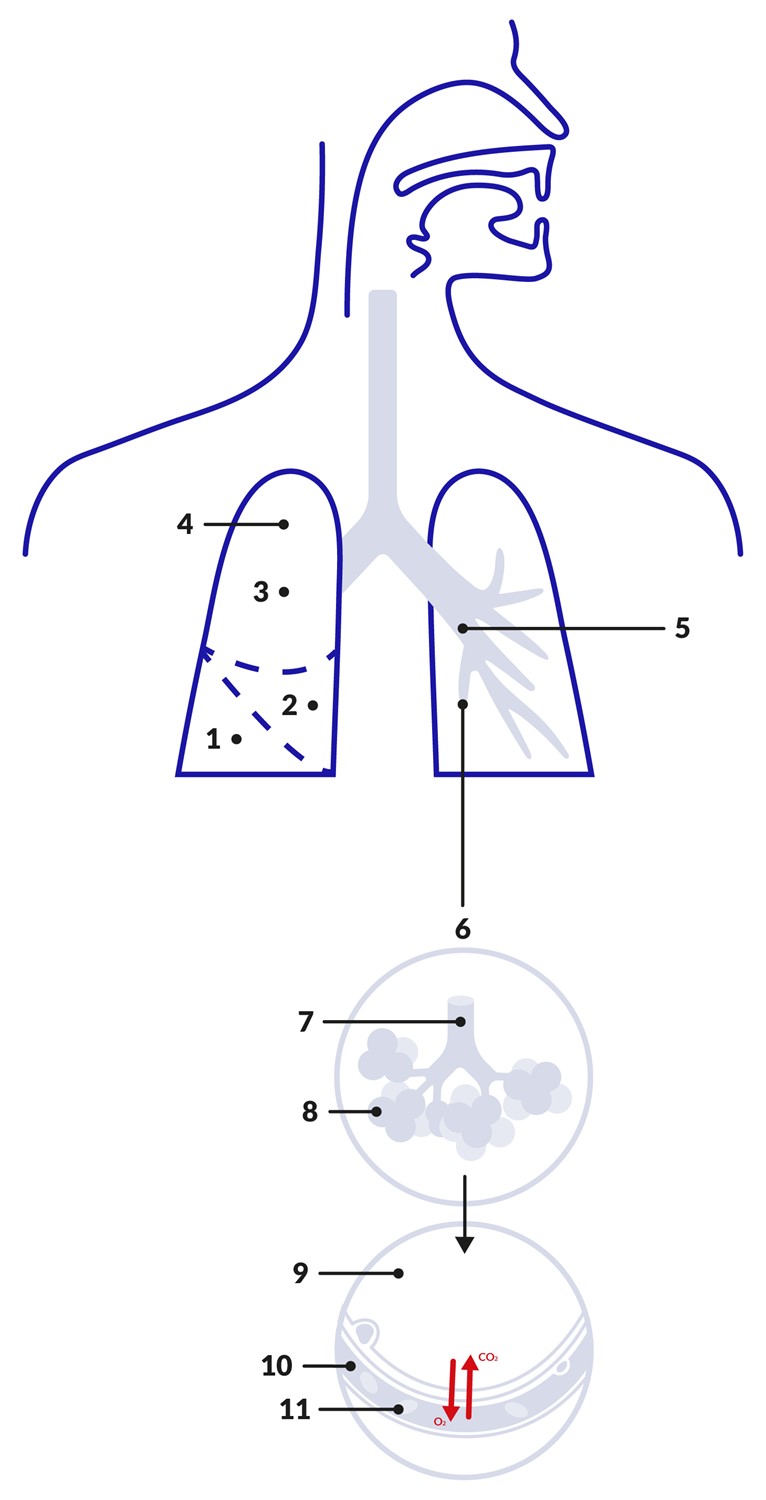
Schlüssel | |
|---|---|
1. Unterlappen | 7. Terminal bronchiole |
Querschnitt eines normalen Atemwegs
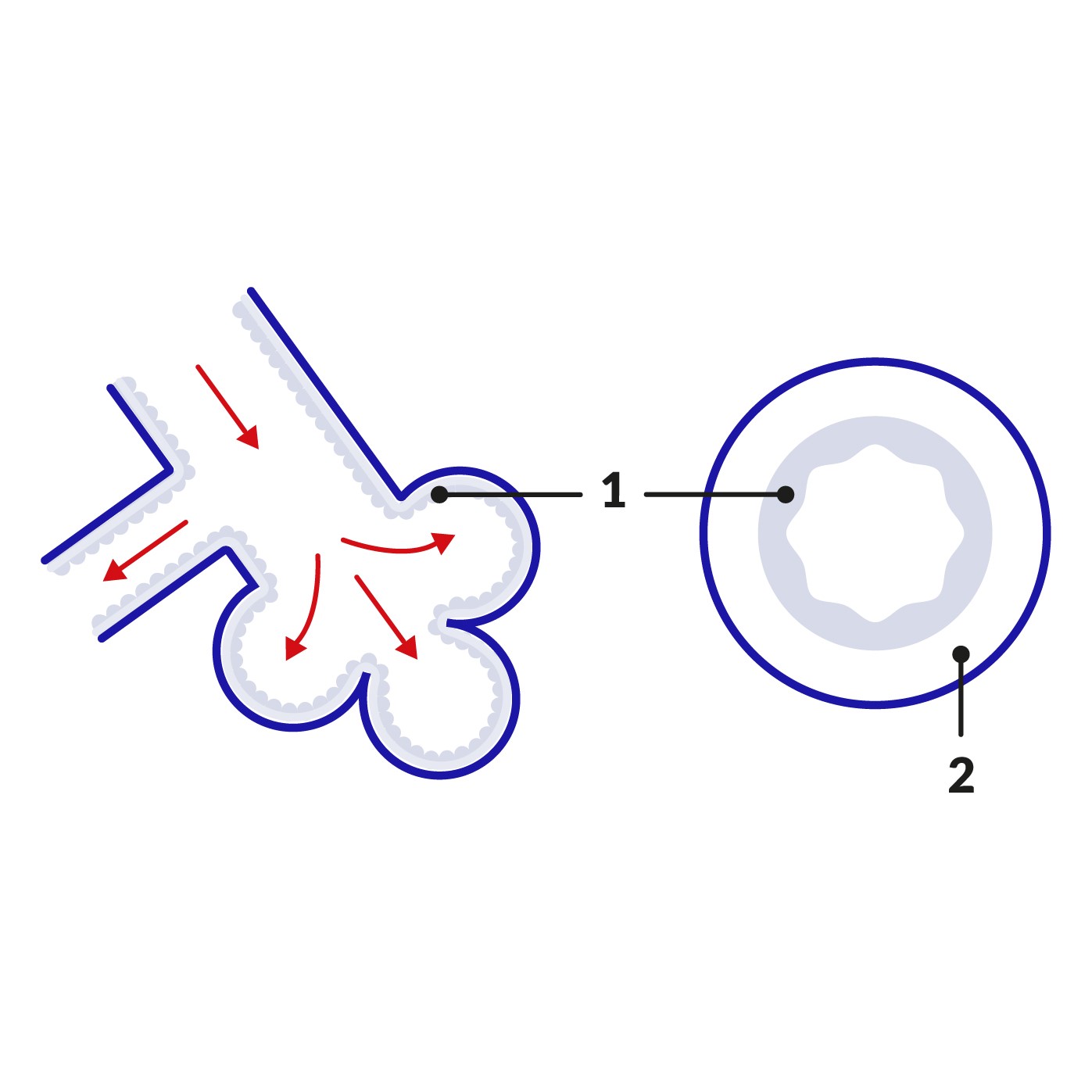
Schlüssel |
|---|
1. Small amount of mucus lines the airways |
Querschnitt der Atemwege während eines Asthmaanfalls
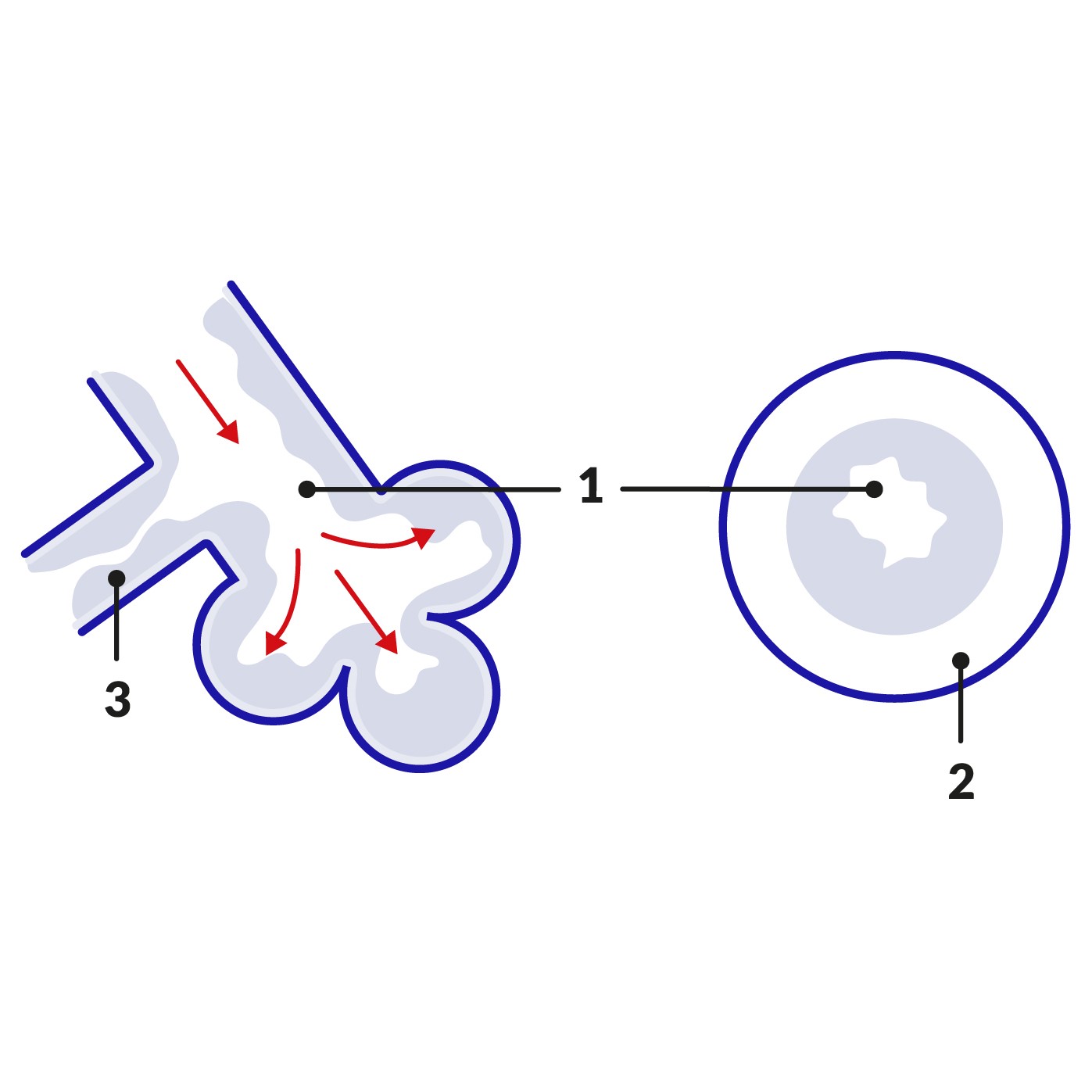
Schlüssel |
|---|
1. Reduced flow of air to the alveoli |
So you can see there are three reasons why people who are having an asthma attack become breathless. The swelling of the lining of the airways, the increased mucus production and the bronchospasm all result in less air than normal entering the alveoli. There is therefore a limited amount of oxygen available to pass on to the red blood cells.
Warum Asthmabehandlungen wirken
Bronchodilators
Bronchodilators such as Salbutamol work by relaxing the muscle of the bronchioles and widening the channels through which the air passes. They are usually administered in the form of inhalers. Salbutamol starts to work within a few minutes and the effect will last between 3-5 hours. Bronchodilator inhalers are referred to as 'reliever' inhalers or 'blue' inhalers. This is because they relieve symptoms of breathlessness, and the inhalers are usually blue in colour. Although they relieve breathlessness, they do not prevent the breathlessness from happening.
Salmeterol works in a similar way to salbutamol but its effects last for about 12 hours.
Steroide
Steroids such as Beclometason work by reducing the inflammation in your airways. When the inflammation has gone, your airways are much less likely to become narrow and cause symptoms such as wheezing. For asthma, steroids are usually prescribed in inhaler form. Although they have no effect during acute asthma attacks, when taken regularly (usually twice daily) they are the inhalers that will stop the attacks from happening. They are usually brown in colour and are known as 'preventer' or 'brown' inhalers. Occasionally, for severe asthma, steroids are prescribed in tablet form.
Wenn Ihr Asthma sich mit Steroid- und Bronchodilatator-Inhalatoren stabilisiert, kann Ihr Arzt Ihnen einen Kombinationsinhalator verschreiben, der regelmäßig eingenommen werden soll und beide Medikamente enthält.
Andere Behandlungen
Antileukotrienes
Antileukotrienes such as montelukast act by blocking the action of leukotriene. Leukotriene is produced when people with asthma come into contact with trigger factors such as substances they are allergic to (such as pollen), or exercise. Leukotriene causes the lining of the bronchioles to become inflamed and swollen and antileukotrienes help to prevent this. Not every person with asthma gets a significant rise in leukotriene production during an attack, which is why antileukotrienes are usually kept in reserve for asthma which does not respond to standard bronchodilator and steroid therapy.
Omalizumab
Omalizumab is a medicine that is only given by injection. It works by interfering with the immune system to reduce inflammation in the airways which is present in asthma. It is reserved for people with severe asthma who do not respond to standard treatment. It can only be started by a specialist.
Get help managing your asthma
Erhalten Sie fachkundige medizinische Beratung bequem von zu Hause aus. Füllen Sie eine kurze Online-Konsultation aus, die rund um die Uhr verfügbar ist. Ihre Anfrage wird von einer in Großbritannien registrierten medizinischen Fachkraft geprüft. Für ausgewählte Behandlungen ist eine Lieferung am nächsten Tag möglich.
Patientenauswahl für Asthma

Brust und Lungen
Sind Reinigungsprodukte schlecht für Ihre Gesundheit?
Wir alle kennen die Gefahren der Außenluftverschmutzung, aber wussten Sie, dass Sie auch in Ihrem eigenen Zuhause schädlichen Chemikalien ausgesetzt sein könnten? Wir sprechen mit Experten über Reinigungsprodukte, die schädliche Symptome auslösen können, und darüber, wie Sie Ihr Zuhause blitzblank halten können, ohne Ihre Gesundheit zu gefährden.
von Natalie Healey

Brust und Lungen
Wie man im Sommer mit Asthma umgeht
Asthma im Sommer kann sehr belastend sein. Mit den richtigen Medikamenten und einem vernünftigen Aktionsplan können Sie jedoch die durch Pollen und Luftverschmutzung ausgelösten Symptome lindern. Unsere Experten geben Ihnen Tipps, wie Sie Ihr Asthma im Sommer in den Griff bekommen.
von Lynn Stephen
Über den AutorVollständige Biografie anzeigen
Verfasst von

Dr. Laurence Knott
Allgemeinmediziner, Medizinischer Autor
BSc (Hons) Biochemie, MBBS
Dr. Laurence Knott qualifizierte sich 1973 und hat umfangreiche Erfahrung als Allgemeinmediziner.
Über den RezensentenVollständige Biografie anzeigen

Dr Hayley Willacy, FRCGP
Allgemeinmediziner, Medizinischer Autor
MBChB (1992), DRCOG, DFFP, MRCOG (Part 1) MRCGP (2007), DFSRH (2013), MSc - medical education (2020)
Dr. Hayley Willacy war eine NHS-Hausärztin, die in Nordwestengland arbeitete und 2022 nach 30 Jahren aus der klinischen Praxis ausschied.
Artikelverlauf
Artikel auch verfügbar in Englisch, Deutsch, Spanisch, Französisch, Italienisch, Portugiesisch, Hindi, Hebräisch, Arabisch, und Schwedisch.
24. Apr. 2019 | Ursprünglich veröffentlicht
Verfasst von:
Dr. Laurence KnottBegutachtet von
Dr Hayley Willacy, FRCGP
Nehmen Sie an der Diskussion teil
Teilen Sie Ihre Gedanken oder Erfahrungen mit anderen in unserem Patientengemeinschaften.

Fragen, teilen, verbinden.
Durchsuchen Sie Diskussionen, stellen Sie Fragen und teilen Sie Erfahrungen zu Hunderten von Gesundheitsthemen.

Fühlen Sie sich unwohl?
Bewerten Sie Ihre Symptome online kostenlos
Abonnieren Sie den Patienten-Newsletter
Ihre wöchentliche Dosis klarer, vertrauenswürdiger Gesundheitsberatung - geschrieben, um Ihnen zu helfen, sich informiert, selbstbewusst und in Kontrolle zu fühlen.
Durch das Abonnieren akzeptieren Sie unsere Datenschutzrichtlinie. Sie können sich jederzeit abmelden. Wir verkaufen Ihre Daten niemals.