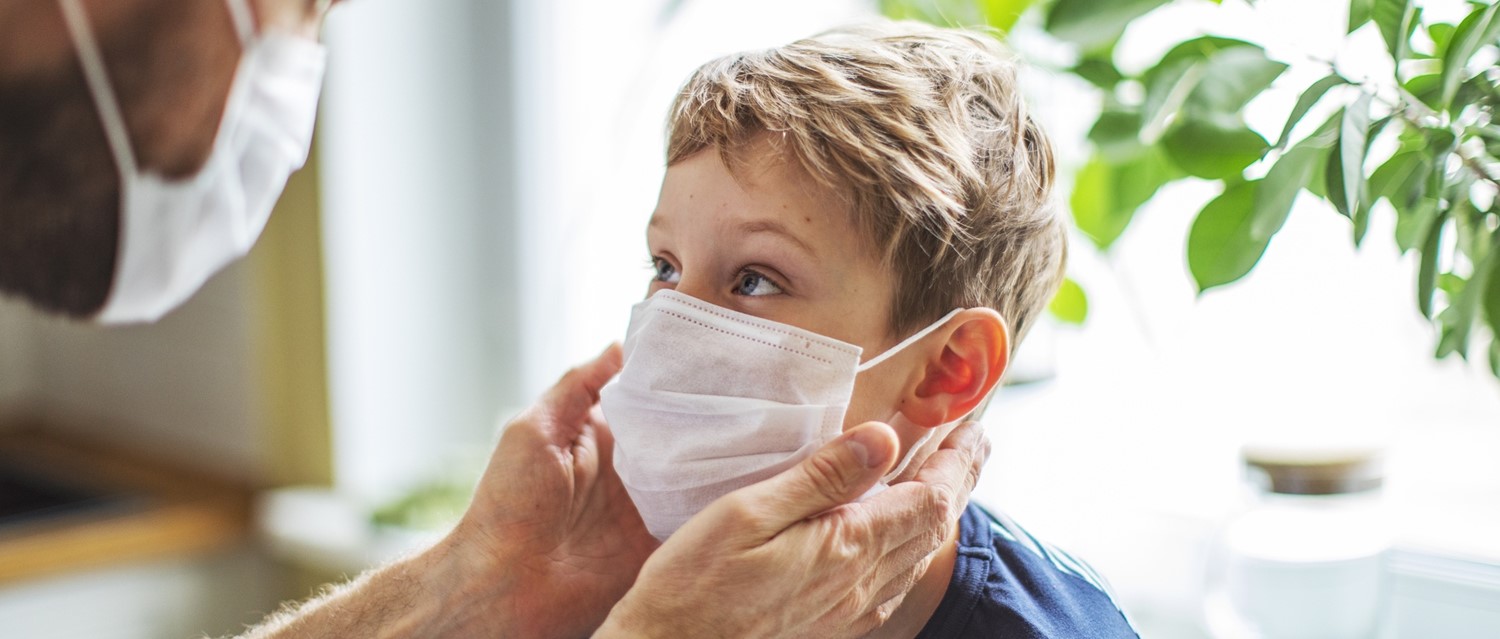
Tipps, um Ihren Kindern zu helfen, sich an Gesichtsmasken und -bedeckungen zu gewöhnen
Begutachtet von Dr Sarah JarvisZuletzt aktualisiert von Gillian HarveyZuletzt aktualisiert 7 Oct 2020
Erfüllt die Anforderungen des Patienten Richtlinien des Patienten
- HerunterladenHerunterladen
- Teilen
- Language
- Diskussion
- Audio-Version
- Zu bevorzugten Quellen bei Google hinzufügen
Da viele Schulen jetzt von Schülern über 11 Jahren verlangen, in bestimmten Situationen Masken zu tragen, werden viele unserer Kinder zum ersten Mal eine Gesichtsbedeckung anlegen. Aber wie sollten Masken getragen werden? Und wie können wir unseren Kindern helfen, sie effektiv zu verwenden?
Face masks have become a regular sight for all of us, whether we're popping to the shops, using public transport or going to a GP appointment. But wearing a face covering is still unfamiliar to most of us. To kids it can feel even more alien, but they're mandatory in certain situations for over-13s in Nordirland, over-11s in England und Wales and over-5s in Schottland. That's why it's important to take the time to get them comfortable with their masks, so they're more likely to wear one properly.
Explain why
Children will have been exposed to information about masks and coronavirus from a variety of sources - some reliable, others less so. It's important that your child understands the reasons masks have been recommended or made compulsory, and the situations in which they are effective.
It's also advisable to remind children that, although they must try their best to follow the instructions for using and wearing their mask as well as they can, they must not panic if they make a mistake - for example, touching their mask while wearing. Children need to understand that masks help as part of a collective effort and that even the best intentioned adults have made the odd error when wearing one - especially for the first time.
Ensure comfort
As your child is likely to be wearing their mask for extended periods of time, it's important that you ensure their mask is comfortable. Geraldine Joaquim, a radiologist used to wearing masks on a regular basis, suggests you get your child to try out their mask in a non-school setting to get used to how it feels.
"Although masks might be comfortable to wear initially, it's important to make sure the banding is comfortable when worn for longer periods," she says. "If necessary, you can purchase special clips to put underneath the elastic to make the mask more comfortable."
Joaquim feels that 30 minutes should be sufficient to ensure comfort. "Doing something while you're wearing it to distract you could be helpful," she says.
Adequate coverage
We've all seen people walking around with their masks covering their mouth and not their nose. While wearers may have the best of intentions, this is not an effective way to wear a mask. In order to prepare our children effectively, it's important that we explain the coverage they should aim for.
"Your mask should rest quite high on your nose - many have an adaptable fitting that will enable you to mould that part of the mask to the bridge of your nose - and should finish under your chin for maximum effectiveness," explains Val Edwards-Jones, Professor of Medical Microbiology who has recently developed her own range of protective masks. She also advises that parents check there are no large gaps at the sides by adjusting the elastic fittings.
Angstzustände
If your child deals with anxiety or is worried about wearing a mask, it's important to ensure them that, while the mask may feel a bit 'stuffy' at times, masks of this kind do not affect oxygen levels in the blood.
Joaquim, who also works as a hypnotherapist, suggests that if anxiety begins to rise, a breathing exercise may help. "Go somewhere where you can safely remove your mask," she advises. "Take two minutes to do some deep breathing. Breathe in for a count of five, hold it for a count of five and breathe out for a count of seven. Doing this ten times will help to slow your breathing down and help you feel better."
Hands off!
When we're wearing something new - particularly on our face - it is natural to want to touch and adjust it. However, it's important we explain to children that they must not touch their mask unless absolutely necessary. It may take children a while to adjust to wearing their mask, so if they do handle their mask, make sure they know to wash their hands afterwards.
Der Weltgesundheitsorganisation (WHO) also advises that fabric masks be placed in a sealed container if it is not possible to wash them immediately on removal, so try to furnish your child with a sealable plastic bag or other suitable container.
Mask-free moments
In England, face coverings are actively discouraged inside the classroom on the basis that they '... can have a negative impact on learning and teaching and so their use in the classroom should be avoided'. In Schottland the advice is that 'face coverings will not generally be necessary in the classroom'. But secondary school children will be moving between classrooms (face coverings are mandatory in corridors) much more than their younger counterparts, so they will have to get used to taking them off and putting them back on. It's important to explain to your child that masks need to be removed properly to ensure protection from potential contamination.
"Don't pull at the front of the mask," advises Edwards-Jones. "Instead, loop your fingers into the ear elastic and take it off that way." Edwards-Jones also advises not pulling the mask down under the chin, as this is likely to cause the front of the mask (where potentially blocked viral particles may rest) to make contact with the skin of the face.
It's also crucial that children understand they must wash hands or use antibacterial gel after removing or touching their mask and before touching their face. And, remind your child that if they do remove their mask and need to put it back on, to make sure they store it somewhere clean and - when reattaching - ensure it is the same way around as before.
Take a spare
The effectiveness of your mask will deteriorate during the day as your breath makes the mask moist. It's important, if possible, to change the mask during the day if you've been wearing it for a long period. "Change your mask as regularly as possible," advises Dr. Stephen Griffin, Chair of the Virus Division of the Microbiology Society. "If you can, children should take 2 or 3 to use per day."
If this is not practical, Griffin advises that we should at least wear a clean mask every day.
Cleaning and disposing
Although it's possible to chuck reusable masks in the washing machine, the World Health Organization advises they be washed at "highest permitted washing temperature" to ensure that any viral particles on the mask are destroyed. Check with the manufacturer about recommended temperatures before your first wash. If hot water is not permitted, WHO recommends washing with soap and cleansing with 0.1% chlorine, ensuring the mask is thoroughly rinsed afterwards.
Fabric masks will deteriorate over time, and many manufacturers recommend we renew our mask after a certain number of washes. Whilst there is no definitive answer to how many washes a fabric mask can endure, make sure you dispose of your mask within the time recommended by the manufacturer, or if the mask becomes ill-fitting or feels loose. It's important to ask your child if their mask feels OK, and whether they have any problems with it.
In an ideal (and pandemic-free) world, it would clearly be better if children didn't have to wear masks at all. But with the right preparation we can ensure our kids experience minimal discomfort and maximum protection for themselves and others.
Patientenauswahl für Pandemie-Artikel

COVID-19
Wie haben Briten während der Pandemie ihre Mundgesundheit vernachlässigt?
Neue Forschungsergebnisse zeigen, dass 1 von 3 Briten seit Beginn der Pandemie ihre Mundgesundheit vernachlässigt haben, bedingt durch fehlende Routine und andere gesundheitliche Probleme, die Vorrang vor der Pflege von Zähnen und Zahnfleisch haben.
von Emily Jane Bashforth
COVID-19
19. Juli: Sicher bleiben, während COVID-19-Beschränkungen gelockert werden
Trotz der Lockerung der Beschränkungen am 19. Juli sind wir noch nicht über den Berg. Da die Zahl der Coronavirus-Fälle steigt, müssen wir alle unseren Teil dazu beitragen, uns selbst und andere vor COVID-19 zu schützen.
von Milly Evans
Über den AutorVollständige Biografie anzeigen

Gillian Harvey
Freiberufliche Autorin
BA (Hons) Englisch
Gillian ist freiberufliche Autorin und Kolumnistin für verschiedene nationale Zeitungen und Zeitschriften.
Über den RezensentenVollständige Biografie anzeigen

Dr. Sarah Jarvis
Klinische Beraterin
MA (Cantab), BM, BCh (Oxon), DRCOG, FRCGP, MBE
Nach ihrer medizinischen Ausbildung in Cambridge und Oxford wurde Dr. Sarah Jarvis MBE Hausärztin.
Artikelverlauf
Die Informationen auf dieser Seite werden von qualifizierten Klinikern begutachtet.
Artikel auch verfügbar in Englisch, Deutsch, Spanisch, Französisch, Italienisch, Portugiesisch, Hindi, Hebräisch, Arabisch, und Schwedisch.
7 Oct 2020 | Neueste Version

Fragen, teilen, verbinden.
Durchsuchen Sie Diskussionen, stellen Sie Fragen und teilen Sie Erfahrungen zu Hunderten von Gesundheitsthemen.

Fühlen Sie sich unwohl?
Bewerten Sie Ihre Symptome online kostenlos
Abonnieren Sie den Patienten-Newsletter
Ihre wöchentliche Dosis klarer, vertrauenswürdiger Gesundheitsberatung - geschrieben, um Ihnen zu helfen, sich informiert, selbstbewusst und in Kontrolle zu fühlen.
Durch das Abonnieren akzeptieren Sie unsere Datenschutzrichtlinie. Sie können sich jederzeit abmelden. Wir verkaufen Ihre Daten niemals.
Mehr zu COVID-19
- Kann ich während des Lockdowns Routineimpfungen erhalten?
- COVID-19-Auffrischungsimpfungen und Schwangerschaft: Sind sie sicher und sollten Sie sie bekommen?
- COVID-19: Wie ansteckend ist Omikron?
- COVID-19: Sollten gefährdete Personen wegen Omikron Schutzmaßnahmen ergreifen?
- Wie man mit traumatischen Ereignissen wie der COVID-19-Pandemie umgeht
- Ist es diesen Winter COVID-19 oder Grippe?
- Die Zukunft der COVID-19-Impfungen
- Tipps zum Neustart Ihrer Trainingsroutine nach dem Lockdown
- Welche Möglichkeiten gibt es für die Behandlung von COVID zu Hause?
- Was sind die Symptome der COVID-19-Variante Pirola?
- Was Sie über den COVID-19-Impfstoff wissen müssen
- Warum es gut ist, wenn Sie sich nach Ihrer COVID-19-Auffrischungsimpfung unwohl fühlen