What is creatine? Benefits, uses and risks
Peer reviewed by Dr Colin Tidy, MRCGPAuthored by Josh AldermanOriginally published 12 Mar 2026
Meets Patient’s editorial guidelines
- DownloadDownload
- Share
- Language
- Discussion
- Audio Version
- Add to preferred sources on Google
Creatine is one of the most popular sports supplements in the UK. Often associated with gym training and muscle building, creatine is widely used to support strength and performance. But it isn’t just for athletes - it’s a naturally occurring substance found in your body and in certain foods.
So, what does creatine do, what are the potential creatine benefits, and are there any downsides to consider?
What is creatine?
Creatine is a natural compound made in your liver, kidneys and pancreas from amino acids. Around 95% of it is stored in your muscles, with small amounts found in your brain.1
You also get creatine from foods such as red meat and fish. However, the amount from diet alone is much lower than the amount typically provided by supplements.
Creatine supplements are usually sold as powders, capsules, or tablets. The most widely studied and commonly used form is creatine monohydrate.2
How does creatine work?
Creatine plays an important role in energy production. It helps your body make adenosine triphosphate (ATP), which is the main energy source your cells use, especially during short bursts of intense activity.
Taking creatine increases the amount stored in your muscles.
This may help your muscles:
Produce energy more quickly.
Sustain high-intensity activity for slightly longer.
Recover more effectively between sets.
So when it comes to short, high-powered efforts such as weightlifting, sprinting, or HIIT, creatine can make a real impact-but it doesn’t offer the same benefit for longer, steady-state endurance exercise.
What are the benefits of creatine?
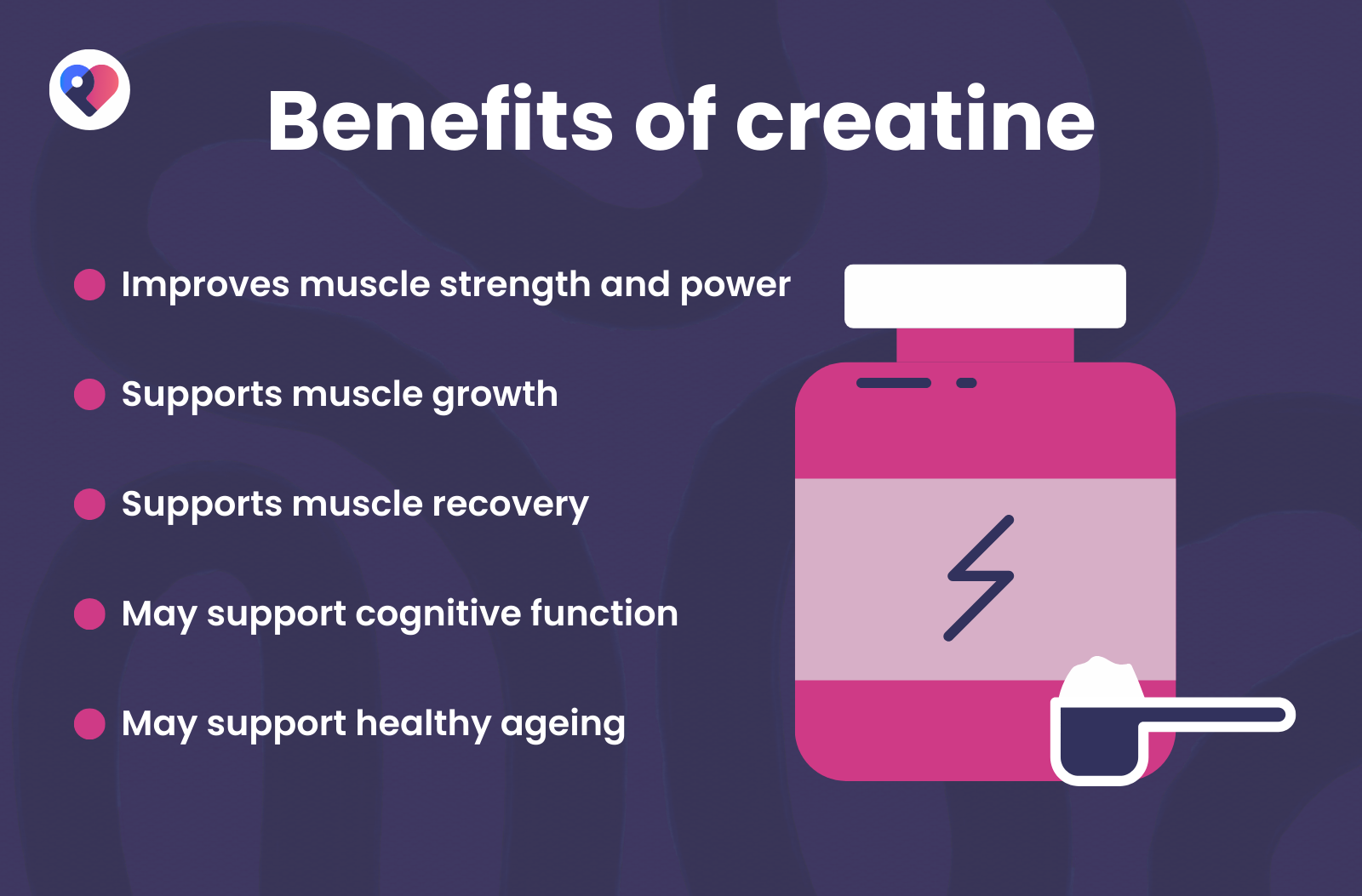
If you're thinking about adding creatine to your routine, here are five reasons it might be worth it.
1. Improves muscle strength and power
Creatine may increase muscle strength and power output.3Many people find they can lift slightly heavier weights or perform more repetitions.
2. Supports muscle growth
Creatine can contribute to increased muscle size.4 This is partly due to greater training capacity and partly because creatine draws water into muscle cells.
A small increase in body weight is common in the first few weeks. This is usually water stored in muscle, not fat.
3. Supports muscle recovery
Some evidence suggests creatine may help support muscle recovery after intense exercise,5 allowing more consistent training.
4. May support cognitive function
Because creatine is also present in the brain, researchers are studying whether it may support memory or mental performance in certain situations as well as possibly aid in combating conditions such as dementia.5 More research is needed before firm conclusions can be made.
5. May support some medical conditions
Creatine has also been studied in a range of medical conditions that affect muscle strength and energy production. These include inherited muscle disorders such as muscular dystrophy and other myopathies,6 as well as mitochondrial disorders,8 where the body’s ability to produce energy is impaired.
Researchers have also explored its potential role in neurological conditions such as Parkinson’s disease7and multiple sclerosis,8 and in age-related muscle loss (sarcopenia). 9
While some small studies suggest creatine may improve muscle strength or reduce fatigue in certain groups, results have been mixed and benefits are not consistent.
Is creatine safe?
For healthy adults taking recommended doses, creatine is generally considered safe. It is one of the most researched supplements available.
Side effects of creatine
Possible side effects include:
Temporary weight gain.
Bloating.
Mild stomach discomfort.
These effects are more likely with higher doses. Drinking enough fluids may help reduce digestive symptoms.
There is no strong evidence that creatine causes kidney damage in healthy people using standard doses.
Should you speak to a doctor before taking creatine?
Creatine may not be suitable for everyone.
Seek medical advice if you:
Have kidney or liver disease.
Are pregnant or breastfeeding.
Are under 18.
Have a long-term medical condition.
Take regular medicine.
As with all supplements, product quality can vary. Choosing reputable brands is advisable.
Summary
Creatine is a naturally occurring compound that helps your muscles produce energy during short bursts of high-intensity activity. When taken as a supplement, it may improve strength, power, and muscle mass - particularly when combined with structured training.
The main creatine benefits relate to improved exercise performance and increased muscle size. For most healthy adults taking recommended doses, creatine is considered safe, with mild side effects such as temporary weight gain or bloating.
However, creatine isn’t suitable for everyone. If you have kidney disease, are pregnant, or manage a long-term health condition, it’s important to seek medical advice before starting supplementation.
Creatine can be a useful addition to a well-balanced training plan - but it’s not a replacement for regular exercise and a healthy diet.
Frequently asked questions
Is creatine safe to take every day?
Yes, for most healthy adults, taking 3-5 grams of creatine daily is considered safe. Consistency is more important than cycling on and off.
Does creatine cause hair loss?
There is limited evidence linking creatine to hair loss. A small study suggested it may increase levels of a hormone linked to male pattern baldness, but this has not been confirmed in larger research. There is no clear evidence that creatine directly causes hair loss.10
Does creatine damage your kidneys?
In healthy people using recommended doses, creatine has not been shown to damage kidney function. However, people with existing kidney disease should avoid it unless advised by a doctor.
Do you need a loading phase?
A loading phase (around 20 grams daily for 5-7 days) can increase muscle creatine stores more quickly. However, it is not essential. Taking 3-5 grams daily will achieve similar levels over several weeks.
Can you take creatine without exercising?
Creatine may still increase muscle stores without exercise, but most creatine benefits are seen when combined with resistance training.
Patient picks for Vitamins and supplements

Diet and nutrition
What are the benefits of vitamin E?
Vitamin E is a well-loved ingredient in any skincare routine. But it's also vital for your health and how your body functions. Find out why and how to get enough vitamin E here.
by Victoria Raw

Senior health
The best anti-ageing supplements for your health
The term anti-ageing is written on many beauty creams and other skincare products packaging. But what does anti-ageing mean inside the body? Here, it goes beyond the appearance of our face lines, to healthy internal ageing. This means how well our cells and organs are remaining healthy and able to fight decline and disease as we grow older - so that we can live happily for as long as possible. We explore the anti-ageing supplements that help our bodies do just this, according to experts.
by Lawrence Higgins
Frequently asked questions
When is the best time to take creatine?
The article does not specify an optimal time to take creatine. The most important factor for creatine supplementation is consistency in daily intake to maintain muscle stores, rather than the specific timing relative to workouts or meals.
Is creatine considered a drug or a hormone?
Creatine is neither a drug nor a hormone. It is a natural compound made in your liver, kidneys, and pancreas from amino acids. It's also obtained from foods like red meat and fish and is widely available as a supplement.
What is the typical dosage for creatine supplements?
For most healthy adults, a daily dosage of 3-5 grams of creatine is considered safe to take every day. A loading phase of around 20 grams daily for 5-7 days can also be used to increase muscle creatine stores more quickly, but it isn't essential.
How long does it take to see the benefits of creatine?
While a loading phase can increase muscle creatine stores more quickly, consistent daily intake of 3-5 grams will achieve similar muscle saturation levels over several weeks. Therefore, changes in strength, power, or muscle size may become noticeable after a few weeks of consistent use, especially when combined with resistance training.
Further reading and references
- Felipe Ribeiro et al. "Creatine supplementation and muscle-brain axis: a new possible mechanism?." Frontiers in Nutrition, 12 (2025).
- R. Kreider et al. "Bioavailability, Efficacy, Safety, and Regulatory Status of Creatine and Related Compounds: A Critical Review."
- Camic CL, Hendrix CR, Housh TJ, et al; The effects of polyethylene glycosylated creatine supplementation on muscular strength and power. J Strength Cond Res. 2010 Dec;24(12):3343-51. doi: 10.1519/JSC.0b013e3181fc5c5c.
- Drzewiecki, Artur, et al. “The Effect of Creatine on Muscle Mass Gain: A Literature Review”. Quality in Sport,
- Xu, Chen, et al. “The Effects of Creatine Supplementation on Cognitive Function in Adults: A Systematic Review and Meta-Analysis.”
- Kley, Rudolf A, et al. “Creatine for Treating Muscle Disorders.” Cochrane Database of Systematic Reviews
- Yea-Hyun Leem, et al. “Creatine Supplementation with Exercise Reduces α-Synuclein Oligomerization and Necroptosis in Parkinson’s Disease Mouse Model.” The Journal of Nutritional Biochemistry, vol. 126
- Ostojic, Sergej M. “Creatine and Multiple Sclerosis.” Nutritional Neuroscience
- Dolan, Eimear, et al. “Muscular Atrophy and Sarcopenia in the Elderly: Is There a Role for Creatine Supplementation?”
- Lak, Mohammadyasin, et al. “Does Creatine Cause Hair Loss? A 12-Week Randomized Controlled Trial.” Journal of the International Society of Sports Nutrition, vol. 22
About the authorView full bio
Authored by

Josh Alderman
SEO Executive
BA (Hons) Media and Print Journalism
Josh is an SEO executive at Patient with over 4 years experience working within the healthcare sphere.
About the reviewerView full bio

Dr Colin Tidy, MRCGP
General Practitioner, Medical Author
MBBS, MRCGP, MRCP (Paediatrics), DCH
Dr Colin Tidy is an NHS Doctor, based in Oxfordshire.
Article history
Article also available in English, German, Spanish, French, Italian, Portuguese, Hindi, Hebrew, Arabic, and Swedish.
Next review due: 12 Mar 2029
12 Mar 2026 | Originally published
Authored by:
Josh AldermanPeer reviewed by
Dr Colin Tidy, MRCGP
Join the conversation
Share your thoughts or experiences with others in our patient communities.

Ask, share, connect.
Browse discussions, ask questions, and share experiences across hundreds of health topics.

Feeling unwell?
Assess your symptoms online for free
Sign up to the Patient newsletter
Your weekly dose of clear, trustworthy health advice - written to help you feel informed, confident and in control.
By subscribing you accept our Privacy Policy. You can unsubscribe at any time. We never sell your data.