Wie man sich selbst auf Hodenkrebs untersucht
Begutachtet von Dr Krishna Vakharia, MRCGPVerfasst von Lydia SmithUrsprünglich veröffentlicht 20 Oct 2022
Erfüllt die Anforderungen des Patienten redaktionellen Richtlinien
- HerunterladenHerunterladen
- Teilen
- Language
- Diskussion
- Audio-Version
- Zu bevorzugten Quellen bei Google hinzufügen
Das Überprüfen Ihrer Hoden kann eine einfache Möglichkeit sein, um sicherzustellen, dass es keine ungewöhnlichen Knoten und Beulen gibt, die das erste Anzeichen von Hodenkrebs sein können. Es kann jedoch schwierig sein zu wissen, was man tut, besonders wenn man es noch nie zuvor gemacht hat.
Wie häufig ist Hodenkrebs?
Testicular cancer is a very common type of cancer. There are around 2,400 new Hodenkrebs cases in the UK every year1, which is more than six every day. Carrying out a self-examination is an important part of staying healthy - especially if you have a family history of testicular cancer, and noticing any changes early could mean catching cancer cells earlier.
Why is it important to check your own testicles?
"Regularly checking your testicles is an important part of keeping on top of your health,” says Kieran Kelly, manager at the testicular cancer charity The OddBalls Foundation.
"It's quick, easy and could potentially save your life. It's important to check regularly because you need to know what feels normal for you. Therefore, if you do notice any changes, you can be proactive and seek the medical help required."
How to check your testicles
From puberty onwards, it is important to check your testicles regularly. Testicular Krebs is usually always cured but it is easier to treat when it is diagnosed early. Examining yourself once a month means you know what feels normal for you.
First, you need to hold your scrotum in the palm of your hand. Use your fingers and thumb to examine each testicle. You should feel for lumps or swellings, anything unusual or any differences between your testicles.
"The best time to check yourself is after having a warm bath or a warm shower because your testicles become more soft and easier to feel for any physical changes," says Kelly.
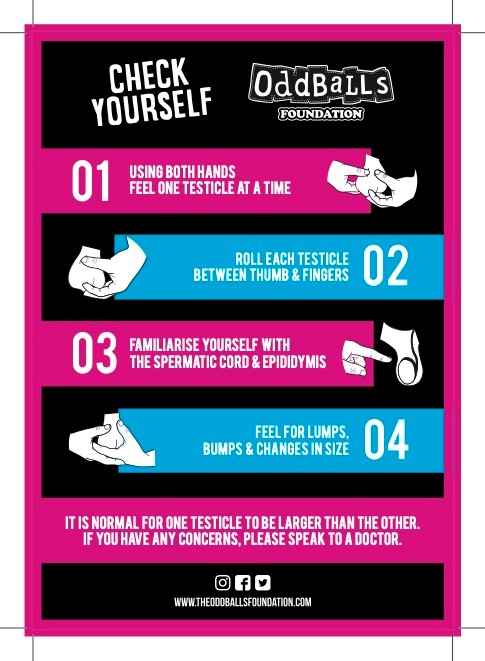
Kelly recommends a four-step process for checking yourself. "Step one involves using both hands to feel one testicle at a time. Step two involves rolling the testicle between your thumb and your fingers to inspect any changes," he says.
"Step three encourages people to familiarise themselves with the spermatic cord and the epididymis tube (- tube that carries sperm - that connects to the back side of each testicle," adds Kelly.
The epididymis feels like a coiled tube and it is common to get harmless cysts and benign Knoten in that area, which can be treated. However, every lump needs to be assessed just in case.
"Lastly, step four involves feeling for lumps, bumps and any changes in size. It's important to note that it is normal for one testicle to be larger than the other. We encourage everyone to speak to a doctor if they have any concerns whatsoever, as it's always better to be safe than sorry."
Oddballs Foundation Testicle Checker
What are the signs of testicular cancer?
The most common symptom of testicular Krebs is a lump in a testicle, or a dull ache or feeling of heaviness in the scrotum. Another symptom is a painless lump or swelling in a testicle, which may suddenly get larger and become painful.
"Some people who have been diagnosed with testicular cancer have been unable to report any specific signs but they just felt like something didn't feel right or normal to them," says Kelly. Other conditions can also cause lumps or swellings.Most lumps are not Krebs. However, it is important you get your doctor to check anything unusual as soon as possible.
What should you do if you are worried about testicular cancer?
If you notice any changes in your testicles or are worried that something doesn't seem right, it's important not to feel embarrassed and to speak to your doctor as soon as you can. Not all lumps and bumps are a sign of testicular cancer, but if you do receive a diagnosis, Chemotherapie, Strahlentherapie and surgery are the three main treatments. Although cancer can be a scary diagnosis, the outlook and survival rates for testicular cancer is one of the best for all cancers2.
"It's important to get things checked out early because treatment for testicular cancer is much more effective when started early," says Kelly.
Weiterführende Lektüre
Patientenauswahl für Hodenbeschwerden

Männergesundheit
Beeinflusst Hodenkrebs Ihre Fruchtbarkeit?
Hodenkrebs hat eine der höchsten Überlebensraten aller Krebsarten, aber die Auswirkungen auf die männliche Fruchtbarkeit variieren je nach Art der Behandlung.
von Amberley Davis

Männergesundheit
Ihre Hoden kennenlernen
Wenn Sie ein junger Mann oder Teenager sind, sollten Sie wissen, wie sich Ihre Hoden (Testikel) normalerweise anfühlen. Melden Sie Ihrem Arzt alle Veränderungen oder Knoten.
von Dr. Laurence Knott
Über den AutorVollständige Biografie anzeigen

Lydia Smith
Feature-Autorin
BA, MA, MSc
Lydia Smith ist eine preisgekrönte Journalistin und Feature-Autorin, die umfangreich über Frauengesundheit und psychische Gesundheit geschrieben hat. Derzeit studiert sie für einen MSc in Psychologie.
Über den RezensentenVollständige Biografie anzeigen

Dr Krishna Vakharia, MRCGP
Chief Medical Officer für Gesundheit, Optum UK
MBChB, MRCGP(2013), BMedSci (hons), DFSRH, DRCOG, PGDipDerm (Distn)
Dr. Krishna Vakharia ist eine NHS-Hausärztin. Sie ist auch regelmäßige Prüferin für das postgraduale Diplom in Praktischer Dermatologie an der Cardiff University und zudem Chief Medical Officer für Gesundheit bei Optum UK.
Artikelverlauf
Die Informationen auf dieser Seite werden von qualifizierten Klinikern begutachtet.
Artikel auch verfügbar in Englisch, Deutsch, Spanisch, Französisch, Italienisch, Portugiesisch, Hindi, Hebräisch, Arabisch, und Schwedisch.
20 Oct 2022 | Ursprünglich veröffentlicht
Verfasst von:
Lydia SmithBegutachtet von
Dr Krishna Vakharia, MRCGP

Fragen, teilen, verbinden.
Durchsuchen Sie Diskussionen, stellen Sie Fragen und teilen Sie Erfahrungen zu Hunderten von Gesundheitsthemen.

Fühlen Sie sich unwohl?
Bewerten Sie Ihre Symptome online kostenlos
Abonnieren Sie den Patienten-Newsletter
Ihre wöchentliche Dosis klarer, vertrauenswürdiger Gesundheitsberatung - geschrieben, um Ihnen zu helfen, sich informiert, selbstbewusst und in Kontrolle zu fühlen.
Durch das Abonnieren akzeptieren Sie unsere Datenschutzrichtlinie. Sie können sich jederzeit abmelden. Wir verkaufen Ihre Daten niemals.
Mehr zur Männergesundheit
- Werden Erektionsprobleme bei jungen Männern häufiger?
- Können Männer postnatale Depressionen erleben?
- Können Männer einen Pilz bekommen?
- Verursachen anabole Steroide Unfruchtbarkeit?
- Verursachen Kondome wirklich Erektionsprobleme?
- Müssen Männer Kegelübungen machen?
- Wie genau sind Prostatakrebstests?
- Wie Erektionsprobleme Ihre Beziehung beeinflussen können
- Wie man vorzeitige Ejakulation verhindert
- Wie Ihr Lebensstil eine Ursache für eine niedrige Spermienzahl sein kann
- Ist es Prostatakrebs oder etwas anderes?
- Die Entscheidung zur Erwachsenenzirkumzision: warum, wo und wie?
- Das männliche Fortpflanzungssystem
- Die einfachste Hautpflegeroutine für Männer
- Urin-Test für Prostatakrebs könnte zeigen, wer dringend behandelt werden muss
- Was sind die Anzeichen von Depressionen bei Männern?
- Was sind die Anzeichen für Prostatakrebs?
- Was ist toxische Männlichkeit und wie wirkt sie sich auf Männer aus?
- Wie groß ist die durchschnittliche Körpergröße von Männern?
- Warum sterben schwarze Männer häufiger an Prostatakrebs?