Wann man sich über ein Muttermal Sorgen machen sollte
Begutachtet von Dr Krishna Vakharia, MRCGPZuletzt aktualisiert von Amberley DavisZuletzt aktualisiert 23. Apr 2024
Erfüllt die Anforderungen des Patienten redaktionellen Richtlinien
- HerunterladenHerunterladen
- Teilen
- Language
- Diskussion
- Audio-Version
- Zu bevorzugten Quellen bei Google hinzufügen
Im Allgemeinen sind Muttermale harmlose Merkmale Ihrer Haut, die selten Probleme verursachen. In einigen Fällen kann jedoch die UV-Strahlung der Sonne dazu führen, dass ein Muttermal seine Form, Größe oder Farbe ändert und krebsartig wird. Wir untersuchen, worauf Sie achten müssen.
We're growing more aware of the dangers of the sun's rays and how important covering up and applying sun cream is, but Melanom skin cancer rates are still increasing. So it's important we all get into the habit of checking our skin regularly.
"If you've ever had a love of sunbathing or sunbeds, you need to be especially aware of the warning signs of Hautkrebs. But even if this doesn't describe you, you still need to look out for the signs," says Dr. Sarah Jarvis, GP and clinical consultant for Patient.Info.
What are moles?
Moles form when pigment-producing cells in the skin grow in a cluster instead of being spread throughout the skin. Most moles are flat, but sometimes they can be raised, and can range from pink, brown to black.
"Most moles will develop on the body during the first 30 years of someone's life, and they can often change due to hormonal fluctuations. Moles are more common and prominent in fairer-skinned people, and may darken after exposure to the sun, during the teen years, and during Schwangerschaft," explains dermatologist Dr Sharon Wong from the London Bridge Hospital, which is part of HCA Healthcare UK.
Gesponsert
Besorgt wegen eines Muttermals?
Lassen Sie Ihr Muttermal von einem Spezialisten überprüfen - Innerhalb von 24 Stunden beruhigt sein
If you have a mole that changes, or if new ones appear, this in-app mole assessment helps identify the need for further investigation - all from the comfort of your home.

How can a mole lead to cancer?
UV light from the sun or using sunbeds can change the structure of a mole and increase the chance of it becoming cancerous. This is known as Melanom.
"Melanoma is one of the most aggressive forms of skin cancer, which can spread to other organs in the body. The most common sign of melanoma is a change in an existing or new mole. The mole may also be larger than normal and can sometimes be itchy or bleed," reveals Wong.
Of course, not all new, enlarged or changing moles will mean skin cancer. But you should keep an eye on them just in case.
"Making a habit of examining your own skin on a monthly basis will help to detect any abnormal growths quickly. I always advise my patients to check their skin after they have had a bath or a shower, in a well-lit room with a full-length mirror," Wong adds.
Jarvis says: "Malignant melanoma can affect adults of all ages, and accounts for around 90% of skin cancer deaths despite being about 20 times less common than other skin cancers. The biggest risk factor is skin damage, particularly from burning and especially in childhood. A combination of pale skin and a hot climate is particularly risky. Most moles are nothing to worry about, but see your doctor immediately if a mole changes or you don't pass the ABCDE test."
What to look for when checking a mole
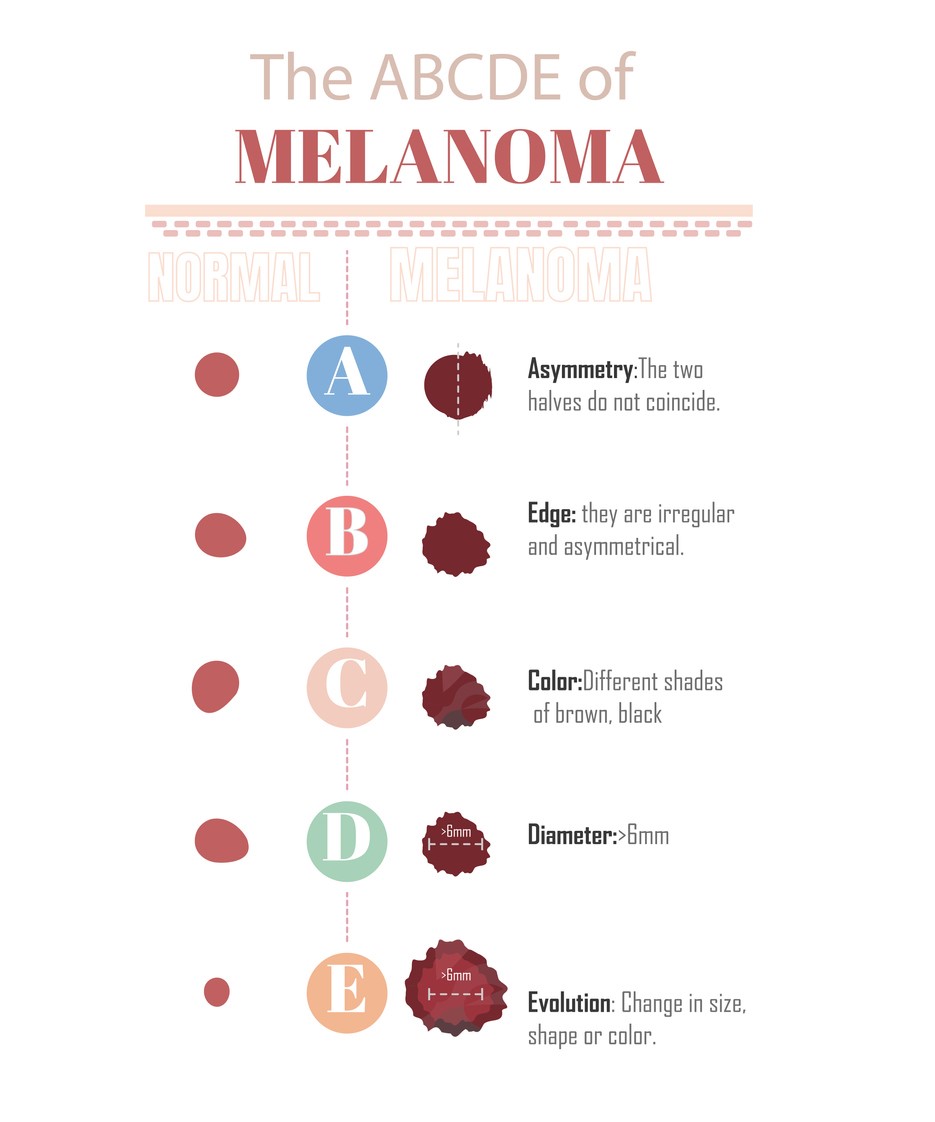
Wong also recommends the ABCDE test, which is a handy guide to remembering what to spot.
ABCDE melanoma
Asymmetrie
Is the mole symmetrical? Look out for changes in pigment, texture or shape from one half of the mole to the other.
Rand
A non-cancerous mole will usually have smooth, even borders, and you can see clearly where the mole ends and normal skin begins. You should look out for uneven formations and rough edges or lack of clarity between the edge of the mole and the skin that surrounds it.
Farbe
Most non-cancerous moles are a single shade of brown, so if a mole is showing a number of colours this could be a warning sign.
Durchmesser
Melanomas are usually larger than 6 mm. If a mole is bigger than this you may want to consider having it checked out.
Veränderung
Non-cancerous moles don't usually change shape or appearance, so if one of your moles is starting to evolve you should definitely book to seek your GP. Also, be aware of any new symptoms such as bleeding, itching or crusting.
But don't fret if you find the self-checking process tricky, or you've found some irregular moles or patches of skin. Book an appointment with your GP who will be able to review your moles and determine if any should be removed or investigated further.
How to reduce your skin cancer risk
Stay safe this year and don't skimp on Sonnencreme. Wong says you need to find one with good UVA and UVB protection. Both types of ray can cause damage to the skin and increase the risk of skin cancer. And cosmetically, UVA can age the skin, resulting in deep wrinkling and dark spots.
And remember, there's no such thing as a healthy tan.
"Unfortunately, there is still a perception within our society that having a tan looks healthy. Due to this, many people apply low-factor sun cream when out in the sun, or don't apply any at all, in order to bronze their skin. I always advise my patients to use between factor 30-50 sun creams with 5* UVA cover, and to apply large amounts every two hours," says Wong.
"I also advise that people should avoid sunbeds at all costs. The UV rays from sunbeds can damage the DNA in your skin cells, and over time this damage can build up to cause skin cancer. Fake tan products are a great option for people who want a darker skin tone, without the long-lasting damage," she concludes.
Patientenauswahl für Muttermale
Haut-, Nagel- und Haargesundheit
Sind Sie wegen eines Muttermals besorgt? Erhalten Sie Sicherheit mit der Online-Muttermalkontrolle
Viele von uns haben Muttermale – kleine, oft harmlose Hautflecken, die sich im Laufe der Zeit langsam verändern können. Manchmal kann jedoch ein neues Muttermal oder Veränderungen an einem bestehenden Muttermal Sorgen bereiten. Während die meisten Veränderungen harmlos sind, ist es wichtig zu wissen, wann man einen Fachmann konsultieren sollte, da eine frühzeitige Erkennung entscheidend bei der Feststellung von Hautkrebs ist.
von Thomas Andrew Porteus, MBCS
Haut-, Nagel- und Haargesundheit
Ganzkörper-3D-Muttermal-Kartierung: die Zukunft der Hautgesundheit?
Noticing changes in your moles is one of the best defences against skin cancer. But if you're someone who has moles in different places, it can be hard to keep track. Mole mapping is a way to look out for changes over time. The most technologically advanced form is whole body 3D imaging. Here's what you need to know.
von Amberley Davis
Über den AutorVollständige Biografie anzeigen

Natalie Healey
Freiberufliche Journalistin
BSc (Hons) Biomedizinische Wissenschaft
Sie ist eine in London ansässige Gesundheitsjournalistin, die seit mehreren Jahren über Wissenschaft und Medizin schreibt. Sie ist die ehemalige Leiterin der Redaktion bei Patient.
Über den RezensentenVollständige Biografie anzeigen

Dr Krishna Vakharia, MRCGP
Chief Medical Officer für Gesundheit, Optum UK
MBChB, MRCGP(2013), BMedSci (hons), DFSRH, DRCOG, PGDipDerm (Distn)
Dr. Krishna Vakharia ist eine NHS-Hausärztin. Sie ist auch regelmäßige Prüferin für das postgraduale Diplom in Praktischer Dermatologie an der Cardiff University und zudem Chief Medical Officer für Gesundheit bei Optum UK.
Artikelverlauf
Die Informationen auf dieser Seite werden von qualifizierten Klinikern begutachtet.
Artikel auch verfügbar in Englisch, Deutsch, Spanisch, Französisch, Italienisch, Portugiesisch, Hindi, Hebräisch, Arabisch, und Schwedisch.
Nächste Überprüfung fällig: 23. Apr. 2027
23. Apr 2024 | Neueste Version
22. Juni 2018 | Ursprünglich veröffentlicht
Verfasst von:
Natalie Healey

Fragen, teilen, verbinden.
Durchsuchen Sie Diskussionen, stellen Sie Fragen und teilen Sie Erfahrungen zu Hunderten von Gesundheitsthemen.

Fühlen Sie sich unwohl?
Bewerten Sie Ihre Symptome online kostenlos
Abonnieren Sie den Patienten-Newsletter
Ihre wöchentliche Dosis klarer, vertrauenswürdiger Gesundheitsberatung - geschrieben, um Ihnen zu helfen, sich informiert, selbstbewusst und in Kontrolle zu fühlen.
Durch das Abonnieren akzeptieren Sie unsere Datenschutzrichtlinie. Sie können sich jederzeit abmelden. Wir verkaufen Ihre Daten niemals.
Mehr über Haut-, Nagel- und Haargesundheit
- Ein Leitfaden für UV-Schutz-Sonnenbrillen
- Zurück zur Schule: So überprüfen Sie Ihr Kind auf Kopfläuse und Nissen
- Biotin: Funktionieren Vitamine für das Haarwachstum wirklich?
- Verbessert guter Schlaf wirklich Ihre Haut?
- Ekzeme bei Kindern: So beruhigen Sie Ihr Kind
- Ekzem-Managementpläne: Helfen sie, Ihr Ekzem zu kontrollieren?
- Wie man im Winter seine Haut pflegt
- Wie man das richtige Sonnenschutzmittel auswählt
- Wie man Hautzysten vorbeugt und beruhigt: ein einfacher Leitfaden
- So beruhigen Sie einen Brennnesselstich
- Wie man Sonnenbrand zu Hause behandelt
- Wie man Sonnenbrandblasen behandelt
- Anstieg der Krätze-Fälle im gesamten Vereinigten Königreich
- Die Auswirkungen von Hauterkrankungen auf die psychische Gesundheit
- Die einfachste Hautpflegeroutine für Männer
- Was sind die Gefahren des Trinkens bei heißem Wetter?
- Was verursacht plötzliches Ekzem bei Erwachsenen?
- Was Ihre Nägel über Ihre Gesundheit aussagen
- Warum tragen Männer seltener Sonnencreme?
- Warum Ekzeme jucken - und wie man es stoppt