Interstitial cystitis
Painful bladder syndrome
Peer reviewed by Dr Doug McKechnie, MRCGPLast updated by Dr Colin Tidy, MRCGPLast updated 20 Jan 2025
Meets Patient’s editorial guidelines
- DownloadDownload
- Share
- Language
- Discussion
- Audio Version
- Add to preferred sources on Google
Interstitial cystitis/painful bladder syndrome is very common in women. It can cause many different symptoms including pain over your bladder and needing to pass urine more often. There are many different treatments for this condition and many women actually need more than one treatment to improve their symptoms.
At a glance
Interstitial cystitis/painful bladder syndrome (IC/PBS) causes recurring bladder and pelvic pain or discomfort.
Symptoms often include needing to pass urine more frequently, pain when passing urine, and reduced ability to hold urine.
The exact cause of IC/PBS is unknown, but theories include bladder tissue defects or nerve changes.
Diagnosis involves tests to rule out other conditions, such as urine tests and cystoscopy.
Treatment aims to control symptoms and may involve lifestyle changes, medication, or surgery.
You may need to try various treatments until your symptoms are relieved, which can take weeks or months.
What is interstitial cystitis/painful bladder syndrome?
Interstitial cystitis/painful bladder syndrome (IC/PBS) is a common condition that usually affects women in their 40s. It is a condition that results in recurring discomfort or pain in your bladder and the surrounding pelvic region. The symptoms can vary from person to person and even in the same individual.
This condition is thought to occur in around one in fifty women. Around a quarter of people with this condition will have actually had some symptoms since they were children.
What is the bladder?
Your bladder is part of the urinary tract. It is at the bottom of your tummy (abdomen). It fills with urine and you pass urine out from time to time through a tube called the urethra. The urethra passes through the prostate gland and penis in men. The urethra is shorter in women and opens just above the vagina. Urine is made in your kidneys and contains water and waste materials. A tube called a ureter comes from each kidney and drains the urine into your bladder.
Urinary system
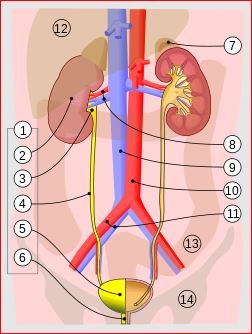
© Jordi March i Nogué [1], CC BY-SA 3.0, via Wikimedia Commons
Key to above urinary system
1. Urinary system | 2. Kidney | 3. Renal pelvis |
4. Ureter | 5. Urinary bladder | 6. Urethra (left side with frontal section) |
7. Adrenal gland | 8. Renal artery and vein | 9. Inferior vena cava |
10. Abdominal aorta | 11. Common iliac artery and vein | 12. Liver |
13. Large intestine | 14. Pelvis |
|
The outer part of your bladder wall contains a thick layer of muscle tissue which contracts from time to time to push out the urine.
What are the symptoms of interstitial cystitis/painful bladder syndrome?
It is common to experience mild discomfort, pressure, tenderness or intense pain in your bladder and pelvic area. These symptoms often persist for many weeks. The intensity of your symptoms can often fluctuate and so be different on different days. Some days your symptoms are likely to be more severe than on other days.
In addition to this pain, you are likely to have symptoms such as needing to pass urine more frequently and/or pain on passing urine. You may also find that you are not able to hold on to urine for as long as you used to. Such symptoms will have lasted for more than six weeks and not have been found to be due to another cause such as infection.
You may feel pain when having sexual intercourse. IC/PBS can affect the way you exercise and sleep and can cause a great deal of distress. Without treatment, IC/PBS symptoms make it hard to get through your day or even to be able to work. This can really affect not only your life but also your relationship with your partner.
Some people with IC/PBS have other conditions such as irritable bowel syndrome, fibromyalgia, chronic fatigue syndrome and other pain syndromes.
What causes interstitial cystitis/painful bladder syndrome?
It is not known exactly what causes IC/PBS. Some theories regarding its cause include:
A defect in your bladder tissue, which may allow irritating substances in the urine to pass through your bladder.
Something in the urine that damages your bladder.
Changes in the nerves that carry bladder sensations, so pain is caused by events that are not normally painful (such as your bladder filling with urine).
A type of allergic reaction.
What are the tests for this condition?
There are no actual tests to diagnose this condition. Tests are usually undertaken to exclude other diseases which may cause your symptoms. These tests often include a urine test, and a cystoscopy. A cystoscopy is a test in which a special thin telescope (a cystoscope) is passed into your bladder via your water pipe (urethra).
Some people are recommended to have a urodynamic test. This involves filling your bladder with water through a small tube called a catheter, which drains fluid from your bladder. This measures bladder pressures as your bladder fills and empties. In patients with IC/PBS the bladder has a small capacity and can lead to pain with filling.
What is the treatment for interstitial cystitis/painful bladder syndrome?
There are many different treatments available for this condition. Many people need a combination of treatments. The type of treatment you receive is usually chosen for each person and is based on the symptoms you are experiencing.
Most treatments are aimed at symptom control. IC/PBS treatment is often done in phases with constant monitoring of your pain and quality of life. It is important to talk with your doctor about how your treatments are working so that together you can find the best treatment option or options for you.
You may find that you need to receive treatment for stress or anxiety symptoms that may be related to having this condition. There are many different treatments available and your doctor will be able to advise you.
Changes to your lifestyle
It is likely that you will be recommended to make some changes to your lifestyle, especially your diet. Certain foods and drinks can irritate the lining of your bladder and make your symptoms worse. These may include alcohol, tomatoes, spices, chocolate, caffeinated and citrus drinks and acidic foods. It may be worthwhile making a food diary to try to assess which foods aggravate and worsen your symptoms.
The simplest way to find out whether any foods bother your bladder is to try an elimination diet for one to two weeks. On an elimination diet, you stop eating all foods that could irritate your bladder. If your bladder symptoms improve while you are on the elimination diet, this means that at least one of the foods was irritating your bladder. The next step is to find out exactly which foods cause bladder problems for you.
You should then try eating one food from the list of foods you stopped eating. If this food does not bother your bladder within 24 hours, this food is likely safe and can be added back into your regular diet. The next day, try eating a second food from the list, and so on. In this way, you will add the foods back into your diet one at a time and your bladder symptoms will tell you if any food causes problems for you.
Some people look at ways to reduce their stress levels, as this can actually improve their symptoms.
Medication
There are many different medications which may be recommended for you. These are either given orally as a tablet or they are injected via a small tube (catheter) into your bladder.
These include painkillers, antihistamines and stronger medicines such as amitriptyline, gabapentin and pregabalin. Medicines such as tolterodine, solifenacin or mirabegron, which work to help relax your bladder muscles, may be used.
A medicine called pentosan polysulfate sodium (Elmiron®) may be given. This may help repair the lining of your bladder. Pentosan polysulfate sodium is recommended by the National Institute for Health and Care Excellence (NICE) as an option for treating bladder pain syndrome in adults with urinary urgency and frequency, and moderate to severe pain, only if:
Your symptoms have not responded to an adequate trial of standard oral treatments.
It is not offered in combination with bladder instillations.
Any previous treatment with bladder instillations was not stopped because of lack of response.
It is used in hospital/specialist care.
Medicines that are given directly into your bladder may include:
A local anaesthetic.
Medicines such as hyaluronic acid or chondroitin sulfate, which are thought to help strengthen the lining of your bladder.
Surgery
For a small number of people with more severe symptoms, an operation may be recommended. A bladder distension is one type of operation in which your bladder is stretched with fluid. Some people have benefit with botulinum toxin injections being injected into their bladder. This is usually a short-term treatment but it can be repeated after a few months if it improves your symptoms.
Other operations are undertaken in some cases. Your doctor will be able to discuss the type of operation with you in more detail.
What is the outlook (prognosis)?
You may need to try different treatments (or often combinations of treatments) until you have relief of your symptoms. It is important to know that none of the treatments usually works right away. It can often take weeks to even months before you notice an improvement in your symptoms. Even with successful treatment, your IC/PBS may not be completely cured.
However, most patients can have significant relief of their symptoms and lead a normal life with the right treatment. You may find that you still experience some symptoms, however, and may find that you constantly have to pass urine more frequently. It is likely that you will always have to avoid certain types of food that have made your symptoms worse in the past.
Patient picks for Urinary problems in women
Women's health
Cystitis in women
A urine infection in the bladder (cystitis), also known as a urinary tract infection (UTI), is common in women. A short course of medicines called antibiotics is the usual treatment.
by Dr Hayley Willacy, FRCGP
Women's health
Lower urinary tract symptoms in women
Lower urinary tract symptoms (LUTS) are common in women of all ages, especially between the ages of 40-60. For many women, the symptoms come and go. But for some women, the symptoms are ongoing and interfere with normal life. The symptoms may include wetting yourself (incontinence), needing to pass urine frequently, or discomfort passing urine. These and other symptoms can result in poor quality of life. Many women never tell anyone about their symptoms. Your doctor may recommend tests to look for an underlying cause. Referral to a specialist is not usually needed. Often, no specific underlying cause is found. Treatment may help to relieve symptoms.
by Dr Rachel Hudson, MRCGP
Frequently asked questions
If I am diagnosed with interstitial cystitis/painful bladder syndrome, will I need ongoing treatment?
Yes, once diagnosed, you will likely need to continue with some form of treatment. Even with successful treatment, the condition may not be completely cured, and you might still experience some symptoms or need to avoid certain foods. The aim of treatment is to significantly relieve symptoms and allow you to lead a normal life.
How long will it take to see an improvement in my symptoms after starting treatment for interstitial cystitis/painful bladder syndrome?
It's important to understand that treatments for interstitial cystitis/painful bladder syndrome do not usually work immediately. It can often take several weeks, or even a few months, before you start to notice an improvement in your symptoms.
Are there any specific lifestyle changes, other than diet, that can help manage symptoms of interstitial cystitis/painful bladder syndrome?
Beyond dietary adjustments, some people find that reducing their stress levels can lead to an improvement in their symptoms. Managing stress is considered a helpful lifestyle change for this condition.
Could my interstitial cystitis/painful bladder syndrome symptoms be related to other health conditions?
Yes, it is noted that some individuals with interstitial cystitis/painful bladder syndrome also experience other conditions. These can include irritable bowel syndrome, fibromyalgia, chronic fatigue syndrome, and various other pain syndromes.
What should I do if I suspect certain foods are making my interstitial cystitis/painful bladder syndrome worse?
If you suspect certain foods are worsening your symptoms, it is recommended to try an elimination diet for one to two weeks. During this period, you stop eating all foods that are known to irritate the bladder. If your symptoms improve, you can then reintroduce foods one at a time to identify which specific items cause problems for you.
Further reading and references
- Management of Bladder Pain Syndrome; Royal College of Obstetricians and Gynaecologists (2016)
- Cox A; Management of interstitial cystitis/bladder pain syndrome. Can Urol Assoc J. 2018 Jun;12(6 Suppl 3):S157-S160. doi: 10.5489/cuaj.5324.
- Guidelines on Chronic Pelvic Pain; European Association of Urology (2020)
- Pentosan polysulfate sodium for treating bladder pain syndrome; NICE Technology appraisal guidance, November 2019
- Juliebo-Jones P, Hjelle KM, Mohn J, et al; Management of Bladder Pain Syndrome (BPS): A Practical Guide. Adv Urol. 2022 Jan 10;2022:7149467. doi: 10.1155/2022/7149467. eCollection 2022.
About the authorView full bio

Dr Colin Tidy, MRCGP
General Practitioner, Medical Author
MBBS, MRCGP, MRCP (Paediatrics), DCH
Dr Colin Tidy is an NHS Doctor, based in Oxfordshire.
About the reviewerView full bio

Dr Doug McKechnie, MRCGP
Medical Writer
MA, MBBS, MSc, DRCOG, MRCP(UK), MRCGP(2021), FHEA
Dr Doug McKechnie is an NHS GP working in London. He works full-time clinically and is also the Deputy Lead for the Clinical and Professional Practice module at University College London Medical School.
Article history
The information on this page is written and peer reviewed by qualified clinicians.
Article also available in English, German, Spanish, French, Italian, Portuguese, Hindi, Hebrew, Arabic, and Swedish.
Next review due: 19 Jan 2028
20 Jan 2025 | Latest version
Join the conversation
Share your thoughts or experiences with others in our patient communities.

Ask, share, connect.
Browse discussions, ask questions, and share experiences across hundreds of health topics.

Feeling unwell?
Assess your symptoms online for free
Sign up to the Patient newsletter
Your weekly dose of clear, trustworthy health advice - written to help you feel informed, confident and in control.
By subscribing you accept our Privacy Policy. You can unsubscribe at any time. We never sell your data.
More in women's health
- 8-Week Healthy Pregnancy Course
- Amniocentesis
- Bartholin's cyst and abscess
- Cervical screening
- Condom
- Diet and lifestyle during pregnancy
- Down's syndrome screening
- Fetal anticonvulsant syndrome
- Heavy periods
- High blood pressure in pregnancy
- Indigestion and acid reflux in pregnancy
- Itchy vulva
- Mastitis and breast abscess
- Nausea and vomiting in pregnancy
- Newborn screening test
- Ovarian cyst
- Pre-eclampsia
- Premenstrual syndrome
- Recurrent cystitis in women
- Signs you're on the wrong contraceptive pill