Hydrozele bei Säuglingen
Fachlich geprüft von Dr Philippa Vincent, MRCGPZuletzt aktualisiert von Dr Toni Hazell, FRCGPZuletzt aktualisiert 14. Nov 2024
Erfüllt die Anforderungen des Patienten Richtlinien des Patienten
- HerunterladenHerunterladen
- Teilen
- Language
- Diskussion
- Audio-Version
- Zu bevorzugten Quellen bei Google hinzufügen
In dieser Serie:Skrotale Knoten, Schmerzen und SchwellungenHodentorsionEpididymo-OrchitisEpididymale ZysteVarikozeleHydrozele bei Erwachsenen
A hydrocele is a collection of fluid in the scrotum, sometimes found in newborn boys. Most hydroceles go down within the first few months of life in babies and so do not need treatment. If a hydrocele persists then a small operation can usually cure the problem.
Auf einen Blick
Ein Hydrozele ist eine Flüssigkeitsansammlung in einem Sack um einen Hoden im Hodensack.
Es fühlt sich normalerweise wie ein glatter, mit Flüssigkeit gefüllter Ballon an und ist oft schmerzlos.
Hydrozele sind bei Neugeborenen sehr häufig.
Sie verbessern sich oft von selbst im ersten Lebensjahr ohne Behandlung.
Eine Operation kann empfohlen werden, wenn ein Hydrozele länger als 12-24 Monate anhält.
The normal scrotum and testes
The scrotum is normally loose, soft and fleshy. It holds the two testicles (testes). Usually you can easily feel the testes in the scrotum. A tube (the vas deferens) takes sperm from each testicle (testis) to the penis. It is normal for one testis to hang lower than the other.
Was ist eine Hydrozele?
A hydrocele is a collection of fluid in a sac in the scrotum next to a testicle (testis). It usually occurs on one side but sometimes a hydrocele forms over both testicles (testes). It is common in newborns.
Diagram of a hydrocele
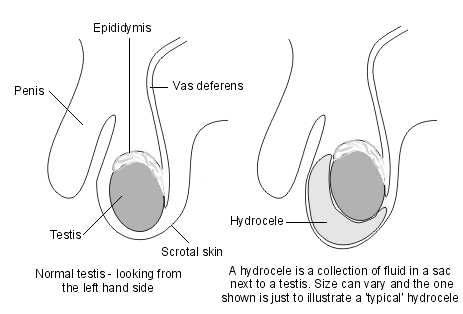
The normal testis is surrounded by a smooth protective tissue sac. You cannot normally feel this. It makes a small amount of 'lubricating' fluid to allow the testis to move freely. Excess fluid normally drains away into the veins in the scrotum. If the balance is altered between the amount of fluid that is made and the amount that is drained, some fluid accumulates as a hydrocele.
What do hydroceles look and feel like?
A hydrocele feels like a small fluid-filled balloon inside the scrotum. It feels smooth and is mainly in front of one of the testicles (testes). They can vary in size. Hydroceles are normally painless. Sometimes fluid can move back and forth between the hydrocele and the abdominal cavity - this is called a communicating hydrocele and you might see swelling that appears to move between the tummy (abdomen) and the scrotum. Another type of hydrocele is called non-communicating, where the fluid stays in the scrotum. There may be no hydrocele symptoms - your baby is unlikely to be in pain - but you might notice an apparent lump or swelling in the scrotum.
What causes hydroceles?
Some babies are born with a hydrocele. Hydroceles are very common in babies. When babies develop in the womb (uterus), the development of the testicles (testes) sees the testicles move from the tummy (abdomen) to the scrotum. Sometimes the passage which allows this to happen (the processus vaginalis) does not close completely. This may then lead to a hydrocele developing.
Hydroceles can sometimes be associated with an inguinal Hernie, which occurs when part of the intestine pushes through a weak spot in the muscles of the abdominal wall.
In older children a hydrocele may have other causes such as injury, torsion of the testis oder nephrotisches Syndrom.
Are any investigations needed for hydrocele?
The diagnosis of hydrocele can normally be made by history and examination. If there is doubt about the nature of the scrotal lump, an ultrasound may be needed.
What is the treatment for hydrocele?
Hydroceles usually improve without any treatment within the first year of life. An operation is usually only advised if the hydrocele persists after 12-24 months of age.
If your child also has a hernia, often seen as a lump in the groin area, then this will usually be corrected in the same operation.
The operation for a hydrocele involves making a very small incision (cut) in the lower tummy (abdomen) or the scrotum. Sometimes the procedure is done by keyhole surgery (laparoscopically). The fluid is then drained from around the testicle (testis). The passage between the abdomen and the scrotum will also be sealed off so the fluid cannot reform in the future. This is a minor operation and is performed as a day case, so does not usually involve an overnight stay in the hospital.
There are no long-term effects of having a hydrocele. Having a hydrocele does not affect the testicles (testes) or a boy's ability to have children in the future.
Patientenauswahl für Baby und Kleinkind

Gesundheit von Kindern
Plötzlicher Kindstod
Die Ursache des plötzlichen Kindstods ist nicht bekannt. Sie können jedoch das Risiko des plötzlichen Kindstods durch die unten aufgeführten Maßnahmen verringern. Am wichtigsten ist es, Ihr Baby auf den Rücken zu legen, um zu schlafen (nicht auf den Bauch oder die Seite) und eine rauchfreie Zone für Ihr Baby zu schaffen.
von Dr. Toni Hazell, FRCGP

Gesundheit von Kindern
Nekrotisierende Enterokolitis
Frühgeborene Babys haben ein höheres Risiko für eine schwere Erkrankung namens Nekrotisierende Enterokolitis, die ihre Därme (Darm) betrifft.
von Dr. Mary Harding, MRCGP
Häufig gestellte Fragen
Wie lange dauert die übliche Erholungszeit nach einer Operation eines Hydrozele?
Der Artikel erwähnt, dass die Operation eines Hydrozele ein kleiner Eingriff ist und als Tagesfall durchgeführt wird, was bedeutet, dass normalerweise kein Übernachtungsaufenthalt im Krankenhaus erforderlich ist. Obwohl keine spezifische Erholungszeit angegeben ist, deutet die Tatsache, dass es sich um einen Tagesfall handelt, auf eine relativ schnelle Rückkehr zu normalen Aktivitäten hin, obwohl unmittelbar danach etwas Ruhe und Pflege erwartet werden.
Kann ein Hydrozele die Fruchtbarkeit meines Kindes im späteren Leben beeinträchtigen?
Nein, ein Hydrozele beeinträchtigt weder die Hoden noch die Fähigkeit eines Jungen, in der Zukunft Kinder zu bekommen. Der Artikel stellt ausdrücklich fest, dass es in dieser Hinsicht keine langfristigen Auswirkungen einer Hydrozele gibt.
Gibt es verschiedene Arten von Hydrocelen?
Ja, es werden zwei Haupttypen erwähnt: kommunizierende und nicht-kommunizierende Hydrozele. Eine kommunizierende Hydrozele ermöglicht es, dass Flüssigkeit zwischen der Hydrozele und der Bauchhöhle hin- und herfließt, wodurch die Schwellung beweglich erscheint. Bei einer nicht-kommunizierenden Hydrozele bleibt die Flüssigkeit im Hodensack eingeschlossen.
Was passiert, wenn ein Hydrozele über das Alter von zwei Jahren hinaus bestehen bleibt?
Wenn ein Hydrozele nach 12-24 Monaten weiterhin besteht, wird normalerweise eine Operation empfohlen, um sie zu korrigieren. Dieser Eingriff beinhaltet das Ablassen der Flüssigkeit und das Verschließen des Durchgangs zwischen dem Bauchraum und dem Hodensack, um ein Wiederauftreten zu verhindern.
Wie wird ein Hydrozele bei Kindern diagnostiziert?
Ein Hydrozele wird normalerweise durch eine Anamnese und eine körperliche Untersuchung diagnostiziert. Ein Ultraschall kann verwendet werden, wenn Unsicherheit über die Beschaffenheit der Skrotalschwellung besteht.
Weiterführende Literatur und Referenzen
- Verma S, Agrawal V, Acharya H, et al; Laparoscopic suture-less herniotomy using tissue-sealing device for paediatric hydrocele. J Minim Access Surg. 2019 Jan 4. pii: 249452. doi: 10.4103/jmas.JMAS_251_18.
- EAU-Leitlinien für Pädiatrische Urologie. Ausgabe präsentiert beim EAU-Jahreskongress in Kopenhagen; Europäische Gesellschaft für Urologie, 2018 – aktualisiert 2023
Über den AutorVollständige Biografie anzeigen

Dr Toni Hazell, FRCGP
MBBS, BSc, FRCGP, DFSRH, Dip GU med, DRCOG, DCH (London, UK, 2000)
Dr. Toni Hazell hat ihren Abschluss an der St. Mary’s Hospital Medical School gemacht und ihr VTS am Northwick Park Hospital absolviert.
Über den RezensentenVollständige Biografie anzeigen

Dr Philippa Vincent, MRCGP
Allgemeinmediziner, Medizinischer Autor
MB BS, Bsc, MRCGP (2000), DCH, DFSRH, DRCOG
Dr Philippa Vincent ist ein NHS-Arzt, der in Nordlondon arbeitet.
Artikelverlauf
Die Informationen auf dieser Seite wurden von qualifizierten Klinikern verfasst und begutachtet.
Artikel auch verfügbar in Englisch, Deutsch, Spanisch, Französisch, Italienisch, Portugiesisch, Hindi, Hebräisch, Arabisch, und Schwedisch.
Nächste Überprüfung fällig: 13. Nov 2027
14. Nov 2024 | Neueste Version

Fragen, teilen, verbinden.
Durchsuchen Sie Diskussionen, stellen Sie Fragen und teilen Sie Erfahrungen zu Hunderten von Gesundheitsthemen.

Fühlen Sie sich unwohl?
Bewerten Sie Ihre Symptome online kostenlos
Abonnieren Sie den Patienten-Newsletter
Ihre wöchentliche Dosis klarer, vertrauenswürdiger Gesundheitsberatung - geschrieben, um Ihnen zu helfen, sich informiert, selbstbewusst und in Kontrolle zu fühlen.
Durch das Abonnieren akzeptieren Sie unsere Datenschutzrichtlinie. Sie können sich jederzeit abmelden. Wir verkaufen Ihre Daten niemals.
Mehr zur Gesundheit von Kindern
- Bettnässen
- Verstopfte Nase bei Babys
- Plötzlicher Kindstod
- Legasthenie
- Erythema toxicum neonatorum
- Paukenerguss
- Wachstumsschmerzen
- Übelkeit und Erbrechen
- Morbus Perthes
- Pneumokokken-Immunisierung
- Polio und Polio-Impfstoff
- Rektale Blutungen bei Kindern
- Wiederkehrende Bauchschmerzen bei Kindern
- Roseola
- Röteln
- Spina bifida
- Schielen bei Kindern
- Turner-Syndrom
- Harnwegsinfektion bei Kindern