
Varicocele
Peer reviewed by Dr Toni Hazell, FRCGPLast updated by Dr Doug McKechnie, MRCGPLast updated 20 Jun 2024
Meets Patient’s editorial guidelines
- DownloadDownload
- Share
- Language
- Discussion
- Audio Version
- Add to preferred sources on Google
In this series:Scrotal lumps, pain and swellingTesticular torsionEpididymo-orchitisEpididymal cystHydrocele in adultsHydrocele in infants
A varicocele is like varicose veins of the small veins (blood vessels) next to one testicle (testis) or both testicles (testes).
At a glance
A varicocele is a collection of enlarged veins in the scrotum, similar to varicose veins in the legs.
They usually develop during puberty and often do not cause any problems.
They form when valves in the scrotal veins do not function well, causing blood to pool.
Sometimes varicoceles can cause discomfort or be linked to fertility problems.
Treatment is usually only needed if symptoms are distressing or if fertility is affected.
See a doctor if a varicocele appears after age 40, is only on the right, or comes with other worrying symptoms.
What is a varicocele?
Cross-section diagram of testicle
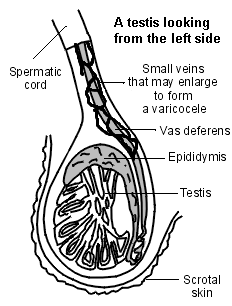
A varicocele is a collection of enlarged (dilated) veins (blood vessels) in the scrotum. It occurs next to and above one testicle (testis) or both testes (testicles).
Varicoceles affect the veins that travel in the spermatic cord. The spermatic cord is like a tube that goes from each testis up towards the lower tummy (abdomen). You can feel the spermatic cord above each testis in the upper side of the scrotum. The spermatic cord contains the tube that carries sperm from the testes to the penis (the vas deferens), blood vessels, lymphatic vessels and nerves.
Normally, you cannot see or feel the veins in the spermatic cord that carry the blood from the testicles. If you have a varicocele, the veins become bigger (they dilate) and this makes them more noticeable. It is similar to varicose veins of the legs. The size of a varicocele can vary. A large varicocele is sometimes said to look and feel like a bag of worms in the scrotum.
Varicoceles usually develop during puberty, and can enlarge slowly over time.
What causes a varicocele?
Venous valve diagram
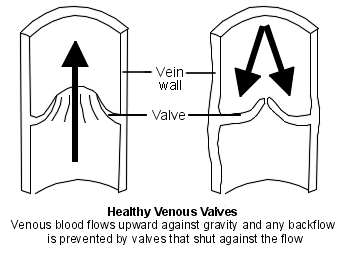
In most cases, the reason why the veins (blood vessels) become larger is because the valves of the small veins in the scrotum do not function well. There are one-way valves at intervals along the veins. The valves open to allow blood to flow towards the heart, but close when blood flow slows to stop blood flowing backwards.
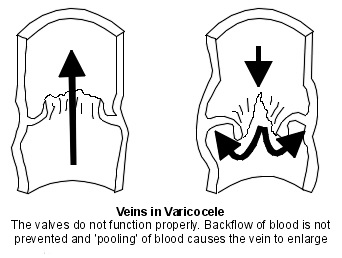
If these valves do not work well, blood can flow backwards (due to gravity) and pool in the lower parts of the vein to form a varicocele. (This is similar to how varicose veins form in legs.)
It is not clear why the valves do not work well.
Abnormal vein valves
Very rarely, a varicocele may develop if there is a blockage of larger veins higher in the tummy (abdomen), such as from a tumour in one of the kidneys, or near to it. This puts back-pressure on the smaller veins in the scrotum which then enlarge (dilate).
This is very rare, and there are usually other signs and symptoms of cancer as well, such as blood in the urine, unexplained abdominal pain, or unexplained weight loss. When it does happen, it usually affects men over 40, or pre-pubertal boys with rare and unusual tumours.
Should I be worried about varicoceles?
Varicoceles are very common. For most men with them, they don't cause any problems at all. Some men get symptoms from a varicocele, and sometimes they can be linked to fertility problems (see below). It's very rare for a varicocele to be caused by anything serious.
How is a varicocele diagnosed?
Varicoceles can be diagnosed by a doctor examining the testicles and scrotum. A colour duplex ultrasound scan (a scan using ultrasound to look at blood flow in an area) is sometimes also done to confirm the diagnosis.
It's also common to find varicoceles that are only visible on an ultrasound, but can't be felt, when having a testicular ultrasound for another reason.
Having a varicocele can be linked to subfertility and infertility - although most men with a varicocele do not have any fertility problems. A semen analysis test might be recommended if you are having difficulty conceiving.
It's very rare for a varicocele to be caused by anything serious. Further tests to look for serious problems usually aren't necessary, but may be recommended if:
The varicocele has developed for the first time after the age of 40.
The varicocele is only present on the right side.
The varicocele has appeared suddenly, and is painful.
The varicocele doesn't disappear when lying down.
There are other worrying symptoms, such as blood in the urine, unexplained abdominal (tummy) pain, swelling of the abdomen, or unexplained weight loss.
See also the separate leaflet on Scrotal lumps, pain and swelling (Hydrocele, varicocele, testicular torsion).
When does a varicocele need treating?
Varicoceles don't need any treatment at all if they aren't causing any symptoms or problems, or if the symptoms are mild.
Treatment might be recommended if:
The varicocele is causing distressing symptoms, particularly if it is large.
The varicocele is thought to be causing fertility problems in a man who wants to conceive.
The varicocele is causing problems with testicular growth in a teenager.
Is a varicocele dangerous?
Varicoceles themselves aren't dangerous, but they can sometimes cause problems.
Possible cause of infertility
Varicoceles are thought to be one of the most common causes of male infertility. However, most men with varicoceles are still fertile - infertility seems to only affect around 10-20% of men with a varicocele.
We don't know exactly why varicoceles are linked to infertility. One theory is that the pooled blood causes a slightly higher temperature in the scrotum than normal, even if the varicocele is only present on one side. This can then affect sperm production in the testicles.
The role of varicocele treatment in fertility problems is controversial. Varicocele treatment does improve semen quality, but it has been debated for years as to whether it actually leads to an improvement in fertility.
Currently, the evidence suggests that varicocele treatment probably does improve fertility, but in a selected group of men.
The European Association of Urology recommends that varicocele treatment should be offered if:
The varicocele can be felt on examination (as opposed to just showing up on a scan), and;
You have an abnormal semen analysis (usually, a low sperm count), and;
As a couple, you have infertility (being unable to get pregnant despite having regular unprotected sex for a year), and this infertility is otherwise unexplained.
Varicocele treatment to improve fertility may be offered in other situations as well, although the evidence is not as strong.
Small testis
If a large varicocele develops in a teenager, the testis on the side of the varicocele may not develop as much as would be expected. The testis may end up being smaller than normal. This may contribute to infertility too.
Surgery to treat the varicocele may be recommended if the testicle on the side of the varicocele remains persistently smaller than the other testicle.
Sudden onset of a varicocele in an older man
Very rarely, a varicocele can develop rapidly as a symptom of a blockage of a larger vein in the tummy (abdomen) - see above. When this does happen, it's usually in men over the age of 40.
Varicocele treatment
As covered above, varicoceles don't need treatment unless they are causing problems.
If there is just mild discomfort, wearing supportive underpants (rather than boxer shorts) can help to ease or prevent discomfort. Taking pain relief can also help.
Surgical treatments for varicoceles include:
Tying off, or clipping, the veins (blood vessels) that are enlarged. This can be done by making a small cut in the groin (open surgery), or by keyhole surgery (laparoscopic surgery).
Using X-ray guidance and a thin, plastic tube (a catheter) to place tiny coils, a foam, or both, into the enlarged veins draining the testicle. This blocks off the veins. This procedure is called a varicocele embolisation.
Your urologist will advise on the pros and cons of the different techniques.
Varicoceles can sometimes come back after an initially-successful surgery. If this happens, a second procedure might be offered to treat the recurrence.
Can a varicocele be prevented?
We don't know exactly why varicoceles happen, and so we don't know how to prevent getting one.
Patient picks for Testicle and scrotum disorders

Men's health
Hydrocele in adults
A hydrocele is a collection of fluid in the scrotum. Most develop for no apparent reason, are harmless and can be left alone. If needed, surgery can usually cure the hydrocele. In a small number of cases, a hydrocele is due to an underlying problem.
by Dr Philippa Vincent, MRCGP
Men's health
Testicular torsion
When a testicle (testis) twists around in the scrotum, the condition is called testicular torsion. An emergency operation is usually needed to treat this condition.
by Dr Toni Hazell, FRCGP
Frequently asked questions
Can a varicocele cause pain in the lower abdomen?
Yes, very rarely, if a varicocele develops rapidly due to a blockage in a larger vein in the abdomen, it can be accompanied by unexplained abdominal pain, among other concerning symptoms. This situation typically affects men over 40.
Does varicocele pain go away?
Varicocele symptoms, including pain, may be mild and can be managed. If there is mild discomfort, wearing supportive underwear can help, and pain relief medication can also be used. If the varicocele is causing more distressing symptoms, treatment might be recommended, which could resolve the pain.
Is a varicocele dangerous?
Varicoceles themselves are not dangerous, but they can sometimes lead to issues. These include potential links to infertility, or in teenagers, a smaller-than-normal testicle on the affected side. Very rarely, a varicocele could be a symptom of a blockage in a larger vein in the abdomen, which would require further investigation.
Can a varicocele be cured?
While a varicocele doesn't always require treatment, if it's causing problems or significant symptoms, surgical treatment or a procedure called varicocele embolisation can be performed to address it. These treatments aim to tie off or block the enlarged veins. However, it's possible for varicoceles to sometimes recur after an initially successful procedure.
What can cause a varicocele to appear suddenly and be painful?
A varicocele that appears suddenly and is painful can be a sign that further tests are needed. In rare cases, especially in men over 40, such a varicocele could indicate a blockage in a larger vein higher in the abdomen, possibly due to a tumour. This would also usually come with other signs like blood in the urine, unexplained abdominal pain, or unexplained weight loss.
Can a varicocele cause blood in the urine?
Blood in the urine, while not directly caused by a varicocele itself, can be a worrying symptom that might lead to further investigation if present alongside a varicocele. Such a symptom, particularly if the varicocele is new, sudden, or on the right side, could indicate a very rare underlying issue like a blockage from a tumour in a larger vein higher in the abdomen.
Further reading and references
- Minhas S, Bettocchi C, Boeri L, et al; European Association of Urology Guidelines on Male Sexual and Reproductive Health: 2021 Update on Male Infertility. Eur Urol. 2021 Nov;80(5):603-620. doi: 10.1016/j.eururo.2021.08.014. Epub 2021 Sep 10.
- Varicocele; NICE CKS, January 2023. (UK access only)
- El-Saeity NS, Sidhu PS; "Scrotal varicocele, exclude a renal tumour". Is this evidence based? Clin Radiol. 2006 Jul;61(7):593-9. doi: 10.1016/j.crad.2006.02.011.
About the authorView full bio
Updated by

Dr Doug McKechnie, MRCGP
Medical Writer
MA, MBBS, MSc, DRCOG, MRCP(UK), MRCGP(2021), FHEA
Dr Doug McKechnie is an NHS GP working in London. He works full-time clinically and is also the Deputy Lead for the Clinical and Professional Practice module at University College London Medical School.
About the reviewerView full bio

Dr Toni Hazell, FRCGP
MBBS, BSc, FRCGP, DFSRH, Dip GU med, DRCOG, DCH (London, UK, 2000)
Dr. Toni Hazell qualified from St. Mary’s Hospital Medical School and did her VTS at Northwick Park Hospital.
Join the conversation
Share your thoughts or experiences with others in our patient communities.

Ask, share, connect.
Browse discussions, ask questions, and share experiences across hundreds of health topics.

Feeling unwell?
Assess your symptoms online for free
Sign up to the Patient newsletter
Your weekly dose of clear, trustworthy health advice - written to help you feel informed, confident and in control.
By subscribing you accept our Privacy Policy. You can unsubscribe at any time. We never sell your data.