Guttate psoriasis
Peer reviewed by Dr Hayley Willacy, FRCGP Last updated by Dr Colin Tidy, MRCGPLast updated 13 Oct 2022
Meets Patient’s editorial guidelines
- DownloadDownload
- Share
- Language
- Discussion
- Audio Version
- Add to preferred sources on Google
In this series:PsoriasisPsoriatic arthritisNail psoriasis
Guttate psoriasis is a skin condition which gives you light red, scaly patches scattered over almost your whole body. It often happens a few weeks after a throat infection with a particular germ (bacterium) called a group A beta-haemolytic streptococcus.
At a glance
Guttate psoriasis is a skin condition that develops quickly, often after a throat infection.
It causes small, raised, pink spots with a thin white scale, usually on the body and limbs.
The spots typically appear over one or two days and can be slightly itchy.
It is diagnosed by its appearance and whether a throat infection recently occurred.
Guttate psoriasis often clears up on its own within a few weeks or months.
In most cases, the spots do not return after clearing.
What is guttate psoriasis?
Although it has the name 'psoriasis', guttate psoriasis is almost a completely different condition to the usual psoriasis. It is a skin condition that comes on quickly, usually a few weeks after a throat infection. Some medications can also cause it.
Guttate psoriasis causes
For some reason a group A beta-haemolytic streptococcus infection, which can cause a really sore throat, sometimes causes a skin reaction.
It's thought to be caused by your immune system going into 'overdrive' and accidentally reacting to your own skin.
The throat infection is found in about 80% of cases.
No one can quite figure out why this happens but some people seem to be more prone to it than others. It might be to do with your genetic make-up.
In this way it's similar to the way a throat infection can lead to rheumatic fever.
Can anything else cause guttate psoriasis?
Rarely some medications can cause guttate psoriasis, particularly lithium (used for mental health problems) and beta-blockers (used in heart conditions).
What does guttate psoriasis look like?
The word 'gutta' means 'drop' in Latin so that's where the name guttate psoriasis comes from: it can look like tiny pink drops have been scattered on the person's body. They are usually slightly raised, with a thin white scale. They don't hurt, but they can be a bit itchy.
Guttate psoriasis hands
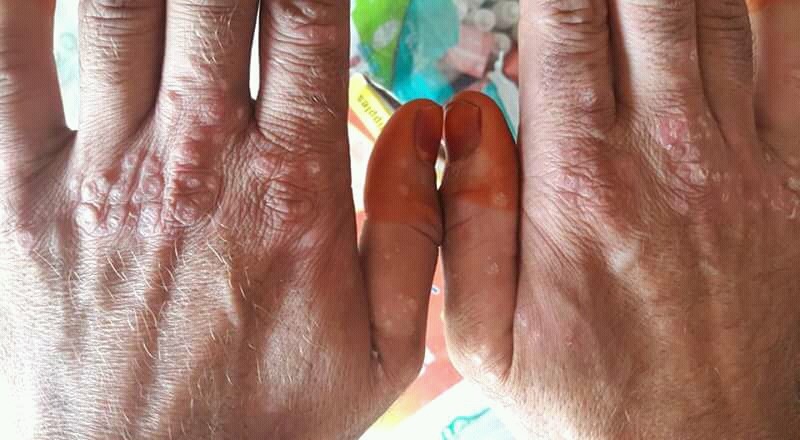
© Mohammad2018, CC BY-SA 4.0, via Wikimedia Commons
The above image shows guttate psoriasis on the back of someone's hands:
The spots come on pretty quickly, over just a day or two.
They usually cover the chest, tummy, upper arms and thighs.
Usually the palms of the hands and soles of the feet are not affected.
It only occasionally affects your head and face.
They are slightly raised, light pink skin marks that might have a white scale to their surface.
Does guttate psoriasis make you feel ill?
Usually the appearance of the spots is the worst thing about it.
It doesn't usually make you feel ill or feverish.
The spots are not usually painful, but they can be a tiny bit itchy (only a little bit though).
You can imagine that coming up in spots all over your body in just a few days can be pretty distressing: a lot of people are quite upset when they see their doctor.
Guttate psoriasis treatment
The good news is, guttate psoriasis typically fades by itself within a few weeks to a few months.
It doesn't necessarily need treating unless it's really bothering the person. No particular treatment option has been shown to work better than others.
A GP may prescribe a mild steroid cream if the lesions are itchy - although in practice it is quite hard to spread cream over such a large area of the body. It is worth nourishing the skin with simple moisturisers.
Although it is related to a bacterial throat infection, giving antibiotics doesn't actually speed up the spots going away.
A dermatologist may use 'light therapy' which is where they beam UV light at you in a special box (a bit like tanning!). This is a specialised treatment that isn't available in all hospitals. It can help to clear up the guttate psoriasis a bit quicker than otherwise.
Guttate psoriasis diagnosis
There aren't any particular tests for guttate psoriasis.
It's diagnosed by the way it looks and also by finding out if there has been a throat infection a few weeks before. Occasionally a blood test can be used to detect the streptococcus germ (bacterium): this is called an anti-streptolysin antibody assay.
A skin biopsy is not usually needed. If it isn't quite clear what the skin condition is, a specialist skin doctor (dermatologist) might use a small microscope (a dermatoscope) to look at it more closely.
Can guttate psoriasis be confused with anything else?
There are other conditions that give similar skin problems.
Pityriasis rosea can look a bit like guttate psoriasis, but doesn't follow a throat infection.
Pityriasis lichenoides can resemble guttate psoriasis, but again doesn't follow a throat infection. And the lesions look a bit different to guttate psoriasis.
See also the separate leaflet on Skin Rashes.
Who is affected by guttate psoriasis?
Usually young people get guttate psoriasis, in their teens or twenties. Men and women are affected equally.
It seems to occur all over the world.
No one really quite knows how common it is. In general, a GP in the UK would have heard of it and probably know how to diagnose it, but they may not have seen a case themselves for many years.
What's the outlook like after having guttate psoriasis?
In nearly two thirds of people with guttate psoriasis, the spots clear up and never come back.
Occasionally the spots turn into a more long-term type of psoriasis called plaque psoriasis. This can be treated with similar creams and light treatment.
Once it's cleared, sometimes (but not very often) a second outbreak of guttate psoriasis happens. This could happen if the streptococcus bug is lurking in your tonsils.
Thankfully the guttate psoriasis never properly scars, although sometimes it can leave tiny pale marks where it used to be: these should fade with time though.
What happens after the first outbreak?
Usually it comes and goes and then that's all there is to it. In about 80% of people the spots will fade in three weeks to three months and never come back. But in some people it carries on to be long-term plaque psoriasis. Sometimes you can get a second outbreak, particularly if the streptococcus germ (bacterium) is still in your throat or tonsils.
Patient picks for Other skin conditions

Skin, nail and hair health
Keratosis pilaris
Keratosis pilaris is a very common skin condition which affects children and teenagers more than adults. It causes rough skin, particularly over the upper arms, outer legs and buttocks.
by Dr Philippa Vincent, MRCGP
Skin, nail and hair health
Acne
Acne (also called 'zits', spots or pimples) is a common condition, particularly in teenagers. It can also occasionally affect middle-aged people and babies. It often causes a lot of worry and distress but can usually be cleared up, or at least improved a lot, with the right treatment. The treatment can take about a month to work and may need to continue for a while, even after the spots have cleared.
by Dr Colin Tidy, MRCGP
Frequently asked questions
Can I prevent guttate psoriasis from developing if I have a strep throat infection?
The article states that guttate psoriasis typically appears a few weeks after a throat infection, most commonly caused by a group A beta-haemolytic streptococcus infection. However, it does not provide information on whether treating the strep throat infection early can prevent guttate psoriasis from occurring.
Does guttate psoriasis leave scars?
Guttate psoriasis never properly scars. However, it can sometimes leave tiny pale marks where the spots used to be. These pale marks should fade over time.
What is the likelihood of guttate psoriasis returning after it has cleared up?
In nearly two-thirds of individuals, the spots clear up and do not return. Sometimes, though not very often, a second outbreak can occur, especially if the streptococcus germ remains in the tonsils.
How common is guttate psoriasis, and are GPs familiar with it?
No one really knows exactly how common guttate psoriasis is. However, a General Practitioner (GP) in the UK would generally have heard of it and likely know how to diagnose it, even if they haven't seen a case themselves for many years.
Can guttate psoriasis feel painful?
The spots from guttate psoriasis are not usually painful. The appearance of the spots and some slight itchiness are generally the main concerns.
Further reading and references
- Maruani A, Samimi M, Stembridge N, et al; Non-antistreptococcal interventions for acute guttate psoriasis or an acute guttate flare of chronic psoriasis. Cochrane Database Syst Rev. 2019 Apr 8;4:CD011541. doi: 10.1002/14651858.CD011541.pub2.
- Guttate psoriasis; DermNet
- Guttate Psoriasis; Primary Care Dermatology Society.
- Psoriasis; NICE CKS, September 2022 (UK access only)
About the authorView full bio

Dr Oliver Starr, MRCGP
MBChB, BMedSc, MRCS, MRCGP, DRCOG
Dr Oliver Starr is a general practitioner in Hertfordshire and an undergraduate tutor at University College Medical School.
About the reviewerView full bio

Dr Hayley Willacy, FRCGP
General Practitioner, Medical Author
MBChB (1992), DRCOG, DFFP, MRCOG (Part 1) MRCGP (2007), DFSRH (2013), MSc - medical education (2020)
Dr Hayley Willacy was an NHS GP working in northwest England, who retired from clinical practice in 2022 after 30 years.
Article history
The information on this page is written and peer reviewed by qualified clinicians.
Article also available in English, German, Spanish, French, Italian, Portuguese, Hindi, Hebrew, Arabic, and Swedish.
Next review due: 12 Oct 2027
13 Oct 2022 | Latest version
8 Jul 2017 | Originally published
Authored by:
Dr Oliver Starr, MRCGP
Join the conversation
Share your thoughts or experiences with others in our patient communities.

Ask, share, connect.
Browse discussions, ask questions, and share experiences across hundreds of health topics.

Feeling unwell?
Assess your symptoms online for free
Sign up to the Patient newsletter
Your weekly dose of clear, trustworthy health advice - written to help you feel informed, confident and in control.
By subscribing you accept our Privacy Policy. You can unsubscribe at any time. We never sell your data.