Peak-Flow-Meter für Asthma
Begutachtet von Dr Philippa Vincent, MRCGPZuletzt aktualisiert von Dr Doug McKechnie, MRCGPZuletzt aktualisiert 20. Jan 2025
Erfüllt die Anforderungen des Patienten Richtlinien des Patienten
- HerunterladenHerunterladen
- Teilen
- Language
- Diskussion
- Audio-Version
- Zu bevorzugten Quellen bei Google hinzufügen
In dieser Serie:AsthmaAsthma-Inhalatoren
Dieses Informationsblatt bietet Informationen über das Peak-Flow-Meter, das von einigen Menschen mit Asthma verwendet wird.
Auf einen Blick
Ein Peak-Flow-Meter misst, wie schnell Sie Luft aus Ihren Lungen ausblasen können.
Es ist ein kleines Gerät, das Ihr Arzt Ihnen verschreiben kann, wenn Sie Asthma haben.
Sie müssen dreimal in das Gerät blasen und das beste Ergebnis aufzeichnen.
Der Spitzenfluss variiert je nach Alter, Größe und Geschlecht, und ein normaler Bereich ist in einer Tabelle zu finden.
Es kann helfen, Asthma zu diagnostizieren und zu überwachen, wie gut Ihre Asthmabehandlung wirkt.
Ein Peak-Flow-Tagebuch hilft, Messungen über die Zeit aufzuzeichnen, um Muster zu erkennen.

What is a peak flow meter?
A peak flow meter is a small device that you blow into. It measures the fastest rate of air (airflow) that you can blow out of your lungs. It records airflow in litres per minute(L/min) and provides you with a score, which is called peak expiratory flow rate (PEFR). Your doctor may prescribe a peak flow meter for you if you have asthma. There are different brands of peak flow meter. They all do the same job.
How to use a peak flow meter
Your doctor, nurse or other healthcare professional will show you how to take a peak flow test. It is important to do this correctly; otherwise, the readings can be misleading. Briefly, you must:
Put the marker to zero.
Take a deep breath.
Close your lips around the mouthpiece.
Then blow air out of your lungs as fast as you can into the device. Note the reading. The further reading section has a link to an Asthma UK website which has a video showing how to use a peak flow meter.
When checking your peak flow score, you should do three blows, one after the other. The 'best of three' is the reading to record.
Common mistakes
When you do three blows straight after each other, the readings should all be about the same. If they are not, you may not be blowing into the device correctly.
A common error is to not to blow as hard as you can.
Another common error is to not put your lips right round the mouthpiece to make sure that all the air you blow out goes through the device.
Peak flow meter normal range
Normal peak flow readings vary, depending on your age, size, and sex. The range of normal peak flow readings is published on a chart, and doctors and nurses refer to the chart when they check your peak flow reading.
Knowing your personal best peak flow is also important, and helps you to know what you should expect.
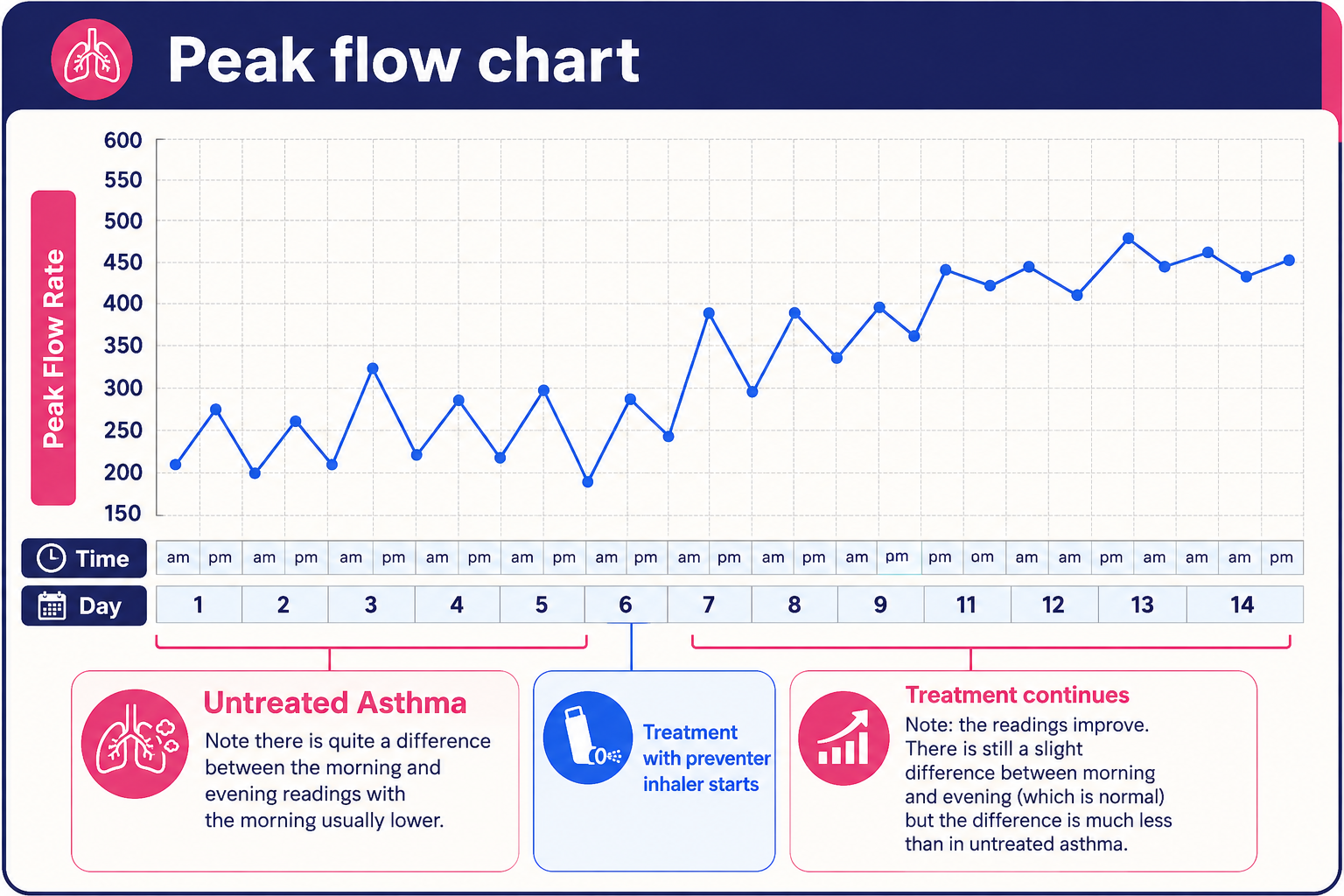
Normally, in healthy people, peak flow readings vary slightly from time to time. The reading is often slightly higher in the evening compared with the morning.
Peak flow graph
What are peak flow meters used for?
To help diagnose asthma
If you have untreated Asthma:
Your peak flow readings will usually be low. No matter how strong you are, if your airways are narrowed, your peak flow will be lower than expected for your age, size, and sex.
Your peak flow readings will tend to vary quite a lot. Typically, the readings are lower in the morning compared with the evening. This difference is much greater in people with untreated asthma than the normal small variation seen in most people.
Sometimes a doctor or nurse will give you a chart (like the one above), and ask you to keep a record of your peak flow readings for a week or so. You will normally be asked to take a 'best of three' peak flow reading each morning and evening. This information can be used to inform your asthma action plan and help doctors make decisions to alleviate asthma symptoms or prevent asthma attacks.
Sometimes a peak flow reading is done before and after you take a dose of asthma medicine to open up your airways. If the treatment causes a large improvement in your reading, this too is typical of asthma.
To monitor treatment
For some people, keeping a peak flow diary can be a good way to monitor how well their asthma is controlled.
This is particularly useful for people who otherwise find it difficult to tell if their asthma is getting worse.
Peak flow meter diary
A peak flow meter diary is a way of recording your peak flow measurements over time. A one-off reading is usually not very useful, but seeing the pattern of how your peak flow measurements change over time can be very helpful.
See the peak flow diary leaflet for an example.
Patientenauswahl für Asthma
Brust und Lungen
Asthma-Inhalatoren
Ein Inhalator ist ein Gerät, das ein Medikament enthält, das durch Einatmen (Inhalieren) aufgenommen wird. Inhalatoren sind die Hauptbehandlung für Asthma und helfen, Asthmasymptome zu kontrollieren. Es gibt viele verschiedene Arten von Inhalatoren. Dieses Merkblatt gibt Informationen über die Medikamente in Inhalatoren, die Arten von Inhalatorgeräten und einige allgemeine Informationen über Inhalatoren. Dieses Merkblatt bezieht sich nur auf Inhalatoren für Asthma. Es ist wichtig zu erkennen, dass dieselben Inhalatoren auch bei anderen medizinischen Bedingungen (zum Beispiel chronisch obstruktive Lungenerkrankung) verwendet werden können, aber dass die Art und Weise, wie sie verwendet werden, unterschiedlich sein kann.
von Dr. Doug McKechnie, MRCGP

Brust und Lungen
Sprödes Asthma
"Brittle-Asthma" ist ein älterer Begriff für eine besonders schwere Form von Asthma. Asthma ist eine sehr häufige Langzeiterkrankung, aber Brittle-Asthma ist selten.
von Dr. Doug McKechnie, MRCGP
Häufig gestellte Fragen
Wann sollte ich meinen Spitzenfluss messen?
Wenn Sie ein Peak-Flow-Meter zur Diagnose von Asthma verwenden, wird Ihr Arzt oder Ihre Krankenschwester Sie normalerweise bitten, Ihre 'Best of Three'-Peak-Flow-Messungen jeden Morgen und Abend für etwa eine Woche aufzuzeichnen. Dies hilft ihnen, das Muster Ihrer Messungen zu verstehen und Ihren Asthma-Aktionsplan zu informieren.
Was ist, wenn meine drei Peak-Flow-Messungen nicht ähnlich sind?
Wenn Sie dreimal hintereinander blasen und die Messwerte nicht ungefähr gleich sind, könnte das bedeuten, dass Sie nicht korrekt in das Gerät blasen. Häufige Fehler sind, nicht so fest wie möglich zu blasen oder die Lippen nicht richtig um das Mundstück zu schließen, sodass die gesamte Luft durch das Gerät strömt.
Warum ist das Führen eines Peak-Flow-Tagebuchs nützlich?
Ein Peak-Flow-Tagebuch hilft dabei, zu überwachen, wie gut Ihr Asthma kontrolliert wird, indem es Ihre Messungen im Laufe der Zeit verfolgt. Eine einzelne Messung ist nicht sehr aussagekräftig, aber das Erkennen von Veränderungsmustern über Tage oder Wochen kann sehr hilfreich sein, insbesondere wenn es Ihnen schwerfällt zu erkennen, ob sich Ihr Asthma verschlechtert.
Kann ein Peak-Flow-Meter zur Überwachung meiner Asthmabehandlung verwendet werden?
Ja, für manche Menschen kann das regelmäßige Aufzeichnen ihres Spitzenflusses in einem Tagebuch eine gute Möglichkeit sein, um zu überwachen, wie effektiv ihre Asthmabehandlung wirkt und ob ihr Asthma gut kontrolliert ist. Dies ist besonders hilfreich, wenn Sie Schwierigkeiten haben zu erkennen, wann sich Ihr Asthma verschlechtert.
Wie beeinflusst Asthma meine Peak-Flow-Messwerte?
Wenn Sie unbehandeltes Asthma haben, sind Ihre Peak-Flow-Werte in der Regel niedriger als erwartet für jemanden in Ihrem Alter, Ihrer Größe und Ihrem Geschlecht, aufgrund verengter Atemwege. Außerdem neigen Ihre Werte dazu, erheblich zu schwanken, oft sind sie morgens viel niedriger als abends, mehr als die kleinen Schwankungen, die bei gesunden Personen zu beobachten sind.
Weiterführende Literatur und Referenzen
- Globale Initiative für Asthma (GINA)
- Asthma: Diagnose, Überwachung und chronisches Asthmamanagement (BTS, NICE, SIGN); NICE-Richtlinie (November 2024)
- Peak-Flow; Asthma UK, 2020
Über den AutorVollständige Biografie anzeigen

Dr Doug McKechnie, MRCGP
Medizinischer Autor
MA, MBBS, MSc, DRCOG, MRCP(UK), MRCGP(2021), FHEA
Dr. Doug McKechnie ist ein NHS-Hausarzt, der in London arbeitet. Er arbeitet klinisch in Vollzeit und ist außerdem stellvertretender Leiter des Moduls für klinische und berufliche Praxis an der University College London Medical School.
Über den RezensentenVollständige Biografie anzeigen

Dr Philippa Vincent, MRCGP
Allgemeinmediziner, Medizinischer Autor
MB BS, Bsc, MRCGP (2000), DCH, DFSRH, DRCOG
Dr Philippa Vincent ist ein NHS-Arzt, der in Nordlondon arbeitet.
Artikelverlauf
Die Informationen auf dieser Seite wurden von qualifizierten Klinikern verfasst und begutachtet.
Artikel auch verfügbar in Englisch, Deutsch, Spanisch, Französisch, Italienisch, Portugiesisch, Hindi, Hebräisch, Arabisch, und Schwedisch.
Nächste Überprüfung fällig: 19. Jan 2028
20. Jan 2025 | Neueste Version

Fragen, teilen, verbinden.
Durchsuchen Sie Diskussionen, stellen Sie Fragen und teilen Sie Erfahrungen zu Hunderten von Gesundheitsthemen.

Fühlen Sie sich unwohl?
Bewerten Sie Ihre Symptome online kostenlos
Abonnieren Sie den Patienten-Newsletter
Ihre wöchentliche Dosis klarer, vertrauenswürdiger Gesundheitsberatung - geschrieben, um Ihnen zu helfen, sich informiert, selbstbewusst und in Kontrolle zu fühlen.
Durch das Abonnieren akzeptieren Sie unsere Datenschutzrichtlinie. Sie können sich jederzeit abmelden. Wir verkaufen Ihre Daten niemals.