Pilzinfektion in der Leistengegend
Tinea cruris
Begutachtet von Dr Toni Hazell, FRCGPZuletzt aktualisiert von Dr Philippa Vincent, MRCGPZuletzt aktualisiert 9 Jan 2025
Erfüllt die Anforderungen des Patienten Richtlinien des Patienten
- HerunterladenHerunterladen
- Teilen
- Language
- Diskussion
- Audio-Version
- Zu bevorzugten Quellen bei Google hinzufügen
In dieser Serie:PilzinfektionenAntimykotische MedikamenteSoor bei MännernFußpilzHefeinfektionRingelflechte
Eine Pilzinfektion der Leiste (Tinea cruris) ist eine Infektion der Haut in der Leistengegend, die durch einen Pilz verursacht wird. Es ist ein häufiges Problem, insbesondere bei Sportlern und älteren Menschen. Die Behandlung mit einer antimykotischen Creme wirkt in der Regel gut. Die unten gegebenen Tipps können helfen, Rückfälle zu verhindern.
Auf einen Blick
Tinea cruris is a fungal skin infection in the groin area.
Symptoms include itchiness, redness, and a scaly rash with a definite border.
It is sometimes called "jock itch" and is common in athletes.
Self-care includes keeping the area dry and wearing loose clothing.
Antifungal creams are often used for treatment.
See a doctor if the rash is painful, causes a fever, or does not improve after a week of treatment.
What is tinea cruris?
Tinea cruris is a fungal skin infection of the groin. Some types of fungal germs (fungi) are commonly found on human skin. These fungi usually cause no problems. However, under certain circumstances, they can multiply and cause an infection. The most common fungus causing a fungal groin infection is trichophyton rubrum.
The conditions that fungi like best are warm, moist and airless areas of skin. This includes the groin, the armpits and the area under the breasts.
Fungal skin infection is also known as intertrigo. This is a word that means "between" and "rubbing". The fungal infection is more likely to take hold because there is so much skin-to-skin contact in these areas - in the groin this is where the scrotum rubs on the skin of the thighs or the thighs rub together.
Tinea cruris in the groin is sometimes called "jock itch" because it is common in athletes. This is because the groin tends to become warm and moist during sports activities.
What does tinea cruris look like?
Fungal groin infection (tinea cruris)
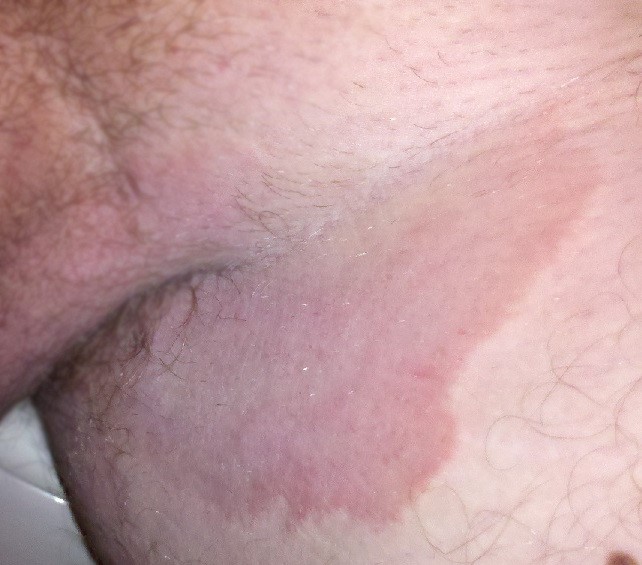
© ByRobertgascoin,via Wikimedia Commons
Jock itch
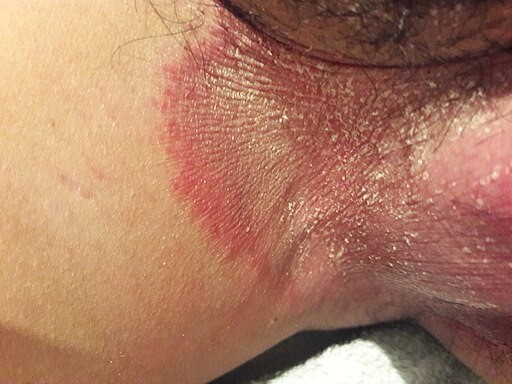
© Gerardolagunes, CC BY-SA 3.0, via Wikimedia Commons
Tinea cruris symptoms
Symptoms of tinea cruris include:
Itchiness. The groin becomes itchy and can be sore, mainly in the crease between the top of the leg and the genitals.
Scrotum. In men the scrotum may also be itchy or sore.
Redness. The skin in the groin area becomes red and slightly scaly. There is usually a definite edge or border. Both sides are commonly affected.
Spreading away from the groin. The rash often spreads a short way down the inside of both thighs.
Smell. Sometimes a musty yeasty smell is noticeable.
Sometimes the infection spreads to the skin on other parts of the body (or may have first started in another area, such as athlete's foot (tinea pedis)). Fungal infections usually remain on the skin and do not usually go deeper into the body; they are not usually serious.
Fungal groin infections are more common in men than women.
When to see a doctor about tinea cruris
Medical advice should be sought if:
The rash is painful or a fever develops.
The rash has not improved after a week or two of using a topical antifungal medicine as recommended by a pharmacist.
The rash hasn't cleared up fully after three weeks of treatment.
People with a weakened body defence (immune system), eg, diabetes or having chemotherapy, may need more treatment so should seek medical advice sooner if the rash is not improving.
Risk factors for fungal groin infection
Diabetes.
Fettleibigkeit.
A weakened immune system.
Tinea cruris diagnosis
Appearance. The diagnosis can usually be made by the features of the rash which is usually obvious.
Skin scrapings. Occasionally, if there is doubt about the diagnosis, skin scrapings can be sent to the laboratory to identify features that would indicate a fungal infection.
Hautbiopsie. If there is any concern about the diagnosis then a specialist (dermatologist) referral may be made. This would be unusual. Occasionally a skin biopsy may be required.
Tinea cruris treatment
Self-care.
Wear loose-fitting clothes made of cotton or material designed to keep moisture away from the skin.
Avoid tight-fitting clothes such as leggings.
Maintain good hygiene by washing the affected skin areas daily.
Dry thoroughly after washing, especially in the skin folds.
Avoid scratching which may spread the infection to other sites.
Do not share towels, and wash them frequently, to reduce the risk of passing on the infection to someone else.
Wash clothes and bed linen frequently to get rid of any fungal spores.
If a child is affected, it is not necessary to exclude them from school or nursery.
Topical antifungal creams. A topical antifungal cream can be used if there is mild, non-extensive disease. Options include:
Treatment with a topical antifungal cream may be repeated in the future if there are recurrent episodes of mild, non-extensive disease. An antifungal powder can be used (eg, miconazole) but creams are recommended as being more effective.
Steroid cream. A mildly-potent topical corticosteroid can be used in addition to a topical antifungal cream if there is associated marked inflammation, eg, hydrocortisone 1% cream, applied once daily for a maximum of 7 days. A topical corticosteroid preparation should not be used alone as it can make the fungal infection worse.
Oral antifungal treatment. For severe or extensive disease, adults can be prescribed oral antifungal treatment, such as:
Oral itraconazole oder oral griseofulvin can be used if terbinafine cannot be used or causes any side effects.
A child with severe or extensive disease would be referred to a specialist (paediatric dermatologist).
Tinea cruris outcome
Tinea cruris usually clears up in 1 to 3 weeks with treatment, including antifungal creams. However, for people who are particularly susceptible, such as athletes and those who sweat a lot, recurrences are common and the problem may become long term (chronic).
Preventing recurrent tinea cruris
To prevent any recurring tinea cruris (fungal groin infection) self-care should be used, as outlined in the treatment above:
Wash the groin daily; then dry thoroughly. Drying is the most important part of this. It is very important to delay putting on underwear until the groin is fully dry. The damp groin is then an ideal site for fungi to multiply. A hairdryer is very useful to dry the area if the groin is more hairy or difficult to dry. However, ensure that the hairdryer is not too hot.
Change underwear daily. Fungi may multiply in flakes of skin in unwashed underwear.
Check for athlete's foot (tinea pedis) and treat it if present. Athlete's foot is a common fungal infection of the toes. In a typical case of athlete's foot, the skin between the toes is itchy and flaky - especially between the outer two toes. The fungi from athlete's foot may spread to the groin. The same creams are used to treat athlete's foot and tinea cruris.
Do not share towels with people in communal changing rooms. Wash towels frequently.
Do not share towels if suffering from tinea cruris.
Patientenauswahl für Pilzinfektionen

Infektionen
Pilzinfektionen der Lunge
Ein Pilz ist eine winzige Art von Keim, die normalerweise keine Probleme verursacht. Sie sind überall um uns herum: Man kann sie nur mit einem Mikroskop sehen. Aber in manchen Situationen, insbesondere wenn Sie andere schwere Krankheiten haben, können Pilze (der Plural von Pilz) Ihre Lunge infizieren. Das kann sehr ernst sein und erfordert fachkundige Behandlung.
von Dr. Colin Tidy, MRCGP

Infektionen
Soor bei Männern
Soor ist eine häufige Infektion, die durch einen Pilz namens Candida verursacht wird. Candida lebt normalerweise in kleinen Mengen auf unserer Haut, ohne Probleme zu verursachen. Manchmal kann es jedoch zu Infektionen kommen. Candida-Infektionen können viele Körpersysteme betreffen, verursachen jedoch am häufigsten Probleme im Genitalbereich, im Mund (Mundsoor) oder auf der Haut. Soor bei Männern ist ziemlich häufig, obwohl Frauen eher Soor bekommen als Männer. Soor ist in der Regel eine milde Infektion, die sich mit Behandlung schnell bessert.
von Dr. Hayley Willacy, FRCGP
Häufig gestellte Fragen
Can I use hydrocortisone cream alone to treat tinea cruris?
No, a topical corticosteroid preparation like hydrocortisone 1% cream should not be used alone to treat tinea cruris, as it can worsen the fungal infection. It should only be used in addition to a topical antifungal cream, and for a maximum of 7 days, if there is significant inflammation.
How long does it typically take for tinea cruris to clear up with treatment?
With appropriate treatment, including antifungal creams, tinea cruris usually clears up within 1 to 3 weeks. However, for individuals who are particularly prone to it, such as athletes or those who sweat a lot, recurrences are common.
Is tinea cruris more common in men or women?
Fungal groin infections, or tinea cruris, are more common in men than in women.
What should I do if the infection keeps coming back?
If you experience recurrent tinea cruris, it's important to consistently follow self-care measures. This includes washing the groin daily and drying thoroughly, changing underwear daily, checking for and treating athlete's foot, and avoiding sharing towels. If recurrences are persistent, medical advice may be helpful.
Should children with tinea cruris be kept home from school or nursery?
No, if a child is affected by tinea cruris, it is not necessary to exclude them from school or nursery.
Weiterführende Literatur und Referenzen
- Pilzinfektionen der Haut; DermNet NZ
- Pilzinfektion der Haut - Körper und Leiste; NICE CKS, Juli 2023 (nur für UK-Zugang)
- Tinea corporis (body), cruris (groin) and incognito (steroid exacerbated); Gesellschaft für Dermatologie in der Primärversorgung.
Über den AutorVollständige Biografie anzeigen

Dr Philippa Vincent, MRCGP
Allgemeinmediziner, Medizinischer Autor
MB BS, Bsc, MRCGP (2000), DCH, DFSRH, DRCOG
Dr Philippa Vincent ist ein NHS-Arzt, der in Nordlondon arbeitet.
Über den RezensentenVollständige Biografie anzeigen

Dr Toni Hazell, FRCGP
MBBS, BSc, FRCGP, DFSRH, Dip GU med, DRCOG, DCH (London, UK, 2000)
Dr. Toni Hazell hat ihren Abschluss an der St. Mary’s Hospital Medical School gemacht und ihr VTS am Northwick Park Hospital absolviert.
Artikelverlauf
Die Informationen auf dieser Seite wurden von qualifizierten Klinikern verfasst und begutachtet.
Artikel auch verfügbar in Englisch, Deutsch, Spanisch, Französisch, Italienisch, Portugiesisch, Hindi, Hebräisch, Arabisch, und Schwedisch.
Next review due: 8 Jan 2028
9 Jan 2025 | Neueste Version

Fragen, teilen, verbinden.
Durchsuchen Sie Diskussionen, stellen Sie Fragen und teilen Sie Erfahrungen zu Hunderten von Gesundheitsthemen.

Fühlen Sie sich unwohl?
Bewerten Sie Ihre Symptome online kostenlos
Abonnieren Sie den Patienten-Newsletter
Ihre wöchentliche Dosis klarer, vertrauenswürdiger Gesundheitsberatung - geschrieben, um Ihnen zu helfen, sich informiert, selbstbewusst und in Kontrolle zu fühlen.
Durch das Abonnieren akzeptieren Sie unsere Datenschutzrichtlinie. Sie können sich jederzeit abmelden. Wir verkaufen Ihre Daten niemals.