Alex Mitchell on comedy, disability - and why he won’t be labelled inspirational
Peer reviewed by Dr Colin Tidy, MRCGPAuthored by Victoria RawOriginally published 10 May 2026
Meets Patient’s editorial guidelines
- DownloadDownload
- Share
- Language
- Discussion
- Audio Version
- Add to preferred sources on Google
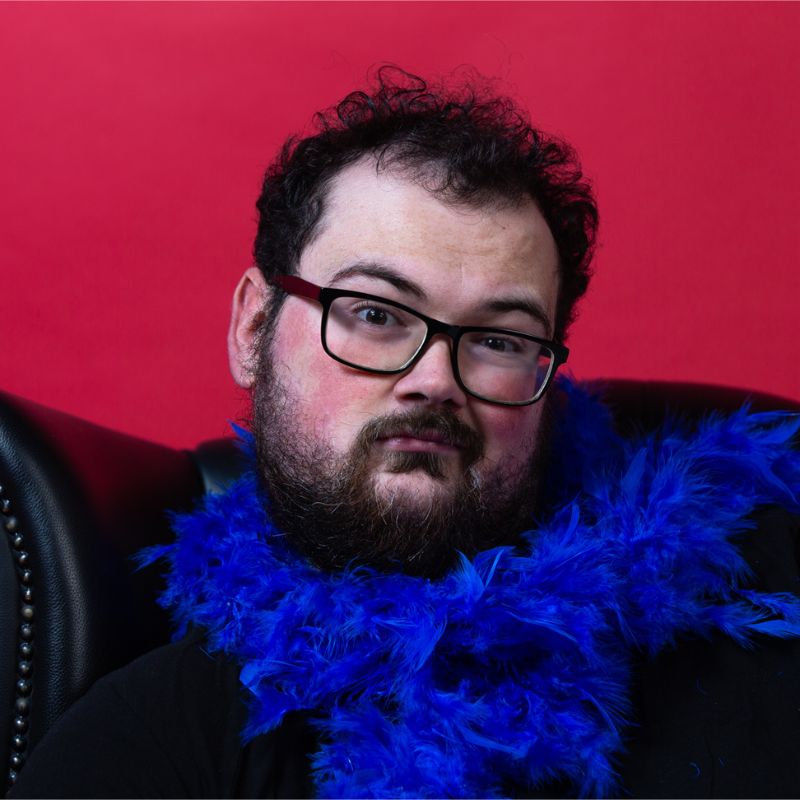
Alex Mitchell is a stand-up comedian who you may recognise from ITV’s Britain’s Got Talent, where he first earned widespread recognition in 2024. Since then, he’s been carving out his place across the comedy circuit while also hosting his own podcast.
Alex identifies as queer, is autistic, and in 2021 was diagnosed with functional neurological disorder (FND), a condition that affects communication between his brain and nervous system. As he explains, this gives him a distinctive voice in mainstream stand-up, though he is careful not to let it define him.
I spoke with Alex about his health, how he navigates his condition through stand-up, and his desire not to be seen as an 'inspiration' because of his disability - but simply as a person doing what he loves.
Living with functional neurological disorder (FND)
FND is commonly described as an issue with the brain’s ‘programming’ rather than its physical structure. This means the difficulty comes from how the brain and nervous system function, rather than from any structural damage.
FND can affect nearly every part of the body, causing a wide range of physical and behavioural challenges.
Alex says his symptoms began in 2021, starting with functional tics. He experiences involuntary movements and sounds, and also has a stammer. In addition, he has a postural tremor that causes regular shaking, along with constant headaches, recurring migraines, blackouts, and - most recently - balance issues that require the use of a walking aid.
There are treatments that can help reduce the effects of FND, but because its cause is still unknown, there is currently no cure. For Alex, despite taking multiple medicines and facing challenges at work, he has reached a stage where he accepts - and even embraces - his condition.
“Every day is a new day with FND, and every day I have to learn something new about my body and my brain,” he says. “It can be very difficult, but I try and use it as an opportunity to learn more about my body and how it works - both physically and mentally.
“It's taken me a long time to accept that. But I’m now at a stage where I'm like - this is who I am, and this is where I'm going. I've got to learn to live with this and still enjoy my life because otherwise what's the point?”
Alex Mitchell
Navigating stand-up comedy with FND
When Alex first started his career in stand-up comedy, he felt he needed to address the fact that he had FND, as it wasn’t possible to mask his disability. Inevitably, features such as his tics and stammer drew attention from people who would naturally have questions.
“I grew up with autism, and quickly developed an ability to mask my autistic symptoms,” he recalls. “FND, however, is a lot harder to mask. People would be looking at you like, ‘What’s going on here? Is this some awful character act?!’”
Looking back, Alex acknowledges that much of his anxiety about people’s reactions stemmed from his own internalised pressure, rather than from anything he actually experienced from audiences or promoters.
He now references his FND far less, noting that his condition is not the most interesting thing about him.
“I've got many more opinions and views on the world that aren't dominated by disability,” he explains. “We're living in a space right now where there are a lot of disabled comedians coming through into the mainstream, which is incredibly exciting.
"But I think the best comics are not just funny - they also have something to say.”
Alex is keen to emphasise that the moment you reclaim your identity - regardless of your disability - and accept your condition, it can become a truly empowering experience.
“It takes a long time to get there. In my case, people might be a little bit surprised for a second, but actually, no one’s viewing me any differently,” he says. “For me, it’s always been about getting out there and pushing myself.
“I wasn’t going to let my condition stop me from doing stand-up - which is what I love most in the world.”
Seeing people beyond their disability
Before becoming a full-time comedian, Alex worked as a primary school teacher, during which time he was first diagnosed with FND. Early on, one of his biggest concerns was how he would be perceived. He soon realised, however, that his fear was more about how his colleagues saw him than how the children he taught experienced him.
“When the children saw my disability for the first time, they showed an initial interest - which is not a bad thing," he explains. "Adults tend to pretend the disability isn’t there, that I don’t even exist.
“What was great about the kids was that they'd ask me a question about it. I’d give them an answer, and then we’d just move on. They were much more interested in me as a person rather than why I was making unusual noises.”
Alex explains that this innocent curiosity is something we should continue to value as adults. He hopes that by doing so, we can start undoing years of being taught to see disabled people as ‘different’ and become more comfortable engaging with them instead.
Why disabled people shouldn’t be automatically seen as inspirational
Alex finds it frustrating that people with disabilities are often perceived as somehow separate from society, or that their condition defines them as anything other than 'normal'. He also rejects the idea of being labelled inspirational simply because he has a disability.
He highlights the London 2012 Paralympic Games as a particularly influential moment in shaping this perspective.
“I was 12 when the Paralympics came to London, and it changed a lot of perceptions about disability,” he says. “The atmosphere was positive, but in a kind of negative way - because the athletes were celebrated as amazing and inspiring, when really they should just be seen as normal people.”
Alex emphasises that he wants his disability to be acknowledged, but only as a starting point - so he can move on and leave it behind, much like the children he taught did. He also objects to disabled people in the media being labelled as inspiring, explaining that, in his words, “it’s setting the bar low for what inspiring is.”
“I don’t want to be labelled as inspiring,” he says. “I just enjoy making myself laugh and making other people laugh. I've not done anything incredible. Everything I have done has been for my own career.
“There’s this perception that all disabled people can only be one of two things - inspiring or miserable. Why can’t we be somewhere in the middle? I want to be able to have a spectrum of emotions just like everyone else.”
Living without the pressure to be perfect
With the rise of social media, more people than ever have the chance to showcase themselves to the world. As a result, many of us feel an underlying pressure to be the best version of ourselves. We all experience this to some degree, but for people with disabilities, it can also take the form of an expectation to be 'inspirational', even when they are simply living as normal people, just like everyone else.
To stress this point, Alex outlines his typical daily routines, stressing that they are far from inspirational.
“I wake up in the morning, unload my dishwasher, I put the bins out, I bring the bins back in - I live that normal life,” he says. “I’ll do a bit of writing, I’ll record an episode of my podcast, I’ll do an acting audition, I’ll write an article, I’ll do an interview like this. I’ll then go out and perform in the evening, and then I’ll come back - that’s my life. I work, I eat, I sleep, all while making some weird noises and shaking a little bit.
“We all live these lives, and there’s no need to label them as normal or not normal, or anything else. When it comes to my comedy, I want to be seen just like any of the other comics in the green room. Obviously, I need some adaptations so I can perform, but beyond that, I just want to have a chat and get on with the work.”
Looking ahead in comedy and life
Whenever Alex is asked about his future career plans, the conversation often turns to what he will do for the disabled community - whether through charity, advocacy, or awareness work. While he embraces the chance to make a difference, he sees his influence as extending far beyond that.
For him, it’s less about leading a single community and more about empowering people in general, showing that support, opportunity, and even 'inspiration' aren’t limited to any one group.
“If you've got a platform, you should use it for good,” he says. “But I also think about what’s empowering for myself more than anyone else - I'm just going to keep working as hard as I can at the thing I love most in the world.
“If people see that and view it as inspiring, then that’s an added positive, but don’t assume that everything I do is to inspire other people. If it does do that, then that’s great. But that’s not the reason I do it.”
Patient picks for Nerves
Brain and nerves
What you need to know about FND
Functional neurological disorder (FND) is a condition that affects the communication between your brain and nervous system. When this communication doesn’t work as it should, it can cause a range of symptoms across your body that affects how you move, feel, or function. There’s still a lot of misunderstanding around FND - including how it’s diagnosed, treated, and the way symptoms show up. It’s also sometimes confused with other neurological conditions, such as Tourette syndrome (TS). We asked an expert to explain the condition more clearly, including the signs to look out for and how to get help.
by Victoria Raw

Brain and nerves
Simple advice could improve long-term health for people with MS
Multiple sclerosis (MS) has been getting more attention lately, especially with Christina Applegate speaking out about her experience in the news. Yet a new survey by Overcoming MS shows that many people living with MS are still unaware of how powerful lifestyle changes can be in managing their condition.
by Victoria Raw
Frequently asked questions
What is the primary difference between FND and other neurological conditions?
FND is distinguished because it involves a problem with how the brain and nervous system function, rather than any physical damage or structural issues within the brain. It's more about the 'software' of the brain than its 'hardware'.
Are there any specific treatments available that can help manage FND symptoms?
While there is currently no cure for FND, there are various treatments available that aim to help reduce its effects and manage symptoms. The article indicates that these treatments can be beneficial in improving a person's living experience with the condition.
How does FND affect daily life and work for someone like Alex?
For Alex, FND significantly impacts physical and mental aspects of his life. He experiences involuntary movements, speech difficulties, tremors, headaches, and balance issues requiring a walking aid. These symptoms affect his work, but he has learned to adapt and continues his career in stand-up comedy.
How can I, as a non-disabled person, interact respectfully with someone who has FND or another disability?
The article suggests treating individuals with FND or other disabilities as normal people. It highlights that children often approach disability with an innocent curiosity, ask questions, receive an answer, and then move on, focusing on the person rather than their condition. Adults are encouraged to adopt a similar open and curious approach, rather than pretending the disability isn't there.
What common misconceptions do people have about individuals with disabilities?
A common misconception is that people with disabilities are either 'inspiring' or 'miserable'. The article argues against this limited view, explaining that disabled individuals, like anyone else, have a full spectrum of emotions and lead normal, everyday lives, which should not be automatically labelled as inspirational.
About the authorView full bio

Victoria Raw
Feature Writer
BA (Hons), English Literature
Victoria is a content writer at Patient, with special interests spanning mental wellbeing, societal trends and the impact of technology on our health.
About the reviewerView full bio

Dr Colin Tidy, MRCGP
General Practitioner, Medical Author
MBBS, MRCGP, MRCP (Paediatrics), DCH
Dr Colin Tidy is an NHS Doctor, based in Oxfordshire.
Article history
The information on this page is peer reviewed by qualified clinicians.
Article also available in English, German, Spanish, French, Italian, Portuguese, Hindi, Hebrew, Arabic, and Swedish.
Next review due: 10 May 2029
10 May 2026 | Originally published
Authored by:
Victoria RawPeer reviewed by
Dr Colin Tidy, MRCGP
Join the conversation
Share your thoughts or experiences with others in our patient communities.

Ask, share, connect.
Browse discussions, ask questions, and share experiences across hundreds of health topics.

Feeling unwell?
Assess your symptoms online for free
Sign up to the Patient newsletter
Your weekly dose of clear, trustworthy health advice - written to help you feel informed, confident and in control.
By subscribing you accept our Privacy Policy. You can unsubscribe at any time. We never sell your data.
More in brain and nerves
- Blood test could predict Alzheimer's 20 years before symptoms
- Brain training apps: do they really work?
- Can a plant-based diet improve your migraines?
- Can diet affect your ADHD?
- Causes of peripheral neuropathy: from diabetes to vaccines
- Common causes of shooting pain
- Experts reveal how a healthy lifestyle can reduce your risk of dementia
- High blood pressure in mid-30s could shrink your brain
- Home remedy relief for common headaches
- How diet can reduce your risk of stroke and heart attack
- How does diet affect dementia?
- How to support someone with dementia
- Is the vagus nerve the key to our mental health?
- Popcorn brain: what it is, why it happens, and how to reset your focus
- Prostate cancer drug could slow down Parkinson's disease
- What are the different types of dementia?
- What is the link between Parkinson's disease and dementia?
- What is the link between stroke recovery and gut health?
- What you need to know about Bell's palsy
- Young-onset dementia is linked to health and lifestyle, as well as genetics