Chromosome 21
Zuletzt aktualisiert 17. März 2023
Erfüllt die redaktionelle Richtlinien
- HerunterladenHerunterladen
- Teilen
- Language
- Diskussion
- Ask Patient
- Audio-Version
- Zu bevorzugten Quellen bei Google hinzufügen
Humans normally have 46 chromosomes in each cell, divided into 23 pairs. Two copies of chromosome 21, one copy inherited from each parent, form one of the pairs. Chromosome 21 is the smallest human chromosome, spanning about 48 million base pairs (the building blocks of DNA) and representing 1.5 to 2 percent of the total DNA in cells.
Videoauswahl für Chromosomes and mitochondrial DNAVideothek
Beschreibung
Humans normally have 46 chromosomes in each cell, divided into 23 pairs. Two copies of chromosome 21, one copy inherited from each parent, form one of the pairs. Chromosome 21 is the smallest human chromosome, spanning about 48 million base pairs (the building blocks of DNA) and representing 1.5 to 2 percent of the total DNA in cells.
In 2000, researchers working on the Human Genome Project announced that they had determined the sequence of base pairs that make up this chromosome. Chromosome 21 was the second human chromosome to be fully sequenced.
Identifying genes on each chromosome is an active area of genetic research. Because researchers use different approaches to predict the number of genes on each chromosome, the estimated number of genes varies. Chromosome 21 likely contains 200 to 300 genes that provide instructions for making proteins. These proteins perform a variety of different roles in the body.
Conditions referring to this gene or chromosome
Related patient information and medicines

Patient information leaflet
Down-Syndrom-Screening
There are two different types of tests that can be done to look for Down's syndrome during pregnancy - a screening test and a diagnostic test. What is Down's syndrome. Down's syndrome is a genetic chromosome problem that some people are born with. Someone with Down's syndrome has an extra copy of chromosome 21 in the cells of their body. This is.

Patient information leaflet
Down-Syndrom
Down's syndrome (also known as Down syndrome) is a genet... Someone with Down's syndrome has an extra copy of chromosome 21 in the cells of their body. Down's syndrome down syndrome Types of Down's syndrome Someone with Down's syndrome has an extra copy of chromosome number 21 in the cells of their body. They have one normal chromosome 21, one.
Patient information leaflet
Amniozentese
The most common reason for a pregnant woman to be offered amniocentesis is to see if a developing baby has a chromosomal disorder such as Down's syndrome. Amniocentesis is a procedure that is carried out during pregnancy. The most common reason for a pregnant woman to be offered amniocentesis is to see if their developing baby has a chromosom....
Patient information leaflet
Chorionzottenbiopsie
Chorionic villus sampling (CVS) is a procedure that is carried out during pregnancy to diagnose or exclude various chromosomal or genetic conditions. Usually the reason is to see if the developing baby has a chromosomal disorder such as Down's syndrome or a genetic disorder. A common reason for a pregnant woman to be offered CVS is to see if her.

Patient information leaflet
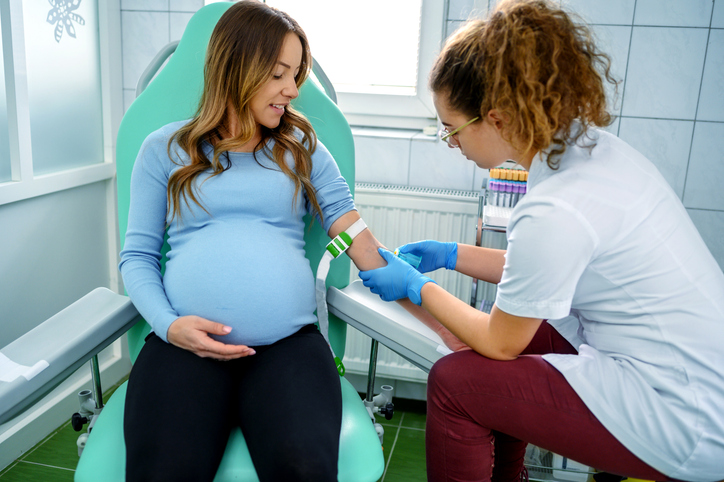
Genetische Tests
Genetic testing is a type of medical test that identifies changes in chromosomes, genes or proteins. Note : the information below is a general guide only. It can identify changes in the number of chromosomes ( for example, Down's syndrome Down's syndrome in which there is an extra chromosome number 21). Fluorescent in situ hybridisation (FISH).
Patient information leaflet
Schwangerschaftsscreening-Tests
The conditions which are checked for are: Down's syndrome, also called trisomy 21. Down's syndrome Down's syndrome Down's syndrome is a genetic chromosomal problem that some people are born with. Someone with Down's syndrome has an extra copy of chromosome number 21 in the cells of their body. Edwards' and Patau's syndrome Babies with Edwards'.
Weiterführende Lektüre und Referenzen
- Chromosome 21; MedlinePlus, National Library of Medicine.
- Ait Yahya-Graison E, Aubert J, Dauphinot L, Rivals I, Prieur M, Golfier G, Rossier J, Personnaz L, Creau N, Blehaut H, Robin S, Delabar JM, Potier MC. Classification of human chromosome 21 gene-expression variations in Down syndrome: impact on disease phenotypes. Am J Hum Genet. 2007 Sep;81(3):475-91. doi: 10.1086/520000. Epub 2007 Jul 19.
- Antonarakis SE, Lyle R, Dermitzakis ET, Reymond A, Deutsch S. Chromosome 21 and down syndrome: from genomics to pathophysiology. Nat Rev Genet. 2004 Oct;5(10):725-38. doi: 10.1038/nrg1448.
- Antonarakis SE, Lyle R, Deutsch S, Reymond A. Chromosome 21: a small land of fascinating disorders with unknown pathophysiology. Int J Dev Biol. 2002 Jan;46(1):89-96.
- Antonarakis SE. Chromosome 21: from sequence to applications. Curr Opin Genet Dev. 2001 Jun;11(3):241-6. doi: 10.1016/s0959-437x(00)00185-4.
- Ensembl Human Map View: Chromosome 21
- Gardiner K, Costa AC. The proteins of human chromosome 21. Am J Med Genet C Semin Med Genet. 2006 Aug 15;142C(3):196-205. doi: 10.1002/ajmg.c.30098.
- Gardiner K, Davisson M. The sequence of human chromosome 21 and implications for research into Down syndrome. Genome Biol. 2000;1(2):REVIEWS0002. doi: 10.1186/gb-2000-1-2-reviews0002. Epub 2000 Aug 4.
- Gilbert F. Disease genes and chromosomes: disease maps of the human genome. Chromosome 21. Genet Test. 1997-1998;1(4):301-6. doi: 10.1089/gte.1997.1.301. No abstract available.
- Hattori M, Fujiyama A, Taylor TD, Watanabe H, Yada T, Park HS, Toyoda A, Ishii K, Totoki Y, Choi DK, Groner Y, Soeda E, Ohki M, Takagi T, Sakaki Y, Taudien S, Blechschmidt K, Polley A, Menzel U, Delabar J, Kumpf K, Lehmann R, Patterson D, Reichwald K, Rump A, Schillhabel M, Schudy A, Zimmermann W, Rosenthal A, Kudoh J, Schibuya K, Kawasaki K, Asakawa S, Shintani A, Sasaki T, Nagamine K, Mitsuyama S, Antonarakis SE, Minoshima S, Shimizu N, Nordsiek G, Hornischer K, Brant P, Scharfe M, Schon O, Desario A, Reichelt J, Kauer G, Blocker H, Ramser J, Beck A, Klages S, Hennig S, Riesselmann L, Dagand E, Haaf T, Wehrmeyer S, Borzym K, Gardiner K, Nizetic D, Francis F, Lehrach H, Reinhardt R, Yaspo ML; Chromosome 21 mapping and sequencing consortium. The DNA sequence of human chromosome 21. Nature. 2000 May 18;405(6784):311-9. doi: 10.1038/35012518.
- Lam K, Zhang DE. RUNX1 and RUNX1-ETO: roles in hematopoiesis and leukemogenesis. Front Biosci (Landmark Ed). 2012 Jan 1;17(3):1120-39. doi: 10.2741/3977.
- Licht JD. AML1 and the AML1-ETO fusion protein in the pathogenesis of t(8;21) AML. Oncogene. 2001 Sep 10;20(40):5660-79. doi: 10.1038/sj.onc.1204593. No abstract available.
- Lubec G, Engidawork E. The brain in Down syndrome (TRISOMY 21). J Neurol. 2002 Oct;249(10):1347-56. doi: 10.1007/s00415-002-0799-9.
- Sawinska M, Ladon D. Mechanism, detection and clinical significance of the reciprocal translocation t(12;21)(p12;q22) in the children suffering from acute lymphoblastic leukaemia. Leuk Res. 2004 Jan;28(1):35-42. doi: 10.1016/s0145-2126(03)00160-7.
- UCSC Genome Browser: Statistics
- Valero R, Marfany G, Gil-Benso R, Ibanez MA, Lopez-Pajares I, Prieto F, Rullan G, Sarret E, Gonzalez-Duarte R. Molecular characterisation of partial chromosome 21 aneuploidies by fluorescent PCR. J Med Genet. 1999 Sep;36(9):694-9.
Artikelverlauf
Artikel auch verfügbar in Englisch, Deutsch, Spanisch, Französisch, Italienisch, Portugiesisch, Hindi, Hebräisch, Arabisch, und Schwedisch.
17. März 2023 | Neueste Version
1 Nov 2013 | Ursprünglich veröffentlicht
Teilen Sie Ihre Gedanken oder Erfahrungen mit anderen in unserem Patientengemeinschaften.
Einfacher Zugang zu vertrauenswürdigen Behandlungen und Gesundheitsdiensten online.
Common conditions
Get help with common conditions through the NHS, without a GP appointment.





Abonnieren Sie den Patienten-Newsletter
Ihre wöchentliche Dosis klarer, vertrauenswürdiger Gesundheitsberatung - geschrieben, um Ihnen zu helfen, sich informiert, selbstbewusst und in Kontrolle zu fühlen.
Durch das Abonnieren akzeptieren Sie unsere Datenschutzrichtlinie. Sie können sich jederzeit abmelden. Wir verkaufen Ihre Daten niemals.