Chorionzottenbiopsie
CVS
Begutachtet von Dr Jacqueline Payne, FRCGPZuletzt aktualisiert von Dr Mary Harding, MRCGPZuletzt aktualisiert 14 Dec 2016
Erfüllt die redaktionelle Richtlinien
- HerunterladenHerunterladen
- Teilen
- Language
- Diskussion
- Audio-Version
- Zu bevorzugten Quellen bei Google hinzufügen
Hinweis zum Inhalt
Diese Seite wurde in letzter Zeit nicht überprüft. Daher haben sich möglicherweise einige Informationen oder externe Links geändert.
Chorionic villus sampling (CVS) is a procedure that is carried out during pregnancy to diagnose or exclude various chromosomal or genetic conditions.
Auf einen Blick
Die Chorionzottenbiopsie (CVS) ist ein Test, der in der frühen Schwangerschaft durchgeführt wird.
Es überprüft, ob ein Baby bestimmte chromosomale oder genetische Bedingungen wie das Down-Syndrom hat.
Eine kleine Gewebeprobe wird in der Regel durch den Bauch aus der Plazenta entnommen.
CVS wird angeboten, wenn ein erhöhtes Risiko besteht, dass Ihr Baby eine Erkrankung hat.
Ergebnisse liegen in der Regel nach einigen Tagen für Schnelltests oder länger für detaillierte genetische Untersuchungen vor.
Es besteht ein geringes zusätzliches Risiko einer Fehlgeburt bei CVS.
Suchen Sie ärztlichen Rat bei starken Schmerzen, anhaltenden Blutungen oder Fieber nach dem Eingriff.
Melden Sie sich für unseren kostenlosen 8-wöchigen Kurs zur gesunden Schwangerschaft an!
Jede Woche teilen wir nützliche Informationen und wichtige Tipps zu Themen wie Ernährung, Bewegung, psychische Gesundheit, Symptome, auf die Sie achten sollten, und Vorbereitung auf die Geburt, um Ihnen zu helfen, Ihre Schwangerschaftsreise in jeder Phase zu meistern.
Durch das Abonnieren akzeptieren Sie unsere Datenschutzrichtlinie. Sie können sich jederzeit abmelden. Wir verkaufen Ihre Daten niemals.
Chorionic villus sampling (CVS) is a procedure that is carried out during early pregnancy. Usually the reason is to see if the developing baby has a chromosomal disorder such as Down's syndrome or a genetic disorder. It is not a standard test done in pregnancy, but is usually offered to women in whom screening tests suggest there may be a higher chance of a baby with Down's syndrome.
A note about DNA, genes and chromosomes
In most cells of your body you have 46 chromosomes arranged in 23 pairs. 22 of the pairs are matching pairs. The 23rd pair is the sex chromosomes, which match exactly in women (who have two X chromosomes) but not in men (who have one X and one Y). One chromosome from each pair comes from your mother and one from your father. Chromosomes are made of DNA, which stands for 'deoxyribonucleic acid'. This is your genetic material. It is found in the nucleus of every cell in your body.
Each of your 46 chromosomes carries hundreds of genes. A gene is the basic unit of your genetic material. It is made up of a piece (sequence) of DNA and sits at a particular place on a chromosome. So, a gene is a small section of a chromosome. A gene is effectively a coded set of instructions to the cells. Each gene has a particular function in your body. For example, a gene may be involved in dictating your eye colour or determining your height. Each gene has a matching 'paired' gene on the paired chromosome. So, as for chromosomes, one gene from each pair is inherited from your mother, the other from your father. Humans have between 20,000 and 25,000 genes.
What is chorionic villus sampling?
Chorionic villus sampling (CVS) is a procedure that is carried out during pregnancy to diagnose or exclude various chromosomal or genetic conditions in your unborn developing baby. A very small sample of tissue is taken from a part of the developing afterbirth (placenta), called chorionic villi. The cells of the chorionic villi contain the exact same genetic material (chromosomes and DNA) as the cells of your developing baby. So, tests can be done on the sample in the laboratory to look at the genetic makeup of your developing baby.
CVS is usually carried out by passing a fine needle through the skin of your tummy (abdomen) and into your womb (uterus) to take the sample of the afterbirth (placenta). This is known as transabdominal CVS. Sometimes, because of the position of your womb or the position of your afterbirth, transabdominal CVS may not be possible. CVS can also be performed by passing a fine plastic tube or biopsy forceps through the neck of your womb (your cervix). This is known as transcervical CVS.
CVS is a diagnostic test. In most cases it tells you for certain whether or not your baby has a particular condition. Compare this with a screening test in pregnancy (for example, blood tests and/or ultrasound screening tests for Down's syndrome). Screening tests give you a risk estimate (that is, they tell you whether it is likely oder unlikely) that the baby has a certain condition. They do not give you a definite 'yes' or 'no' answer. If you have a screening test that shows a high risk of a certain condition, you will usually be offered a diagnostic test.
An alternative diagnostic test to CVS is amniocentesis. Briefly, amniocentesis involves taking a sample of the fluid that surrounds your developing baby inside your womb (uterus). This fluid contains the baby's cells and so examination of the fluid allows genetic testing of the baby. Amniocentesis is carried out after 15 weeks of pregnancy. Read more about amniocentesis.
The advantage of CVS over amniocentesis is that CVS can be carried out earlier in pregnancy. This means that decisions about what you would like to happen with your pregnancy can be made sooner. However, there is a slightly higher risk of complications such as miscarriage with CVS (see below).
Why are pregnant women offered chorionic villus sampling?
CVS is not carried out as a routine test in pregnancy. It is offered if you are thought to have an increased chance of having a baby with a certain condition. It is generally only offered to pregnant women who have a higher-than-average likelihood of a particular condition.
You do not have to have CVS if offered. It is a choice that you can make. You should discuss the test fully with your doctor, including the potential risks or complications, before you decide whether or not to go ahead.
A common reason for a pregnant woman to be offered CVS is to see if her developing baby has a chromosomal disorder such as Down's syndrome. Someone with Down's syndrome has an extra copy of chromosome number 21 in the cells of their body. See separate leaflet called Down's Syndrome for more details.
A screening test for Down's syndrome is offered to all pregnant women in the UK. If this screening test shows a higher risk result, you may be offered CVS.
Other reasons why CVS may be offered during pregnancy include:
If you have previously had a baby with a chromosomal or genetic condition.
If you have, or your partner has, a genetic disorder, or are carriers for a genetic disorder that could be passed on to the baby. Examples include Sichelzellanämie, Thalassämie, zystische Fibrose oder Duchenne-Muskeldystrophie.
If there is a history of certain genetic conditions in your family.
If other tests during pregnancy (for example, scans) have raised the possibility that the baby has a chromosomal disorder such as Down's syndrome.
It is thought that about 5 in every 100 pregnant women are offered a prenatal diagnostic test such as amniocentesis or CVS. Amniocentesis is the most common prenatal diagnostic test that is offered to pregnant women.
At what stage of pregnancy is chorionic villus sampling offered?
CVS is usually carried out between the beginning of the 11th and the end of the 13th week of pregnancy - most commonly between the 11th and 12th weeks of pregnancy.
Early CVS is CVS that is carried out before 10 weeks. This is not routinely done because there may be an increased risk of complications (see below). Also, CVS is technically difficult at this stage of pregnancy because the womb (uterus) is still small and the afterbirth (placenta) is still quite thin and delicate.
How is chorionic villus sampling carried out?
The doctor carrying out the procedure will decide whether transabdominal or transcervical CVS is best in your situation. This will depend on the position of your womb (uterus) and the position of your afterbirth (placenta). For most women CVS is done transabdominally.
If you have not already been tested for HIV und Hepatitis B, you will be offered this testing before CVS. You may also be offered testing for Hepatitis C. This is so that if you do have one of these infections, the risk of you passing it on to the baby during CVS can be kept to a minimum.
You may prefer to have some support during the procedure. If you feel comfortable about this, consider asking your partner, a friend or a family member to accompany you. The whole procedure will probably take about 10 minutes but your appointment will usually last longer than this because you will need some time to rest afterwards.
Transabdominal CVS
During the procedure itself, first you can expect to have ist eine Ultraschalluntersuchung similar to other scans during pregnancy. For this, gel is put on the skin of your tummy (abdomen) and the ultrasound probe is passed over the skin of your tummy. This is to check the position of the baby and the placenta, and to identify the best place to take a sample of placental tissue.
Transabdominal CVS is carried out under 'continuous ultrasound guidance'. This means that throughout the procedure, the doctor performing the CVS holds the ultrasound probe on the skin of your tummy. This allows them to see an ultrasound picture continuously and to keep a close eye on your uterus, your baby and the position of the needle used to take the sample.
You may be given a local anaesthetic to numb an area of the skin of your tummy. Once the best position is identified, the skin of your tummy is then cleaned. A fine needle is passed through your skin, into your womb and into the placenta. A syringe attached to the end of the needle allows a sample of tissue from the placenta to be sucked (drawn) up into the syringe. An ultrasound scan is usually carried out after CVS has been taken to check your baby.
Transcervical CVS
You will first have an ultrasound scan to check your baby and to look at your placenta. Transcervical CVS is also carried out under 'continuous ultrasound guidance'.
A speculum (the same instrument that is used when you have a cervical smear test) is inserted into your vagina. This enables the doctor to see the neck of your womb (your cervix). They will then clean the inside of your vagina and your cervix with an antiseptic cleansing solution. A fine tube or some fine biopsy forceps are then passed through the neck of your womb, into your womb so that a sample of the placenta can be taken. As before, an ultrasound scan is usually carried out after CVS to check your baby.
What tests are carried out on the placental tissue?
There are two main tests that can be done to look at the baby's chromosomes. The first is called a rapid test. It can look for the chromosomal disorders Down's syndrome, Edward's syndrome and Patau's syndrome. Sometimes it can detect sex chromosome disorders such as Turner syndrome. This test usually gives results within three days. The results are very accurate.
The second test is called a chromosomal microarray test. This looks at all of the baby's chromosomes in detail. It can detect other chromosomal disorders and abnormal genes, and is ordered if other conditions than those above are suspected. It takes longer to get the results of this test, usually two to three weeks. Sometimes only a rapid test is carried out. Your doctor or midwife will discuss with you which tests are best in your situation.
Occasionally, the chromosome test results are uncertain. If this is the case, you may be offered a repeat CVS or an amniocentesis. However, this is rare and in most cases, definite results are possible. There is also a very small chance that the test results for the rapid test are normal but that the chromosomal microarray test shows up a problem. Very rarely, a woman's full chromosomal microarray result may be reported as normal but she will still have a baby born with a chromosomal disorder or other problem. This is because some changes in chromosomes may be so small that they are very difficult to see. CVS cannot exclude all possible disorders.
Also, it should be understood that the chromosome result does not provide information about the physical development of your baby. The fetal anomaly ultrasound scan that is done at around 18-20 weeks of pregnancy can help to look for these physical problems. However, it is also not possible for this scan to show up all abnormalities.
You should ask your doctor or midwife to explain how long it will take for the results of your CVS. You should also ask them how you will receive the results. For example, you may be given another appointment or sometimes results are given by telephone.
Are there any complications of chorionic villus sampling?
Most women who have CVS during pregnancy have no complications. However, CVS does carry some risks of complications. You need to balance the small risk of complications against having the extra information about the baby and their genetic makeup. Complications can include the following.
Fehlgeburt
Es gibt ein small risk of miscarriage with every pregnancy, whether or not you have CVS or amniocentesis. This is the background risk of having a miscarriage. However, for women who have had CVS, there is an additional (or 'extra') risk that they will have a miscarriage.
For women who have had CVS it used to be thought that there was about a 3 in 200 additional, or extra, risk that they will have a miscarriage. (Out of 200 women who have CVS, three will have a miscarriage that they would not otherwise have had and four will miscarry whether or not they have a CVS.) Recent research suggests the risk is actually much lower than this. This might be because the way that the procedure is carried out is safer than it used to be. The additional risk of miscarriage after CVS is slightly higher than that after an amniocentesis.
The reason for this slightly higher risk of miscarriage after CVS compared with amniocentesis may be because CVS is carried out earlier in pregnancy. (There is a greater risk of having a miscarriage earlier in pregnancy regardless of whether you have CVS/amniocentesis or not.)
Another factor is that CVS is usually carried out because of suspected problems with the developing baby. These problems, if present, may in themselves increase the risk of miscarriage compared to an unaffected pregnancy.
Most miscarriages happen within two weeks of having CVS. A miscarriage after three weeks is less likely. It is not certain why there is a small chance that CVS can lead to a miscarriage. It may be that it is caused by infection, bleeding, or rupture of the amniotic membranes (the bag/sac containing the amniotic fluid that surrounds the baby) caused by the procedure.
Ask your doctor what the miscarriage rate is for CVS in the unit where you will be treated. The chance of miscarriage may be slightly lower if CVS is carried out by someone who is very experienced at the procedure.
Infektion
Infection can, rarely, occur after CVS. Less than 1 in 1,000 women who have CVS will develop a serious infection. Infection can be caused by a number of things - for example, in transabdominal CVS:
By injury to your bowel with the needle used so that germs that are normally contained inside the bowel escape.
By germs that are present on the skin of your tummy (abdomen) travelling along the track of the needle into your tummy or womb (uterus).
By germs that are present on the ultrasound probe or in the ultrasound gel travelling along the track of the needle into your tummy or womb.
And after transcervical CVS, infection may be possible if germs enter with the biopsy forceps or fine tube that is passed through the neck of your womb (your cervix).
Symptoms of infection can include high temperature (fever), tenderness of your tummy and contractions of your womb.
Limb abnormalities in the developing baby
Back in the 1990s concern was raised after a small study reported that five babies had limb abnormalities such as missing fingers and toes after their mother had CVS. However, in all cases CVS was carried out before 10 completed weeks of pregnancy. Later studies showed that the risks of such problems after CVS were no higher than the risk in the general population (ie in those pregnancies where the woman had not had CVS).
Even so, CVS before 10 completed weeks of pregnancy is now not recommended. This is also because of the fact that CVS is more difficult to carry out at this stage of pregnancy.
Rhesus disease in the developing baby
If your blood group is rhesus negative and the baby's blood group is rhesus positive, there is a risk that you may develop small proteins called antibodies against the baby's blood cells after CVS. These antibodies can attack the red blood cells of the baby, a condition called rhesus disease. So, if you are rhesus negative, you will be advised to have an injection with anti-D immunoglobulin after CVS so as to help to prevent this.
How can I expect to feel after chorionic villus sampling?
The procedure itself can be a little painful. Many women describe the discomfort as being a bit like period pain. Some describe having a transcervical CVS as feeling a bit like having a cervical smear test.
It is best if you can arrange for someone to drive you home after the CVS if possible. You should also take things easy over the subsequent few days but total bed rest is not necessary. Some mild, period-like cramping tummy (abdominal) pains with some light spotting of blood from your vagina can be normal immediately after CVS. Paracetamol can be taken to help the pain.
However, if you develop any of the following, you need to seek medical advice immediately, as they may be signs of complications:
Starke Bauchschmerzen.
Contractions.
Persistent back pain.
Continuous bleeding from your vagina.
A watery fluid loss from your vagina.
A smelly discharge from your vagina.
Eine hohe Temperatur (Fieber).
Grippeähnliche Symptome.
What are my choices if the results are abnormal?
Deciding to have CVS can be a very difficult decision and a very anxious time. However, most women who have a CVS will have a normal result. (That is, the baby won't have the genetic problem that the test was looking for.) However, before you go through CVS, it is important for you to think through carefully what difference an abnormal test result would make to you. How would it be likely to affect your decision about whether or not to continue with the pregnancy?
Once you know the results, and if the results show a problem, you need to make a decision about what is best for you and your baby. This decision may be very difficult to make. You may find it helpful to talk things through with:
Your GP.
Your midwife.
A doctor who specialises in pregnancy and childbirth (an obstetrician).
A doctor who specialises in the medical care of children (a paediatrician).
A genetic specialist.
An advisor (a counsellor).
You may also wish to talk things through with your partner or family.
If you feel this is the right decision for you, there is time to have an abortion after a CVS shows an abnormality. An advantage of CVS is that you usually get the results earlier in the pregnancy. The type of abortion you are offered depends on how many weeks pregnant you are when you decide to end the pregnancy. Since CVS is performed so early then, if this is your choice, it is likely that you will just need a simple surgical procedure to end the pregnancy, and will not need to have your labour induced. If you have an amniocentesis (which is done later in pregnancy) and choose to end the pregnancy, this may mean an induced labour. However, in either case, the type of abortion will depend on how many weeks pregnant you are when you decide to end the pregnancy. You should discuss this with your doctor or midwife.
Equally, if the results of CVS show a problem, you may choose to continue with the pregnancy. With the knowledge of the results, you can start to prepare for the birth and care of your baby, who is likely to have special needs. Your baby may need special care or surgical care immediately after they are born. Prior knowledge that your baby has a certain condition means that you can plan to give birth in a hospital where all the appropriate facilities are available.
In rare situations, CVS may show that the baby has a condition that is treatable. Occasionally, there may be the possibility that treatment can be given while the baby is still in your womb (uterus).
Dr. Mary Lowth ist eine Autorin oder die ursprüngliche Autorin dieses Merkblatts.
Patientenauswahl für Screening-Tests
Tests und Untersuchungen
Schwangerschaftsscreening-Tests
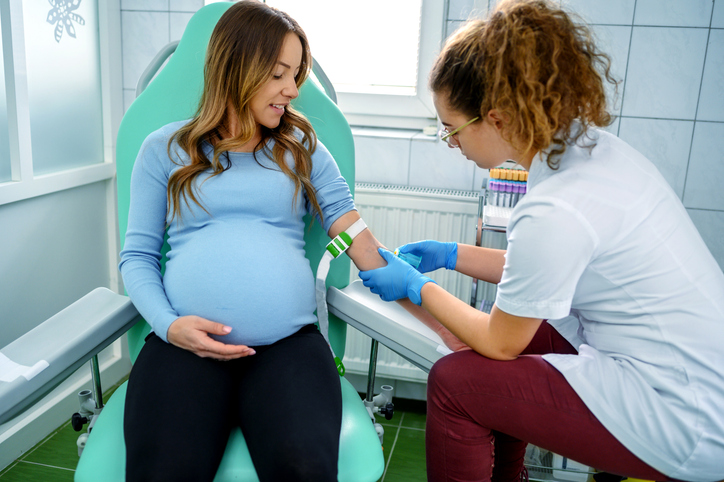
Dieses Informationsblatt behandelt die routinemäßigen Schwangerschafts-Screening-Tests (Vorsorgeuntersuchungen), die allen schwangeren Frauen im Vereinigten Königreich angeboten werden sollten. Dabei handelt es sich um Screening- und Diagnosetests, die durchgeführt werden, um festzustellen, ob Ihr Baby vor der Geburt gesundheitliche Probleme hat. Nach der Geburt Ihres Babys werden separate Neugeborenen-Screening-Tests angeboten.
von Dr. Rosalyn Adleman, MRCGP
Tests und Untersuchungen
Gebärmutterhalsuntersuchung
A note on terminology - cervical screening is available to those of the female sex, and this leaflet will therefore use the words woman/women and the pronouns she/her. The information also applies to those whose gender identity is not the same as their biological sex, as long as they have not had their cervix surgically removed. Cervical screening tests (smear tests) are available to women aged 25-64 years in the UK. The tests are done to prevent cervical cancer by finding abnormalities that can, with relatively simple treatments, be prevented from progressing to cervical cancer. Cervical screening tests are not used to diagnose cancer.
von Dr. Toni Hazell, FRCGP
Häufig gestellte Fragen
Wie wahrscheinlich ist es, CVS zu benötigen?
CVS wird nicht als routinemäßiger Test durchgeführt. Es wird angeboten, wenn ein erhöhtes Risiko besteht, dass das Baby eine bestimmte Erkrankung hat, was eine überdurchschnittliche Wahrscheinlichkeit bedeutet. Etwa 5 von 100 schwangeren Frauen wird ein pränataler Diagnosetest wie CVS oder Amniozentese angeboten, wobei die Amniozentese die häufigere der beiden ist.
Werde ich die Wahl haben, ob ich CVS in Anspruch nehme, wenn es angeboten wird?
Ja, Sie müssen CVS nicht in Anspruch nehmen, wenn es angeboten wird. Es ist ganz Ihre Entscheidung. Es ist wichtig, den Test ausführlich mit Ihrem Arzt zu besprechen, einschließlich potenzieller Risiken oder Komplikationen, bevor Sie eine Entscheidung treffen.
Was ist der erwartete Zeitrahmen für den Erhalt der CVS-Ergebnisse?
Es gibt zwei Haupttests, die am Plazentagewebe durchgeführt werden. Ein Schnelltest sucht nach Down-Syndrom, Edwards-Syndrom und Pätau-Syndrom, mit Ergebnissen, die normalerweise innerhalb von drei Tagen verfügbar sind. Ein chromosomaler Mikroarray-Test, der alle Chromosomen im Detail untersucht, dauert länger, normalerweise zwei bis drei Wochen. Sie sollten Ihren Arzt oder Ihre Hebamme fragen, wie lange Ihre spezifischen Ergebnisse dauern werden und wie Sie informiert werden.
Was soll ich tun, wenn ich nach CVS Schmerzen oder andere Symptome habe?
Ein leichtes, menstruationsähnliches Ziehen und leichte Blutungen aus der Scheide können unmittelbar nach CVS normal sein. Paracetamol kann bei diesen Schmerzen helfen. Sie sollten jedoch sofort einen Arzt aufsuchen, wenn Sie starke Bauchschmerzen, Wehen, anhaltende Rückenschmerzen, kontinuierliche vaginale Blutungen, wässrigen Flüssigkeitsverlust aus der Scheide, übelriechenden vaginalen Ausfluss, hohes Fieber oder grippeähnliche Symptome haben, da dies Anzeichen für Komplikationen sein könnten.
Kann CVS Informationen über die körperliche Entwicklung meines Babys bereitstellen?
Die Ergebnisse des Chromosomentests aus der Chorionzottenbiopsie (CVS) liefern keine Informationen über die körperliche Entwicklung Ihres Babys. Der fetale Anomalie-Ultraschall, der typischerweise in der 18. bis 20. Schwangerschaftswoche durchgeführt wird, kann helfen, nach körperlichen Problemen zu suchen, obwohl er auch nicht alle Anomalien zeigen kann.
Was passiert, wenn ich mich entscheide, die Schwangerschaft nach einem auffälligen CVS-Ergebnis fortzusetzen?
Wenn die CVS-Ergebnisse ein Problem zeigen und Sie sich entscheiden, die Schwangerschaft fortzusetzen, können Sie dieses Wissen nutzen, um sich auf die Geburt und die Pflege Ihres Babys vorzubereiten, das möglicherweise besondere Bedürfnisse hat. Vorheriges Wissen über einen Zustand ermöglicht es Ihnen, die Geburt in einem Krankenhaus mit den entsprechenden Einrichtungen zu planen und sicherzustellen, dass Ihr Baby unmittelbar nach der Geburt die notwendige spezielle oder chirurgische Versorgung erhält.
Weiterführende Lektüre und Referenzen
- Amniozentese und Chorionzottenbiopsie; Royal College of Obstetricians and Gynaecologists (Juni 2010 - aktualisiert Oktober 2021)
- Schwangerschaftsvorsorge für unkomplizierte Schwangerschaften; NICE Klinische Leitlinie (März 2008 - aktualisiert Februar 2019)
- Routinemäßige pränatale Anti-D-Prophylaxe für Frauen, die rhesus D negativ sind; NICE Technologie-Bewertungsleitlinie, August 2008
- The UK NSC recommendation on Down's syndrome screening in pregnancy
- Bevölkerungs-Screening-Programme (England); GOV.UK
- Fetal anomaly screening: programme overview; GOV.UK
- Ogilvie C, Akolekar R; Schwangerschaftsverlust nach Amniozentese oder CVS-Probenentnahme - Zeit für eine Neubewertung des Risikos. J Clin Med. 2014 Jul 8;3(3):741-6. doi: 10.3390/jcm3030741.
- Zolotor AJ, Carlough MC; Update on prenatal care. Am Fam Physician. 2014 Feb 1;89(3):199-208.
- Antenatal Screening Wales; Öffentliche Gesundheit Wales
- Antenatal Screening; Health and Social Care Northern Ireland
Über den AutorVollständige Biografie anzeigen
Aktualisiert von

Dr Mary Harding, MRCGP
Allgemeinmediziner, Medizinischer Autor
BA, MA, MB, BChir, MRCGP, DFFP
Dr. Mary Harding schloss 1989 ihr Medizinstudium an der Universität Cambridge ab.
Über den RezensentenVollständige Biografie anzeigen

Dr Jacqueline Payne, FRCGP
Allgemeinmediziner, Medizinischer Autor
MB, BS, DFFP, DRCOG, FRCGP
Jacqueline war 25 Jahre lang Hausärztin in Kendal, Cumbria, wo sie junge Hausärzte für das RCGP ausbildete und als Ausbilderin für das FSRH tätig war.
Artikelverlauf
Artikel auch verfügbar in Englisch, Deutsch, Spanisch, Französisch, Italienisch, Portugiesisch, Hindi, Hebräisch, Arabisch, und Schwedisch.
14 Dec 2016 | Neueste Version
Nehmen Sie an der Diskussion teil
Teilen Sie Ihre Gedanken oder Erfahrungen mit anderen in unserem Patientengemeinschaften.

Fragen, teilen, verbinden.
Durchsuchen Sie Diskussionen, stellen Sie Fragen und teilen Sie Erfahrungen zu Hunderten von Gesundheitsthemen.

Fühlen Sie sich unwohl?
Bewerten Sie Ihre Symptome online kostenlos
Abonnieren Sie den Patienten-Newsletter
Ihre wöchentliche Dosis klarer, vertrauenswürdiger Gesundheitsberatung - geschrieben, um Ihnen zu helfen, sich informiert, selbstbewusst und in Kontrolle zu fühlen.
Durch das Abonnieren akzeptieren Sie unsere Datenschutzrichtlinie. Sie können sich jederzeit abmelden. Wir verkaufen Ihre Daten niemals.