Hereditary angiopathy with nephropathy, aneurysms, and muscle cramps syndrome
Zuletzt aktualisiert 21. März 2023
Erfüllt die redaktionelle Richtlinien
- HerunterladenHerunterladen
- Teilen
- Language
- Diskussion
- Audio-Version
- Zu bevorzugten Quellen bei Google hinzufügen
Hereditary angiopathy with nephropathy, aneurysms, and muscle cramps (HANAC) syndrome is part of a group of conditions called the COL4A1-related disorders. The conditions in this group have a range of signs and symptoms that involve fragile blood vessels. HANAC syndrome is characterised by angiopathy, which is a disorder of the blood vessels. In people with HANAC syndrome, angiopathy affects several parts of the body. The blood vessels as well as thin sheet-like structures called basement membranes that separate and support cells are weakened and more susceptible to breakage.
Beschreibung
Hereditary angiopathy with nephropathy, aneurysms, and muscle cramps (HANAC) syndrome is part of a group of conditions called the COL4A1-related disorders. The conditions in this group have a range of signs and symptoms that involve fragile blood vessels. HANAC syndrome is characterised by angiopathy, which is a disorder of the blood vessels. In people with HANAC syndrome, angiopathy affects several parts of the body. The blood vessels as well as thin sheet-like structures called basement membranes that separate and support cells are weakened and more susceptible to breakage.
People with HANAC syndrome develop kidney disease (nephropathy). Fragile or damaged blood vessels or basement membranes in the kidneys can lead to blood in the urine (hematuria). Cysts can also form in one or both kidneys, and the cysts may grow larger over time.
Compared to other COL4A1-related disorders, the brain is only mildly affected in HANAC syndrome. People with this condition may have a bulge in one or multiple blood vessels in the brain (intracranial aneurysms). These aneurysms have the potential to burst, causing bleeding within the brain (hemorrhagic stroke). However, in people with HANAC syndrome, these aneurysms typically do not burst. About half of people with this condition also have leukoencephalopathy, which is a change in a type of brain tissue called white matter that can be seen with magnetic resonance imaging (MRI).
Muscle cramps experienced by most people with HANAC syndrome typically begin in early childhood. Any muscle may be affected, and cramps usually last from a few seconds to a few minutes, although in some cases they can last for several hours. Muscle cramps can be spontaneous or triggered by exercise.
Individuals with HANAC syndrome also experience a variety of eye problems. All individuals with this condition have arteries that twist and turn abnormally within the light-sensitive tissue at the back of the eyes (arterial retinal tortuosity). This blood vessel abnormality can cause episodes of bleeding within the eyes following any minor trauma to the eyes, leading to temporary vision loss. Other eye problems associated with HANAC syndrome include a clouding of the lens of the eye (cataract) and an abnormality called Axenfeld-Rieger anomaly. Axenfeld-Rieger anomaly is associated with various other eye abnormalities, including underdevelopment and eventual tearing of the colored part of the eye (iris), and a pupil that is not in the center of the eye.
Rarely, affected individuals will have a condition called Raynaud phenomenon in which the blood vessels in the fingers and toes temporarily narrow, restricting blood flow to the fingertips and the ends of the toes. As a result, the skin around the affected area may turn white or blue for a brief period of time and the area may tingle or throb. Raynaud phenomenon is typically triggered by changes in temperature and usually causes no long term damage.
Inheritance patterns
The source lists the following possible inheritance patterns: Autosomal dominant. More than one pattern can apply in different cases.
Related genes
Other names
Autosomal dominant familial hematuria, retinal arteriolar tortuosity, contractures
HANAC
HANAC syndrome
Hereditary angiopathy with nephropathy, aneurysm, and muscle cramps syndrome
Related patient information and medicines

Patient information leaflet
Nephrotisches Syndrom
Nephrotic syndrome is a condition where the 'filters' in the kidney become 'leaky' and large amounts of protein leak from the blood into the urine. Nephrotic syndrome is not a single disease - it is a syndrome. For example, membranoproliferative glomerulonephritis, mesangial proliferative glomerulonephritis, fibrillary glomerulosclerosis, diffuse.
Patient information leaflet
Bauchaortenaneurysma
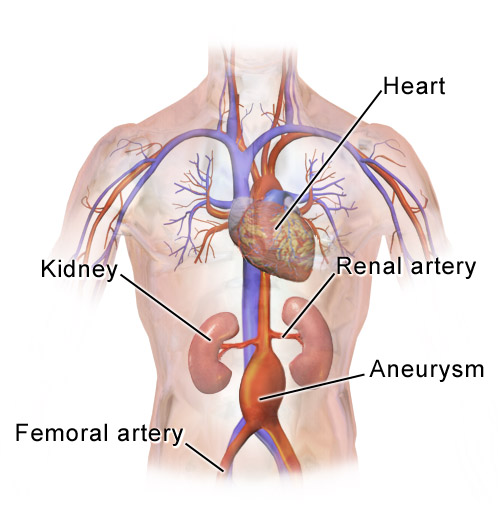
This is called an abdominal aortic aneurysm (often abbreviated to AAA, pronounced 'triple-A'). This also means that people with triple-As are likely to have atherosclerosis affecting other arteries, a... Rarer causes Rare causes of triple-As include: Genetic connective tissue disorders that affect the structure of blood vessels, such as Marfan's.

Patient information leaflet
Beinkrämpfe
Leg cramps are common and most common in the calf muscles. They can occur in any muscle group. The cause is not known in most cases. However, some medications and diseases can cause leg cramps. Lack of fluid in the body (dehydration). Conditions that cause alterations in the balance of salts in the bloodstream (such as a high or low sodium or.

Patient information leaflet
Marfan-Syndrom
Marfan-Syndrom (named after Dr Antoine Marfan, the French doctor who first described it in 1896) is a genetic disorder which people are born with and which lasts lifelong. If you have Marfan syndrome, you have a problem with the connective tissue in your body. In Marfan syndrom... Marfan-Syndrom can affect the connective tissue in different.

Patient information leaflet
Ehlers-Danlos-Syndrom
The Ehlers-Danlos syndromes (EDS) are a group of conditions that affect the stretchiness and strength of supporting tissues in the body, including skin, joints, blood vessels and internal organs. Some people with EDS h... In the rare vascular type of EDS, serious complications involving Blut vessels can develop, including Aneurysmen und blood.

Patient information leaflet
IgA-Nephropathie
IgA-Nephropathie is a condition in which a protein causes damage to the kidneys. The protein is called immunoglobulin A or IgA. Nephropathy means an illness that damages the kidney. The main job of the kidneys is to clear waste materials from the body and maintain a normal balance of fluids and chemicals in the body. The kidneys also have other.
Weiterführende Lektüre und Referenzen
- Hereditary angiopathy with nephropathy, aneurysms, and muscle cramps syndrome; MedlinePlus, National Library of Medicine.
- Alamowitch S, Plaisier E, Favrole P, Prost C, Chen Z, Van Agtmael T, Marro B, Ronco P. Cerebrovascular disease related to COL4A1 mutations in HANAC syndrome. Neurology. 2009 Dec 1;73(22):1873-82. doi: 10.1212/WNL.0b013e3181c3fd12.
- Plaisier E, Chen Z, Gekeler F, Benhassine S, Dahan K, Marro B, Alamowitch S, Paques M, Ronco P. Novel COL4A1 mutations associated with HANAC syndrome: a role for the triple helical CB3[IV] domain. Am J Med Genet A. 2010 Oct;152A(10):2550-5. doi: 10.1002/ajmg.a.33659.
- Vahedi K, Alamowitch S. Clinical spectrum of type IV collagen (COL4A1) mutations: a novel genetic multisystem disease. Curr Opin Neurol. 2011 Feb;24(1):63-8. doi: 10.1097/WCO.0b013e32834232c6.
Artikelverlauf
Artikel auch verfügbar in Englisch, Deutsch, Spanisch, Französisch, Italienisch, Portugiesisch, Hindi, Hebräisch, Arabisch, und Schwedisch.
21. März 2023 | Neueste Version
1 Sept 2011 | Ursprünglich veröffentlicht
Nehmen Sie an der Diskussion teil
Teilen Sie Ihre Gedanken oder Erfahrungen mit anderen in unserem Patientengemeinschaften.

Fragen, teilen, verbinden.
Durchsuchen Sie Diskussionen, stellen Sie Fragen und teilen Sie Erfahrungen zu Hunderten von Gesundheitsthemen.
Abonnieren Sie den Patienten-Newsletter
Ihre wöchentliche Dosis klarer, vertrauenswürdiger Gesundheitsberatung - geschrieben, um Ihnen zu helfen, sich informiert, selbstbewusst und in Kontrolle zu fühlen.
Durch das Abonnieren akzeptieren Sie unsere Datenschutzrichtlinie. Sie können sich jederzeit abmelden. Wir verkaufen Ihre Daten niemals.