Autosomal dominant vitreoretinochoroidopathy
Zuletzt aktualisiert 24. Nov 2021
Erfüllt die redaktionelle Richtlinien
- HerunterladenHerunterladen
- Teilen
- Language
- Diskussion
- Audio-Version
- Zu bevorzugten Quellen bei Google hinzufügen
Autosomal dominant vitreoretinochoroidopathy (ADVIRC) is a disorder that affects several parts of the eyes, including the clear gel that fills the eye (the vitreous), the light-sensitive tissue that lines the back of the eye (the retina), and the network of blood vessels within the retina (the choroid). The eye abnormalities in ADVIRC can lead to varying degrees of vision impairment, from mild reduction to complete loss, although some people with the condition have normal vision.
Beschreibung
Autosomal dominant vitreoretinochoroidopathy (ADVIRC) is a disorder that affects several parts of the eyes, including the clear gel that fills the eye (the vitreous), the light-sensitive tissue that lines the back of the eye (the retina), and the network of blood vessels within the retina (the choroid). The eye abnormalities in ADVIRC can lead to varying degrees of vision impairment, from mild reduction to complete loss, although some people with the condition have normal vision.
The signs and symptoms of ADVIRC vary, even among members of the same family. Many affected individuals have microcornea, in which the clear front covering of the eye (cornea) is small and abnormally curved. The area behind the cornea can also be abnormally small, which is described as a shallow anterior chamber. Individuals with ADVIRC can develop increased pressure in the eyes (glaucoma) or clouding of the lens of the eye (cataract). In addition, some people have breakdown (degeneration) of the vitreous or the choroid.
A characteristic feature of ADVIRC, visible with a special eye exam, is a circular band of excess coloring (hyperpigmentation) in the retina. This feature can help physicians diagnose the disorder. Affected individuals may also have white spots on the retina.
Inheritance patterns
The source lists the following possible inheritance patterns: Autosomal dominant. More than one pattern can apply in different cases.
Related genes
Other names
ADVIRC
Vitreoretinochoroidopathy dominant
Vitreoretinochoroidopathy with microcornea, glaucoma, and cataract
Vitreoretinochoroidopathy, autosomal dominant, with nanophthalmos
Related patient information and medicines

Patient information leaflet
Marfan-Syndrom
It affects people of all ethnicities equally. It is the most common genetic problem affecting connective tissue. It is an autosomal dominant condition, meaning you only need one parent, not both, to have it to inherit it yourself. You can inherit Marfan s... It is known as an autosomal dominant disorder - this means only one of your parents needs.

Patient information leaflet
Ehlers-Danlos-Syndrom
The Ehlers Danlos syndromes (EDS) are a group of conditions which are usually (although not always) inherited from parents. These can be inherited via autosomal-dominanter Erbgang (for hypermobile, classical and venous EDS) which means one in two children will be affected on average, or autosomal recessive inheritance (for kyphoscoliotic EDS).

Patient information leaflet
Huntington-Krankheit
Huntington's disease affects between 11 - 14 people per 100,000 in the UK, the rest of Europe and North America. Worldwide, it seems to be more common amongst w... Huntington-Krankheit ist caused by a defective gene that Sie inherit from your parents. Huntington-Krankheit ist an autosomal dominant condition, meaning you can inherit the disease from.

Patient information leaflet
Porphyrie
Der porphyrias are a group of disorders in which there is a problem with the production of haem (also spelled heme) within the body. Haem is used to make haemoglobin in red blood cells. In these ... Most types of inherited porphyria are passed on in families through what is called autosomal dominant inheritance. Briefly, this means that if you.

Patient information leaflet
Albinismus
Albinismus is a rare inherited (genetic) condition which reduces the amount of of melanin pigment in the skin, hair and/or eyes. People with albinism are often pale, with light-coloured irises. However, there are many types of albinism and people can be a... How is albinism inherited. The genes for occulocutaneous albinism (OCA) are located on.
Patient information leaflet
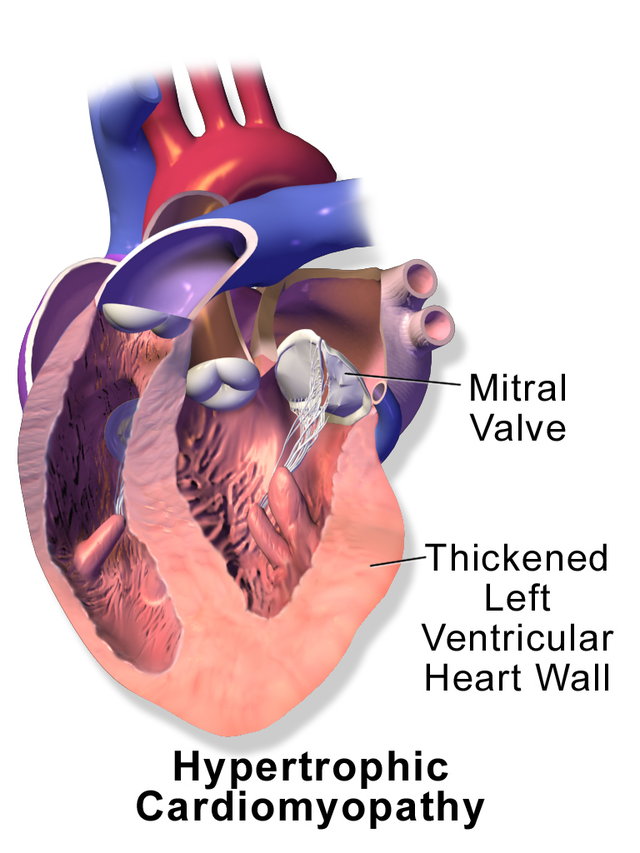
Hypertrophe Kardiomyopathie
Verwirrung hypertrophe Kardiomyopathie Arztpraxis heart muscle becomes thickened (hypertrophies) in parts of the heart. In the normal heart, the muscle cells are regular and patterned. Genetics In most cases the condition is inherited. If a couple (where one person has HCM) has a child, there is a 1 in 2 chance of the child being affected. This pattern of.
Weiterführende Lektüre und Referenzen
- Autosomal dominant vitreoretinochoroidopathy; MedlinePlus, National Library of Medicine.
- Burgess R, MacLaren RE, Davidson AE, Urquhart JE, Holder GE, Robson AG, Moore AT, Keefe RO, Black GC, Manson FD. ADVIRC is caused by distinct mutations in BEST1 that alter pre-mRNA splicing. J Med Genet. 2009 Sep;46(9):620-5. doi: 10.1136/jmg.2008.059881. Epub 2008 Jul 8.
- Vincent A, McAlister C, Vandenhoven C, Heon E. BEST1-related autosomal dominant vitreoretinochoroidopathy: a degenerative disease with a range of developmental ocular anomalies. Eye (Lond). 2011 Jan;25(1):113-8. doi: 10.1038/eye.2010.165. Epub 2010 Nov 12.
- Yardley J, Leroy BP, Hart-Holden N, Lafaut BA, Loeys B, Messiaen LM, Perveen R, Reddy MA, Bhattacharya SS, Traboulsi E, Baralle D, De Laey JJ, Puech B, Kestelyn P, Moore AT, Manson FD, Black GC. Mutations of VMD2 splicing regulators cause nanophthalmos and autosomal dominant vitreoretinochoroidopathy (ADVIRC). Invest Ophthalmol Vis Sci. 2004 Oct;45(10):3683-9. doi: 10.1167/iovs.04-0550.
Artikelverlauf
Artikel auch verfügbar in Englisch, Deutsch, Spanisch, Französisch, Italienisch, Portugiesisch, Hindi, Hebräisch, Arabisch, und Schwedisch.
24. Nov 2021 | Neueste Version
1 Nov 2014 | Ursprünglich veröffentlicht
Nehmen Sie an der Diskussion teil
Teilen Sie Ihre Gedanken oder Erfahrungen mit anderen in unserem Patientengemeinschaften.

Fragen, teilen, verbinden.
Durchsuchen Sie Diskussionen, stellen Sie Fragen und teilen Sie Erfahrungen zu Hunderten von Gesundheitsthemen.
Abonnieren Sie den Patienten-Newsletter
Ihre wöchentliche Dosis klarer, vertrauenswürdiger Gesundheitsberatung - geschrieben, um Ihnen zu helfen, sich informiert, selbstbewusst und in Kontrolle zu fühlen.
Durch das Abonnieren akzeptieren Sie unsere Datenschutzrichtlinie. Sie können sich jederzeit abmelden. Wir verkaufen Ihre Daten niemals.