matrix metallopeptidase 20
Zuletzt aktualisiert 3 Dec 2025
Erfüllt die redaktionelle Richtlinien
- HerunterladenHerunterladen
- Teilen
- Language
- Diskussion
- Audio-Version
- Zu bevorzugten Quellen bei Google hinzufügen
Der MMP20 gene provides instructions for making a protein called enamelysin, which is essential for normal tooth development. Enamelysin is involved in the formation of enamel, which is the hard, white material that forms the protective outer layer of each tooth. Enamel is composed mainly of mineral crystals. These microscopic crystals are arranged in organized bundles that give enamel its strength and durability.
Normal function
Der MMP20 gene provides instructions for making a protein called enamelysin, which is essential for normal tooth development. Enamelysin is involved in the formation of enamel, which is the hard, white material that forms the protective outer layer of each tooth. Enamel is composed mainly of mineral crystals. These microscopic crystals are arranged in organized bundles that give enamel its strength and durability.
Certain proteins are needed to shape and organize the crystals as they form, but these proteins must be removed for enamel to harden normally. Enamelysin cuts (cleaves) other proteins involved in enamel formation, such as amelogenin and ameloblastin, into smaller pieces. Cleavage of these proteins makes them easier to remove when they are no longer needed.
Conditions referring to this gene or chromosome
Other names
enamel metalloproteinase
matrix metallopeptidase 20 (enamelysin)
matrix metalloproteinase 20
MMP-20
MMP20_HUMAN
Related patient information and medicines
Patient information leaflet
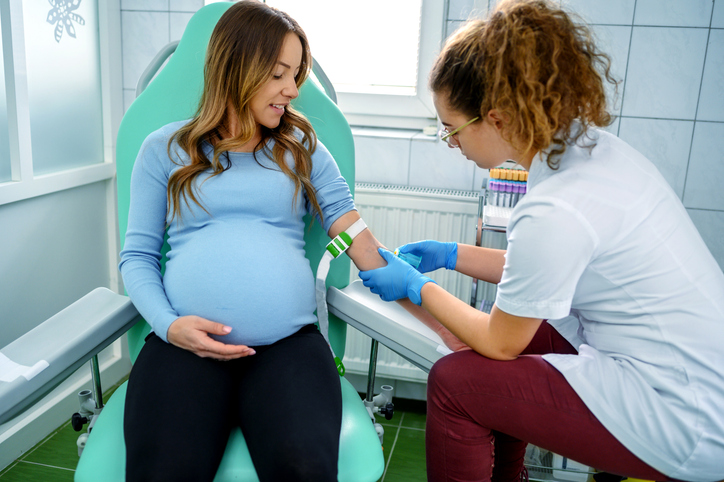
Schwangerschaftsscreening-Tests
Early on in the Schwangerschaft your doctor or midwife will check dein weight and height. This is to see if you are significantly underweight or overweight which may increase the risk of developing problems during pregnancy. Assessing the growth of the baby. This is done by a midwife or doctor during routine antenatal checks. They use a tape to measure.

Patient information leaflet
Down-Syndrom-Screening
It involves the baby having a bl... The chromosomes in their blood can then be examined to look for an extra chromosome 21. The rest of this leaflet concentrates on Untersuchung für Down-Syndrom and the diagnosis of Down-Syndrom during pregnancy, before the baby is born. What is the difference between a screening test and a diagnostic test for.
Patient information leaflet
Vorzeitige Ovarialinsuffizienz
Vorzeitige Ovarialinsuffizienz is sometimes called premature ovarian failure. The condition occurs when your ovaries no longer work properly when you are under the age of 40 years. Your ovaries no longer produce normal amounts of oestrogen and therefore may not produce eggs. This means that your periods stop (or become irregular) and you may.

Patient information leaflet
Osler-Weber-Rendu-Syndrom
Osler-Weber-Rendu-Syndrom is a disorder of the blood vessels that can cause excessive bleeding. Osler-Weber-Rendu syndrome is also called hereditary haemorrhagic telangiectasia. The abnormal blood vessels can cause bleeding both into the skin and inside your body. What is Osler-Weber-Rendu syndrome. People with Osler-Weber-Rendu syndrome can.

Patient information leaflet
BRCA-Gene
There are a few known gene changes (mutations) that can increase the risk of certain cancers, and tests available for some of them, including BRCA1 und BRCA2 gene mutations. The BRCA1 and BRCA2 genes normally protect against certain cancers, particularly breast cancer and ovarian cancer. If there is a mutation in one of these genes then this may.
Patient information leaflet
Periphere arterielle Verschlusskrankheit
Peripheral arterial disease, also called peripheral vascular disease, is a narrowing of the blood vessels (arteries). In addition to also being known as peripheral vascular disease (PVD), it is also sometimes called 'hardening' of the arteries of the legs. What is peripheral arterial disease. Peripheral arterial disease (PAD) is narrowing of one.
Weiterführende Lektüre und Referenzen
- matrix metallopeptidase 20; MedlinePlus, National Library of Medicine.
- Gasse B, Karayigit E, Mathieu E, Jung S, Garret A, Huckert M, Morkmued S, Schneider C, Vidal L, Hemmerle J, Sire JY, Bloch-Zupan A. Homozygous and compound heterozygous MMP20 mutations in amelogenesis imperfecta. J Dent Res. 2013 Jul;92(7):598-603. doi: 10.1177/0022034513488393. Epub 2013 Apr 26.
- Iwata T, Yamakoshi Y, Hu JC, Ishikawa I, Bartlett JD, Krebsbach PH, Simmer JP. Processing of ameloblastin by MMP-20. J Dent Res. 2007 Feb;86(2):153-7. doi: 10.1177/154405910708600209.
- Khan F, Liu H, Reyes A, Witkowska HE, Martinez-Avila O, Zhu L, Li W, Habelitz S. The proteolytic processing of amelogenin by enamel matrix metalloproteinase (MMP-20) is controlled by mineral ions. Biochim Biophys Acta. 2013 Mar;1830(3):2600-7. doi: 10.1016/j.bbagen.2012.11.021.
- Kim JW, Simmer JP, Hart TC, Hart PS, Ramaswami MD, Bartlett JD, Hu JC. MMP-20 mutation in autosomal recessive pigmented hypomaturation amelogenesis imperfecta. J Med Genet. 2005 Mar;42(3):271-5. doi: 10.1136/jmg.2004.024505. No abstract available.
- Ozdemir D, Hart PS, Ryu OH, Choi SJ, Ozdemir-Karatas M, Firatli E, Piesco N, Hart TC. MMP20 active-site mutation in hypomaturation amelogenesis imperfecta. J Dent Res. 2005 Nov;84(11):1031-5. doi: 10.1177/154405910508401112.
- Simmer JP, Hu JC. Expression, structure, and function of enamel proteinases. Connect Tissue Res. 2002;43(2-3):441-9. doi: 10.1080/03008200290001159.
- Turk BE, Lee DH, Yamakoshi Y, Klingenhoff A, Reichenberger E, Wright JT, Simmer JP, Komisarof JA, Cantley LC, Bartlett JD. MMP-20 is predominately a tooth-specific enzyme with a deep catalytic pocket that hydrolyzes type V collagen. Biochemistry. 2006 Mar 28;45(12):3863-74. doi: 10.1021/bi052252o.
- Wang SK, Hu Y, Simmer JP, Seymen F, Estrella NM, Pal S, Reid BM, Yildirim M, Bayram M, Bartlett JD, Hu JC. Novel KLK4 and MMP20 mutations discovered by whole-exome sequencing. J Dent Res. 2013 Mar;92(3):266-71. doi: 10.1177/0022034513475626. Epub 2013 Jan 25.
Artikelverlauf
Artikel auch verfügbar in Englisch, Deutsch, Spanisch, Französisch, Italienisch, Portugiesisch, Hindi, Hebräisch, Arabisch, und Schwedisch.
3 Dec 2025 | Neueste Version
1 May 2015 | Ursprünglich veröffentlicht
Nehmen Sie an der Diskussion teil
Teilen Sie Ihre Gedanken oder Erfahrungen mit anderen in unserem Patientengemeinschaften.

Fragen, teilen, verbinden.
Durchsuchen Sie Diskussionen, stellen Sie Fragen und teilen Sie Erfahrungen zu Hunderten von Gesundheitsthemen.
Abonnieren Sie den Patienten-Newsletter
Ihre wöchentliche Dosis klarer, vertrauenswürdiger Gesundheitsberatung - geschrieben, um Ihnen zu helfen, sich informiert, selbstbewusst und in Kontrolle zu fühlen.
Durch das Abonnieren akzeptieren Sie unsere Datenschutzrichtlinie. Sie können sich jederzeit abmelden. Wir verkaufen Ihre Daten niemals.