Brustkorbdeformität
Begutachtet von Dr Colin Tidy, MRCGPZuletzt aktualisiert von Dr Toni Hazell, FRCGPZuletzt aktualisiert 23. Dez 2022
Erfüllt die Anforderungen des Patienten Richtlinien des Patienten
- HerunterladenHerunterladen
- Teilen
- Language
- Diskussion
- Audio-Version
- Zu bevorzugten Quellen bei Google hinzufügen
Medizinische Fachkräfte
Fachartikel sind für die Nutzung durch Gesundheitsfachkräfte konzipiert. Sie werden von britischen Ärzten verfasst und basieren auf Forschungsergebnissen, britischen und europäischen Richtlinien. Möglicherweise finden Sie einen unserer Gesundheitsartikel nützlicher.
Dieser Artikel behandelt zwei der drei häufigsten Brustkorbdeformitäten: Pectus excavatum (Trichterbrust) und Pectus carinatum (Kielbrust). Die dritthäufigste Brustkorbdeformität wird durch Skoliose verursacht. Siehe den separaten Scoliosis and Kyphosis Artikel.
Pectus excavatum (funnel chest)
Es wird angenommen, dass dies durch eine Anomalie des Bindegewebes verursacht wird, die zu einer Einsenkung des Brustbeins führt. Es ist manchmal verbunden mit Marfan-Syndrom und Ehlers-Danlos-Syndrom. Most cases are recognised at birth or within the first two years of life.
Pectus excavatum
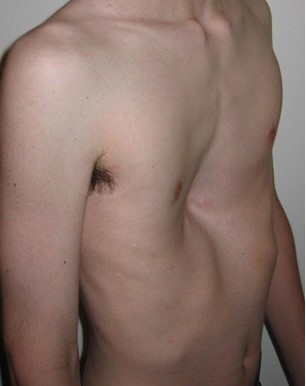
© ShareAlike 3.0 Unported(CC BY-SA 3.0), via Wikimedia Commons
Epidemiologie1 2
Pectus excavatum is a congenital anomaly. It is the most common deformity of the anterior chest in children and is present in between 1 in 300-400 live births. There is a 4:1 male-to-female ratio. It is thought to be an inherited condition.
Untersuchungen3
Radio-imaging with CXR is the first-line investigation.
Two clinical methods have also been developed here in assessing the severity of pectus excavatum:4
Chest cytometry involves measuring the circumference of the chest in the region of the distal third of the sternum or at the site of greatest deformity with the patient in the orthostatic position and inspiring deeply.
Calculation of the anthropomorphic index - this involves taking two measurements. Firstly, the maximum anteroposterior measurement in the region of greatest deformity or of the distal third of the sternum (A) is assessed. Secondly, the greatest depth of the defect is measured with the highest point of the anterior costal wall and the lowest point of the pre-sternal region at the site of greatest deformity being used as reference (B). The index is calculated as B/A.
Standardised cardiopulmonary function tests may be useful, particularly in assessing whether patients would benefit from surgery.
CT chest scanning may be indicated to assess the degree of sternal deformity, the severity of lung compression and the presence of mediastinal displacement.
An MRI technique has been developed due to concerns about the radiation dose obtained from CT scans.5
Echocardiography may be clinically indicated in patients with dyspnoea to evaluate cardiac compression. 20-60% of patients have mitral valve prolapse. Atrial compression and cardiac displacement are frequently seen.
Pulmonary function tests may be required to assess lung capacity.6
Behandlung3
Mild cases may not require treatment, as the deformity can be hidden under clothing.
The treatment to correct functional disability was for many years the Ravitch operation in which the anterior chest wall is exposed, skin and muscle flaps are created, the affected cartilages are excised and sternal osteotomy is performed.
A newer minimally invasive procedure called the Nuss technique has been developed which involves the insertion of a retrosternal metal bar via two incisions, using a thorascope - this is now the standard treatment. The bar is removed 2-3 years later.7 2 Es wird hauptsächlich bei 12- bis 14-Jährigen angewendet, kann aber auch bei jüngeren Kindern und Erwachsenen durchgeführt werden, bei denen möglicherweise zwei Stäbe erforderlich sind.8 Die Technik könnte die Schwelle für chirurgische Eingriffe senken, die zuvor durch die hohe Inzidenz von Keloidbildung an der vorderen Brustwand, die das Ravitch-Verfahren erschwerte, behindert wurde. Es scheint wenig Unterschied zwischen dem Nuss-Verfahren und dem Ravitch-Verfahren in Bezug auf allgemeine Komplikationen, die Dauer des Krankenhausaufenthalts und die Zeit bis zur Mobilisierung zu geben. Allerdings könnte die Rate der Reoperationen, postoperativen Hämatothorax und Pneumothorax nach dem Nuss-Verfahren im Vergleich zum Ravitch-Verfahren höher sein.9
Autologous fat transplantation has been reported, as has polyethylene implant for patients with mild deformity who required aesthetic improvement.10 11
A survey of patients who have had surgery showed considerable improvement in body image and function.12
NHS England does not routinely fund surgery for pectus excavatum.13
Pectus carinatum (pigeon chest)14
In this condition, the sternum is raised (carina = keel). It used to be associated with rickets. Nowadays there is usually an associated history of severe asthma in childhood, sometimes with a ventricular septal defect (VSD). 20% of patients have an associated scoliosis. Pectus carinatum complicating surgical treatment for pectus excavatum has been reported.15
Pectus carinatum
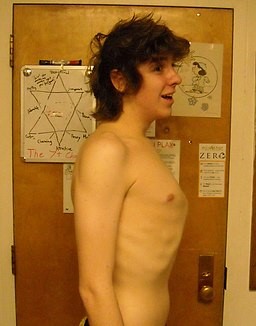
© Tolson411, CC BY-SA 3.0,via Wikimedia Commons
Two main types have been identified - chondrogladiolar (90%, keel chest, prominent middle and lower sternum) and chondromanubrial (pouter pigeon breast, prominent upper sternum). Some authorities also identify a lateral type.
The large forces needed for inspiration lead to an in-drawing of the lower portion of the ribs giving a Harrison's sulcus.
Most cases were thought to be asymptomatic. However, recent studies suggest that some patients develop a rigid chest wall resulting in reduced vital capacity and symptoms of dyspnoea, exertional tachypnoea and reduced endurance.
Epidemiologie1
Dies ist viel weniger verbreitet als Pectus excavatum. Die Prävalenz in den USA wurde auf 0,06 % geschätzt, wobei ein Drittel der Patienten eine positive Familienanamnese aufweist. Assoziierte Krankheiten sind Marfan-Syndrom und angeborene Herzkrankheit. The patient or their parents will often be aware of the condition from early childhood but typically present to health professionals between the ages of 11-15.
Untersuchungen
Pulmonary function tests should be performed if reduced lung capacity is suspected.
Electrocardiography and echocardiography may be needed to rule out cardiac abnormalities and assess cardiac function.
Chest radiography should be carried out; CT scanning may be helpful.
A scoliosis series should be arranged if this condition is suspected.
Behandlung14
Many patients have a mild deformity with no associated morbidity requiring treatment.
Various physical methods of correcting the deformity have been tried, including casting, bracing and chest compressors.
Endoscopic resection of costal cartilage and sternal osteotomy is available for patients who require cosmetic correction but this procedure does nothing to correct any functional disability.
Rarely, if there is significant pulmonary and/or cardiac dysfunction, open surgical repair is performed. Various techniques have been tried.16 17
NHS England does not routinely fund surgery for pectus excavatum.13
Exklusive Updates für medizinisches Fachpersonal
Bleiben Sie informiert mit den neuesten klinischen Updates, professionellen Einblicken und evidenzbasierten Leitlinien. Der Patient Pro-Newsletter stellt wesentliche Inhalte für Gesundheitsfachkräfte zusammen – direkt in Ihren Posteingang geliefert.
Durch das Abonnieren akzeptieren Sie unsere Datenschutzrichtlinie. Sie können sich jederzeit abmelden. Wir verkaufen Ihre Daten niemals.
Weiterführende Literatur und Referenzen
- Placement of pectus bar for pectus excavatum (also known as MIRPE or the Nuss procedure); NICE Interventional procedures guidance, August 2009
- Park SY, Park TH, Kim JH, et al; A case of right ventricular dysfunction caused by pectus excavatum. J Cardiovasc Ultrasound. 2010 Jun;18(2):62-5. Epub 2010 Jun 30.
- Weiss HR, Goodall D; Rate of complications in scoliosis surgery - a systematic review of the Pub Med literature. Scoliosis. 2008 Aug 5;3:9.
- Coelho Mde S, Guimaraes Pde S; Pectus carinatum. J Bras Pneumol. 2007 Aug;33(4):463-74.
- Cobben JM, Oostra RJ, van Dijk FS; Pectus excavatum and carinatum. Eur J Med Genet. 2014 Aug;57(8):414-7. doi: 10.1016/j.ejmg.2014.04.017. Epub 2014 May 10.
- Cardio-respiratory investigation & management of adolescents with pectus excavatum; NHS Greater Glasgow and Clyde, 2021
- Jaroszewski D, Notrica D, McMahon L, et al; Current management of pectus excavatum: a review and update of therapy and treatment recommendations. J Am Board Fam Med. 2010 Mar-Apr;23(2):230-9. doi: 10.3122/jabfm.2010.02.090234.
- Brigato RR, Campos JR, Jatene FB, et al; Pectus excavatum: evaluation of Nuss technique by objective methods. Interact Cardiovasc Thorac Surg. 2008 Dec;7(6):1084-8. Epub 2008 Sep 4.
- Marcovici PA, Losasso BE, Kruk P, et al; MRI for the evaluation of pectus excavatum. Pediatr Radiol. 2011 Jun;41(6):757-8. Epub 2011 Mar 8.
- Malek MH, Coburn JW; Strategies for cardiopulmonary exercise testing of pectus excavatum patients. Clinics. 2008 Apr;63(2):245-54.
- Nyboe C, Knudsen MR, Pilegaard HK; Elective pectus bar removal following Nuss procedure for pectus excavatum: a Eur J Cardiothorac Surg. 2011 Jun;39(6):1040-2. Epub 2010 Nov 13.
- Pilegaard HK, Licht PB; Routine use of minimally invasive surgery for pectus excavatum in adults. Ann Thorac Surg. 2008 Sep;86(3):952-6.
- Nasr A, Fecteau A, Wales PW; Comparison of the Nuss and the Ravitch procedure for pectus excavatum repair: a meta-analysis. J Pediatr Surg. 2010 May;45(5):880-6. doi: 10.1016/j.jpedsurg.2010.02.012.
- Pereira LH, Sterodimas A; Free fat transplantation for the aesthetic correction of mild pectus excavatum. Aesthetic Plast Surg. 2008 Mar;32(2):393-6.
- Grappolini S, Fanzio PM, D'Addetta PG, et al; Aesthetic treatment of pectus excavatum: a new endoscopic technique using a porous polyethylene implant. Aesthetic Plast Surg. 2008 Jan;32(1):105-10. Epub 2007 Sep 5.
- Kelly RE Jr, Cash TF, Shamberger RC, et al; Surgical repair of pectus excavatum markedly improves body image and perceived ability for physical activity: multicenter study. Pediatrics. 2008 Dec;122(6):1218-22.
- Clinical Commissioning Policy: Surgery for pectus deformity (all ages); NHS England, 2019
- Desmarais TJ, Keller MS; Pectus carinatum. Curr Opin Pediatr. 2013 Jun;25(3):375-81. doi: 10.1097/MOP.0b013e3283604088.
- Swanson JW, Colombani PM; Reactive pectus carinatum in patients treated for pectus excavatum. J Pediatr Surg. 2008 Aug;43(8):1468-73.
- Schaarschmidt K, Lempe-Sellin M, Schlesinger F, et al; New Berlin-Buch "Reversed Nuss," Endoscopic Pectus Carinatum Repair using eight-hole stabilizers, submuscular CO2, and presternal Nuss bar compression: first results in 35 patients. J Laparoendosc Adv Surg Tech A. 2011 Apr;21(3):283-6.
- Del Frari B, Schwabegger AH; Ten-year experience with the muscle split technique, bioabsorbable plates, and postoperative bracing for correction of pectus carinatum: the Innsbruck protocol. J Thorac Cardiovasc Surg. 2011 Mar 30.
Über den AutorVollständige Biografie anzeigen

Dr Toni Hazell, FRCGP
MBBS, BSc, FRCGP, DFSRH, Dip GU med, DRCOG, DCH (London, UK, 2000)
Dr. Toni Hazell hat ihren Abschluss an der St. Mary’s Hospital Medical School gemacht und ihr VTS am Northwick Park Hospital absolviert.
Über den RezensentenVollständige Biografie anzeigen

Dr Colin Tidy, MRCGP
Allgemeinmediziner, Medizinischer Autor
MBBS, MRCGP, MRCP (Paediatrics), DCH
Dr. Colin Tidy ist ein NHS-Arzt mit Sitz in Oxfordshire.
Artikelverlauf
Die Informationen auf dieser Seite wurden von qualifizierten Klinikern verfasst und begutachtet.
Artikel auch verfügbar in Englisch, Deutsch, Spanisch, Französisch, Italienisch, Portugiesisch, Hindi, Hebräisch, Arabisch, und Schwedisch.
Nächste Überprüfung fällig: 22. Dez 2027
23. Dez 2022 | Neueste Version

Fragen, teilen, verbinden.
Durchsuchen Sie Diskussionen, stellen Sie Fragen und teilen Sie Erfahrungen zu Hunderten von Gesundheitsthemen.

Fühlen Sie sich unwohl?
Bewerten Sie Ihre Symptome online kostenlos
Mehr in Geschichte und Untersuchung
- Abdominale Aufblähung und Völlegefühl
- Abdominale Hernien
- Abnormer Gewichtsverlust
- Alkoholismus und Alkoholmissbrauch - Erkennung und Bewertung
- Kachexie
- Chronische eitrige Mittelohrentzündung
- Delirium
- Foster-Kennedy-Syndrom
- Hydrozele
- Geschwollene Knie
- Neugeborenenuntersuchung
- Neugeborenengelbsucht
- Nachtangst und Parasomnien
- Adipositas-Hypoventilationssyndrom
- Verhinderung von Stürzen bei älteren Menschen
- Proctalgia fugax und Analschmerzen
- Ptosis und Lidverzögerung
- Schwere und teilweise Sehbehinderung
- Supraventrikuläre Tachykardie bei Erwachsenen
- Tourette-Syndrom und andere Tic-Störungen