Systemic scleroderma
Zuletzt aktualisiert 22 Dec 2025
Erfüllt die redaktionelle Richtlinien
- HerunterladenHerunterladen
- Teilen
- Language
- Diskussion
- Audio-Version
- Zu bevorzugten Quellen bei Google hinzufügen
Systemic scleroderma is an autoimmune disorder that affects the skin and internal organs. Autoimmune disorders occur when the immune system malfunctions and attacks the body's own tissues and organs. The word "scleroderma" means hard skin in Greek, and the condition is characterised by the buildup of scar tissue (fibrosis) in the skin and other organs. The condition is also called systemic sclerosis because the fibrosis can affect organs other than the skin. Fibrosis is due to the excess production of a tough protein called collagen, which normally strengthens and supports connective tissues throughout the body.
Beschreibung
Systemic scleroderma is an autoimmune disorder that affects the skin and internal organs. Autoimmune disorders occur when the immune system malfunctions and attacks the body's own tissues and organs. The word "scleroderma" means hard skin in Greek, and the condition is characterised by the buildup of scar tissue (fibrosis) in the skin and other organs. The condition is also called systemic sclerosis because the fibrosis can affect organs other than the skin. Fibrosis is due to the excess production of a tough protein called collagen, which normally strengthens and supports connective tissues throughout the body.
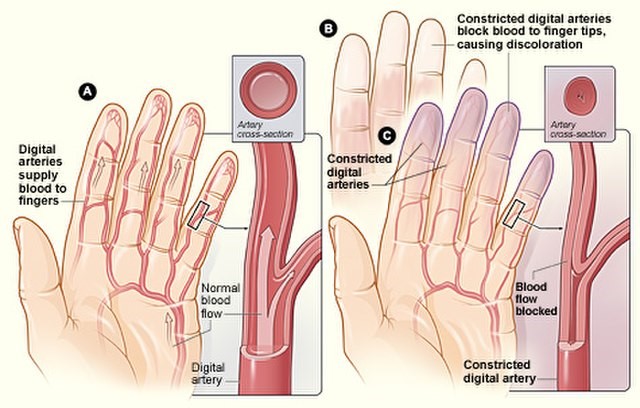
The signs and symptoms of systemic scleroderma usually begin with episodes of Raynaud phenomenon, which can occur weeks to years before fibrosis. In Raynaud phenomenon, the fingers and toes of affected individuals turn white or blue in response to cold temperature or other stresses. This effect occurs because of problems with the small vessels that carry blood to the extremities. Another early sign of systemic scleroderma is puffy or swollen hands before thickening and hardening of the skin due to fibrosis. Skin thickening usually occurs first in the fingers (called sclerodactyly) and may also involve the hands and face. In addition, people with systemic scleroderma often have open sores (ulcers) on their fingers, painful bumps under the skin (calcinosis), or small clusters of enlarged blood vessels just under the skin (telangiectasia).
Fibrosis can also affect internal organs and can lead to impairment or failure of the affected organs. The most commonly affected organs are the esophagus, heart, lungs, and kidneys. Internal organ involvement may be signaled by heartburn, difficulty swallowing (dysphagia), high blood pressure (hypertension), kidney problems, shortness of breath, diarrhea, or impairment of the muscle contractions that move food through the digestive tract (intestinal pseudo-obstruction).
There are three types of systemic scleroderma, defined by the tissues affected in the disorder. In one type of systemic scleroderma, known as limited cutaneous systemic scleroderma, fibrosis usually affects only the hands, arms, and face. Limited cutaneous systemic scleroderma used to be known as CREST syndrome, which is named for the common features of the condition: calcinosis, Raynaud phenomenon, esophageal motility dysfunction, sclerodactyly, and telangiectasia. In another type of systemic scleroderma, known as diffuse cutaneous systemic scleroderma, the fibrosis affects large areas of skin, including the torso and the upper arms and legs, and often involves internal organs. In diffuse cutaneous systemic scleroderma, the condition worsens quickly and organ damage occurs earlier than in other types of the condition. In the third type of systemic scleroderma, called systemic sclerosis sine scleroderma ("sine" means without in Latin), fibrosis affects one or more internal organs but not the skin.
Approximately 15 percent to 25 percent of people with features of systemic scleroderma also have signs and symptoms of another condition that affects connective tissue, such as polymyositis, dermatomyositis, rheumatoid arthritis, Sjögren syndrome, or systemic lupus erythematosus. The combination of systemic scleroderma with other connective tissue abnormalities is known as scleroderma overlap syndrome.
Inheritance patterns
The source lists the following possible inheritance patterns: Not inherited; Pattern unknown. More than one pattern can apply in different cases.
Related genes
Other names
Familial progressive scleroderma
Progressive scleroderma
Systemische Sklerose
Related patient information and medicines
Patient information leaflet
Systemische Sklerose
Systemische Sklerose is a type of scleroderma, which means hard skin. Wenn Sie haben scleroderma, you have areas of hardening of the skin. In systemic sclerosis, you can also get hardening of some of your internal organs. The word scleroderma means hard skin. There are two kinds von scleroderma: Localised scleroderma (also known as morphoea). This only.
Patient information leaflet
Lokalisierte Sklerodermie
Was ist localised scleroderma. Scleroderma is a condition that causes areas of the skin to become harder than usual. Hence the name scleroderma, which means hard skin. There are two k... Localised scleroderma (also known as morphoea or morphea) only affects the skin. In some cases it can spread to the tissues underneath the skin, such as muscles.

Patient information leaflet
Gelenkschmerzen
See the separate leaflet called Vitamin D deficiency. Connective tissue diseases For example, conditions such as systemic lupus erythematosus and scleroderma: connective tissue diseases affect tissues throughout the body, including tendons, ligaments, skin, eyes, cartilage, bone and blood vessels. See the separate leaflets called Ehlers-Danlos.
Patient information leaflet
Perikarditis
Perikarditis ist inflammation of the pericardium, which is the sac which surrounds and helps to protect the heart. For example, pericarditis can develop following a stab wound or a severe blow to the chest (for example, following a road tra... Inflammatory diseases which can affect various parts of the body may include inflammation of the.
Patient information leaflet
Raynaud-Phänomen
Raynaud-Phänomen (often just called Raynaud's), is a condition where the small Blut vessels of the fingers become narrow (constrict). This... In some cases, it is a symptom of an underlying condition such as Sklerodermie , lupus , or rheumatoid arthritis. For example, scleroderma , rheumatoid arthritis , multiple sclerosis , systemic lupus.

Patient information leaflet
Gastroparese
... Auto-immune conditions. Gastroparese is a rare complication of some auto-immune conditions such as hypothyroidism or systemische Sklerose. Other conditions. Some neurological conditions such as multiple sclerosis , Parkinson's disease , or following a stroke , increase the risk of gastroparesis although this is not common. As a result of having.
Weiterführende Lektüre und Referenzen
- Systemic scleroderma; MedlinePlus, National Library of Medicine.
- Allanore Y, Saad M, Dieude P, Avouac J, Distler JH, Amouyel P, Matucci-Cerinic M, Riemekasten G, Airo P, Melchers I, Hachulla E, Cusi D, Wichmann HE, Wipff J, Lambert JC, Hunzelmann N, Tiev K, Caramaschi P, Diot E, Kowal-Bielecka O, Valentini G, Mouthon L, Czirjak L, Damjanov N, Salvi E, Conti C, Muller M, Muller-Ladner U, Riccieri V, Ruiz B, Cracowski JL, Letenneur L, Dupuy AM, Meyer O, Kahan A, Munnich A, Boileau C, Martinez M. Genome-wide scan identifies TNIP1, PSORS1C1, and RHOB as novel risk loci for systemic sclerosis. PLoS Genet. 2011 Jul;7(7):e1002091. doi: 10.1371/journal.pgen.1002091. Epub 2011 Jul 7.
- Dieude P, Guedj M, Wipff J, Avouac J, Fajardy I, Diot E, Granel B, Sibilia J, Cabane J, Mouthon L, Cracowski JL, Carpentier PH, Hachulla E, Meyer O, Kahan A, Boileau C, Allanore Y. Association between the IRF5 rs2004640 functional polymorphism and systemic sclerosis: a new perspective for pulmonary fibrosis. Arthritis Rheum. 2009 Jan;60(1):225-33. doi: 10.1002/art.24183.
- Hachulla E, Launay D. Diagnosis and classification of systemic sclerosis. Clin Rev Allergy Immunol. 2011 Apr;40(2):78-83. doi: 10.1007/s12016-010-8198-y.
- Hua-Huy T, Dinh-Xuan AT. Cellular and molecular mechanisms in the pathophysiology of systemic sclerosis. Pathol Biol (Paris). 2015 Apr;63(2):61-8. doi: 10.1016/j.patbio.2015.03.003. Epub 2015 Mar 25.
- Ito I, Kawaguchi Y, Kawasaki A, Hasegawa M, Ohashi J, Hikami K, Kawamoto M, Fujimoto M, Takehara K, Sato S, Hara M, Tsuchiya N. Association of a functional polymorphism in the IRF5 region with systemic sclerosis in a Japanese population. Arthritis Rheum. 2009 Jun;60(6):1845-50. doi: 10.1002/art.24600.
- Korman BD, Criswell LA. Recent advances in the genetics of systemic sclerosis: toward biological and clinical significance. Curr Rheumatol Rep. 2015 Mar;17(3):21. doi: 10.1007/s11926-014-0484-x.
- Rueda B, Broen J, Simeon C, Hesselstrand R, Diaz B, Suarez H, Ortego-Centeno N, Riemekasten G, Fonollosa V, Vonk MC, van den Hoogen FH, Sanchez-Roman J, Aguirre-Zamorano MA, Garcia-Portales R, Pros A, Camps MT, Gonzalez-Gay MA, Coenen MJ, Airo P, Beretta L, Scorza R, van Laar J, Gonzalez-Escribano MF, Nelson JL, Radstake TR, Martin J. The STAT4 gene influences the genetic predisposition to systemic sclerosis phenotype. Hum Mol Genet. 2009 Jun 1;18(11):2071-7. doi: 10.1093/hmg/ddp119. Epub 2009 Mar 13.
- Thieu VT, Yu Q, Chang HC, Yeh N, Nguyen ET, Sehra S, Kaplan MH. Signal transducer and activator of transcription 4 is required for the transcription factor T-bet to promote T helper 1 cell-fate determination. Immunity. 2008 Nov 14;29(5):679-90. doi: 10.1016/j.immuni.2008.08.017.
Artikelverlauf
Artikel auch verfügbar in Englisch, Deutsch, Spanisch, Französisch, Italienisch, Portugiesisch, Hindi, Hebräisch, Arabisch, und Schwedisch.
22 Dec 2025 | Neueste Version
1 Sept 2011 | Ursprünglich veröffentlicht
Nehmen Sie an der Diskussion teil
Teilen Sie Ihre Gedanken oder Erfahrungen mit anderen in unserem Patientengemeinschaften.

Fragen, teilen, verbinden.
Durchsuchen Sie Diskussionen, stellen Sie Fragen und teilen Sie Erfahrungen zu Hunderten von Gesundheitsthemen.
Abonnieren Sie den Patienten-Newsletter
Ihre wöchentliche Dosis klarer, vertrauenswürdiger Gesundheitsberatung - geschrieben, um Ihnen zu helfen, sich informiert, selbstbewusst und in Kontrolle zu fühlen.
Durch das Abonnieren akzeptieren Sie unsere Datenschutzrichtlinie. Sie können sich jederzeit abmelden. Wir verkaufen Ihre Daten niemals.