Hypospadie
Begutachtet von Dr. Rachel Hoad-RobsonZuletzt aktualisiert von Dr Toni Hazell, FRCGPZuletzt aktualisiert 15. Nov. 2024
Erfüllt die Anforderungen des Patienten Richtlinien des Patienten
- HerunterladenHerunterladen
- Teilen
- Language
- Diskussion
- Audio-Version
- Zu bevorzugten Quellen bei Google hinzufügen
Hypospadie ist eine häufige Anomalie der Harnröhre und des Penis, die bei der Geburt vorhanden ist; eine Art Geburtsfehler. Dies kann Probleme beim Wasserlassen und auch bei Erektionen verursachen. Der Schweregrad kann variieren. Eine chirurgische Korrektur ist in der Regel sehr erfolgreich.
Auf einen Blick
Hypospadias is a birth defect where the urethra opening is on the underside of the penis.
This can cause a hooded foreskin or a penis that curves downwards.
It can make it difficult to pass urine normally.
Surgery is often performed between 4 and 18 months of age to correct the condition.
The foreskin is usually needed for surgery, so circumcision should not be done beforehand.
What is hypospadias?
The main problem is that the urethra (which is the tube which drains urine from the bladder) forms in such a way that it opens on the underside of the shaft of the penis instead of at the tip of the penis (also called the head of the penis). There are different types of hypospadias - the location of the opening can be anywhere from just below the normal position (mild) to as far back as the base of the scrotum (severe). 7 out of 10 cases are usually the mild type.
Hypospadias may also include the following:
A hooded appearance of the foreskin. This is because the foreskin does not develop on the underside of the penis.
Tightening of the tissues on the underside of the penis (called 'chordee'). This pulls the penis down and it cannot fully straighten. The further back the urethral opening is, the more severe the chordee tends to be. Mild hypospadias may not have any chordee.
Hypospadie
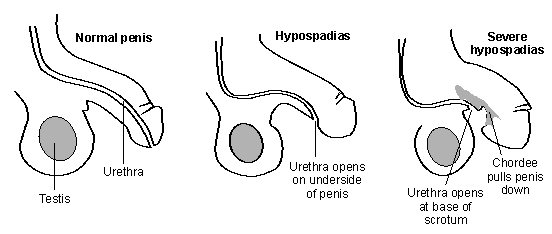
Hypospadias occurs in about 1 in 250 boys. It seems to be getting more common. The reason why the penis does not develop properly is still not clear. The development of the penis whilst the baby is growing in the womb (uterus) is partly dependent on the male sex hormones such as testosterone. The effects of testosterone on the growing penis may be blocked in some way. Although it is not a genetic condition, hypospadias can run in some families.
What problems can hypospadias cause?
Problems are likely to occur if hypospadias is left untreated. The further back the opening of the urethra is, the more severe the problems are likely to be.
Passing urine is different to normal. Babies with hypospadias will have no symptoms of hypospadias, because they use a nappy. However, when older, the urine stream may not be able to be directed forward into a urinal. When going to the toilet the urine is likely to 'spray' backwards. Sitting on a toilet may be needed to pass urine without mess.
Chordee which causes bending of the penis. This is more noticeable when the penis is erect. Sexual intercourse may be difficult or impossible in severe cases.
Psychological problems about being 'different' to normal are common.
Mild erection difficulties and premature ejaculation have been reported in adulthood in patients who have had surgery for hypospadias in childhood.
Sind Tests erforderlich?
The diagnosis is usually obvious from examining the penis. No other tests are routine. However, a small number of people with starker hypospadias (when the urethral opening is at the base of the scrotum) may have other abnormalities of the genitals including undescended testicles. The appearance of severe hypospadias may be part of a rare 'intersex' syndrome. Therefore, tests of the chromosomes and scans of the genitals may be made to determine if it is part of a wider syndrome. Hinweis: these syndromes are rare and most boys with hypospadias are of the male sex and have no other abnormalities.
How is hypospadias treated?
If the hypospadias is mild, with the opening of the urethra just a little down from normal and with no bending of the penis, no treatment may be needed.
Hypospadias surgery
However, in most cases an operation is required to correct the hypospadias - a hypospadias repair. This can usually be done in one operation. However, if the hypospadias is more complicated, two operations may be necessary. The operation is usually done when the child is around 4-18 months old.
A full discussion with a surgeon is needed to decide what can be done. The goals of treatment are:
For urine to be passed in a forward way.
For the penis to be straight when erect.
For the penis to look as normal as possible.
The position of the opening of the urethra is altered. Also, if chordee is present then this is corrected to allow the penis to straighten. The foreskin is usually used during the operation to make the new urethra so it is very important that a circumcision is not done before the corrective surgery is performed. Parents who would usually circumcise their child for religious reasons may want to discuss the need to delay circumcision with their spiritual leader, who would usually be able to reassure them as to how this can be done in accordance with their faith.
What is the outlook (prognosis) for hypospadias?
The success of the operation and the 'normality' that can be achieved, depend on the severity of the hypospadias.
Patientenauswahl für Penisstörungen

Männergesundheit
Phimose und Paraphimose
Phimosis means that the foreskin of the penis is too tight and so cannot be pulled back off the rounded head of the penis (glans). In paraphimosis, the foreskin has been pulled back (retracted) but cannot be returned to the original position. Paraphimosis needs emergency medical treatment to prevent complications.
von Dr. Doug McKechnie, MRCGP
Männergesundheit
Peyronie-Krankheit
Peyronies Krankheit verursacht einen gekrümmten oder gebogenen Penis. Sie wird durch Narbengewebe entlang des Penis schulter verursacht. Dies führt zu schmerzhaften Erektionen und einer Biegung oder Krümmung, meist etwa in der Mitte des Penis. Die Veränderung der Form ist normalerweise nur sichtbar, wenn der Penis erigiert ist.
von Dr. Doug McKechnie, MRCGP
Häufig gestellte Fragen
What is 'chordee' and how does it relate to hypospadias?
Chordee refers to the tightening of tissues on the underside of the penis, which causes it to pull downwards and prevents it from fully straightening. It is often associated with hypospadias, and its severity tends to increase the further back the urethral opening is located. Mild hypospadias may not involve chordee.
Why is it important to avoid circumcising a child with hypospadias before corrective surgery?
The foreskin is typically used during the hypospadias repair operation to construct the new urethra. Therefore, it is crucial that circumcision is not performed before the corrective surgery takes place. Parents who plan to circumcise their child for religious reasons may need to discuss delaying the procedure with their spiritual leader.
Are there any long-term issues for adults who had hypospadias surgery as children?
Some adults who underwent surgery for hypospadias in childhood have reported mild erection difficulties and premature ejaculation. However, the primary goals of treatment are for urine to pass forward, for the penis to be straight when erect, and for it to appear as normal as possible.
At what age is hypospadias surgery typically performed?
Hypospadias repair surgery is usually carried out when the child is approximately between 4 and 18 months old. This timing is chosen to allow for optimal results from the procedure.
How many operations are usually needed to correct hypospadias?
In most cases, hypospadias can be corrected in a single operation. However, if the hypospadias is more complex or severe, it may require two separate operations to achieve the desired outcome.
Weiterführende Literatur und Referenzen
- van Rooij IA, van der Zanden LF, Brouwers MM, et al; Risk factors for different phenotypes of hypospadias: results from a Dutch case-control study. BJU Int. 2013 Jan 10. doi: 10.1111/j.1464-410X.2012.11745.x.
- EAU-Leitlinien für Pädiatrische Urologie. Ausgabe präsentiert beim EAU-Jahreskongress in Kopenhagen; Europäische Gesellschaft für Urologie, 2018 – aktualisiert 2023
- van der Horst HJ, de Wall LL; Hypospadie, alles Wissenswerte. Eur J Pediatr. 2017 Apr;176(4):435-441. doi: 10.1007/s00431-017-2864-5. Epub 2017 Feb 11.
- White JT, Kovar E, Chambers TM, et al; Hypospadias Risk from Maternal Residential Exposure to Heavy Metal Hazardous Air Pollutants. Int J Environ Res Public Health. 2019 Mar 15;16(6). pii: ijerph16060930. doi: 10.3390/ijerph16060930.
- Mole RJ, Nash S, MacKenzie DN; Hypospadias. BMJ. 2020 Jun 17;369:m2070. doi: 10.1136/bmj.m2070.
Über den AutorVollständige Biografie anzeigen

Dr Toni Hazell, FRCGP
MBBS, BSc, FRCGP, DFSRH, Dip GU med, DRCOG, DCH (London, UK, 2000)
Dr. Toni Hazell hat ihren Abschluss an der St. Mary’s Hospital Medical School gemacht und ihr VTS am Northwick Park Hospital absolviert.
Über den Rezensenten

Dr. Rachel Hoad-Robson
Artikelverlauf
Die Informationen auf dieser Seite wurden von qualifizierten Klinikern verfasst und begutachtet.
Artikel auch verfügbar in Englisch, Deutsch, Spanisch, Französisch, Italienisch, Portugiesisch, Hindi, Hebräisch, Arabisch, und Schwedisch.
Nächste Überprüfung fällig: 14. Nov 2027
15. Nov. 2024 | Neueste Version

Fragen, teilen, verbinden.
Durchsuchen Sie Diskussionen, stellen Sie Fragen und teilen Sie Erfahrungen zu Hunderten von Gesundheitsthemen.

Fühlen Sie sich unwohl?
Bewerten Sie Ihre Symptome online kostenlos
Abonnieren Sie den Patienten-Newsletter
Ihre wöchentliche Dosis klarer, vertrauenswürdiger Gesundheitsberatung - geschrieben, um Ihnen zu helfen, sich informiert, selbstbewusst und in Kontrolle zu fühlen.
Durch das Abonnieren akzeptieren Sie unsere Datenschutzrichtlinie. Sie können sich jederzeit abmelden. Wir verkaufen Ihre Daten niemals.
Mehr zur Männergesundheit
- Akute Prostatitis
- Alpha-Blocker
- Balanitis
- Blut im Sperma
- Brustkrebs bei Männern
- Beschneidung
- Epididymale Zyste
- Erektile Dysfunktion
- Niedriger Testosteronspiegel
- Peniskrebs
- Penisprobleme, juckender Penis und Penisschmerzen
- Peyronie-Krankheit
- Phimose und Paraphimose
- Vorzeitige Ejakulation
- Skrotale Knoten, Schmerzen und Schwellungen
- Spermatest
- Hodenkrebs
- Soor bei Männern
- Urethritis bei Männern
- Harnverhalt