Kleienpilzflechte
Tinea versicolor
Begutachtet von Dr Philippa Vincent, MRCGPZuletzt aktualisiert von Dr Toni Hazell, FRCGPZuletzt aktualisiert 10. Dez 2024
Erfüllt die Anforderungen des Patienten redaktionellen Richtlinien
- HerunterladenHerunterladen
- Teilen
- Language
- Diskussion
- Audio-Version
- Zu bevorzugten Quellen bei Google hinzufügen
Pityriasis versicolor ist eine Pilzinfektion der Haut, die durch einen pilzähnlichen Erreger verursacht wird und einen Hautausschlag verursacht. Sie ist nicht schädlich und nicht ansteckend durch Berührung. Die Behandlung kann den Ausschlag beseitigen. Manche Menschen, die zu dieser Erkrankung neigen, benötigen eine regelmäßige Behandlung, um ein Wiederauftreten des Ausschlags zu verhindern (rezidivierend).
Auf einen Blick
Pityriasis versicolor is a common fungal skin condition, also known as tinea versicolor.
Es verursacht blasse oder dunklere Flecken auf der Haut, oft auf dem Rücken, der Brust oder dem Nacken.
Diese Flecken können schuppig werden und sind auf gebräunter Haut auffälliger.
Der Zustand ist weder ernst noch ansteckend.
Treatments include special shampoos or antifungal creams.
Es kann Wochen oder Monate dauern, bis die Hautfarbe nach der Behandlung wieder normal ist.
Der Ausschlag kann wiederkehren, und vorbeugende Behandlungen sind verfügbar.
What is pityriasis versicolor?
Small numbers of the malassezia germs that causes pityriasis versicolor commonly live on the skin and do no harm. However, some people are prone to this germ multiplying and spreading on their skin more than usual, which then leads to a rash developing. Often the germ multiplies and causes the rash for no apparent reason. In some cases, hot, sunny or humid weather seems to trigger the germ to multiply on the skin. In people who sweat more it may be more likely to occur.
Pityriasis versicolor is a common fungal condition. It is more common in young adults - people in their teens and 20s. It is sometimes called tinea versicolor.
Pityriasis versicolor symptoms
The rash
Pityriasis versicolor close-up
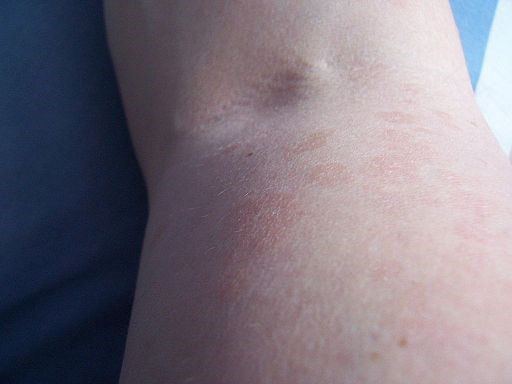
© Richardkiwi at nl.wikipedia (Own work), Public domain, via Wikimedia Commons
This usually starts as small pale patches. Sometimes the rash is darker than the skin in fair-skinned people, and in this case it looks like brown marks. In those with darker skin, it will be lighter than the usual colour of the skin. At first these usually appear on your back, chest, neck or upper arms.
The rash sometimes spreads to your tummy (abdomen) and thighs. Occasionally it may affect your face. More patches may appear and patches next to each other may join together. The affected skin may become slightly scaly.
Pityriasis versicolor on the forehead
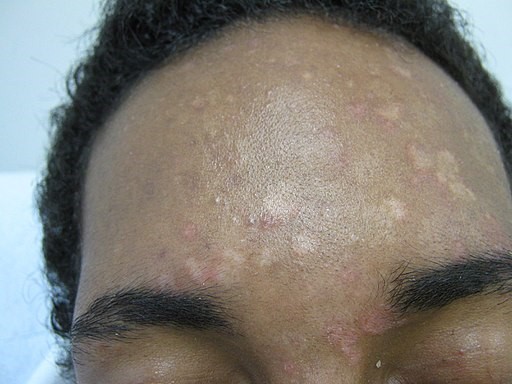
© Grook Da Oger (Own work) CC BY-SA 3.0, via Wikimedia Commons
The rash is usually pale and is barely noticeable if you are fair-skinned. You may not notice it until after you sunbathe. Affected areas do not tan and therefore the rash becomes more obvious on tanned skin. The pale patches are more obvious if you have dark skin.
There are usually no other symptoms. Sometimes it is slightly itchy.
Is pityriasis versicolor serious?
No. If you wanted an even suntan then this rash is a nuisance, as pale patches on tanned skin may look unsightly. It does not lead to any other skin conditions, or cause damage to the surrounding skin.
Is pityriasis versicolor contagious?
No - it is not possible to catch this condition from another person. The type of yeast that causes the rash is commonly found on the skin and usually does no harm. For reasons that are not clear, it seems that the germ grows out of control more easily with certain people, and causes a rash.
Pityriasis versicolor treatment
The type of treatment varies between cases and may depend on the location of the rash and also if you have had this condition before. It may take weeks or months for the rash to fully go after you treat it. The following are treatment options:
Ketoconazole shampoo (Nizoral®)
Ketoconazole shampoo (Nizoral®): is commonly advised. You can buy this at pharmacies and it is also available on prescription. Ketoconazole kills the germ that causes this rash. Apply the shampoo directly to affected areas and then wash off after three to five minutes. Repeat every day for five days.
Selenium sulfide shampoo
This is an alternative treatment. It is not strictly licensed for the treatment of this rash; however, it works. You can buy it from pharmacies or it is also available on prescription. Apply the shampoo to the affected areas and leave to dry for ten minutes and then rinse off. This should be repeated daily for a week. Diluting it (half water and half shampoo) may prevent it irritating your skin. This should not be used if you are pregnant. Selenium sulfide shampoo has been unavailable in the UK for some years.
Antimykotische Cremes
These may be used if only a very small area of skin is affected. Clotrimazole (Canesten®) cream is one example. It should be applied twice a day for two or three weeks.
Antimykotische Tabletten
Antimykotische Tabletten may very occasionally be prescribed if the rash is over a large area of your skin, or is not cleared by the above treatments. The ones used are usually Itraconazol oder Fluconazol.
Antifungal treatment may need to be repeated if this rash comes back (recurs) and becomes scaly again.
If you are prone to develop recurrent episodes in the sun then it may be advisable to use ketoconazole shampoo once a day for three days prior to going on holiday to the sun. This will help to prevent recurrence when you are away.
Hinweis: after treatment, skin colour usually takes 2-3 months to return to normal. It sometimes takes even longer. As long as the rash is not scaly, this does not mean the treatment has not worked.
How to prevent pityriasis versicolor
Some people seem prone to this yeast-like germ multiplying on their skin and the rash may come back (recur) after treatment. One option is to apply one of the above shampoos to your skin every 2-4 weeks. This may keep the germ away, or prevent the numbers building up, which will prevent the rash from recurring. Alternatively, if you have frequent recurrences then you may be advised to take antifungal tablets for one day each month as a preventative measure.
Patientenauswahl für Hautinfektionen

Infektionen
Mpox-Virus
Mpox, früher bekannt als Affenpocken, ist eine Virusinfektion, die durch das Mpox-(Affenpocken)-Virus verursacht wird. Es ist dem Pockenvirus sehr ähnlich, verursacht jedoch weniger Todesfälle. Es wurde früher angenommen, dass es nicht sehr ansteckend ist, aber in den letzten Jahren scheint es sich leichter auszubreiten. Es gibt einen wirksamen Impfstoff gegen Pocken, der auch gegen Mpox wirkt.
von Dr. Philippa Vincent, MRCGP

Infektionen
Katzenkratzkrankheit
Katzenkratzkrankheit ist eine bakterielle Infektion, die durch Katzenkratzer oder -bisse verursacht wird. Sie führt zu geschwollenen Lymphknoten und anderen Symptomen wie Fieber. Sie verschwindet normalerweise ohne Behandlung, aber Antibiotika werden oft verwendet, um die Infektion schneller zu beseitigen.
von Dr. Doug McKechnie, MRCGP
Häufig gestellte Fragen
Kann Pityriasis versicolor von selbst verschwinden?
Der Artikel legt nahe, dass in der Regel eine Behandlung erforderlich ist, um den Ausschlag zu beseitigen. Obwohl nicht ausdrücklich erwähnt wird, ob er spontan verschwinden kann, deutet der Fokus auf verschiedene Behandlungsoptionen und die Verhinderung eines Rückfalls darauf hin, dass in der Regel ein Eingreifen erforderlich ist. Die Rückkehr der Hautfarbe zur Normalität nach der Behandlung kann 2-3 Monate dauern, manchmal länger.
Verursacht Pityriasis versicolor Schäden an der Haut?
Nein, Pityriasis versicolor führt nicht zu anderen Hauterkrankungen und verursacht keine Schäden an der umliegenden Haut. Es wird als lästig angesehen, insbesondere aufgrund des Auftretens von hellen Flecken auf gebräunter Haut, ist jedoch nicht ernst.
Wie lange dauert es, bis sich die Hautfarbe nach der Behandlung von Pityriasis versicolor wieder normalisiert?
Nach erfolgreicher Behandlung dauert es normalerweise 2-3 Monate, bis die Hautfarbe wieder normal ist. In einigen Fällen kann es sogar länger dauern. Wenn der Ausschlag nicht mehr schuppig ist, deutet dies darauf hin, dass die Behandlung gewirkt hat, auch wenn die Farbe noch nicht vollständig normalisiert ist.
Ist es möglich, dass Pityriasis versicolor nach der Behandlung zurückkehrt?
Ja, Pityriasis versicolor kann nach der Behandlung erneut auftreten. Einige Personen neigen dazu, dass sich der Keim erneut auf ihrer Haut vermehrt. Der Artikel schlägt vorbeugende Maßnahmen vor, wie das Auftragen von Shampoo alle 2-4 Wochen oder bei häufigen Rückfällen die Einnahme von Antipilztabletten einmal im Monat.
Was kann ich tun, um zu verhindern, dass Pityriasis versicolor zurückkommt?
Um zu verhindern, dass Pityriasis versicolor erneut auftritt, können Sie alle 2-4 Wochen eines der verschriebenen Shampoos auf Ihre Haut auftragen. Dies hilft, die Vermehrung der Keime zu verhindern. Wenn Sie häufige Rückfälle erleben, könnte Ihr Arzt empfehlen, einmal im Monat Antipilztabletten als vorbeugende Maßnahme einzunehmen. Für diejenigen, die es im Urlaub in der Sonne bekommen, wird empfohlen, Ketoconazol-Shampoo einmal täglich für drei Tage vor der Abreise zu verwenden.
Weiterführende Literatur und Referenzen
- Pityriasis Versicolor; DermIS (Dermatologisches Informationssystem)
- Kleienpilzflechte; DermNet NZ
- Kleienpilzflechte; NICE CKS, Oktober 2023 (nur für UK-Zugang)
- Gupta AK, Foley KA; Antifungal Treatment for Pityriasis Versicolor. J Fungi (Basel). 2015 Mar 12;1(1):13-29. doi: 10.3390/jof1010013.
Über den AutorVollständige Biografie anzeigen

Dr Toni Hazell, FRCGP
MBBS, BSc, FRCGP, DFSRH, Dip GU med, DRCOG, DCH (London, UK, 2000)
Dr. Toni Hazell hat ihren Abschluss an der St. Mary’s Hospital Medical School gemacht und ihr VTS am Northwick Park Hospital absolviert.
Über den RezensentenVollständige Biografie anzeigen

Dr Philippa Vincent, MRCGP
Allgemeinmediziner, Medizinischer Autor
MB BS, Bsc, MRCGP (2000), DCH, DFSRH, DRCOG
Dr Philippa Vincent ist ein NHS-Arzt, der in Nordlondon arbeitet.
Artikelverlauf
Die Informationen auf dieser Seite wurden von qualifizierten Klinikern verfasst und begutachtet.
Artikel auch verfügbar in Englisch, Deutsch, Spanisch, Französisch, Italienisch, Portugiesisch, Hindi, Hebräisch, Arabisch, und Schwedisch.
Next review due: 9 Dec 2024
10. Dez 2024 | Neueste Version

Fragen, teilen, verbinden.
Durchsuchen Sie Diskussionen, stellen Sie Fragen und teilen Sie Erfahrungen zu Hunderten von Gesundheitsthemen.

Fühlen Sie sich unwohl?
Bewerten Sie Ihre Symptome online kostenlos
Abonnieren Sie den Patienten-Newsletter
Ihre wöchentliche Dosis klarer, vertrauenswürdiger Gesundheitsberatung - geschrieben, um Ihnen zu helfen, sich informiert, selbstbewusst und in Kontrolle zu fühlen.
Durch das Abonnieren akzeptieren Sie unsere Datenschutzrichtlinie. Sie können sich jederzeit abmelden. Wir verkaufen Ihre Daten niemals.