Ganglion
Begutachtet von Dr Toni Hazell, FRCGPZuletzt aktualisiert von Dr Philippa Vincent, MRCGPZuletzt aktualisiert 11. Aug 2025
Erfüllt die Anforderungen des Patienten Richtlinien des Patienten
- HerunterladenHerunterladen
- Teilen
- Language
- Diskussion
- Audio-Version
- Zu bevorzugten Quellen bei Google hinzufügen
Ein Ganglionzyste ist eine harmlose, mit Flüssigkeit gefüllte Beule, die in der Nähe von Gelenken oder Sehnen auftreten kann. Sie treten am häufigsten an Handgelenken oder Händen auf. Sie sind harmlos, können jedoch Unbehagen, Schmerzen und Schwäche verursachen. Einige Menschen empfinden sie als unansehnlich. In der Regel ist keine Behandlung erforderlich. Manchmal kann ein Ganglion durch einen kleinen Eingriff entfernt werden.
Auf einen Blick
Ein Ganglionzyste ist eine Beule unter der Haut, die eine geleeartige Flüssigkeit enthält.
Es erscheint oft auf der Rückseite oder Vorderseite des Handgelenks, Fußes oder der Finger.
Ganglionzysten variieren in der Größe und können manchmal schmerzhaft sein.
Sie sind nicht krebsartig und breiten sich nicht auf andere Teile des Körpers aus.
Einige Ganglienzysten verschwinden im Laufe der Zeit ohne jegliche Behandlung.
Behandlungsoptionen umfassen Aspiration (Absaugen von Flüssigkeit) oder chirurgische Entfernung.
What is a ganglion cyst?
Wrist ganglion cyst
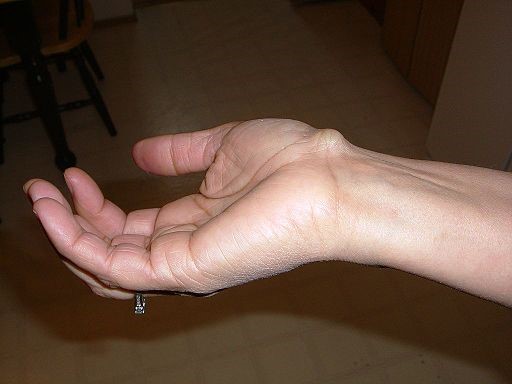
© GEMalone, CC BY 3.0, via Wikimedia Commons
A ganglion cyst is a small swelling that contains a thick jelly-like material. It looks and feels like a smooth lump under the skin. It is not fully understood how it occurs but most experts think that they occur due to multiple micro-traumas to the area of the body.
A ganglion is usually attached to a joint or tendon, and the fluid inside is a thicker version of the fluid which 'lubricates' the joint and tendon sheaths (synovial fluid).
Where are ganglion cysts found?
Back of the wrist. The most common site for a ganglion to be found is on the back of the wrist. 7 out of 10 ganglion cysts are found here.
Front of the wrist (the same side as the palm). It can also occur on the other side of the wrist. 2 out of 10 ganglion cysts are found here.
Top of foot, ankle, top parts of the fingers. 1 out of 10 ganglion cysts are found here.
Other sites of the body are affected less commonly.
Ganglion cyst symptoms
Schwellung. The main symptom is a lump, which is usually very smooth and round.
Size. Their size can vary from being very small (pea-sized) to being larger (plum-sized).
Schmerzhaft. They can sometimes be painful or tender, particularly if they lie next to a nerve.
Never spread. They never spread to other areas of the body.
Usually when a ganglion cyst is present it is there all the time but sometimes they come and go. 5 out of 10 ganglion cysts disappear completely over time without any treatment.
Your doctor will usually be able to tell if the lump is a ganglion just by examining it. Very occasionally, if the diagnosis is not clear, a scan such as an ultrasound scan oder MRT-Scan kann erforderlich sein.
Ganglion cyst treatment
If a ganglion cyst does not cause symptoms it can be best just to leave it alone. However, many people prefer to get rid of them.
Many people have heard of the traditional cure, which is to smash them with a heavy book (tradition holds it to be the family bible). This bursts the cyst under the skin. The fluid is then absorbed into the bloodstream. In some people this works well, but there is a high chance of it coming back (recurring), as the walls of the cyst can reform. It is not usually recommended as there is a risk of injury to the area around the ganglion cyst.
Medical treatment is not always available on the NHS.
Aspiration
In some cases it is possible to suck out (aspirate) the fluid with a needle and syringe. If the jelly-like fluid is very thick this may not work. Also, if it does work, there is a chance that the cyst will recur, as the wall of the cyst is not removed, and the fluid may form again to refill the ganglion. However, in some people it cures the problem. As it is quite easy for a doctor (usually an orthopaedic surgeon) to do, this is often attempted first.
Operation
Surgical removal of the ganglion cyst is the most successful cure. This is a relatively minor operation. This is the treatment that is most likely to be permanent but still around 3 cases in 20 will come back.
Patientenauswahl für Knoten und Beulen

Anzeichen und Symptome
Knoten in der Leiste
Knoten in der Leiste sind häufig. Die häufigsten Ursachen für Knoten in der Leiste sind Leistenbrüche (inguinale Hernien) oder geschwollene Lymphknoten. Geschwollene Lymphknoten in der Leiste können durch Infektionen oder selten durch bösartige Erkrankungen verursacht werden. Dieses Merkblatt gibt eine kurze Beschreibung einiger dieser Ursachen und weist darauf hin, wo weitere Informationen zu den einzelnen Erkrankungen erhältlich sind.
von Dr. Colin Tidy, MRCGP

Anzeichen und Symptome
Schwellungen
Die meisten Knoten sind harmlos und benötigen keine Behandlung. Es ist jedoch sehr wichtig, Ihren Hausarzt aufzusuchen, wenn Sie Bedenken wegen des Knotens haben oder wenn der Knoten nicht innerhalb von zwei Wochen verschwindet.
von Dr. Hayley Willacy, FRCGP
Häufig gestellte Fragen
Woraus besteht die Flüssigkeit in einer Ganglionzyste?
Die Flüssigkeit in einer Ganglionzyste ist eine dickere Version der Synovialflüssigkeit. Synovialflüssigkeit ist das, was normalerweise die Gelenke und die Sehnenscheiden im Körper schmiert.
Bleiben Ganglienzysten immer gleich groß?
Nein, die Größe einer Ganglionzyste kann sich ändern. Sie können von sehr klein, wie eine Erbse, bis größer, wie eine Pflaume, variieren. Ihre Größe kann auch schwanken, und manchmal können sie sogar von selbst verschwinden.
Sind Ganglienzysten ein Anzeichen für eine ernstere Erkrankung, wie Krebs?
Nein, Ganglienzysten sind nicht krebsartig oder bösartig und breiten sich nie auf andere Körperbereiche aus. Sie sind eine gutartige Erkrankung.
Wie kann ein Arzt feststellen, ob eine Schwellung eine Ganglionzyste ist?
Meistens kann ein Arzt ein Ganglionzyste allein durch die Untersuchung des Knotens identifizieren. In seltenen Fällen, in denen die Diagnose nicht eindeutig ist, können weitere bildgebende Verfahren wie ein Ultraschall oder eine MRT-Untersuchung zur Bestätigung eingesetzt werden.
Wenn ich eine Ganglionzyste habe, die mich nicht stört, muss ich sie behandeln?
Wenn eine Ganglionzyste keine Symptome oder Schmerzen verursacht, kann sie oft in Ruhe gelassen werden. Viele Menschen entscheiden sich dafür, sie nicht zu behandeln, wenn sie keine Probleme verursachen.
Weiterführende Literatur und Referenzen
- Gude W, Morelli V; Ganglion cysts of the wrist: pathophysiology, clinical picture, and management. Curr Rev Musculoskelet Med. 2008 Dec;1(3-4):205-11. doi: 10.1007/s12178-008-9033-4. Epub 2008 Aug 26.
- Ganglion - Clinical guidance; Gesellschaft für Dermatologie in der Primärversorgung. November 2021.
- Ganglion cysts; British Society for Surgery of the Hand (BSSH)
- BSSH Evidence for Surgical Treatment - Wrist Ganglion; British Society for Surgery of the hand
Über den AutorVollständige Biografie anzeigen

Dr Philippa Vincent, MRCGP
Allgemeinmediziner, Medizinischer Autor
MB BS, Bsc, MRCGP (2000), DCH, DFSRH, DRCOG
Dr Philippa Vincent ist ein NHS-Arzt, der in Nordlondon arbeitet.
Über den RezensentenVollständige Biografie anzeigen

Dr Toni Hazell, FRCGP
MBBS, BSc, FRCGP, DFSRH, Dip GU med, DRCOG, DCH (London, UK, 2000)
Dr. Toni Hazell hat ihren Abschluss an der St. Mary’s Hospital Medical School gemacht und ihr VTS am Northwick Park Hospital absolviert.
Artikelverlauf
Die Informationen auf dieser Seite wurden von qualifizierten Klinikern verfasst und begutachtet.
Artikel auch verfügbar in Englisch, Deutsch, Spanisch, Französisch, Italienisch, Portugiesisch, Hindi, Hebräisch, Arabisch, und Schwedisch.
Nächste Überprüfung fällig: 10. Aug. 2025
11. Aug 2025 | Neueste Version

Fragen, teilen, verbinden.
Durchsuchen Sie Diskussionen, stellen Sie Fragen und teilen Sie Erfahrungen zu Hunderten von Gesundheitsthemen.

Fühlen Sie sich unwohl?
Bewerten Sie Ihre Symptome online kostenlos
Abonnieren Sie den Patienten-Newsletter
Ihre wöchentliche Dosis klarer, vertrauenswürdiger Gesundheitsberatung - geschrieben, um Ihnen zu helfen, sich informiert, selbstbewusst und in Kontrolle zu fühlen.
Durch das Abonnieren akzeptieren Sie unsere Datenschutzrichtlinie. Sie können sich jederzeit abmelden. Wir verkaufen Ihre Daten niemals.
Mehr zu Anzeichen und Symptomen
- Abszess
- Arthritis
- Brustknoten
- Häufige Ursachen für Mundgeruch
- Husten und Erkältungen bei Kindern
- Flüssigkeitsüberladung
- Hyperhidrose
- Gelbsucht
- Schwellungen
- Menière-Krankheit
- Ödem
- Olekranon-Bursitis
- Beckenschmerzen bei Frauen
- Präkordialer Fangsyndrom
- Steroide Injektionen
- Geschwollene Lymphknoten
- Tinnitus
- Harnröhrenstriktur
- Vestibularneuritis und Labyrinthitis
- Bluterbrechen