Hernie
Begutachtet von Dr Colin Tidy, MRCGPZuletzt aktualisiert von Dr Toni Hazell, FRCGPZuletzt aktualisiert 22. Jan 2023
Erfüllt die Anforderungen des Patienten Richtlinien des Patienten
- HerunterladenHerunterladen
- Teilen
- Language
- Diskussion
- Audio-Version
- Zu bevorzugten Quellen bei Google hinzufügen
Ein Leistenbruch tritt auf, wenn ein innerer Teil des Körpers durch eine Schwachstelle in der umgebenden Muskel- oder Gewebewand drückt. Dieses Merkblatt befasst sich mit Bauchhernien, die auftreten, wenn eine Schwäche in der Bauchwand dazu führt, dass ein Teil des Inhalts der Bauchhöhle hervortritt. Einige Hernien müssen durch eine Operation behandelt werden. Es gibt jetzt verschiedene Arten von Operationen, die in der Regel sehr erfolgreich sind.
Auf einen Blick
A hernia is when tissue pushes through a weakness in your abdominal wall, often causing a lump.
They are usually not painful but can ache, especially after activity, and the lump may disappear when lying down.
Treatment is usually advised as hernias can get bigger or the contents may become trapped or strangulated.
Surgery is recommended for repair, often as a day case using a mesh to strengthen the area.
Recovery from hernia repair surgery is often quick, with some people returning to work within two weeks.
What are the symptoms of a hernia ?
Sometimes a hernia is noticed after a strain - for example, after lifting a heavy object. Sometimes one may develop for no good reason and you may simply notice a small lump, usually in the groin area. Usually, at first, the lump can be pushed back but may pop out after straining again. Coughing is a common strain that brings them out. The swelling often disappears when you lie down.
Hernias are not usually painful but many people feel an ache over a hernia, which worsens after doing any activity. In time, they might become bigger as the gap in their muscle or ligament tissue becomes larger. Sometimes, in men, they track down into the scrotum.
Why do they need treatment?
Although having a hernia is not usually a serious condition, treatment to fix it is usually advised for two reasons:
It may gradually become bigger and more uncomfortable.
The contents of the hernia may become trapped in the weak point in the abdominal wall. This can cause bowel obstruction with severe pain, nausea and vomiting (incarcerated hernia).
There is a small chance the hernia might strangulate:
This happens when the bowel (intestine) that comes through the gap in the weak spot becomes squeezed. This can cut off the blood supply to the portion of intestine in the hernia.
This can lead to severe pain and some damage to the part of the intestines in the hernia.
A strangulated hernia is uncommon and is usually dealt with by emergency surgery.
The risk of strangulation is greater with a femoral hernia than with an inguinal hernia. The risk is also greater with smaller hernias. In some areas, NHS funding for hernia repair is not automatically given and your GP or surgeon may need to apply for this.
How are hernias repaired?
A small operation is recommended. Wearing a support (truss) was a method used in the past but is now not recommended.
The operation is one of the most common operations performed by surgeons. The repair can usually be performed as a day case so that there is no need to stay overnight in hospital. A hernia can either be repaired under a local or a general anaesthetic. This will depend on the actual type of operation needed.
There are now various different ways of repairing a hernia, which will depend on many factors. For example, the type of hernia, the size of the hernia, and your general health. Your surgeon will be able to discuss the type of operation with you in more detail.
Inguinal hernia repair
This can be done by opening the tummy (abdomen) or by a 'keyhole' operation. The keyhole option is becoming more popular with surgeons as the recovery is quicker compared to having an open operation. However, research suggests that there is little difference in complication rates between the two procedures. The keyhole operation is performed through three tiny cuts, the largest of which is only around 1.5 cm in size.
It is more common that inguinal hernias be repaired by using a mesh. This is a thin sheet of material which is usually stitched or glued over the hole of the hernia. This has been shown to be stronger and more effective than sewing the edges of the hole together. With time, the mesh safely becomes incorporated into the muscle layer, which results in a very strong, permanent repair.
Femoral hernia repair
As the hole through which a femoral hernia has to pass is very tight, there is a significant chance that any bowel that passes into it will become strangulated. This means that a femoral repair should be repaired early. Femoral hernias are usually repaired using a mesh although some surgeons favour open repair.
Incisional hernia repair
Incisional hernias vary enormously in size. Again, a mesh is usually used, especially for larger hernias.
Umbilical and paraumbilical hernia repair
Smaller hernias are usually repaired by an operation which simply closes the defect with stitches. However, umbilical and paraumbilical hernias over 2 cm in length are usually repaired by using a mesh.
Epigastric hernia repair
The operation dissects out the contents of the hernia and closes the gap in the linea alba (a fibrous structure that runs down the front of the abdomen) so that the hernia can't happen again.
Newer techniques mean that people tend to be off work for much shorter periods than in the past. Even workers in heavy work can often be back in two weeks. The operation is usually very successful. However, hernias can return (recur) in a small number of people, when a further operation may be advised.
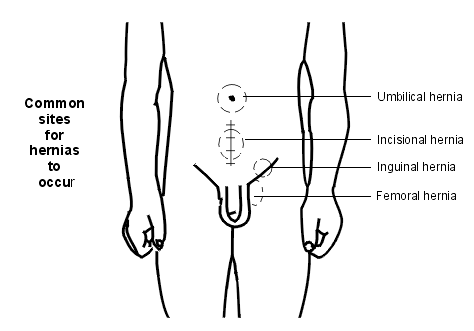
What are the types of hernia?
The most common types are listed here:
Hernie
Leistenbruch
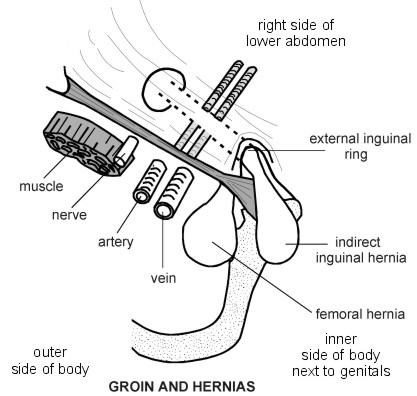
This is the most common type. They are more likely in males, as they have a small tunnel in the tissues of their groins which occurred when they were developing as a baby. This tunnel allowed the testicles (testes) to come down from the tummy (abdomen) into the scrotum. Tissue from the intestines can also pass into this tunnel, forming an inguinal hernia.
There are two main types:
Indirect, which are usually congenital and common in boys.
Direct, which are more common in adult men.
They can occur in both sides of the body.
Hernias in groin areas
Femurhernie
This also occurs when some tissue pushes through in the groin. It occurs a little lower down than where an inguinal hernia occurs, and it tends to be smaller. It occurs more commonly in women.
Operationshernie
This occurs when tissue pushes through a previous scar or wound. It is more common if you have had a scar in the past that has not healed well. For example, if the wound had an infection after the operation. It usually occurs within two years of having an operation.
Epigastric hernia
These present with a lump in the middle of the body, usually between the belly button and the sternum (breastbone). Presentation is usually between the ages of 20 and 50 and they are more common in men than in women. They are usually repaired surgically because small epigastric hernias are at risk of strangulation, and large ones are uncomfortable.
Umbilical and paraumbilical hernias
These occur when some tissue pushes through the abdomen near to the belly button (umbilicus). Umbilical hernias can be present from birth and in most cases the hernia goes back in and the muscles re-seal on their own before the baby is 1 year old. They will generally be repaired if they persist beyond 5 years of age or if they are very large.
Umbilical hernias may develop in adults with being overweight (obesity) and excessive accumulation of fluid within the peritoneum of the abdomen. The peritoneum is a lining of the abdomen and consists of two layers, one which lines the abdominal wall and the other which covers the organs in the abdomen.
Paraumbilical hernias occur in adults and appear above the umbilicus. Although they are generally small, they usually need repairing because there is a risk of intestines contained within them becoming strangulated.
Who develops hernias?
They may occur in adults as a result of the strain which raises the pressure in the tummy (abdomen), causing a weakness or tear in the abdominal wall. This can be caused by:
Being overweight or pregnant.
Lifting, carrying or pushing heavy loads.
Straining on the toilet.
Patientenauswahl für Andere Verdauungsbeschwerden
Verdauungsgesundheit
Hiatushernie
Ein Zwerchfellbruch ist der Begriff, der verwendet wird, um einen Zustand zu beschreiben, bei dem ein Teil des Magens durch eine Schwäche im Zwerchfell in den unteren Brustbereich drückt. Nicht jeder mit einem Zwerchfellbruch entwickelt Symptome. Wenn Sie jedoch einen Zwerchfellbruch haben, sind Sie anfälliger für Säurereflux in Ihre Speiseröhre, was Sodbrennen und andere Symptome verursachen kann. Wenn Symptome auftreten, wirkt eine Behandlung mit säurehemmenden Medikamenten in der Regel gut.
von Dr. Colin Tidy, MRCGP

Verdauungsgesundheit
Akute Pankreatitis
Akute Pankreatitis ist eine Entzündung der Bauchspeicheldrüse, die sich schnell entwickelt. Das Hauptsymptom ist Bauchschmerzen. Sie klingt in der Regel innerhalb weniger Tage ab, kann aber manchmal schwerwiegend und sehr ernst werden. Die häufigsten Ursachen für akute Pankreatitis sind Gallensteine und Alkoholkonsum über den empfohlenen Grenzen.
von Dr. Philippa Vincent, MRCGP
Häufig gestellte Fragen
Can hernias ever go away on their own without surgery?
For most types of hernias, especially in adults, they will not go away on their own. However, umbilical hernias present from birth in babies can often go back in and the muscles re-seal before the baby is 1 year old.
What is the recovery period after hernia surgery?
Newer surgical techniques mean that people tend to be off work for much shorter periods than in the past. Even those in heavy work can often return within two weeks. The operation is usually very successful.
Are there any long-term complications if a hernia is not treated?
If a hernia is not treated, it may gradually become bigger and more uncomfortable. The contents could also become trapped, leading to bowel obstruction with severe pain, nausea, and vomiting (incarcerated hernia). There's also a small risk of strangulation, where the blood supply to the trapped intestine is cut off, which can lead to severe pain and damage.
Is it possible for a hernia to return after it has been surgically repaired?
Yes, hernias can return (recur) in a small number of people, even after a successful operation. If this happens, a further operation may be advised to address the recurrence.
What does it mean if a hernia is described as 'incarcerated'?
An incarcerated hernia means that the contents of the hernia, such as a loop of bowel, have become trapped in the weak point of the abdominal wall. This can lead to serious symptoms like bowel obstruction, severe pain, nausea, and vomiting.
Weiterführende Literatur und Referenzen
- Castorina S, Luca T, Privitera G, et al; An evidence-based approach for laparoscopic inguinal hernia repair: lessons learned from over 1,000 repairs. Clin Anat. 2012 Sep;25(6):687-96. doi: 10.1002/ca.22022. Epub 2012 Jan 24.
- Lockhart K, Dunn D, Teo S, et al; Mesh versus non-mesh for inguinal and femoral hernia repair. Cochrane Database Syst Rev. 2018 Sep 13;9:CD011517. doi: 10.1002/14651858.CD011517.pub2.
- International guidelines for groin hernia management. Hernia. 2018 Feb;22(1):1-165. doi: 10.1007/s10029-017-1668-x. Epub 2018 Jan 12.
- Kockerling F, Simons MP; Current Concepts of Inguinal Hernia Repair. Visc Med. 2018 Apr;34(2):145-150. doi: 10.1159/000487278. Epub 2018 Mar 26.
Über den AutorVollständige Biografie anzeigen

Dr Toni Hazell, FRCGP
MBBS, BSc, FRCGP, DFSRH, Dip GU med, DRCOG, DCH (London, UK, 2000)
Dr. Toni Hazell hat ihren Abschluss an der St. Mary’s Hospital Medical School gemacht und ihr VTS am Northwick Park Hospital absolviert.
Über den RezensentenVollständige Biografie anzeigen

Dr Colin Tidy, MRCGP
Allgemeinmediziner, Medizinischer Autor
MBBS, MRCGP, MRCP (Paediatrics), DCH
Dr. Colin Tidy ist ein NHS-Arzt mit Sitz in Oxfordshire.
Artikelverlauf
Die Informationen auf dieser Seite wurden von qualifizierten Klinikern verfasst und begutachtet.
Artikel auch verfügbar in Englisch, Deutsch, Spanisch, Französisch, Italienisch, Portugiesisch, Hindi, Hebräisch, Arabisch, und Schwedisch.
Nächste Überprüfung fällig: 21. Jan. 2028
22. Jan 2023 | Neueste Version

Fragen, teilen, verbinden.
Durchsuchen Sie Diskussionen, stellen Sie Fragen und teilen Sie Erfahrungen zu Hunderten von Gesundheitsthemen.

Fühlen Sie sich unwohl?
Bewerten Sie Ihre Symptome online kostenlos
Abonnieren Sie den Patienten-Newsletter
Ihre wöchentliche Dosis klarer, vertrauenswürdiger Gesundheitsberatung - geschrieben, um Ihnen zu helfen, sich informiert, selbstbewusst und in Kontrolle zu fühlen.
Durch das Abonnieren akzeptieren Sie unsere Datenschutzrichtlinie. Sie können sich jederzeit abmelden. Wir verkaufen Ihre Daten niemals.
Mehr zur Verdauungsgesundheit
- Abdominalmassen
- Akute Pankreatitis
- Analfissur
- Antispasmodika
- Darmkrebs
- Darmkrebsvorsorge
- Cholezystitis
- Kryptosporidium
- Gallensteine
- Gastritis
- Helicobacter pylori
- Mallory-Weiss-Riss
- Norovirus
- Primär biliäre Cholangitis
- Primärer Leberkrebs
- Proctalgia fugax und Analschmerzen
- Rektalblutung
- Wiederkehrende Bauchschmerzen bei Kindern
- Symptome einer Blinddarmentzündung
- Eingeschlossene Luft, Gas und Blähungen