Keratosis pilaris
Peer reviewed by Dr Toni Hazell, FRCGPLast updated by Dr Jo SealeLast updated 29 Nov 2022
Meets Patient’s editorial guidelines
- DownloadDownload
- Share
- Language
- Discussion
- Audio Version
- Add to preferred sources on Google
Medical Professionals
Professional Reference articles are designed for health professionals to use. They are written by UK doctors and based on research evidence, UK and European Guidelines. You may find the Keratosis pilaris article more useful, or one of our other health articles.
Synonyms: hyperkeratosis, folliculocentric keratotic papules, follicular keratotic papules
Keratosis pilaris is a very common skin condition characterised by the presence of follicular keratotic papules, sometimes associated with baseline erythema on the affected areas. Keratosis pilaris is often described in association with other dry skin conditions.
How common is keratosis pilaris? (Epidemiology)
It affects nearly 50-80% of all adolescents and approximately 40% of adults.1
Most people with keratosis pilaris are asymptomatic and are often unaware of the condition.
There is no racial bias but females are affected more often than males.
It tends to present in the first decade of life. It may become worse in adolescence and often improves or disappears in adult life.
Around half of cases have a positive family history.
There have been reports of genetic syndromes, such as chromosome 18p deletion, which may manifest as prominent and extensive keratosis pilaris.2
Risk factors
There is an association with ichthyosis and atopy. It tends to improve in the summer. There may be a chronic course of exacerbations and remissions. It is worse with dry skin.
Other associations of keratosis pilaris include scarring alopecia, ectodermal dysplasia, obesity and Down's syndrome.1 3
Keratosis pilaris symptoms3
There is a rough, goose-flesh appearance of the skin.
There are small papules of keratosis that are one to two millimetres in diameter.
There may be some erythema around the lesions or they may be a normal skin colour. A coiled hair may be apparent beneath the papule.
Pruritus may also be present
Keratosis pilaris can affect all skin surfaces where hair grows. However, it is more common on the proximal and extensor surfaces of extremities and convex areas such as cheeks and buttocks.
Keratosis pilaris - moderate
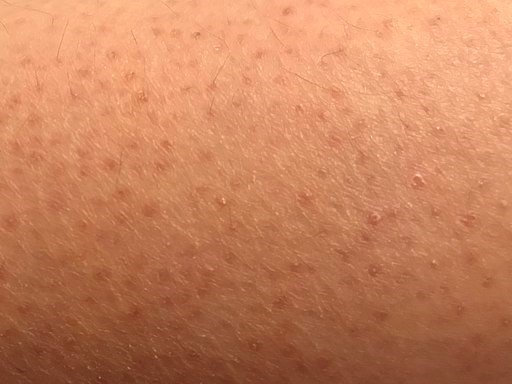
© QuarterNotes, CC BY-SA 4.0, via Wikimedia Commons
Differential diagnosis
Eruptive vellus hair cysts.
Keratosis follicularis (Darier's disease).
Kyrle's disease.
Lichen nitidus.
Lichen spinulosus.
Perforating folliculitis.
Investigations
The diagnosis is purely clinical and no investigations are required. In very exceptional atypical cases a skin biopsy with histopathological examination may be used to confirm diagnosis.
Keratosis pilaris treatment and management
Current treatment options for keratosis pilaris can temporarily improve the condition although they do not cure it.4 Treatment options vary, focusing on avoiding skin dryness using emollients and adding keratolytic agents when necessary.5
The British Association of Dermatologists recommends the following:4
Avoid excessive dryness of the skin; emollients and moisturisers can help soften the skin.
Creams with salicylic acid, lactic acid or urea may be of use in flattening the bumps on the skin
Expensive cosmetic or vitamin creams have not been shown to be effective.
An abrasive pad may be helpful.
Take tepid showers rather than hot baths.
Laser treatment has been shown to lead to significant improvements in skin texture and roughness or bumpiness in keratosis pilaris patients.6
Complications
Complications are uncommon. Pigmentary changes and even scarring can sometimes occur.
Prognosis
It often resolves spontaneously over time but there may be exacerbations and remissions over many years. The outcome can be quite variable between cases.
Exclusive updates for healthcare professionals
Stay informed with the latest clinical updates, professional insights, and evidence-based guidance. The Patient Pro newsletter curates essential content for healthcare professionals—delivered straight to your inbox.
By subscribing you accept our Privacy Policy. You can unsubscribe at any time. We never sell your data.
Further reading and references
- Keratosis pilaris; DermNet
- Thomas M, Khopkar US; Keratosis pilaris revisited: is it more than just a follicular keratosis? Int J Trichology. 2012 Oct;4(4):255-8. doi: 10.4103/0974-7753.111215.
- Carvalho CA, Carvalho AV, Kiss A, et al; Keratosis pilaris and ulerythema ophryogenes in a woman with monosomy of the short arm of chromosome 18. An Bras Dermatol. 2011 Jul-Aug;86(4 Suppl 1):S42-5.
- Wang JF, Orlow SJ; Keratosis Pilaris and its Subtypes: Associations, New Molecular and Pharmacologic Etiologies, and Therapeutic Options. Am J Clin Dermatol. 2018 Oct;19(5):733-757. doi: 10.1007/s40257-018-0368-3.
- Keratosis Pilaris; British Association of Dermatologists
- Hwang S, Schwartz RA; Keratosis pilaris: a common follicular hyperkeratosis. Cutis. 2008 Sep;82(3):177-80.
- Maghfour J, Ly S, Haidari W, et al; Treatment of keratosis pilaris and its variants: a systematic review. J Dermatolog Treat. 2022 May;33(3):1231-1242. doi: 10.1080/09546634.2020.1818678. Epub 2020 Sep 14.
About the authorView full bio

Dr Jo Seale
About the reviewerView full bio

Dr Toni Hazell, FRCGP
MBBS, BSc, FRCGP, DFSRH, Dip GU med, DRCOG, DCH (London, UK, 2000)
Dr. Toni Hazell qualified from St. Mary’s Hospital Medical School and did her VTS at Northwick Park Hospital.
Article history
The information on this page is written and peer reviewed by qualified clinicians.
Article also available in English, German, Spanish, French, Italian, Portuguese, Hindi, Hebrew, Arabic, and Swedish.
Next review due: 28 Nov 2027
29 Nov 2022 | Latest version

Ask, share, connect.
Browse discussions, ask questions, and share experiences across hundreds of health topics.

Feeling unwell?
Assess your symptoms online for free
More in dermatology
- Albinism
- Birt-Hogg-Dubé syndrome
- Boils and carbuncles
- Bullous pemphigoid
- Coxsackievirus infection
- Eczema on hands and feet
- Erythema induratum
- Erythema marginatum rheumatica
- Guttate psoriasis
- Juvenile plantar dermatosis
- Mastocytosis and mast cell disorders
- Molluscum contagiosum
- Necrotising fasciitis
- Parkes Weber's syndrome
- Port-wine stain
- Rosacea and rhinophyma
- Scabies
- Topical steroids for the skin
- Vasculitis
- Vulval problems