Ein Nasenbluten stoppen
Fachlich geprüft von Dr Colin Tidy, MRCGPZuletzt aktualisiert von Dr Hayley Willacy, FRCGP Zuletzt aktualisiert 24. Okt 2023
Entspricht den redaktionellen Richtlinien
- HerunterladenHerunterladen
- Teilen
- Language
- Diskussion
- Audio-Version
- Zu bevorzugten Quellen bei Google hinzufügen
In dieser Serie:Nasenbluten
This leaflet is created from first aid advice provided by St John Ambulance, the nation's leading first aid charity. This advice is no substitute for first aid training - find a training course near you.
Auf einen Blick
A nosebleed is blood flowing from one or both nostrils, often from ruptured tiny blood vessels.
Common causes include a blow to the nose, sneezing, picking, or blowing the nose.
To stop a nosebleed, sit down and lean forward, then pinch the soft part of your nose.
Do not speak, swallow, cough, spit, or sniff to avoid disturbing blood clots.
Seek urgent medical help if bleeding is severe, lasts over 30 minutes, or if blood is thin and watery after a head injury.
What is a nose bleed?
A nose bleed is when blood flows from one or both nostrils. It's normally caused by the tiny blood vessels inside the nostrils being ruptured.
Common causes of nose bleeds include a blow to the nose, sneezing, picking or blowing the nose, and high blood pressure.
What to look for with a nose bleed
Most nose bleeds are minor and only last a few minutes, but they can be dangerous if someone loses a lot of blood or if they have frequently nose bleeds.
If someone has had a blow to the head, the blood may appear thin and watery. This could mean that their skull is fractured and fluid is leaking from around the brain. If that happens, it is very serious and you should call 999 or 112 for emergency medical help. See advice for Kopfverletzungen.
How to stop a nose bleed
If someone is having a nose bleed, your priority is to control the bleeding and keep their airway open. To stop a nose bleed:
Get them to sit down (not lie down) as keeping the nose above the heart will reduce bleeding.
Get them to lean forward (not backwards), to make sure the blood drains out through their nose, rather than down their throat which could block their airway.
Nose pinch SJA
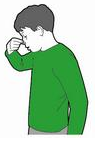
Ask them to breathe through their mouth and pinch the soft part of the nose, taking a brief pause every ten minutes, until the bleeding has stopped.
Encourage them not to speak, swallow, cough, spit or sniff because this may break blood clots that may have started to form in the nose.
If the bleeding is severe, or if it lasts more than 30 minutes, call 999 or 112 for medical help.
Hinweis: these hints are no substitute for thorough knowledge of first aid. St John Ambulance holds first aid courses throughout the country.
What will my GP do if I have nosebleeds?
When you go and see your local doctor about a nosebleed, they will ask you questions about the bleeds, such as how often they occur and how long they last? Do both nostrils bleed or does it tend to be one side? They will try to discover what might have caused the bleeding. They will ask about what medicines you take, if any, and any family history of bleeding disorders. Then they will examine the inside of your nose and take your blood pressure. A high blood pressure can cause nose bleeds.
Sometimes the GP may be able to see a bleeding point (a small blood vessel) in the nostril and cauterise it. This might be with electrocautery or silver nitrate. This can be quite uncomfortable to tolerate and similar results are obtained using a cream called Naseptin® for a few days. If they cannot stop the bleeding they will pack the nose with soft dressing material. This applies pressure to the small blood vessels and stops the bleeding.
Preventing a nosebleed
Try to avoid picking your nose and keep your fingernails short.
Blow your nose less often and do so gently.
Don't allow your nostrils to become dry. If you feel the skin is dry, you can help by applying a small amount of petroleum jelly.
If you use a nasal decongestant, follow the instructions carefully. Overusing them can cause nosebleeds.
Adapted from the St John Ambulance leaflet: nose bleeds. Copyright for this leaflet is with St John Ambulance.
Patientenauswahl für Nase und Nebenhöhlen

Ohr, Nase und Hals
Chronische Rhinitis
Persistierende Rhinitis verursacht typischerweise Niesen sowie eine verstopfte, juckende und laufende Nase. Eine Allergie ist eine häufige Ursache, aber es gibt auch nicht-allergische Ursachen. Behandlungsoptionen umfassen das Vermeiden von Dingen, die eine Allergie auslösen, ein Antihistamin-Nasenspray, Antihistamin-Tabletten und ein Steroid-Nasenspray. Andere Behandlungen werden manchmal ebenfalls eingesetzt.
von Dr. Doug McKechnie, MRCGP
Ohr, Nase und Hals
Nasale Verstopfung
Nasale Verstopfung ist ein blockiertes, verstopftes oder verstopftes Gefühl in der Nase. Dieses Merkblatt behandelt die Ursachen und die Behandlung der nasalen Verstopfung.
von Dr. Philippa Vincent, MRCGP
Häufig gestellte Fragen
What should I do if a nose bleed happens after a head injury and the blood is watery?
If someone has had an injury to their head and the blood from their nose appears thin and watery, it is a very serious situation. This could indicate a skull fracture and the leaking of fluid from around the brain. You should immediately call 999 or 112 for emergency medical help.
How long does a typical nose bleed last?
Most nose bleeds are minor and usually stop within a few minutes. However, if a nosebleed lasts for more than 30 minutes or if there is a significant amount of blood loss, it can be dangerous and medical help should be sought.
When should I be concerned enough about a nose bleed to call for emergency help?
You should call 999 or 112 for medical help if the nosebleed is severe, lasts for more than 30 minutes, or if it occurs after a head injury and the blood appears thin and watery.
What medicines can cause nose bleeds?
The article mentions that your doctor will ask about any medicines you take to determine if they might be causing the bleeding, but it does not specify which particular medicines can cause nosebleeds.
What should I avoid doing when I have a nose bleed to help it stop?
To help a nosebleed stop and prevent further bleeding, you should avoid speaking, swallowing, coughing, spitting, or sniffing. These actions can disrupt any blood clots that are forming in the nose and restart the bleeding.
What can a doctor do if my nose bleeds frequently?
If you visit your GP for frequent nosebleeds, they will ask about your bleeding patterns, examine your nose, and check your blood pressure. They may be able to see a bleeding point inside your nostril and treat it using electrocautery or silver nitrate, or by prescribing a cream like Naseptin®. If these methods don't stop the bleeding, they might pack your nose with a soft dressing.
Weiterführende Lektüre und Referenzen
- Epistaxis (Nasenbluten); NICE CKS, Oktober 2024 (nur für UK-Zugang)
- Tunkel DE, Anne S, Payne SC, et al; Clinical Practice Guideline: Nosebleed (Epistaxis). Otolaryngol Head Neck Surg. 2020 Jan;162(1_suppl):S1-S38. doi: 10.1177/0194599819890327.
Über den AutorVollständige Biografie anzeigen

Dr Hayley Willacy, FRCGP
Allgemeinmediziner, Medizinischer Autor
MBChB (1992), DRCOG, DFFP, MRCOG (Part 1) MRCGP (2007), DFSRH (2013), MSc - medical education (2020)
Dr. Hayley Willacy war eine NHS-Hausärztin, die in Nordwestengland arbeitete und 2022 nach 30 Jahren aus der klinischen Praxis ausschied.
Über den RezensentenVollständige Biografie anzeigen

Dr Colin Tidy, MRCGP
Allgemeinmediziner, Medizinischer Autor
MBBS, MRCGP, MRCP (Paediatrics), DCH
Dr. Colin Tidy ist ein NHS-Arzt mit Sitz in Oxfordshire.
Artikelverlauf
Die Informationen auf dieser Seite wurden von qualifizierten Klinikern verfasst und begutachtet.
Artikel auch verfügbar in Englisch, Deutsch, Spanisch, Französisch, Italienisch, Portugiesisch, Hindi, Hebräisch, Arabisch, und Schwedisch.
Nächste Überprüfung fällig: 22. Okt. 2028
24. Okt 2023 | Neueste Version

Fragen, teilen, verbinden.
Durchsuchen Sie Diskussionen, stellen Sie Fragen und teilen Sie Erfahrungen zu Hunderten von Gesundheitsthemen.

Fühlen Sie sich unwohl?
Bewerten Sie Ihre Symptome online kostenlos
Abonnieren Sie den Patienten-Newsletter
Ihre wöchentliche Dosis klarer, vertrauenswürdiger Gesundheitsberatung - geschrieben, um Ihnen zu helfen, sich informiert, selbstbewusst und in Kontrolle zu fühlen.
Durch das Abonnieren akzeptieren Sie unsere Datenschutzrichtlinie. Sie können sich jederzeit abmelden. Wir verkaufen Ihre Daten niemals.
Mehr zu Ohr, Nase und Hals
- Akustikusneurinom
- Akute Sinusitis
- Barotrauma des Ohrs
- Verstopfte Nase bei Babys
- Cholesteatom
- Abschwellende Mittel
- Ohrenschmalz
- Epiglottitis
- Pfeiffersches Drüsenfieber
- Heuschnupfen
- Hörtests
- Hausstaubmilben- und Tierallergie
- Nasenbluten
- Otosklerose
- Perforiertes Trommelfell
- Halsschmerzen
- Steroidhaltige Nasensprays
- Kehlkopfkrebs
- Tinnitus
- Mandelentzündung