
Ihre Hoden kennenlernen
Begutachtet von Dr John Cox, MRCGPVerfasst von Dr Laurence KnottUrsprünglich veröffentlicht 11 Okt 2017
Erfüllt die redaktionelle Richtlinien
- HerunterladenHerunterladen
- Teilen
- Language
- Diskussion
- Audio-Version
- Zu bevorzugten Quellen bei Google hinzufügen
Wenn Sie ein junger Mann oder Teenager sind, sollten Sie wissen, wie sich Ihre Hoden (Testikel) normalerweise anfühlen. Melden Sie Ihrem Arzt alle Veränderungen oder Knoten.
Why should I know how my testicles (testes) feel?
Although uncommon, cancer of the testicles (testicular cancer) is the most common cancer in young men in the UK. About 1 man in 500, aged between 15 and 50 years, develops testicular cancer. The exact cause is not known. However, if caught early it is one of the easiest cancers to treat and cure. So, If you are a teenage boy or young man, you should get to know how each testicle (testis) normally feels. Any changes would then be easier to detect. This is especially important for brothers of people with testicular cancer, as they have a higher-than-average chance of developing this type of cancer.
Normal testicles (testes)
Cross-section view
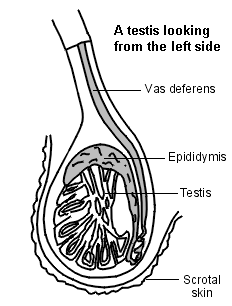
The best time to feel your testes is after a bath or shower when you are relaxed. Hold each testicle (testis) in turn in the palm of a hand and use your finger and thumb gently to feel the testes and nearby structures.
It is normal for one testis to be slightly bigger than the other and for one to hang slightly lower than the other. The testes themselves feel like smooth, soft balls inside the baggy scrotum. At the top and to the back of each testis is the epididymis (this stores the sperm). This feels like a soft swelling attached to the testis; it can be quite tender if you press it firmly. Leading from the epididymis is the vas deferens. You can feel each vas deferens at each side at the back and top of the scrotum. They feel like soft, narrow tubes which pass up and into the groin. (The vas deferens carries the sperm to the penis.) Some people confuse the normal epididymis or vas deferens with an abnormal lump.
What changes should I look out for?
If you notice any change in size or weight of a testicle (testis), or any abnormal lumps, swellings, or tender spots, see your doctor. Doctors are used to examining testicles (testes) and will be able to advise if the abnormality is serious or not.
Hinweis: most abnormalities are not cancer. For example: collections of fluid, infections, and harmless cysts are common and treatable. Testicular cancer usually starts as a small, hard, painless lump on one testis, which you can feel away from the normal soft lump of the epididymis.
What if it is cancer?
Treatment of cancer of the testicle (testis) is often effective. In more than 9 in 10 cases, treatment can result in a complete cure. However, the earlier it is detected, the easier it is to treat. More than a third of people with this cancer consult their doctor after the cancer has spread, which makes treatment more difficult. Often this is because of unfounded fears, or just hoping it will go away.
Patientenauswahl für Hodenbeschwerden

Männergesundheit
Beeinflusst Hodenkrebs Ihre Fruchtbarkeit?
Hodenkrebs hat eine der höchsten Überlebensraten aller Krebsarten, aber die Auswirkungen auf die männliche Fruchtbarkeit variieren je nach Art der Behandlung.
von Amberley Davis

Männergesundheit
Wie man sich selbst auf Hodenkrebs untersucht
Das Überprüfen Ihrer Hoden kann eine einfache Möglichkeit sein, um sicherzustellen, dass es keine ungewöhnlichen Knoten und Beulen gibt, die das erste Anzeichen von Hodenkrebs sein können. Es kann jedoch schwierig sein zu wissen, was man tut, besonders wenn man es noch nie zuvor gemacht hat.
von Lydia Smith
Über den AutorVollständige Biografie anzeigen
Verfasst von

Dr. Laurence Knott
Allgemeinmediziner, Medizinischer Autor
BSc (Hons) Biochemie, MBBS
Dr. Laurence Knott qualifizierte sich 1973 und hat umfangreiche Erfahrung als Allgemeinmediziner.
Über den RezensentenVollständige Biografie anzeigen

Dr John Cox, MRCGP
MA, MB, B Chir, DCH, DRCOG, MRCP (UK), MRCGP
Dr. John Cox arbeitete als Assistenzarzt im Vereinigten Königreich und in Neuseeland sowie als Vertretungsarzt in Neuseeland.
Artikelverlauf
Artikel auch verfügbar in Englisch, Deutsch, Spanisch, Französisch, Italienisch, Portugiesisch, Hindi, Hebräisch, Arabisch, und Schwedisch.
11 Okt 2017 | Ursprünglich veröffentlicht
Verfasst von:
Dr. Laurence KnottBegutachtet von
Dr John Cox, MRCGP
Nehmen Sie an der Diskussion teil
Teilen Sie Ihre Gedanken oder Erfahrungen mit anderen in unserem Patientengemeinschaften.

Fragen, teilen, verbinden.
Durchsuchen Sie Diskussionen, stellen Sie Fragen und teilen Sie Erfahrungen zu Hunderten von Gesundheitsthemen.

Fühlen Sie sich unwohl?
Bewerten Sie Ihre Symptome online kostenlos
Abonnieren Sie den Patienten-Newsletter
Ihre wöchentliche Dosis klarer, vertrauenswürdiger Gesundheitsberatung - geschrieben, um Ihnen zu helfen, sich informiert, selbstbewusst und in Kontrolle zu fühlen.
Durch das Abonnieren akzeptieren Sie unsere Datenschutzrichtlinie. Sie können sich jederzeit abmelden. Wir verkaufen Ihre Daten niemals.