
Wie groß ist die durchschnittliche Körpergröße von Männern?
Begutachtet von Dr Krishna Vakharia, MRCGPZuletzt aktualisiert von Amberley DavisZuletzt aktualisiert 30 May 2024
Erfüllt die Anforderungen des Patienten Richtlinien des Patienten
- HerunterladenHerunterladen
- Teilen
- Language
- Diskussion
- Audio-Version
- Zu bevorzugten Quellen bei Google hinzufügen
Wie schneiden Sie im Vergleich zur durchschnittlichen Körpergröße für Männer in Ihrem Land ab? Die Körpergröße wurde mit Lebenserwartung, Krankheiten und sogar akademischem sowie finanziellem Erfolg in Verbindung gebracht. Hier untersuchen wir, was Ihre Körpergröße und Taillenumfang über Ihre Gesundheit aussagen können.
Average height of men by region
You may wonder if you're shorter or taller than the average height for men in your country, or how you measure up on a global scale.
Several factors influence how tall you could grow. Understanding them, and knowing your height-to-weight ratio, can help you understand your own health a bit better.
Average height for men in the UK
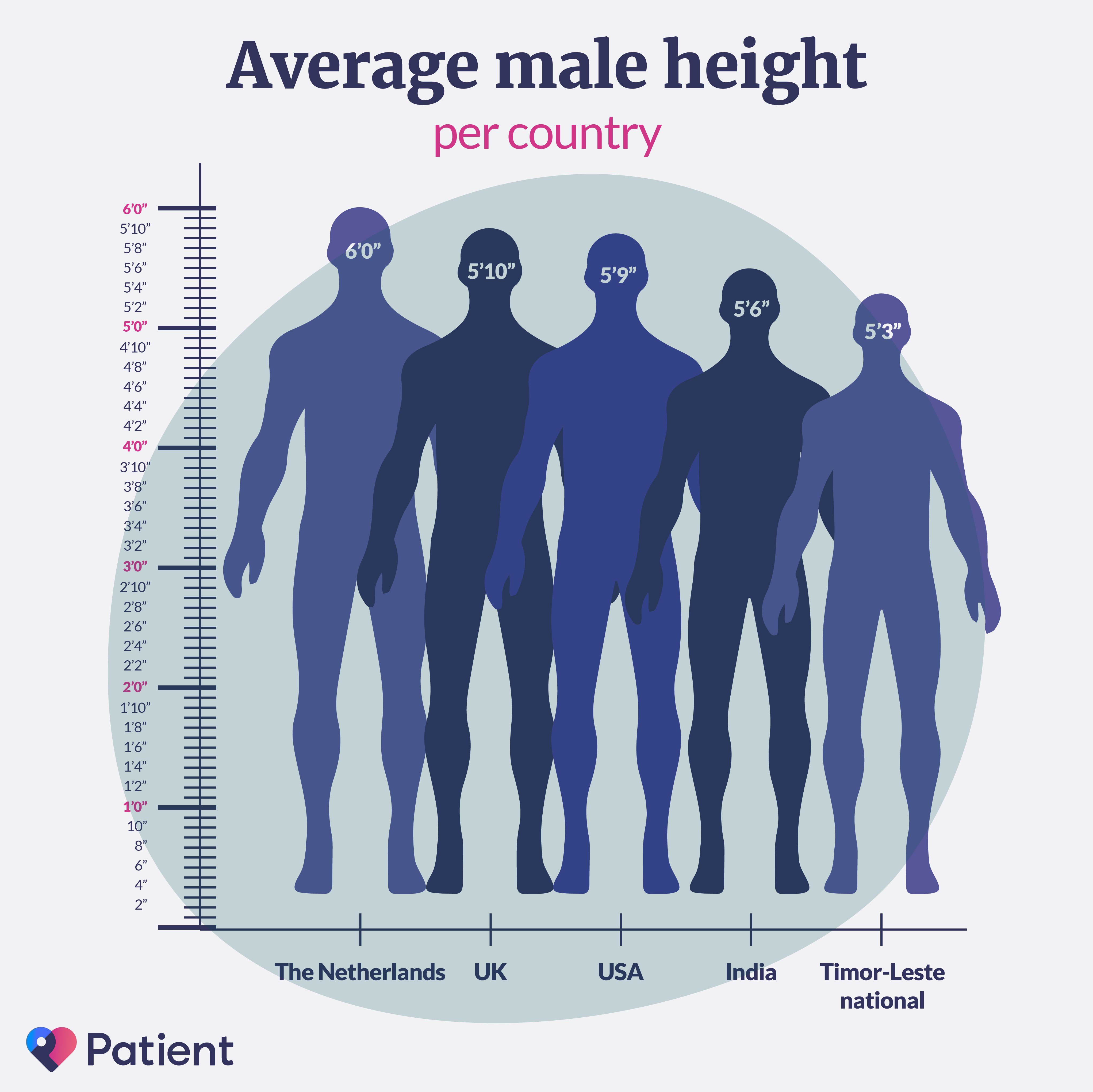
In the UK, the average man is considered relatively tall compared with other countries. According to 2024 data1, the average height for men here is 178.2 cm - this is equal to 5 ft 10 in.
Average height for men in the USA, Canada, Australia, and India
There's not a great deal of difference in height between men from the UK and those in the USA, Australia, and Canada. On average, Indian men are four to five inches shorter than these countries - this reflects the general trend that South Asia is the continent with the shortest height.
The average height for men in Canada - 178.7 cm/ 5 ft 10.5 in.
The average height for men in Australia - 178.8 cm/ 5 ft 10.5 in.
The average height for men in the USA - 176.9 cm/ 5 ft 9.5 in.
The average height for men in India - 167.6 cm/ 5 ft 6 in.
What are the 5 tallest countries for men?
The Netherlands - 183.8 cm/ 6 ft.
Montenegro - 183.3 cm/ 6 ft.
Estonia - 182 cm/ 5 ft 11.5 in.
Croatia - 181 cm/ 5 ft 11 in.
Slovenia - 180.5 cm/ 5 ft 11 in.
What are the 5 shortest global countries for men?
Timor Leste - 160 cm/ 5 ft 3 in.
Laos - 162.5 cm/ 5 ft 4 in.
Soloman Islands - 162.8 cm/ 5 ft 4 in.
Papua New Guinea - 163 cm/ 5 ft 4 in.
Mozambique - 165 cm/ 5 ft 5 in.
Figures in cm are rounded up or down for conversion into feet and inches
Average male height
Factors that influence height
There is around 24 cm (9.4 in) between the shortest and tallest average height for men in the world. Within any given population, the actual height difference can be even greater than this.
This is because there are several factors that influence differences in height. These influence both men and women equally, but women have genetics to thank for shorter average heights.
Genetik
Experts believe that your inherited DNA determines around 80% of your height2. This means that 80% of height differences between people can be attributed to genetics. This is a predetermined height that could never be changed, no matter where you grew up or how your health has been affected.
Geographical location
Genetics also partially explains the height differences between different countries. When it comes to the biological differences between regions, each race has a set of shared genetic characteristics, including average height3.
But this is only part of the story. Your location also impacts many other height-influencing factors, including your exposure to vitamin D through sunlight, access to nutritious food, and vulnerability to serious diseases.
Ernährung
What you eat growing up also affects how tall you'll grow. Key nutrients such as vitamin D and Kalzium are needed for bone growth, and so a diet lacking in these could lead you to fall short of your potential maximum height.
Birth weight and premature birth
Your birth weight is determined by several factors, including genetics and the nutrition you receive in the womb. It's an important predictor of a person's adult height - the general rule is that the more you weigh at birth, the taller you're likely to be4.
Frühgeborene - those born before their due date - usually have a below average birth weight. At the same time, prematurity is also an independent factor that slows down growth. Although many preterm babies reach the same average heights as non-preterm babies in adulthood, many are shorter in childhood and adolescence5.
Environment versus genetics - The Romans in Britain
The Roman occupation in Britain during 200-410 AD is a great example of the effects of the environment on average height. Although the genetic traits of Britons didn't change, average height rose from 167 cm (5 ft 5 in) to 170 cm (5 ft 6 in) during this period.
Scientists attribute this national growth spurt to improved health thanks to the Roman's infrastucture6:
Cleaner drinking water.
Improved sanitation systems.
A more varied diet.
Over time, height declined when Britons abandoned Roman cities and their more hygienic water and waste systems.
What medical conditions can affect men's height?
Children or adolescents affected by serious diseases and disorders will generally be shorter as adults7. Here are some examples8:
Illnesses affecting the whole body, known as systemic diseases - for example Diabetes, Herzerkrankungen, and digestive tract diseases.
Illnesses that create hormone imbalances, known as endocrine diseases - for example growth hormone deficiency and Cushing’s syndrome.
A handful of medical conditions can also lead to extremes in height, including:
Achondroplasia - leads to short legs and arms and is the most common cause of those with short stature (medical term: dwarfism).
Spondyloepiphyseal dysplasias (SED) - leads to a shorter trunk.
Hypophysentumoren - in children these tumours can cause excess growth and result in people becoming much taller than they would have.
Acromegaly - is a condition in adults where too much growth hormone is produced causing increased height but also increased bone in arms, hands and the face. There are also a number of other symptoms associated with this rare condition. Famously, Richard Kiel (Jaws in James Bond) had this condition.
What is the link between height, weight, and health?
Do taller people enjoy better health and wellbeing? Studies suggest that people who are taller - but aren't extremely tall - generally live longer and have a lesser chance of developing some diseases, including Schlaganfall und Herzerkrankungen7.
However, being tall can also make you more at risk of some cancers, including, ovarian, pancreatic, prostate and colorectal cancer7.
Extremes of height at both ends of the spectrum can also have lots of health risks. For example, being very short could lead to back pain or breathing difficulties if you have a hunched or swayed back, while being very tall puts extra strain on your metabolic systems, increasing your chances of heart disease and Diabetes.
Height and weight
Some of these health issues are outside of your control, but others aren't. While you can't control your height, you can manage your weight, and your height to weight ratio determines your risk of cardiovascular illnesses - diseases affecting you heart and blood vessels.
It's this rule that favours taller people - it's generally easier to maintain a healthy weight-height balance when you're tall. If you've ever had a healthcare professional check your Körpermasseindex (BMI), this is what they're measuring.
A BMI-Rechner works out if your weight is healthy for your height.
Although a useful tool, BMI doesn't tell the whole story, for example, where fat sits on your body and influencing factors such as gender. Modern studies reveal that storing excess fat around your waist is a significant predictor of health. Relative fat mass (RFM) aims to take this into account9.
A RFM calculator specifically measures the fat around your waist in comparison to your height.
Weiterführende Lektüre
National Library of Medicine: Is height determined by genetics?
Mittal et al: Short stature: understanding the stature of ethnicity in height determination.
Jelenkovic et al: Associations between birth size and later height from infancy through adulthood.
Ferguson et al: Adult height of preterm infants: a longitudinal cohort study.
University of Oxford: Highs and lows of an Englishman’s average height over 2000 years.
Woolcott and Bergman: Relative fat mass (RFM) as a new estimator of whole-body fat percentage.
Patientenauswahl für Allgemeine Männergesundheit

Männergesundheit
9 Anzeichen für niedrigen Testosteronspiegel bei Männern
Wenn Sie sich ungewöhnlich müde, launisch fühlen oder das Interesse an Dingen verlieren, die Ihnen früher Freude bereitet haben, könnte ein niedriger Testosteronspiegel die Ursache sein – und das ist häufiger, als Sie denken.
von Heather Ainsworth
Männergesundheit
Wie groß ist die durchschnittliche Körpergröße von Männern?
Wie schneiden Sie im Vergleich zur durchschnittlichen Körpergröße für Männer in Ihrem Land ab? Die Körpergröße wurde mit Lebenserwartung, Krankheiten und sogar akademischem sowie finanziellem Erfolg in Verbindung gebracht. Hier untersuchen wir, was Ihre Körpergröße und Taillenumfang über Ihre Gesundheit aussagen können.
von Amberley Davis
Über den AutorVollständige Biografie anzeigen

Amberley Davis
Senior-Autorin
BA (Hons), CPD
Amberley ist eine leitende Autorin bei Patient und hat umfangreich über eine Vielzahl von Gesundheits- und Wohlfühlthemen geschrieben.
Über den RezensentenVollständige Biografie anzeigen

Dr Krishna Vakharia, MRCGP
Chief Medical Officer für Gesundheit, Optum UK
MBChB, MRCGP(2013), BMedSci (hons), DFSRH, DRCOG, PGDipDerm (Distn)
Dr. Krishna Vakharia ist eine NHS-Hausärztin. Sie ist auch regelmäßige Prüferin für das postgraduale Diplom in Praktischer Dermatologie an der Cardiff University und zudem Chief Medical Officer für Gesundheit bei Optum UK.
Artikelverlauf
Die Informationen auf dieser Seite werden von qualifizierten Klinikern begutachtet.
Artikel auch verfügbar in Englisch, Deutsch, Spanisch, Französisch, Italienisch, Portugiesisch, Hindi, Hebräisch, Arabisch, und Schwedisch.
Next review due: 30 May 2027
30 May 2024 | Neueste Version
22. Nov. 2022 | Ursprünglich veröffentlicht
Verfasst von:
Amberley Davis

Fragen, teilen, verbinden.
Durchsuchen Sie Diskussionen, stellen Sie Fragen und teilen Sie Erfahrungen zu Hunderten von Gesundheitsthemen.

Fühlen Sie sich unwohl?
Bewerten Sie Ihre Symptome online kostenlos
Abonnieren Sie den Patienten-Newsletter
Ihre wöchentliche Dosis klarer, vertrauenswürdiger Gesundheitsberatung - geschrieben, um Ihnen zu helfen, sich informiert, selbstbewusst und in Kontrolle zu fühlen.
Durch das Abonnieren akzeptieren Sie unsere Datenschutzrichtlinie. Sie können sich jederzeit abmelden. Wir verkaufen Ihre Daten niemals.
Mehr zur Männergesundheit
- 9 Anzeichen für niedrigen Testosteronspiegel bei Männern
- Sind Testosteronpräparate für Männer sicher?
- Blasenprobleme, die Männer nicht ignorieren sollten
- Können Männer einen Pilz bekommen?
- Sex nach einer Vasektomie
- Wie Erektionsprobleme Ihre Beziehung beeinflussen können
- Wie man sich selbst auf Hodenkrebs untersucht
- Wie man vorzeitige Ejakulation verhindert
- Wie Ihr Lebensstil eine Ursache für eine niedrige Spermienzahl sein kann
- Ist es Prostatakrebs oder etwas anderes?
- Neuer Bluttest könnte aggressiven Prostatakrebs erkennen
- Die Entscheidung zur Erwachsenenzirkumzision: warum, wo und wie?
- Das männliche Fortpflanzungssystem
- Die einfachste Hautpflegeroutine für Männer
- Urin-Test für Prostatakrebs könnte zeigen, wer dringend behandelt werden muss
- Was sind die Anzeichen von Depressionen bei Männern?
- Was sind die Anzeichen für Prostatakrebs?
- Was ist toxische Männlichkeit und wie wirkt sie sich auf Männer aus?
- Wie es ist, eine Vasektomie zu haben
- Werden wir jemals eine Verhütungspille für Männer haben?