Milien
Begutachtet von Dr Hayley Willacy, FRCGP Zuletzt aktualisiert von Dr Philippa Vincent, MRCGPZuletzt aktualisiert 18. Apr 2023
Erfüllt die Anforderungen des Patienten Richtlinien des Patienten
- HerunterladenHerunterladen
- Teilen
- Language
- Diskussion
- Audio-Version
- Zu bevorzugten Quellen bei Google hinzufügen
Milien sind sehr kleine, erhabene, perlweiße oder gelbliche Beulen auf der Haut. Sie treten am häufigsten im Bereich der Wangen, Nase, Augen und Augenlider, Stirn und Brust auf. Allerdings können sie überall am Körper auftreten. Milien sind bei Neugeborenen sehr häufig, können aber Menschen jeden Alters betreffen. Bei Babys verschwinden Milien von selbst, und eine Behandlung ist nicht erforderlich. Bei anderen Menschen kann es länger dauern, bis sie verschwinden. In hartnäckigen Fällen kann eine Behandlung empfohlen werden.
Auf einen Blick
Milia are tiny, raised, pearly-white or yellowish bumps on the skin.
They are small skin cysts filled with a protein called keratin.
Milia are usually harmless and often clear up on their own without treatment.
There are different types, including neonatal milia in babies and primary or secondary milia in adults.
Do not try to squeeze or treat milia yourself, as this can cause skin damage, scarring, or infection.
If milia are widespread, persistent, or a concern, a dermatologist may suggest treatments.
In diesem Artikel:
Videoauswahl für Hautausschläge
Lesen Sie unten weiter
Was sind Milien?
A milium is a small, raised bump on the skin. It is a type of tiny skin cyst filled with a protein called keratin.
Many are usually found together and so they are called milia (the plural of milium).
What do milia look like?
Zurück zum InhaltMilia bei einem Neugeborenen
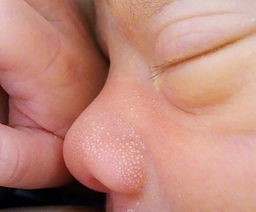
© Serephine, CC0, über Wikimedia Commons
As can be seen in the picture, milia are usually each about 1 or 2 millimetres across and are pearly-white or yellowish. They appear to be small white bumps on the face.
They are most often seen on the skin around the cheeks, nose, eyes and eyelids, forehead and chest but they can occur anywhere on the body.
Lesen Sie unten weiter
Types and causes of milia
Zurück zum InhaltThere are different types of milia.
Neonatal milia
These are milia that are seen in young babies soon after they are born. They are very common and are usually found around the nose area but may also occur on the scalp, cheeks, upper body and inside the mouth. They are thought to arise from sweat glands that aren't fully developed or mature. Around half of all babies develop neonatal milia. In fact, because they are so common, they are actually considered as normal in newborn babies - often they are called "milk spots" although they are nothing to do with milk. They usually disappear by 12 weeks of age.
Primäre Milien
These are milia that can occur in both children and adults. They occur in an area of skin that has otherwise been normal without any previous damage or injury.
Sekundäre Milien
These are milia that develop in an area of skin, anywhere on the body, that has previously been damaged or injured. For example, after a burn or a blistering rash. The milia develop as the skin heals and it is thought that damage to the sweat glands may be an underlying cause. Secondary milia also sometimes develop after some skin creams have been used.
Milia en plaque
Milia of this type are extremely rare. The milia develop on an inflamed, raised patch of skin known as a plaque which may be several centimetres across. The cause of milia en plaque is not fully understood. It usually occurs behind the ears, on an eyelid or on the cheeks or jaw area. This type of milia tends to particularly affect middle-aged women.
Multiple eruptive Milien
The milia appear in crops, or patches, of milia that develop over a period of weeks or months. The crops usually appear on the face, the upper arms and the upper trunk. Milia of this type are also extremely rare.
Milien-Symptome
Zurück zum InhaltMilia do not usually cause any symptoms but,they can occasionally become itchy.
Lesen Sie unten weiter
How are milia diagnosed?
Zurück zum InhaltMilia are usually diagnosed by their typical appearance and generally no investigations are needed. However, occasionally, if the diagnosis is uncertain or if milia en plaque are suspected, a skin biopsy might be recommended.
During a skin biopsy, a small piece of skin is removed so that it can be examined under a microscope. There are different ways that a skin biopsy can be carried out. For example, by shaving away a small piece of skin or by using a special instrument to punch a tiny hole in the skin.
How long do milia last?
Zurück zum InhaltMilia are harmless and, in most cases, they will eventually clear by themselves. In babies, they clear after a few weeks. However, in some people, milia can persist for months or longer. Secondary milia are sometimes permanent.
Milienbehandlung
Zurück zum InhaltBecause they normally clear by themselves, milia do not usually need any treatment. However, some people find them unsightly and so opt for treatment to remove milia.
Milia removal
Milia may be removed using a fine needle and then squeezing, or pricking, out the contents. No anaesthetic is needed. However, it is not recommended to squeeze or try to treat milia yourself. This can lead to skin damage and scarring or infection.
If milia become very widespread and persistent, various other treatments may be suggested, usually by a skin specialist (a dermatologist). They include:
Kryotherapie: a type of treatment that freezes skin lesions. Where a patch of skin has changed in appearance, it is known as a skin lesion.
Laserbehandlung.
Dermabrasion: a procedure that removes the topmost layers of the affected skin.
Chemical peeling: a treatment where a chemical is applied to the face to burn off skin lesions.
In the rare type of milia called milia en plaque, certain creams such as Isotretinoin or tretinoin are sometimes suggested as treatment, or the antibiotic tablet, minocycline.
Can milia be prevented?
Zurück zum InhaltMost milia cannot be avoided, particularly neonatal milia. The risk of developing secondary milia development can be reduced by avoiding excessive sun exposure, only using steroid creams for the length of time they are prescribed and regularly exfoliating and cleansing the skin to remove dead skin cells.
Patientenauswahl für Hautausschläge

Haut-, Nagel- und Haargesundheit
Aktinische Keratose
Aktinische Keratose (auch bekannt als Sonnenkeratose) ist die häufigste durch Sonnenschäden verursachte Hauterkrankung. Sie entsteht durch langjährige Sonneneinstrahlung, die die Haut schädigt. Aktinische Keratosen sind meist raue, schuppige Flecken auf sonnenexponierten Bereichen wie Kopf und Gesicht. Aktinische Keratosen sind häufig, besonders bei älteren Menschen, von denen viele mehr als eine haben. In der Regel sind sie harmlos, aber es besteht ein geringes Risiko, dass sie sich schließlich in Hautkrebs verwandeln können, weshalb eine Behandlung empfohlen werden kann.
von Dr. Doug McKechnie, MRCGP

Haut-, Nagel- und Haargesundheit
Epidermoide und Pilarzysten
Epidermoide und Pilarzysten werden häufig als 'Talgzysten' bezeichnet (ausgesprochen 'seb-ay-shuss'). Sie sind Überwucherungen von Hautzellen (genannt Keratin), die in einer kleinen Kapsel oder einem Sack zusammengehalten werden. Sie sind harmlose, glatte Knoten direkt unter der Hautoberfläche. Sie sind nicht krebsartig und müssen nicht entfernt werden, es sei denn, sie stören Sie durch ihr Aussehen oder Gefühl. Sie können fast überall am Körper auftreten, werden jedoch häufig am Rücken oder auf der Kopfhaut gefunden.
von Dr. Doug McKechnie, MRCGP
Häufig gestellte Fragen
Are milia itchy?
Milia typically do not cause any symptoms. However, on rare occasions, they can become itchy.
How to get rid of milia on eyelids?
It is not recommended to try to treat milia yourself, especially in sensitive areas like the eyelids, as this can lead to skin damage, scarring, or infection. Milia usually clear on their own. If they are persistent and bothersome, a skin specialist may suggest treatments like removal with a fine needle, cryotherapy, laser treatment, dermabrasion, or chemical peeling. For the rare type called milia en plaque, which can affect the eyelid, specific creams or an antibiotic tablet might be suggested.
What causes milia?
Different types of milia have different causes. Neonatal milia in babies are thought to arise from underdeveloped sweat glands. Primary milia in children and adults occur in otherwise normal skin without prior damage. Secondary milia develop in areas where the skin has been previously damaged, for instance, after a burn or blistering rash, and may involve damage to sweat glands. They can also sometimes appear after using certain skin creams. The causes of very rare types like milia en plaque and multiple eruptive milia are not fully understood.
What is the cure for milia?
Most milia do not require a 'cure' as they are harmless and will eventually clear up by themselves. In babies, they typically disappear within a few weeks. However, in some people, milia can last for months or longer, and secondary milia can sometimes be permanent. If you find them unsightly or they are persistent, treatment options are available through a skin specialist.
Weiterführende Literatur und Referenzen
- O'Connor NR, McLaughlin MR, Ham P; Neugeborenenhaut: Teil I. Häufige Ausschläge. Am Fam Physician. 1. Januar 2008;77(1):47-52.
- Milium, Milien; DermNet NZ
Lesen Sie unten weiter
Über den AutorVollständige Biografie anzeigen

Dr Michelle Wright, MRCGP
Allgemeinmediziner, Medizinischer Autor
MB, ChB, MRCGP, DCH, DRCOG
Dr. Michelle Wright qualifizierte sich 1997 im Vereinigten Königreich und arbeitete als Hausärztin in London, bevor sie in die Schweiz zog. Seit 2007 ist sie Autorin bei EMIS.
Über den RezensentenVollständige Biografie anzeigen

Dr Hayley Willacy, FRCGP
Allgemeinmediziner, Medizinischer Autor
MBChB (1992), DRCOG, DFFP, MRCOG (Part 1) MRCGP (2007), DFSRH (2013), MSc - medical education (2020)
Dr. Hayley Willacy war eine NHS-Hausärztin, die in Nordwestengland arbeitete und 2022 nach 30 Jahren aus der klinischen Praxis ausschied.
Artikelverlauf
Die Informationen auf dieser Seite wurden von qualifizierten Klinikern verfasst und begutachtet.
Nächste Überprüfung fällig: 16. Apr. 2028
18. Apr 2023 | Neueste Version
15 Mar 2012 | Ursprünglich veröffentlicht
Verfasst von:
Dr Michelle Wright, MRCGP

Fragen, teilen, verbinden.
Durchsuchen Sie Diskussionen, stellen Sie Fragen und teilen Sie Erfahrungen zu Hunderten von Gesundheitsthemen.

Fühlen Sie sich unwohl?
Bewerten Sie Ihre Symptome online kostenlos
Abonnieren Sie den Patienten-Newsletter
Ihre wöchentliche Dosis klarer, vertrauenswürdiger Gesundheitsberatung - geschrieben, um Ihnen zu helfen, sich informiert, selbstbewusst und in Kontrolle zu fühlen.
Durch das Abonnieren akzeptieren Sie unsere Datenschutzrichtlinie. Sie können sich jederzeit abmelden. Wir verkaufen Ihre Daten niemals.