Irak
Reisegesundheitsberatung, Impfungen und Risiken
Begutachtet von Nationales Netzwerk und Zentrum für Reisemedizin (NaTHNaC)Zuletzt aktualisiert von Nationales Netzwerk und Zentrum für Reisemedizin (NaTHNaC)Zuletzt aktualisiert 3. Juni 2026
Erfüllt die Anforderungen des Patienten Richtlinien des Patienten
- HerunterladenHerunterladen
- Teilen
- Language
- Diskussion
- Audio-Version
- Zu bevorzugten Quellen bei Google hinzufügen
Travellers are drawn to Iraq for Tigris river heritage, archaeological sites and date-palm groves. Give yourself time to explore local culture and landscapes as distances and climates can vary. For peace of mind, look over vaccine advice and other health precautions before travelling.
Ländersteckbrief
Land | Irak |
Amtssprache | Arabic; Kurdish |
Hauptstadt | Baghdad |
Währungseinheit | Iraqi dinar (ID) |
Längengrad | 43.679291 |
Breitengrad | 33.223191 |
Reisehinweise des Auswärtigen Amtes |
Allgemeine Informationen
Die Informationen auf diesen Seiten sollten genutzt werden, um Gesundheitsrisiken zu recherchieren und die Beratung vor der Reise zu informieren.
Reisende sollten die Länderspezifische Reisehinweise des Außen-, Commonwealth- und Entwicklungsministeriums (FCDO) (wo verfügbar) bietet Informationen zu Einreisebestimmungen sowie Sicherheits- und Schutzempfehlungen.
Reisende sollten idealerweise mindestens vier bis sechs Wochen vor der Reise einen Termin mit ihrem Gesundheitsdienstleister vereinbaren. Auch wenn die Zeit knapp ist, lohnt sich ein Termin dennoch. Dieser Termin bietet die Möglichkeit, Gesundheitsrisiken unter Berücksichtigung verschiedener Faktoren wie Reiseziel, Krankengeschichte und geplanter Aktivitäten zu bewerten. Für Personen mit bestehenden Gesundheitsproblemen wird ein früherer Termin empfohlen.
Alle Reisenden sollten sicherstellen, dass sie ausreichende Reisekrankenversicherung.
Eine Liste nützlicher Ressourcen, einschließlich Ratschlägen zur Verringerung des Risikos bestimmter Gesundheitsprobleme, ist unten verfügbar
Ressourcen
What vaccinations do I need for Iraq?
Details zu Impfempfehlungen und -anforderungen werden unten bereitgestellt.
Alle Reisenden
Reisende sollten gemäß den Empfehlungen im Vereinigten Königreich entsprechend ihrem Alter, ihrer Krankengeschichte und ihren individuellen Risiken auf dem neuesten Stand der routinemäßigen Impfungen und Auffrischungsimpfungen sein.
Aktueller Routine-Impfplan im Vereinigten Königreich
Die reisemedizinische Beratung bietet die Möglichkeit zu überprüfen, ob die Standardimpfungen wie MMR/MMRV und Diphtherie-Tetanus-Polio-Impfstoffe auf dem neuesten Stand sind. Der folgende Link bietet Informationen zu den aktuellen Empfehlungen Impfplan, der im Vereinigten Königreich empfohlen wird.
Länderspezifische Empfehlungen zur Diphtherie werden hier nicht bereitgestellt. In Großbritannien sind Diphtherie, Tetanus und Polio in einem einzigen Impfstoff kombiniert. Daher wird bei einer empfohlenen Tetanus-Auffrischimpfung für Reisende auch der Diphtherie-Impfstoff verabreicht. Im Falle eines Diphtherieausbruchs in einem Land werden spezifische Impfempfehlungen zur Diphtherie bereitgestellt.
Impfung von Personen mit unklarer oder unvollständiger Immunisierung
Für Personen mit einer unsicheren oder unvollständigen Impfanamnese finden Sie hier Hinweise für Gesundheitsfachkräfte Impfung von Personen mit unklarer oder unvollständiger Immunisierung.
Die UKHSA bietet ein Vergleichstool für Impfungen für Personen an, die möglicherweise im Ausland geimpft wurden Vergleichstool für Impfpläne im Vereinigten Königreich und international.
Selektive Impfprogramme
Personen, die aufgrund ihrer Arbeit, ihrer Lebensweise oder bestimmter gesundheitlicher Probleme ein erhöhtes Risiko für eine Infektionskrankheit haben, sollten mit zusätzlichen empfohlenen Impfungen auf dem neuesten Stand sein. Siehe Impfempfehlungen für diese Gruppen am Ende der 'Vollständiger Routine-Impfplan' Dokument. Die einzelnen Krankheitskapitel des 'Grünen Buches' Impfung gegen Infektionskrankheiten bietet weitere Details.
Zertifikatsanforderungen
Es gibt keine Zertifikatsanforderungen gemäß den Internationalen Gesundheitsvorschriften.
Die meisten Reisenden
Die Impfstoffe in diesem Abschnitt werden für die meisten Reisenden empfohlen, die dieses Land besuchen. Informationen zu diesen Impfstoffen finden Sie, indem Sie auf den blauen Pfeil klicken. Impfstoffe sind alphabetisch aufgelistet.
Hepatitis A
Hepatitis A ist eine Virusinfektion, die durch kontaminierte Lebensmittel und Wasser oder durch direkten Kontakt mit einer infizierten Person übertragen wird. Die Symptome sind bei kleinen Kindern oft mild oder fehlen ganz, aber die Krankheit kann mit zunehmendem Alter ernster werden. Die Genesung kann von Wochen bis zu Monaten variieren. Nach einer Hepatitis-A-Infektion ist die Immunität lebenslang.
Prävention
Alle Reisenden sollten auf persönliche Hygiene sowie auf Lebensmittel- und Wasserhygiene achten.
Hepatitis-A-Impfung
Da der Hepatitis-A-Impfstoff gut verträglich ist und einen langanhaltenden Schutz bietet, wird er für alle bisher ungeimpften Reisenden empfohlen.
Tetanus
Tetanus wird durch ein Toxin verursacht, das freigesetzt wird von Clostridium tetani Bakterien und tritt weltweit auf. Tetanusbakterien sind im Boden und in Dung vorhanden und können durch offene Wunden wie Stichwunden, Verbrennungen oder Kratzer eingeführt werden.
Prävention
Reisende sollten alle Wunden gründlich reinigen und bei Verletzungen wie Tierbissen/-kratzern, Verbrennungen oder mit Erde verunreinigten Wunden ärztliche Hilfe in Anspruch nehmen.
Tetanusimpfung
Reisende sollten gemäß dem britischen Impfplan eine Tetanus-Impfserie abgeschlossen haben.
Wenn Sie in ein Land oder eine Region reisen, in der die medizinische Versorgung eingeschränkt sein könnte, wird eine Auffrischungsimpfung mit einem Tetanus-haltigen Impfstoff empfohlen, wenn die letzte Dosis vor mehr als zehn Jahren verabreicht wurde, selbst wenn zuvor fünf Dosen des Impfstoffs gegeben wurden.
Länderspezifische Informationen zu medizinischen Einrichtungen finden Sie im Abschnitt 'Gesundheit' der FCDO Auslandsreisehinweise Seiten.
Typhus
Typhus ist eine bakterielle Infektion, die durch kontaminierte Lebensmittel und Wasser übertragen wird. Eine frühere Typhuserkrankung kann nur teilweise vor einer erneuten Infektion schützen.
Eine Impfung wird für die meisten Reisenden empfohlen, insbesondere für Reisende, die Freunde und Verwandte besuchen, Personen, die mit einer infizierten Person in Kontakt kommen, kleine Kinder, häufige oder Langzeitreisende, die Gebiete besuchen, in denen die sanitären Einrichtungen und die Lebensmittelsicherheit wahrscheinlich schlecht sind, sowie für Laborpersonal, das möglicherweise mit den Bakterien für ihre Arbeit umgeht.
Prävention
Alle Reisenden sollten auf persönliche Hygiene sowie auf Lebensmittel- und Wasserhygiene achten.
Typhus-Impfung
Orale und injizierbare Typhus-Impfungen sind verfügbar.
Einige Reisende
Die Impfstoffe in diesem Abschnitt werden für einige Reisende empfohlen, die dieses Land besuchen. Die Impfstoffe sind alphabetisch aufgelistet.
Cholera
Cholera ist eine bakterielle Infektion, die durch kontaminierte Lebensmittel und Wasser verbreitet wird. Cholera kann schweren wässrigen Durchfall verursachen, obwohl milde Infektionen häufig sind. Das Risiko für Cholera ist für die meisten Reisenden gering.
Prävention
Alle Reisenden sollten auf persönliche Hygiene sowie auf Lebensmittel- und Wasserhygiene achten.
Cholera-Impfung
Dieser orale Impfstoff wird für Personen empfohlen, deren Aktivitäten oder medizinische Vorgeschichte sie einem erhöhten Risiko für Infektionen oder Komplikationen aussetzen. Dazu gehören:
humanitäre Helfer
Personen, die in Gebiete mit Cholera-Ausbrüchen reisen und nur begrenzten Zugang zu sicherem Wasser und medizinischer Versorgung haben
andere Reisende in Cholera-Risikogebiete, für die eine Impfung als potenziell vorteilhaft angesehen wird (z.B. aufgrund ihres Berufs, ihrer Aktivitäten oder zugrunde liegender Gesundheitsprobleme)
Hepatitis B
Hepatitis B ist eine Virusinfektion, die durch Blut, Samenflüssigkeit und Vaginalflüssigkeiten übertragen wird. Dies geschieht hauptsächlich während des Geschlechtsverkehrs oder infolge von Blut-zu-Blut-Kontakt (zum Beispiel durch kontaminierte Geräte bei medizinischen und zahnärztlichen Eingriffen, Tätowierungen oder Piercing-Verfahren und das Teilen von intravenösen Nadeln). Mütter mit dem Virus können die Infektion auch während der Geburt auf ihr Baby übertragen.
Dieses Land wird als ein Gebiet mit mittlerer oder hoher Prävalenz von Hepatitis B angesehen.
Prävention
Reisende sollten den Kontakt mit Blut oder Körperflüssigkeiten vermeiden. Dies umfasst:
Vermeidung ungeschützten Geschlechtsverkehrs.
Vermeiden von Tätowierungen, Piercings, öffentlichem Rasieren und Akupunktur (es sei denn, es wird steriles Equipment verwendet).
Keine Nadeln oder anderes Injektionszubehör teilen.
Befolgen Sie universelle Vorsichtsmaßnahmen, wenn Sie in einem Gesundheitswesen oder einem anderen risikoreichen Umfeld arbeiten.
Ein steriles medizinisches Ausrüstungsset kann hilfreich sein, wenn man in ressourcenarme Gebiete reist.
Hepatitis-B-Impfung
Eine Impfung könnte für alle Reisenden in Betracht gezogen werden und wird für diejenigen empfohlen, deren Aktivitäten oder medizinische Vorgeschichte sie einem erhöhten Risiko aussetzen. Dazu gehören:
Diejenigen, die ungeschützten Sex haben könnten.
Personen, die durch den Gebrauch von Injektionsdrogen kontaminierten Nadeln ausgesetzt sein könnten.
Personen, die durch ihre Arbeit möglicherweise mit Blut oder Körperflüssigkeiten in Kontakt kommen (z.B. Gesundheits- und Hilfskräfte).
Personen mit hohem Risiko, medizinische oder zahnärztliche Eingriffe oder Krankenhausaufenthalte zu benötigen, z. B. Personen mit bestehenden medizinischen Bedingungen, Personen, die möglicherweise für medizinische Versorgung ins Ausland reisen müssen, oder Personen, die reisen, um Familien oder Verwandte zu besuchen.
Langzeitreisende.
Diejenigen, die an Kontaktsportarten teilnehmen.
Familien, die Kinder aus diesem Land adoptieren.
Masern
Masern sind eine hoch ansteckende Viruserkrankung, die durch Luftübertragung oder Tröpfcheninfektion (Husten, Niesen, Tropfen aus Mund/Nase) verbreitet wird. Masern beginnen normalerweise mit erkältungsähnlichen Symptomen, z.B. Fieber, Husten, laufende Nase und Bindehautentzündung (wunde, rote Augen). Darauf folgt ein fleckiger Ausschlag, der im Gesicht/Kopf beginnt und sich auf den Rest des Körpers ausbreitet.
Komplikationen einer Maserninfektion können Ohrinfektionen, Durchfall, Lungenentzündung und Krampfanfälle (Anfälle) umfassen. Lebensbedrohliche Komplikationen wie Enzephalitis (Gehirnentzündung) können in seltenen Fällen auftreten. Masern können schwerwiegende Folgen haben, insbesondere bei Kindern unter 1 Jahr, immungeschwächten Personen (Personen mit einem geschwächten Immunsystem) und während der Schwangerschaft.
Masern sind entweder 'endemisch' (kontinuierliche Übertragung über einen Zeitraum von 12 Monaten) und/oder das Masernrisiko wird aufgrund aktueller Ausbrüche, Konflikte, beschädigter Infrastruktur, reisebedingter Fälle oder schlechter Impfquote als höher als im Vereinigten Königreich eingeschätzt.
Prävention
Alle Reisenden sollten folgen gute Atemwegshygiene Regeln befolgen und den Kontakt mit Personen mit Maserninfektion vermeiden.
Masernimpfung
Alle Reisenden sollten sicherstellen, dass sie auf dem neuesten Stand sind mit den Masern, Mumps und Röteln (MMR) oder Masern, Mumps, Röteln und Windpocken (MMRV) Impfstoffe, gemäß aktuelle Empfehlungen des Vereinigten Königreichs.
Richtlinien zur Impfung von Erwachsenen finden Sie in Masern: das Kapitel des grünen Buches – GOV.UK.
Erwägen Sie eine frühzeitige Impfung gegen Masern, Mumps, Röteln (MMR)/Masern, Mumps, Röteln, Varizellen (MMRV) für Säuglinge und Kinder.
Säuglinge ab einem Alter von sechs Monaten, die wahrscheinlich mit Einheimischen in Kontakt kommen, sollten eine MMR Impfstoff. Der MMRV Der Impfstoff kann ab einem Alter von neun Monaten verabreicht werden, wenn der MMR-Impfstoff zum Zeitpunkt des Termins nicht verfügbar ist.
Nicht alle Kinder reagieren auf MMR/MMRV, die im ersten Lebensjahr verabreicht werden. Wenn der Impfstoff vor dem ersten Lebensjahr verabreicht wurde, sollte diese Dosis nicht berücksichtigt werden und zwei weitere Dosen von MMR/MMRV sollten in den empfohlenen Altersstufen verabreicht werden.
Reisende Kinder, die bereits eine Dosis MMR/MMRV im Routinealter erhalten haben, sollten die zweite Dosis mindestens einen Monat nach der ersten vorziehen.
Wenn ein Kind die zweite Dosis weniger als drei Monate nach der ersten Dosis erhält und jünger als 18 Monate ist, sollte die routinemäßige 18-Monats-Dosis (die eine dritte Dosis darstellen würde) verabreicht werden, um optimalen Schutz zu gewährleisten.
Tollwut
Tollwut ist eine Virusinfektion, die normalerweise durch Kontakt mit dem Speichel eines infizierten Tieres übertragen wird, meist durch einen Biss, Kratzer oder Lecken einer offenen Wunde oder Schleimhaut (wie am Auge, an der Nase oder im Mund). Obwohl viele verschiedene Tiere das Virus übertragen können, folgen die meisten Fälle einem Biss oder Kratzer von einem infizierten Hund. In einigen Teilen der Welt sind Fledermäuse eine wichtige Infektionsquelle.
Tollwutsymptome können einige Zeit brauchen, um sich zu entwickeln, aber wenn sie auftreten, ist die Erkrankung fast immer tödlich.
Das Risiko einer Exposition wird durch bestimmte Aktivitäten und die Aufenthaltsdauer erhöht (siehe unten). Kinder sind einem erhöhten Risiko ausgesetzt, da sie weniger wahrscheinlich den Kontakt mit Tieren vermeiden und einen Biss, Kratzer oder Lecken melden.
Rabies in Iraq
Tollwut wird als Risiko angesehen und wurde bei Haustieren in diesem Land gemeldet. Fledermäuse können auch tollwutähnliche Viren übertragen.
Prävention
Reisende sollten den Kontakt mit allen Tieren vermeiden. Tollwut ist durch eine schnelle Behandlung nach der Exposition vermeidbar.
Nach einer möglichen Exposition sollten Wunden gründlich gereinigt und eine dringende lokale medizinische Beurteilung eingeholt werden, selbst wenn die Wunde unbedeutend erscheint.
Die Nachbehandlung und Beratung nach einer Exposition sollten im Einklang mit nationalen Richtlinien.
Tollwutimpfung
Ein vollständiger Kurs von Präexpositionsimpfungen vereinfacht und verkürzt den Verlauf der Nachbehandlung und beseitigt die Notwendigkeit von Tollwut-Immunglobulin, das weltweit knapp ist.
Vorbeugende Impfungen werden für Reisende empfohlen, deren Aktivitäten sie einem erhöhten Risiko aussetzen, einschließlich:
Personen, die aufgrund ihrer Arbeit gefährdet sind (z. B. Laborpersonal, das mit dem Virus arbeitet, Personen, die mit Tieren arbeiten, oder Gesundheitsarbeiter, die möglicherweise infizierte Patienten betreuen).
die in Gebiete reisen, in denen der Zugang zu Nachbehandlungsmaßnahmen und medizinischer Versorgung eingeschränkt ist.
die höhere Risikobereiche wie Laufen oder Radfahren planen.
Langzeitreisende (mehr als ein Monat).
Tuberkulose
TB ist eine bakterielle Infektion, die am häufigsten die Lungen betrifft, aber jeden Teil des Körpers befallen kann. Wenn eine Person mit TB in ihren Lungen oder ihrem Rachen hustet oder niest, kann sie TB auf andere Menschen übertragen. TB ist heilbar, kann aber ernst werden, wenn sie nicht behandelt wird.
Die BCG-Impfung hilft, einige Menschen zu schützen, insbesondere Babys und Kleinkinder, die ein erhöhtes Risiko für Tuberkulose haben.
Dieses Land hat in den letzten fünf Jahren mindestens einmal eine jährliche TB-Inzidenz von 40 oder mehr Fällen pro 100.000 Einwohner gemeldet (weitere Details).
Prävention
Reisende sollten engen Kontakt mit Personen vermeiden, die bekanntermaßen an ansteckender pulmonaler (Lungen-) oder laryngealer (Kehlkopf-) Tuberkulose erkrankt sind.
Personen, die bei ihrer Arbeit gefährdet sind (wie z.B. Gesundheitsdienstleister), sollten geeignete Maßnahmen zur Infektionskontrolle und -prävention ergreifen.
Tuberkulose (BCG) Impfung
Der BCG-Impfstoff wird für Personen empfohlen, die ein erhöhtes Risiko haben, eine schwere Krankheit zu entwickeln und/oder einer TB-Infektion ausgesetzt zu sein. Siehe UK Health Security Agency Immunisierung gegen Infektionskrankheiten, das 'Grüne Buch'.
Für Reisende wird der BCG-Impfstoff empfohlen für:
Ungeimpfte Kinder unter 16 Jahren, die länger als 3 Monate in diesem Land leben werden. Ein Tuberkulin-Hauttest ist vor der Impfung für alle Kinder ab 6 Jahren erforderlich und kann für einige jüngere Kinder empfohlen werden.
Ungeimpfte, tuberkulin-hauttest-negative Personen, die aufgrund ihrer Arbeit gefährdet sind, wie z.B. Gesundheits- oder Laborarbeiter, die direkten Kontakt mit TB-Patienten oder potenziell infektiösem klinischem Material haben, sowie Tierärzte und Schlachthofarbeiter, die mit tierischem Material umgehen, das mit TB infiziert sein könnte.
Es gibt spezifische Kontraindikationen für den BCG-Impfstoff. Gesundheitsfachkräfte müssen geschult und als kompetent bewertet werden, um diesen Impfstoff intradermal zu verabreichen.
Nach der Verabreichung sollten in demselben Gliedmaß für 3 Monate keine weiteren Impfstoffe verabreicht werden.
Der BCG-Impfstoff wird nur einmal verabreicht, Auffrischungsdosen werden nicht empfohlen.
Is there a malaria risk in Iraq?
Malaria ist eine schwere Krankheit, die durch die Infektion von roten Blutkörperchen mit einem Parasiten namens Plasmodium verursacht wird. Die Krankheit wird durch Mücken übertragen, die überwiegend zwischen Dämmerung und Morgengrauen stechen.
Die Symptome beginnen normalerweise mit Fieber (hohe Temperatur) von 38°C (100°F) oder mehr. Weitere Symptome können Kältegefühl und Zittern, Kopfschmerzen, Übelkeit, Erbrechen und schmerzende Muskeln sein. Die Symptome können zwischen acht Tagen und einem Jahr nach dem Stich der infizierten Mücke auftreten.
Schnelle Diagnose und Behandlung sind erforderlich, da Menschen mit Malaria schnell schlechter werden können. Zu den Personen mit höherem Risiko für Malaria oder schwere Komplikationen durch Malaria gehören schwangere Frauen, Säuglinge und Kleinkinder, ältere Menschen, Reisende ohne funktionierende Milz und Personen, die Freunde und Verwandte besuchen.
Prävention
Reisende sollten einem ABCD-Leitfaden zur Vorbeugung von Malaria folgen:
ABewusstsein für das Risiko – Das Risiko hängt vom spezifischen Standort, der Reisezeit, der Aufenthaltsdauer, den Aktivitäten und der Art der Unterkunft ab.
BMückenstichprävention – Reisende sollten Maßnahmen zur Vermeidung von Mückenstichen ergreifen.
CHämaprophylaxe – Reisende sollten Antimalariamittel (Malariaprophylaxetabletten) einnehmen, wenn dies für das Gebiet angemessen ist (siehe unten). Keine Antimalariamittel sind zu 100 % wirksam, aber die Einnahme in Kombination mit Maßnahmen zur Vermeidung von Mückenstichen bietet einen erheblichen Schutz gegen Malaria.
DDiagnose – Reisende, die mehr als eine Woche nach dem Aufenthalt in einem Malariarisikogebiet Fieber von 38°C [100°F] oder höher entwickeln oder innerhalb eines Jahres nach der Rückkehr Symptome entwickeln, die auf Malaria hindeuten, sollten sofort medizinische Hilfe in Anspruch nehmen. Eine Notfall-Standby-Behandlung kann für diejenigen in Betracht gezogen werden, die in abgelegene Gebiete mit begrenztem Zugang zu medizinischer Versorgung reisen.
Risikogebiete
There is a very low risk of malaria in the rural northern area of Iraq below 1,500m, from May to November: Bewusstsein für das Risiko und Vermeidung von Stichen empfohlen.
There is no risk in the rest of Iraq.
Karte mit Empfehlungen zur Malariaprophylaxe
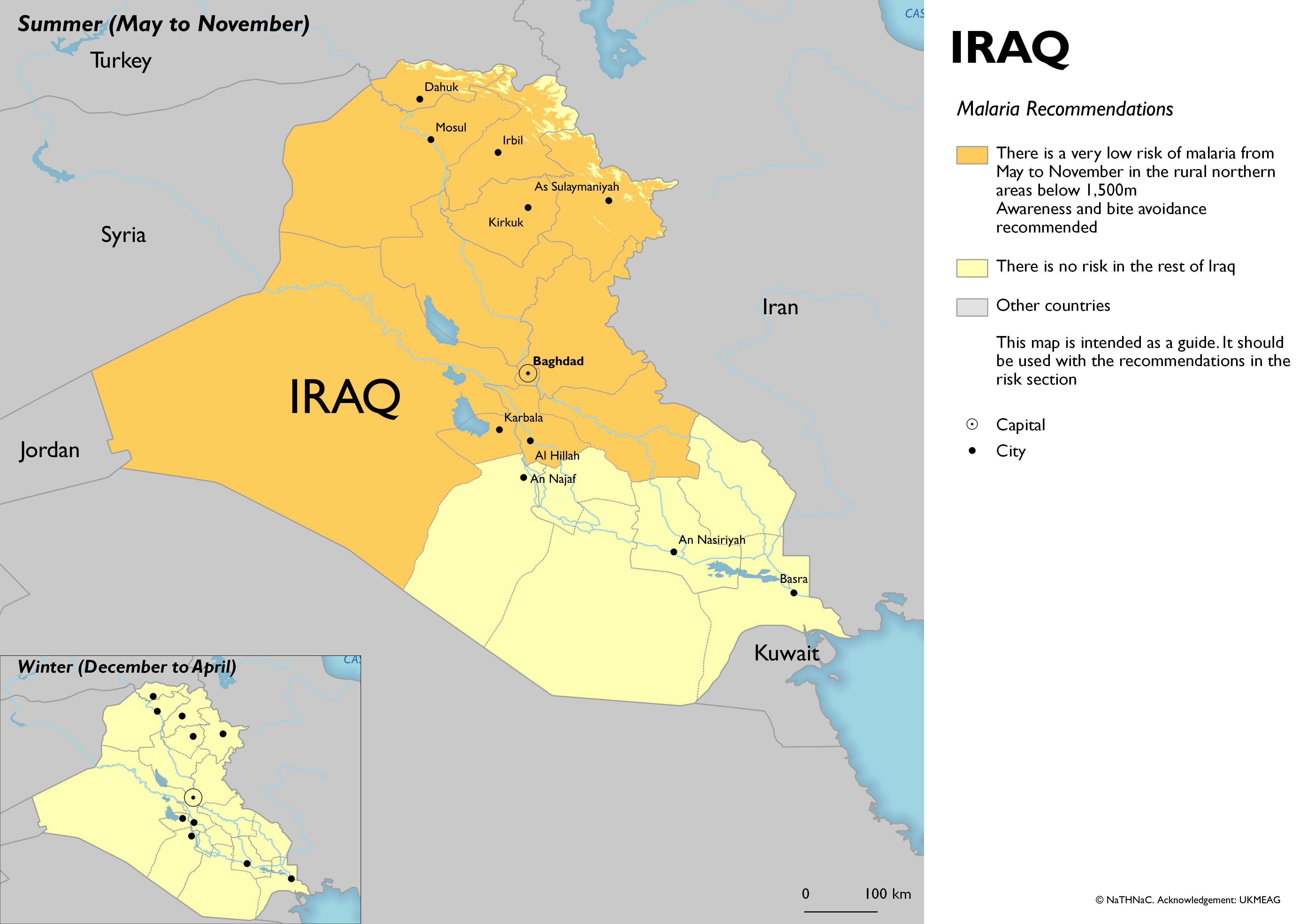
Klicken Sie auf die Karte, um sie in einem neuen Fenster zu öffnen
There are no antimalarial drugs recommended for Iraq.
Ressourcen
What other health risks are there in Iraq?
Es gibt einige Risiken, die für alle Reisenden unabhängig vom Reiseziel relevant sind. Dazu können beispielsweise Straßenverkehrs- und andere Unfälle, durch Insekten oder Zecken übertragene Krankheiten, durch kontaminierte Lebensmittel und Wasser übertragene Krankheiten oder gesundheitliche Probleme im Zusammenhang mit Hitze oder Kälte gehören.
Einige zusätzliche Risiken (die möglicherweise in ganz oder in Teilen dieses Landes vorhanden sind) werden unten erwähnt und alphabetisch aufgeführt.
Höhe
Es besteht ein Risiko für Höhenkrankheit, wenn man zu Zielen von 2.500 Metern (8.200 Fuß) oder höher reist. Wichtige Risikofaktoren sind die erreichte Höhe, die Aufstiegsrate und die Schlafhöhe. Ein schneller Aufstieg ohne eine Phase der Akklimatisierung setzt einen Reisenden einem höheren Risiko aus.
Es gibt drei Syndrome: akute Höhenkrankheit (AMS), Höhenhirnödem (HACE) und Höhenlungenödem (HAPE). HACE und HAPE erfordern einen sofortigen Abstieg und medizinische Behandlung.
Altitude illness in Iraq
Es gibt einen Punkt in diesem Land, der höher als 2.500 Meter liegt.
Prävention
Reisende sollten ein paar Tage in einer Höhe unter 3.000 m verbringen.
Wo möglich, sollten Reisende vermeiden, innerhalb eines Tages von Höhen unter 1.200 m auf Höhen über 3.500 m zu reisen.
Der Aufstieg über 3.000 m sollte allmählich erfolgen. Reisende sollten vermeiden, die Schlafhöhe um mehr als 500 m pro Tag zu erhöhen und alle drei bis vier Tage einen Ruhetag (auf derselben Höhe) einlegen.
Acetazolamid kann zur Unterstützung der Akklimatisierung verwendet werden, sollte jedoch keinen allmählichen Aufstieg ersetzen.
Reisende, die Symptome der Höhenkrankheit (Kopfschmerzen, Müdigkeit, Appetitlosigkeit, Übelkeit und Schlafstörungen) entwickeln, sollten einen weiteren Aufstieg vermeiden. Bei ausbleibender Besserung oder Verschlimmerung der Symptome sollte die erste Reaktion der Abstieg sein.
Die Entwicklung von HACE- oder HAPE-Symptomen erfordert einen sofortigen Abstieg und eine Notfallbehandlung.
Stechende Insekten oder Zecken
Insekten- oder Zeckenstiche können an der Einstichstelle Hautreizungen und Infektionen verursachen. Sie können auch bestimmte Krankheiten übertragen.
Krankheiten in Westasien
There is a risk of insect or tick-borne diseases in some areas of Western Asia. This includes diseases such as Krim-Kongo hämorrhagisches Fieber, Leishmaniose, Rift-Valley-Fieber und West-Nil-Virus.
Prävention
Alle Reisenden sollten Tag und Nacht Insekten- und Zeckenstiche vermeiden.
Es gibt keine Impfungen (oder Medikamente), um diese Krankheiten zu verhindern.
Weitere Informationen über spezifische durch Insekten oder Zecken übertragene Krankheiten für dieses Land finden Sie gegebenenfalls auf dieser Seite, in anderen Abschnitten der Länderinformationsseiten und der Informationsblatt zur Vermeidung von Insekten- und Zeckenstichen.
Influenza
Saisonale Influenza ist eine virale Infektion der Atemwege und verbreitet sich leicht von Mensch zu Mensch über Tröpfcheninfektion beim Husten und Niesen. Die Symptome treten schnell auf und umfassen Fieber, Muskelschmerzen, Kopfschmerzen, Unwohlsein (sich unwohl fühlen), Husten, Halsschmerzen und eine laufende Nase. Bei gesunden Personen verbessern sich die Symptome ohne Behandlung innerhalb von zwei bis sieben Tagen. Eine schwere Erkrankung tritt häufiger bei Personen ab 65 Jahren, unter 2 Jahren oder bei Personen mit zugrunde liegenden medizinischen Bedingungen auf, die ihr Risiko für Komplikationen der Influenza erhöhen.
Seasonal influenza in Iraq
Saisonale Influenza tritt weltweit auf. Auf der Nordhalbkugel (einschließlich des Vereinigten Königreichs) tritt die meiste Influenza von Oktober bis März auf. Auf der Südhalbkugel tritt Influenza hauptsächlich zwischen April und September auf. In den Tropen kann Influenza das ganze Jahr über auftreten.
Prävention
Alle Reisenden sollten:
Vermeiden Sie engen Kontakt mit symptomatischen Personen
Vermeiden Sie nach Möglichkeit überfüllte Bedingungen
Hände häufig waschen
Üben Sie 'Hustenhygiene': Niesen oder Husten in ein Taschentuch und es sicher entsorgen, und die Hände waschen
Vermeiden Sie Reisen, wenn Sie sich mit grippeähnlichen Symptomen unwohl fühlen
Ein Impfstoff ist unter bestimmten Umständen verfügbar (siehe unten)*
*Im Vereinigten Königreich wird der saisonale Influenza-Impfstoff routinemäßig jedes Jahr Personen angeboten, die ein höheres Risiko haben, nach einer Influenza-Infektion eine schwere Erkrankung zu entwickeln, sowie bestimmten zusätzlichen Gruppen wie Gesundheitsdienstleistern und Kindern im Rahmen des nationalen Programms des Vereinigten Königreichs (siehe Informationen zur Impfung). Für diejenigen, die nicht zu diesen Gruppen gehören, kann die Impfung privat verfügbar sein.
Wenn Personen mit einem höheren Risiko für schwere Erkrankungen nach einer Grippeinfektion in ein Land reisen, in dem die Grippe wahrscheinlich zirkuliert, sollten sie sicherstellen, dass sie in den letzten 12 Monaten eine Grippeimpfung erhalten haben.
Der in Großbritannien verwendete Impfstoff schützt gegen die Stämme, die voraussichtlich während der Wintermonate der nördlichen Hemisphäre auftreten werden. Es ist nicht möglich, in Großbritannien einen Impfstoff für die südliche Hemisphäre zu erhalten, aber der während der britischen Grippesaison verwendete Impfstoff sollte dennoch einen wichtigen Schutz gegen Stämme bieten, die wahrscheinlich während der Grippesaison der südlichen Hemisphäre und in den Tropen auftreten werden.
Vogelgrippe
Vogelgrippeviren können selten Menschen infizieren und Krankheiten verursachen. Solche Fälle sind normalerweise mit engem Kontakt zu infizierten Vogel- oder Tierpopulationen verbunden. Gegebenenfalls sind Informationen dazu in den Ausbruchs- und Nachrichtenabschnitten der entsprechenden Länderseiten verfügbar. Saisonale Grippeimpfstoffe bieten keinen Schutz gegen die Vogelgrippe.
Coronavirus des respiratorischen Syndroms im Nahen Osten
MERS-CoV ist eine Virusinfektion, die durch direkten oder indirekten Kontakt mit infizierten Kamelen oder kameelbezogenen Produkten verbreitet wird. Eine begrenzte Übertragung von Mensch zu Mensch durch Husten und Niesen von infizierten Personen, typischerweise in Gesundheitseinrichtungen, wurde ebenfalls berichtet.
Zu den Symptomen gehören Fieber und Husten, die zu schwerer Atemnot und Atembeschwerden fortschreiten können. Todesfälle wurden gemeldet, wobei das Risiko mit zunehmendem Alter oder bestehenden Vorerkrankungen steigt.
MERS-CoV wird in diesem Land als Risiko angesehen.
Prävention
Alle Reisenden, insbesondere diejenigen mit chronischen Erkrankungen, sollten gute allgemeine Gesundheitsmaßnahmen praktizieren, wie z.B. regelmäßiges Händewaschen mit Seife und Wasser zu jeder Zeit, aber besonders nach dem Besuch von Bauernhöfen, Scheunen oder Marktplätzen. Sie sollten:
Vermeiden Sie den Kontakt mit Kamelen.
Vermeiden Sie rohe Kamelmilch und/oder Kamelprodukte.
Vermeiden Sie den Verzehr von Rohmilch, Rohmilchprodukten und Lebensmitteln, die mit tierischen Sekreten kontaminiert sein könnten, es sei denn, sie sind geschält und gereinigt und/oder gründlich gekocht.
Derzeit gibt es keinen Impfstoff zur Vorbeugung von MERS-CoV.
Außenluftqualität
Schlechte Luftqualität ist in vielen Teilen der Welt ein erhebliches Problem für die öffentliche Gesundheit. Die Exposition gegenüber hohen Luftverschmutzungswerten über kurze Zeiträume (z. B. Minuten/Stunden/Tage) und längere Zeiträume (z. B. Jahre) wird mit vielen verschiedenen akuten und chronischen Gesundheitsproblemen in Verbindung gebracht. Diese Auswirkungen betreffen hauptsächlich die Atemwege (Lungen und Atemwege) und das Herz-Kreislauf-System (Herzfunktion und Blutkreislauf).
Aktuelle Informationen zur Luftqualität weltweit sind verfügbar von der Weltluftqualitätsindex-Projekt.
Prävention
Reisende mit gesundheitlichen Problemen, die sie anfälliger für die Auswirkungen von Luftverschmutzung machen könnten und die in Gebiete mit hoher Verschmutzung reisen, sollten:
ihre Reisepläne mit ihrem Arzt besprechen und ausreichende Vorräte ihrer regulären Medikamente mitführen.
treffen Sie sinnvolle Vorsichtsmaßnahmen, um ihre Exposition gegenüber hohen Luftverschmutzungswerten zu minimieren.
überprüfen Sie lokale Luftqualitätsdaten und passen Sie ihre Aktivitäten entsprechend an.
Beachten Sie alle Gesundheitshinweise, die vom örtlichen Gesundheitsministerium und dem Umweltministerium veröffentlicht werden, und befolgen Sie die bereitgestellten Anweisungen.
Es ist unklar, ob Gesichtsmasken hilfreich sind, um die Exposition zu verringern, und sie können das Atmen für Personen mit bestehenden Lungenerkrankungen erschweren. Diejenigen, die sich für die Verwendung einer Maske entscheiden, sollten sicherstellen, dass die Maske gut sitzt und wissen, wie man sie richtig trägt.
Außenluftqualität im Überblick
Schistosomiasis
Schistosomiasis ist eine parasitäre Infektion. Schistosoma-Larven werden von infizierten Süßwasserschnecken freigesetzt und können intakte menschliche Haut durchdringen, wenn sie mit kontaminiertem Süßwasser in Kontakt kommen. Reisende können bei Aktivitäten wie Waten, Schwimmen, Baden oder Wäschewaschen in Süßwasserbächen, Flüssen oder Seen exponiert werden.
Eine Schistosomiasis-Infektion kann symptomlos verlaufen, aber frühe Symptome können einen Ausschlag und juckende Haut ('Badejucken'), Fieber, Schüttelfrost, Husten oder Muskelschmerzen umfassen. Wenn sie nicht behandelt wird, kann sie ernsthafte langfristige Gesundheitsprobleme wie Darm- oder Blasenerkrankungen verursachen.
In diesem Land besteht ein Risiko für Schistosomiasis.
Prävention
Es gibt keinen Impfstoff oder Tabletten zur Vorbeugung von Schistosomiasis.
Alle Reisenden sollten das Waten, Schwimmen oder Baden in Süßwasser vermeiden. Das Schwimmen in ausreichend gechlortem Wasser oder Meerwasser birgt kein Risiko für Schistosomiasis.
Trinken Sie Wasser, das abgekocht, gefiltert oder in Flaschen abgefüllt ist.
Die Anwendung von Insektenschutzmittel vor dem Kontakt mit Süßwasser oder das Abtrocknen mit einem Handtuch nach möglichem Kontakt mit Schistosomiasis sind keine zuverlässigen Methoden zur Verhinderung einer Infektion.
Alle Reisenden, die möglicherweise Schistosomiasis ausgesetzt waren, sollten sich einer Gesundheitsuntersuchung unterziehen, um auf eine Schistosomiasis-Infektion getestet zu werden.
Sexuell übertragbare Infektionen
Sexuell übertragbare Infektionen (STIs) sind eine Gruppe von viralen, bakteriellen und parasitären Infektionen, die während des Geschlechtsverkehrs oder durch intimen Kontakt übertragen werden. Bestimmte STIs können aufgrund höherer Antibiotikaresistenz schwieriger zu behandeln sein, und einige STIs, die im Vereinigten Königreich selten sind, können in anderen Weltregionen häufiger vorkommen.
Jeder, der sexuell aktiv ist, läuft Gefahr, sich überall auf der Welt mit einer STI zu infizieren.
Das Risiko ist höher für Reisende, die:
Sex ohne Kondom haben
Sex mit neuen oder gelegentlichen Partnern haben
sich am Sextourismus beteiligen
Sex unter dem Einfluss von Drogen oder Alkohol haben
Die Symptome von sexuell übertragbaren Infektionen (STIs) variieren je nach Art der Infektion; einige können nur milde oder unbemerkbare Symptome verursachen. Wenn Symptome auftreten, können sie einen Ausschlag, Ausfluss, Juckreiz, Blasen, Wunden oder Warzen im Genital- und/oder Analbereich, Schmerzen beim Wasserlassen und grippeähnliche Symptome umfassen.
Unbehandelt können sexuell übertragbare Infektionen ernsthafte langfristige Gesundheitsprobleme verursachen, wie Fruchtbarkeitsprobleme, entzündliche Beckenerkrankungen und Schwangerschaftskomplikationen.
Prävention
Die konsequente und korrekte Verwendung von Kondomen mit neuen oder gelegentlichen Partnern ist der effektivste Weg, das Risiko von sexuell übertragbaren Infektionen zu verringern.
Reisende können ihr Risiko für sexuell übertragbare Infektionen (STIs) auch verringern, indem sie:
sicherstellen, dass sie auf dem neuesten Stand für alle in Großbritannien empfohlenen Impfungen sind, einschließlich, falls zutreffend Gonorrhö, Hepatitis B, Mpox und humanes Papillomavirus (HPV)
in Anbetracht HIV-Präexpositionsprophylaxe (PrEP) wenn zutreffend
Reisende sollten medizinischen Rat einholen und ihre Reisegeschichte angeben, wenn sie denken, dass sie eine STI haben könnten, auch wenn sie keine Symptome haben. Sie sollten sich auch auf STIs testen lassen, wenn sie im Ausland ungeschützten Sex mit einem neuen oder gelegentlichen Partner hatten.
In Großbritannien ist der STI-Test ist kostenlos und vertraulich.
Quelle und Haftungsausschluss
Diese Reisegesundheitsinformationen basieren auf Daten, die von NaTHNaC (dem National Travel Health Network and Centre) bereitgestellt wurden. Alle geistigen Eigentumsrechte an den Daten gehören NaTHNaC. Sie dürfen nicht ohne vorherige schriftliche Zustimmung von NaTHNaC kopiert, reproduziert, verteilt, geändert oder zum Verkauf angeboten werden.
Patient.info stellt sicher, dass diese Informationen mindestens wöchentlich überprüft und aktualisiert werden. Allerdings sind die Daten von NaTHNaC nur zum Zeitpunkt ihrer Erstellung genau, und Patient.info ist allein dafür verantwortlich, deren Genauigkeit und Vollständigkeit nach diesem Datum zu gewährleisten. NaTHNaC übernimmt keine Haftung für die Nutzung dieser Daten durch Patient.info oder dessen Nutzer.
Patientenauswahl für Reisegesundheit nach Land
Reisen und Impfungen
Gesundheitsberatung für Auslandsreisen
Ins Ausland zu reisen bedeutet, auf unbekannte Orte und Situationen zu stoßen, die unerwartete Risiken bergen können. Gute Planung und Risikobewertung ermöglichen es uns, viele mögliche Schwierigkeiten vorherzusehen und zu vermeiden. Dieses Merkblatt befasst sich mit der Reisevorbereitung, Aspekten der persönlichen Sicherheit und Gesundheit beim Reisen. Es weist auf Informationsquellen und Ratschläge hin, die bei der Planung helfen.
von Dr. Toni Hazell, FRCGP

Reisen und Impfungen
Reiseimpfungen
Reiseimpfungen sind ein wesentlicher Bestandteil der Urlaubs- und Reiseplanung, insbesondere wenn Ihre Reise Sie zu einem exotischen Ziel oder „abseits der ausgetretenen Pfade“ führt. Die Risiken beschränken sich nicht auf tropische Reisen, obwohl die meisten Reiseimpfstoffe auf Krankheiten abzielen, die in den Tropen häufiger vorkommen. Für allgemeinere Informationen über Reisen siehe das separate Merkblatt mit dem Titel Gesundheitshinweise für Auslandsreisen. Dieses Merkblatt behandelt die verfügbaren Impfungen und gibt eine Vorstellung davon, wie viel Zeit Sie einplanen müssen, um einen vollständigen Schutzimpfkurs abzuschließen. Weitere Informationen, die speziell für Ihr Reiseziel relevant sind, können Sie von Ihrer Arztpraxis (sofern diese über die Ressourcen zur Bereitstellung dieses Dienstes verfügt), von spezialisierten Reisekliniken und von einer Reihe von Websites erhalten. Eine Auswahl dieser finden Sie am Ende dieses Merkblatts und unter den Referenzen.
von Dr. Toni Hazell, FRCGP
Über den AutorVollständige Biografie anzeigen

Nationales Netzwerk und Zentrum für Reisemedizin (NaTHNaC)
NaTHNaC wurde 2002 vom Gesundheitsministerium mit dem allgemeinen Ziel gegründet, 'den Schutz der Gesundheit britischer Reisender' zu gewährleisten. Sie streben an, die Qualität der Reisegesundheitsberatung, die von Hausarztpraxen, Reisekliniken, Apotheken und anderen Gesundheitsdienstleistern gegeben wird, zu verbessern und aktuelle und zuverlässige Informationen für internationale Reisende, die Reisebranche und die nationale Regierung bereitzustellen.
Über den RezensentenVollständige Biografie anzeigen
Nationales Netzwerk und Zentrum für Reisemedizin (NaTHNaC)
NaTHNaC wurde 2002 vom Gesundheitsministerium mit dem allgemeinen Ziel gegründet, 'den Schutz der Gesundheit britischer Reisender' zu gewährleisten. Sie streben an, die Qualität der Reisegesundheitsberatung, die von Hausarztpraxen, Reisekliniken, Apotheken und anderen Gesundheitsdienstleistern gegeben wird, zu verbessern und aktuelle und zuverlässige Informationen für internationale Reisende, die Reisebranche und die nationale Regierung bereitzustellen.
Artikelverlauf
Die Informationen auf dieser Seite wurden von qualifizierten Klinikern verfasst und begutachtet.
Artikel auch verfügbar in Englisch, Deutsch, Spanisch, Französisch, Italienisch, Portugiesisch, Hindi, Hebräisch, Arabisch, und Schwedisch.
3. Juni 2026 | Neueste Version
Zuletzt aktualisiert von
Nationales Netzwerk und Zentrum für Reisemedizin (NaTHNaC)Begutachtet von
Nationales Netzwerk und Zentrum für Reisemedizin (NaTHNaC)23. Okt 2025 | Ursprünglich veröffentlicht
Verfasst von:
Nationales Netzwerk und Zentrum für Reisemedizin (NaTHNaC)

Fragen, teilen, verbinden.
Durchsuchen Sie Diskussionen, stellen Sie Fragen und teilen Sie Erfahrungen zu Hunderten von Gesundheitsthemen.

Fühlen Sie sich unwohl?
Bewerten Sie Ihre Symptome online kostenlos
Abonnieren Sie den Patienten-Newsletter
Ihre wöchentliche Dosis klarer, vertrauenswürdiger Gesundheitsberatung - geschrieben, um Ihnen zu helfen, sich informiert, selbstbewusst und in Kontrolle zu fühlen.
Durch das Abonnieren akzeptieren Sie unsere Datenschutzrichtlinie. Sie können sich jederzeit abmelden. Wir verkaufen Ihre Daten niemals.