Lumbalpunktion
Spinal tap
Begutachtet von Dr Colin Tidy, MRCGPZuletzt aktualisiert von Dr Toni Hazell, MRCGPZuletzt aktualisiert 10. Feb 2023
Erfüllt die Anforderungen des Patienten Richtlinien des Patienten
- HerunterladenHerunterladen
- Teilen
- Language
- Diskussion
- Audio-Version
Eine Lumbalpunktion wird zur Diagnose von Meningitis und einigen anderen Erkrankungen des Gehirns und Rückenmarks verwendet.
In diesem Artikel:
Videoauswahl für Weitere Tests und Untersuchungen
Hinweis: the information below is a general guide only. The arrangements, and the way tests are performed, may vary between different hospitals. Always follow the instructions given by your doctor, specialist, or local hospital.
Lesen Sie unten weiter
What is a lumbar puncture?
A lumbar puncture (sometimes called a spinal tap) is a procedure where a sample of cerebrospinal fluid (CSF) is taken for testing. CSF is the fluid that surrounds the brain (cerebrum) and spinal cord. This test is most commonly used to diagnose meningitis (an infection of the meninges - the structure that surrounds the brain and spinal cord). It is also used to help diagnose some other conditions of the brain, spinal cord and central nervous system, including a subarachnoid haemorrhage which is a type of bleed inside the brain.
When is a lumbar puncture needed?
Zurück zum InhaltIf you, or your child, is admitted to hospital with symptoms that could be caused by meningitis then a lumbar puncture may be done urgently, either in the emergency department or very soon after your admission to a ward. Alternatively, you might be admitted for a planned lumbar puncture, as part of the diagnostic process for a long-term (chronic) neurological condition.
Lesen Sie unten weiter
How is a lumbar puncture done?
Zurück zum InhaltUsually you lie on a couch on your side with your knees pulled up against your chest. Sometimes it is done with you sitting up and leaning forwards on some pillows. The doctor or nurse will clean an area of your lower back with antiseptic.
They will then inject some local anaesthetic into a small area of skin which lies over a space between two lower spinal bones (vertebrae). This stings a little at first but then makes the skin numb.
The doctor then pushes a thin hollow needle through the skin and tissues between two vertebrae into the space around the spinal cord which is filled with CSF. Because the skin is numbed with local anaesthetic, most people do not feel pain. You may feel pressure as the needle is inserted. However, some people do have a sharp feeling in the back or leg when the needle is pushed through.
Procedure method
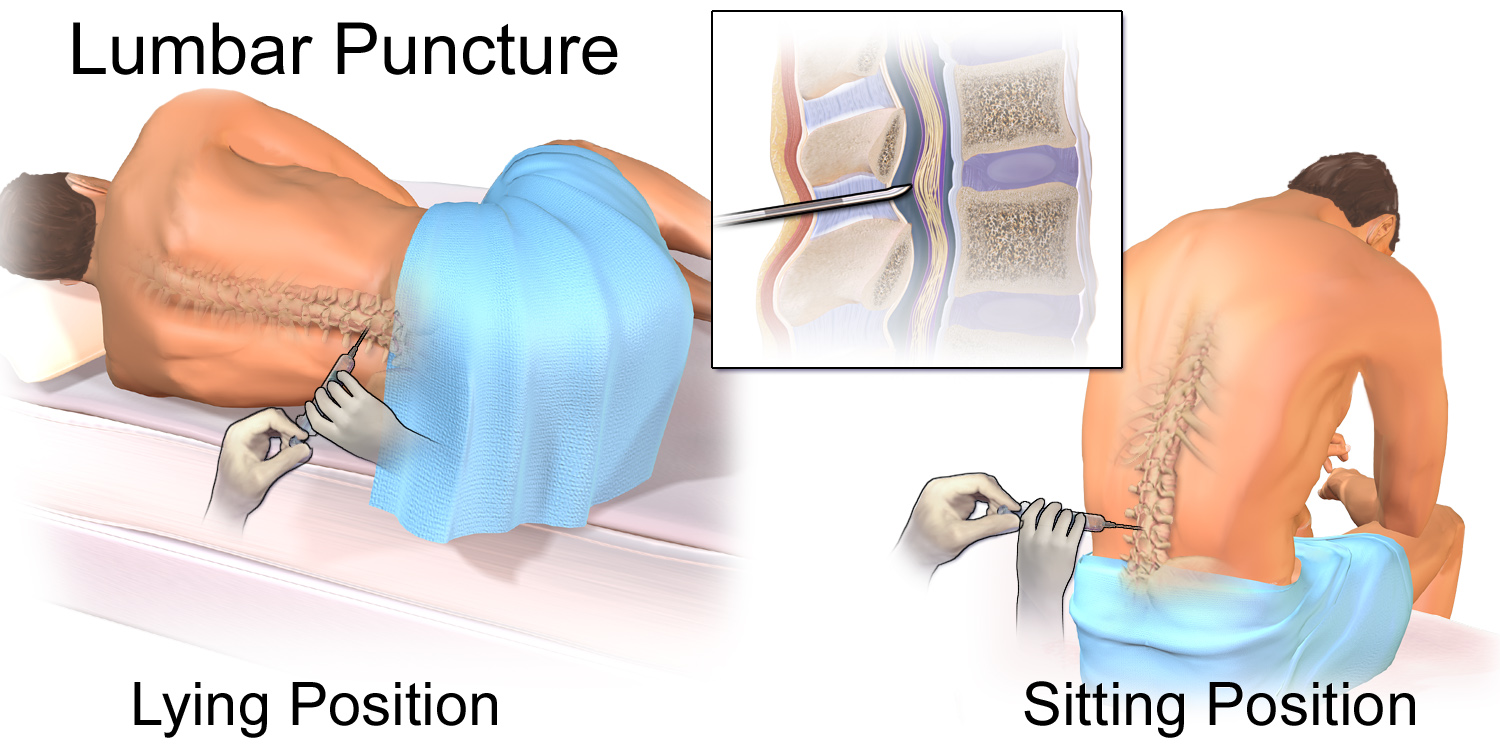
© Blausen.com staff, "Blausen gallery 2014", Wikiversity Journal of Medicine, via Wikimedia Commons
Some fluid leaks back through the needle and is collected in a sterile pot. If you have possible meningitis, this fluid sample is sent to the laboratory to be examined under the microscope to look for germs (bacteria), red blood cells and white blood cells, which are a sign of infection. It is also 'cultured' to see if any bacteria grow and what type they are.
The fluid can also be tested for protein, sugar and other chemicals if necessary. Sometimes the doctor will also measure the fluid pressure. This is done by attaching a special tube to the needle, which can measure the pressure of the fluid coming out.
The needle is usually in for about 1-2 minutes. As soon as the required amount of fluid is collected, the needle is taken out and a sticking plaster put over the site of needle entry.
How long does a lumbar puncture take?
Zurück zum InhaltIn total the procedure will take about 30-45 minutes; this includes the time to get you ready in the correct position and set up all the equipment.
Lesen Sie unten weiter
Are there any side-effects or risks from a lumbar puncture?
Zurück zum InhaltSome people develop a post lumbar puncture headache. This usually goes after a few hours. It is best to lie down for a few hours after the test, as this makes a headache less likely to develop. There is also risk of infection or bleeding at the needle puncture site and although rare, some damage to the spinal cord or brain may occur as a result on a lumbar puncture. It is very important that you tell the doctor if you are taking anticoagulants (blood-thinning drugs) so that they can take any necessary precautions to reduce the risk of bleeding.
Recovering from a lumbar puncture
Zurück zum InhaltIt is sensible to stay lying flat for a period of time after a lumbar puncture - the doctor who does it will tell you how long. They will usually advise you not to operate heavy machinery or drive for at lest 24 hours and not to play sport or do any strenuous activities for at least a week.
Patientenempfehlungen für Weitere Tests und Untersuchungen

Tests und Untersuchungen
Hörtests
There are various different ways to test hearing, depending on the age of the person involved and the type of hearing loss. The medical term for hearing tests is audiometry. Note: the information below is a general guide only. The arrangements, and the way tests are performed, may vary between different hospitals. Always follow the instructions given by your healthcare professional or local hospital.
von Dr. Hayley Willacy, FRCGP

Tests und Untersuchungen
Spirometrie
Spirometry is a test that can help diagnose various lung conditions, most commonly chronic obstructive pulmonary disease (COPD). Spirometry may also be used to monitor the severity of some other lung conditions and their response to treatment. Although spirometry is very useful for helping to diagnose some conditions and monitor their treatment, a normal spirometry test does not necessarily rule out some forms of lung disease as there can be periods when spirometry tests can be normal even where a lung condition exists, such as asthma. Note: the information below is a general guide only. The arrangements, and the way tests are performed, may vary between different hospitals. Always follow the instructions given by your doctor or local hospital.
von Dr. Colin Tidy, MRCGP
Weiterführende Lektüre und Referenzen
- Bakterielle Meningitis und Meningokokken-Sepsis: Behandlung von bakterieller Meningitis und Meningokokken-Sepsis bei Kindern und Jugendlichen unter 16 Jahren in der Primär- und Sekundärversorgung; NICE-Leitlinie (zuletzt aktualisiert Februar 2015)
- Neisserienkrankheit: Leitlinien, Daten und Analysen; UK-Gesundheitsbehörde (zuletzt aktualisiert April 2022)
- Sepsis - Erkennung, Diagnose und frühzeitige Behandlung; NICE-Richtlinie (Juli 2016 - aktualisiert Januar 2024)
- Viallon A, Botelho-Nevers E, Zeni F; Klinische Entscheidungsregeln für akute bakterielle Meningitis: Aktuelle Erkenntnisse. Open Access Notfallmedizin. 19. April 2016;8:7-16. doi: 10.2147/OAEM.S69975. eCollection 2016.
- Cognat E, Koehl B, Lilamand M, et al; Preventing Post-Lumbar Puncture Headache. Ann Emerg Med. 2021 Sep;78(3):443-450. doi: 10.1016/j.annemergmed.2021.02.019. Epub 2021 May 7.
Lesen Sie unten weiter
Artikelverlauf
Die Informationen auf dieser Seite wurden von qualifizierten Klinikern verfasst und begutachtet.
Nächste Überprüfung fällig: 9. Feb 2028
10. Feb 2023 | Neueste Version

Fragen, teilen, verbinden.
Durchsuchen Sie Diskussionen, stellen Sie Fragen und teilen Sie Erfahrungen zu Hunderten von Gesundheitsthemen.

Fühlen Sie sich unwohl?
Bewerten Sie Ihre Symptome online kostenlos
Abonnieren Sie den Patienten-Newsletter
Ihre wöchentliche Dosis klarer, vertrauenswürdiger Gesundheitsberatung - geschrieben, um Ihnen zu helfen, sich informiert, selbstbewusst und in Kontrolle zu fühlen.
Mit dem Abonnieren akzeptieren Sie unsere Datenschutzrichtlinie. Sie können sich jederzeit abmelden. Wir verkaufen Ihre Daten niemals.