Eosinophilic oesophagitis
Peer reviewed by Dr Caroline Wiggins, MRCGP Last updated by Dr Rachel Hudson, MRCGPLast updated 11 Mar 2025
Meets Patient’s editorial guidelines
- DownloadDownload
- Share
- Language
- Discussion
- Audio Version
- Add to preferred sources on Google
The oesophagus is the gullet, or food pipe, that connects the mouth to the stomach. Inflammation of the oesophagus is known as oesophagitis. Commonly, the inflammation is caused by acid leaking up from the stomach (a condition known as acid reflux).
In some people, however, it can be caused by a condition known as eosinophilic oesophagitis. In eosinophilic oesophagitis, particular types of white blood cells (called eosinophils) gather in large numbers in the lining of the oesophagus, causing inflammation. It occurs in children and in adults. The condition can be controlled by making changes to your diet and/or taking steroids. Occasionally, an operation to stretch the oesophagus through a telescope (endoscope) may be needed.
At a glance
Eosinophilic oesophagitis (EO) is inflammation of the gullet.
It is caused by white blood cells called eosinophils building up in the gullet's lining.
Symptoms in adults include difficulty swallowing, chest pain, and regurgitation.
Children and teenagers may have vomiting, stomach pain, or difficulty eating.
Diagnosis involves a gastroscopy and a biopsy of the gullet lining.
Treatments can include dietary changes, steroids, or proton pump inhibitors.
EO can be controlled with treatment, but symptoms may return if treatment stops.
What is eosinophilic oesophagitis?
Oesophagitis means inflammation of the gullet or oesophagus. In eosinophilic oesophagitis (EO) lots of white cells called eosinophils can be seen in the oesophageal lining. EO is thought to occur due to a combination of genetic makeup and the body's response to the environment.
If you have EO you may be allergic to certain foods, although tests do not always identify the specific foods causing the problem. You are also more likely to have other allergies such as asthma or hay fever.
What are the symptoms of eosinophilic oesophagitis?
The symptoms of EO vary depending on whether you are an adult, a teenager or a child.
Adult symptoms
Difficulty in swallowing (dysphagia).
A feeling that food is sticking in the gullet.
Chest pain.
Regurgitation.
Child and teenager symptoms
Being sick (vomiting), in teenagers.
Chest pain.
Stomach pain.
Difficulty eating, in children
Weight loss.
These symptoms are similar to those of people who have acid reflux (also known as gastro-oesophageal reflux disease).
What causes eosinophilic oesophagitis?
The cause or causes of EO are not fully understood, but it is thought that it is due to a combination of your genes, and how your body's immune system responds to the environment around us. The symptoms can be triggered by eating certain foods and possibly by breathing in certain substances. Once triggered, lots of eosinophils build up in the lining of the oesophagus (the swallowing tube between the throat and stomach) and this causes the symptoms.
Who does eosinophilic oesophagitis affect?
Most people with EO are white men between the ages of 30-50 years. However, the condition can occur in all ages and in both sexes. Men are three times more likely than women to be affected. For unknown reasons, it has become more common in recent years, currently affecting about 7 in 100,000 people every year.
How is eosinophilic oesophagitis diagnosed?
If you are suspected of having EO, you will need to have a gastroscopy (endoscopy). This involves putting a thin flexible telescope called an endoscope through the mouth or nose and down into the gullet (oesophagus). The endoscope has a tiny light and video camera at the end. These help the doctor to take a film or photographs and see inside your oesophagus.
An instrument can also be passed down the endoscope to take a small sample of the lining of the oesophagus (a biopsy). Your symptoms, the appearance of the lining of your oesophagus and the biopsy report will all help the doctor to diagnose EO.
If your child is suspected of having EO, endoscopy can be performed using a smaller tube.
Sometimes, blood tests and/or skin prick tests are used to help identify specific foods that might be causing the condition. These are more commonly used in children than in adults.
What are the treatments for eosinophilic oesophagitis?
Dietary manipulation
You may be advised to alter your diet, either as the main treatment for your EO or in addition to other treatment. Dietary manipulation may involve cutting out certain foods to which you may be allergic.
Sometimes food allergy tests may be able to identify which foods to avoid but these tests do not always provide the answer. If your allergy tests are not helpful, you may be advised to avoid the types of food which are well known to cause allergic reactions. A dietician and/or an allergy specialist may be involved in giving you advice about what changes to your diet you need to make,
What foods trigger eosinophilic oesophagitis?
Nuts.
Seafood.
Milk.
Egg.
Wheat.
Soya products.
Usually you need to avoid these foods for about six weeks and then gradually reintroduce them one by one. Another approach, most commonly used in children, is to try a specially made-up mixture of basic food chemicals called amino acids. This mixture needs to be taken instead of food for about six weeks. Your child may not like the taste of the mixture and it may be difficult to persevere with this treatment. However, it is particularly useful if your child has a severe form of EO which is difficult to control.
Steroids
Steroids such as fluticasone are often recommended, with or without dietary manipulation. They are usually prescribed in the form of an inhaler. It is the same type of inhaler as that used by patients with asthma. However, you will be asked to spray the inhaler into your mouth without breathing in and to swallow the powder without water. You should not eat food or drink liquids for half an hour after spraying the medicine.
Another type of steroid called budesonide is also available in liquid form. The liquid form is not specially made for people with EO but comes in small plastic containers called budesonide respules which are used by asthma patients. This can be mixed with something sweet, such as a sweetener called sucralose, or with honey or chocolate syrup, or apple or oranges juice. This is a particularly useful option for children who have problems with the inhaler method.
Budesonide is now also available in orodispersible tablet form. These are tablets which dissolve in your mouth - they are sometimes called orally disintegrating tablets. These tablets can be used as an option for treating symptoms of eosinophilic oesophagitis in adults only.
Proton Pump Inhibitors (PPIs)
These are medications that are commonly used to treat acid reflux. While EO is not caused by acid reflux, PPIs can be effective in reducing the symptoms. These include medicines such as Omeprazole and Lansoprazole and they come in tablet, dispersible tablet, and liquid forms.
Gastroscopy (endoscopy)
You may need to have a gastroscopy using an endoscope if dietary manipulation or steroids do not work. You may also need endoscopy if you develop a complication of EO such as narrowing of the oesophagus.
Does eosinophilic oesophagitis get better?
EO can be controlled in most cases by dietary manipulation and/or steroid medicine. However, you or your child may find that the condition returns as soon as treatment is stopped. Treatment may therefore need to be continued long-term to keep the condition under control.
Understanding the oesophagus and stomach
When we eat, food passes down the gullet (oesophagus) into the stomach. Cells in the lining of the stomach make acid and other chemicals which help to digest food. Stomach cells also make mucus which protects them from damage from the acid. The cells lining the oesophagus are different and have little protection from acid.
Barrett's oesophagus
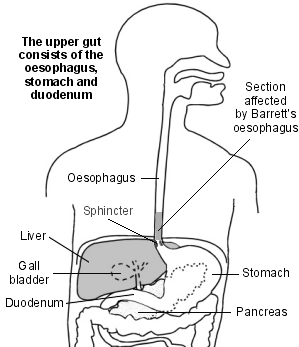
There is a circular band of muscle (a sphincter) at the junction between the oesophagus and stomach. This relaxes to allow food down but then normally tightens up and stops food and acid leaking up (refluxing) into the oesophagus. In effect, the sphincter acts like a valve.
Patient picks for Other digestive conditions

Digestive health
Abdominal masses
An abdominal mass is a lump felt in the tummy (abdomen). There are many different causes of an abdominal mass. Urgent medical attention should be sought if a new mass is found in the abdomen.
by Dr Philippa Vincent, MRCGP
Digestive health
Gastroparesis
Gastroparesis is now more commonly known as delayed gastric emptying. It is a chronic condition in which food passes through the stomach and into the gut (intestine) more slowly than usual. The nerves that usually trigger the stomach muscles to move food out of the stomach and into the intestine don't work as effectively as normal. This is not caused by an obstruction or structural abnormality but by a failure of the normal mechanisms.
by Dr Philippa Vincent, MRCGP
Frequently asked questions
Are there any long-term complications if eosinophilic oesophagitis is left untreated?
The article mentions that you might need an endoscopy if you develop a complication of EO, such as narrowing of the oesophagus. This implies that if left untreated, the inflammation could lead to such issues.
Can eosinophilic oesophagitis affect areas other than the oesophagus?
The article specifically defines eosinophilic oesophagitis as having eosinophils in the oesophageal lining and discusses symptoms, causes, and treatments solely related to the oesophagus. There is no mention of it affecting other parts of the body.
What is the typical timeframe to see improvement after starting treatment for eosinophilic oesophagitis?
For dietary manipulation involving avoiding certain foods, the article states that you usually need to avoid these foods for about six weeks before gradually reintroducing them. Similarly, for the amino acid mixture, it needs to be taken for about six weeks. This suggests a timeframe of around six weeks for initial treatment periods.
Is eosinophilic oesophagitis a curable condition?
The article states that EO can be controlled in most cases, but you or your child may find that the condition returns as soon as treatment is stopped. It also mentions that treatment may need to be continued long-term to keep the condition under control. This indicates that while treatable and controllable, it may not be curable in the sense of permanently resolving.
Do I need to make permanent changes to my diet after identifying trigger foods?
The article suggests that after avoiding trigger foods for about six weeks, you should gradually reintroduce them one by one. This implies that not all foods will necessarily need to be permanently avoided, and the approach is to identify specific triggers rather than a permanent blanket restriction.
Further reading and references
- Murali AR, Gupta A, Attar BM, et al; Topical steroids in eosinophilic esophagitis: Systematic review and meta-analysis of placebo-controlled randomized clinical trials. J Gastroenterol Hepatol. 2016 Jun;31(6):1111-9. doi: 10.1111/jgh.13281.
- Furuta GT, Katzka DA; Eosinophilic Esophagitis. N Engl J Med. 2015 Oct 22;373(17):1640-8. doi: 10.1056/NEJMra1502863.
- Velikova T; Challenges and updates in the management of eosinophilic esophagitis. Prz Gastroenterol. 2020;15(1):27-33. doi: 10.5114/pg.2019.84476. Epub 2019 Apr 12.
- Visaggi P, Savarino E, Sciume G, et al; Eosinophilic esophagitis: clinical, endoscopic, histologic and therapeutic differences and similarities between children and adults. Therap Adv Gastroenterol. 2021 Jan 31;14:1756284820980860. doi: 10.1177/1756284820980860. eCollection 2021.
- Budesonide orodispersible tablet for inducing remission of eosinophilic oesophagitis; NICE Technology appraisal guidance, June 2021
- Dhar A, Haboubi HN, Attwood SE, et al; British Society of Gastroenterology (BSG) and British Society of Paediatric Gastroenterology, Hepatology and Nutrition (BSPGHAN) joint consensus guidelines on the diagnosis and management of eosinophilic oesophagitis in children and adults. Gut. 2022 Aug;71(8):1459-1487. doi: 10.1136/gutjnl-2022-327326. Epub 2022 May 23.
About the authorView full bio

Dr Rachel Hudson, MRCGP
General Practitioner and Medical Author
MBChB, MRCGP (2008), BSc (Medical Science), DFSRH, DRCOG, DCH
Dr Rachel Hudson, is an NHS GP working in the North West of England.
About the reviewerView full bio

Dr Caroline Wiggins, MRCGP
General Practitioner, Medical Author
MBBS Honours (with Distinction), MRCGP (2016), MSc.SEM (with Distinction), BSc (Hons)
Dr Caroline Wiggins is a GP locum currently in the South-West of England.
Article history
The information on this page is written and peer reviewed by qualified clinicians.
Article also available in English, German, Spanish, French, Italian, Portuguese, Hindi, Hebrew, Arabic, and Swedish.
Next review due: 10 Mar 2028
11 Mar 2025 | Latest version
Join the conversation
Share your thoughts or experiences with others in our patient communities.

Ask, share, connect.
Browse discussions, ask questions, and share experiences across hundreds of health topics.

Feeling unwell?
Assess your symptoms online for free
Sign up to the Patient newsletter
Your weekly dose of clear, trustworthy health advice - written to help you feel informed, confident and in control.
By subscribing you accept our Privacy Policy. You can unsubscribe at any time. We never sell your data.
More in digestive health
- Acid reflux and oesophagitis
- Acute diarrhoea in children
- Anal fissure
- Anal fistula
- Appendicitis
- Bowel polyps
- Chronic pancreatitis
- Crohn's disease
- Cyclical vomiting syndrome
- Giardia
- Hirschsprung's disease
- Inflammatory bowel disease
- Left lower quadrant pain
- Liver biopsy
- Local preparations for anal disorders
- Piles
- Right lower quadrant pain in pregnancy
- Trapped wind, gas and bloating
- Ulcerative colitis
- Wilson's disease