Gastroskopie
Endoskopie
Begutachtet von Dr Hayley Willacy, FRCGP Zuletzt aktualisiert von Dr Philippa Vincent, MRCGPZuletzt aktualisiert 3. Juli 2024
Erfüllt die Anforderungen des Patienten Richtlinien des Patienten
- HerunterladenHerunterladen
- Teilen
- Language
- Diskussion
- Audio-Version
- Zu bevorzugten Quellen bei Google hinzufügen
In dieser Serie:VerdauungsstörungenGastritisFunktionelle DyspepsieMagengeschwürZwölffingerdarmgeschwürHelicobacter pylori
Gastroscopy is a test to look inside the gullet (oesophagus), the stomach and the first part of the gut (small intestine) known as the duodenum.
Hinweis: the information below is a general guide only. The arrangements, and the way tests are performed, may vary between different hospitals and areas. Always follow the instructions given by your doctor or local hospital.
Auf einen Blick
A gastroscopy is a test to look inside your oesophagus, stomach, and first part of the small intestine.
A thin, flexible tube with a camera is passed through your mouth down to your stomach.
It can help identify causes of indigestion, heartburn, tummy pain, or difficulty swallowing.
The procedure usually takes about 10 minutes, but allow at least two hours for your appointment.
You will be asked not to eat or drink for 4-6 hours before the test.
Seek immediate medical help if you have worsening tummy pain, fever, difficulty breathing, or vomit blood after the test.
What is a gastroscopy?
Gastroskopie
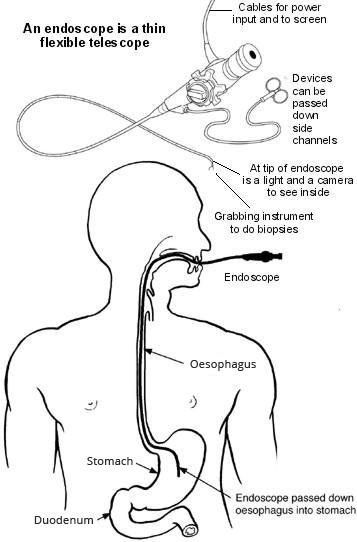
A gastroscopy is a test where an operator - usually a doctor or nurse - looks into the upper part of the gut (the upper gastrointestinal tract) with a camera.
The upper gut consists of the gullet (oesophagus), the stomach and the first part of the gut (small intestine) known as the duodenum. The operator uses an endoscope to look inside the gut.
An endoscope is a thin, flexible telescope. It is about as thick as a little finger. The endoscope is passed through the mouth, down the food pipe into the oesophagus and down towards the stomach and duodenum.
The tip of the endoscope contains a light and a tiny video camera so the operator can see inside the gut.
The endoscope also has a side channel down which various instruments can pass. These can be manipulated by the operator. For example, the operator may take a small sample (Biopsie) from the inside lining of the stomach by using a thin 'grabbing' instrument which is passed down a side channel.
The procedure is sometimes called an "upper GI endoscopy" - this refers to the upper gastro-intestinal tract.
Why do I need a gastroscopy?
A gastroscopy may be advised for symptoms such as:
Repeated (recurring) indigestion.
Recurring heartburn.
Pains in the upper tummy (abdomen).
Wiederholtes Erbrechen (Übergeben).
Schwierigkeiten beim Schlucken.
Other symptoms thought to be coming from the upper gut, stomach or oesophagus.
What is a gastroscopy looking for?
Inflammation of the gullet (oesophagus), called oesophagitis. The operator will see areas of redness on the lining of the oesophagus.
Magengeschwür und Zwölffingerdarmgeschwür. An ulcer looks like a small, red crater on the inside lining of the stomach or on the first part of the gut (small intestine) known as the duodenum.
Inflammation of the duodenum (duodenitis) and inflammation of the stomach (Gastritis).
Magen und Speiseröhrenkrebs cancer.
Hiatushernie
Various other rare conditions.
What happens during a gastroscopy?
Gastroscopy is usually done as an outpatient 'day case'. It is a routine test which is commonly done. Before the test the operator will explain what is going to happen and ask for a consent form to be signed.
The operator may numb the back of the throat by spraying on some local anaesthetic or giving an anaesthetic lozenge to suck. A sedative may also be given to help relaxation. This is usually given by an injection into a vein in the back of the hand. The sedative causes drowsiness but is not a general anaesthetic and does not put someone to sleep.
You lie on your side on a couch. You are asked to put a plastic mouth guard between your teeth. This works to protect your teeth and stops you biting the endoscope. The operator will then ask you to swallow the first section of the endoscope. Modern endoscopes are quite thin but some people may find this difficult.
The operator then gently pushes it further down the gullet (oesophagus) and into the stomach and the first part of the gut (small intestine) known as the duodenum. The video camera at the tip of the endoscope sends pictures to a screen.
The operator watches the screen for abnormalities of the oesophagus, stomach and duodenum. Air is passed down a channel in the endoscope into the stomach to make the stomach lining easier to see. This may cause a bloating sensation and belching.
The operator may take one or more small tissue samples (biopsies) of parts of the inside lining of the gut - depending on why the test is done and what they see on the screen. This is painless. The biopsy samples are sent to the laboratory for testing and to look at under the microscope. The endoscope is then gently pulled out.
How long does a gastroscopy take?
A gastroscopy usually takes about 10 minutes. However, at least two hours should be allowed for the whole appointment. This is to prepare, give time for the sedative to work, for the gastroscopy itself and to recover. A gastroscopy may be quite uncomfortable but it does not usually hurt.
How do you prepare for a gastroscopy?
You should receive instructions from the hospital department before your test. The sort of instructions given commonly include:
Avoid eating or drinking for 4-6 hours before the test. The stomach needs to be empty. (Small sips of water may be allowed up to two hours before the test.)
If you have a sedative you will need somebody to accompany you home.
Advice about medication which may need to be stopped before the test.
What can I expect after a gastroscopy?
Most people are ready to go home after resting for half an hour or so.
Wenn Sie ein Beruhigungsmittel eingenommen haben - you may take a bit longer to be ready to go home. The sedative will normally make you feel quite pleasant and relaxed. However, you should not drive, operate machinery or drink alcohol for 24 hours after having the sedative. You will need somebody to accompany you home and to stay with you for 24 hours until the effects have fully worn off. Most people are able to resume normal activities after 24 hours.
The operator writes a report and sends it to the doctor who requested the gastroscopy, usually a gastroenterologist but occasionally another specialist or GP. The result from any sample (biopsy) may take some days or even weeks, which can delay the report being sent. The operator may inform you about what they saw before you leave. However, if you have had a sedative you may not remember afterwards what you were told. Therefore, you may wish to have a relative or close friend with you who may be able to help remember what was said.
Is gastroscopy reliable?
Gastroscopy is a good test for seeing abnormalities in the upper gut. However, it is not fool-proof. For example, gastroscopy may not detect a small number of cases of early ulcers or early cancer. Sometimes a repeat gastroscopy may be advised if symptoms persist or become worse, even if a previous gastroscopy was reported as normal.
Is a gastroscopy dangerous?
Most gastroscopies are done without any problem. Some people have a mildly sore throat for a day or so afterwards. You may feel tired or sleepy for several hours if you have a sedative. There is a slight risk of developing a chest infection or pneumonia following a gastroscopy.
Occasionally, the endoscope causes some damage to the gut. This may cause bleeding, infection and rarely a hole (perforation). If any of the following occur within 48 hours after a gastroscopy, seek immediate medical help:
Bauchschmerzen (abdominale Schmerzen). (In particular, if it becomes gradually worse, and is different from or more intense than any 'usual' indigestion pains or heartburn.)
Erhöhte Temperatur (Fieber).
Atembeschwerden.
Blut erbrechen.
A small number of people have a Herzinfarkt oder Schlaganfall during, or soon after, a gastroscopy. These tend to be older people who are already in poor health. These serious complications are rare in most people who are otherwise reasonably healthy.
Rarely, some people have an allergic reaction to the sedation.
Patientenauswahl für Endoskopie

Chirurgie und Verfahren
Sigmoidoskopie
Eine Sigmoidoskopie ist ein Test, der das Rektum und den unteren Teil des Dickdarms untersucht. Hinweis: Die unten stehenden Informationen sind nur eine allgemeine Anleitung. Die Abläufe und die Durchführung der Tests können in verschiedenen Krankenhäusern variieren. Befolgen Sie stets die Anweisungen Ihres Arztes oder Ihres örtlichen Krankenhauses.
von Dr. Claudia Berty, MRCGP

Chirurgie und Verfahren
Bronchoskopie
Eine Bronchoskopie ist ein Test, der bei der Diagnose und Behandlung von Atemwegserkrankungen helfen kann. Dabei schiebt ein Arzt ein flexibles Kamerarohr in Ihre Lunge. Hinweis: Die nachstehenden Informationen sind nur eine allgemeine Orientierung. Die Abläufe und die Durchführung der Tests können in verschiedenen Krankenhäusern variieren.
von Dr. Toni Hazell, FRCGP
Häufig gestellte Fragen
What is the purpose of the plastic mouth guard used during a gastroscopy?
During a gastroscopy, a plastic mouth guard is placed between your teeth. Its purpose is to protect your teeth and prevent you from accidentally biting the endoscope during the procedure.
How does the doctor see inside the gut during a gastroscopy?
The endoscope, which is a thin, flexible tube, has a tiny video camera and light at its tip. This camera sends live pictures to a screen, allowing the operator to view the inside lining of your gullet, stomach, and the first part of the small intestine.
What happens to the tissue samples (biopsies) taken during a gastroscopy?
If small tissue samples (biopsies) are taken during the gastroscopy, they are sent to a laboratory for testing. There, they are examined under a microscope to help in diagnosing any abnormalities.
Why might I experience bloating or belching during a gastroscopy?
During the procedure, air is passed down a channel in the endoscope into your stomach. This is done to help make the stomach lining easier for the operator to see, but it may cause you to feel a sensation of bloating and lead to belching.
Can I get the results of my gastroscopy immediately after the procedure?
The operator may inform you about their findings immediately after the procedure. However, if you received a sedative, you might not remember what was discussed. Also, if any tissue samples (biopsies) were taken, the full report may be delayed as it can take several days or even weeks for those results to come back from the laboratory.
If my gastroscopy results are normal, does that mean I definitely don't have a problem?
While gastroscopy is generally reliable, it's not always foolproof. In a small number of cases, it might not detect very early ulcers or early-stage cancer. If your symptoms continue or get worse, even after a normal gastroscopy, your doctor might recommend a repeat procedure.
Weiterführende Literatur und Referenzen
Über den AutorVollständige Biografie anzeigen

Dr Philippa Vincent, MRCGP
Allgemeinmediziner, Medizinischer Autor
MB BS, Bsc, MRCGP (2000), DCH, DFSRH, DRCOG
Dr Philippa Vincent ist ein NHS-Arzt, der in Nordlondon arbeitet.
Über den RezensentenVollständige Biografie anzeigen

Dr Hayley Willacy, FRCGP
Allgemeinmediziner, Medizinischer Autor
MBChB (1992), DRCOG, DFFP, MRCOG (Part 1) MRCGP (2007), DFSRH (2013), MSc - medical education (2020)
Dr. Hayley Willacy war eine NHS-Hausärztin, die in Nordwestengland arbeitete und 2022 nach 30 Jahren aus der klinischen Praxis ausschied.
Artikelverlauf
Die Informationen auf dieser Seite wurden von qualifizierten Klinikern verfasst und begutachtet.
Artikel auch verfügbar in Englisch, Deutsch, Spanisch, Französisch, Italienisch, Portugiesisch, Hindi, Hebräisch, Arabisch, und Schwedisch.
Nächste Überprüfung fällig: 2. Juli 2027
3. Juli 2024 | Neueste Version

Fragen, teilen, verbinden.
Durchsuchen Sie Diskussionen, stellen Sie Fragen und teilen Sie Erfahrungen zu Hunderten von Gesundheitsthemen.

Fühlen Sie sich unwohl?
Bewerten Sie Ihre Symptome online kostenlos
Abonnieren Sie den Patienten-Newsletter
Ihre wöchentliche Dosis klarer, vertrauenswürdiger Gesundheitsberatung - geschrieben, um Ihnen zu helfen, sich informiert, selbstbewusst und in Kontrolle zu fühlen.
Durch das Abonnieren akzeptieren Sie unsere Datenschutzrichtlinie. Sie können sich jederzeit abmelden. Wir verkaufen Ihre Daten niemals.
Mehr zu Chirurgie und Verfahren
- Anästhesie
- Anästhesie für Hüft- oder Kniegelenkersatz
- Botox
- Kolposkopie und zervikale Behandlungen
- Koronararterien-Bypass-Operation
- Tod oder Hirnschäden durch Anästhesie
- Tiefe Venenthrombose
- Endometriumbiopsie
- Epidurale Schmerzbehandlung nach der Operation
- Laparoskopie und laparoskopische Chirurgie
- Laser-Augenchirurgie
- Lippenvergrößerung
- Lokalanästhesie für Ihre Augenoperation
- Nervenschäden nach Epiduralinjektion
- Nasenverkleinerung (Rhinoplastik)
- Lungenembolie
- Sigmoidoskopie
- Spinalanästhesie
- Videoassistierte thorakoskopische Chirurgie
- Gewichtsverlustchirurgie