Abdominalmassen
Fachlich geprüft von Dr Toni Hazell, FRCGPZuletzt aktualisiert von Dr Philippa Vincent, MRCGPZuletzt aktualisiert 30. Jul 2024
Entspricht den redaktionellen Richtlinien
- HerunterladenHerunterladen
- Teilen
- Language
- Diskussion
- Audio-Version
- Zu bevorzugten Quellen bei Google hinzufügen
Eine Bauchmasse ist eine im Bauch (Abdomen) gefühlte Beule. Es gibt viele verschiedene Ursachen für eine Bauchmasse. Bei einer neu entdeckten Masse im Bauch sollte umgehend medizinische Hilfe in Anspruch genommen werden.
Auf einen Blick
An abdominal mass is a lump in the tummy.
It can be felt or discovered during an examination for other symptoms like abdominal pain.
Symptoms can include pain, changes in bowel habits, weight loss, or blood in urine.
Causes vary depending on the lump's location and can range from normal body parts to more serious conditions like cancer.
Diagnosis often involves physical examination, blood, urine, or stool tests, and scans.
Treatment depends on the cause; some masses may not need treatment.
What is an abdominal mass?
An abdominal mass is a lump in the tummy (abdomen). The abdomen contains many different structures including the:
Stomach and gut (bowel).
Leber.
Kidneys and bladder.
Womb (uterus) and ovaries in women.
Major blood vessels - for example, the aorta.
The position of the mass will help to determine which structure the mass is arising from.
The abdomen is traditionally divided into nine areas:
Just below the ribs on the right side (right upper quadrant/hypogastrium).
Just below the ribs in the middle (epigastrium).
Just below the ribs on the left side (left upper quadrant/hypogastrium).
Right side of the middle abdomen (right loin/lumbar region).
Around the tummy button (periumbilical).
Left side of the middle abdomen (left loin/lumbar region).
Right side of the lower abdomen (right lower quadrant/inguinal or iliac region).
Middle of the lower abdomen (suprapubic and pelvis).
Left side of the lower abdomen (left lower quadrant/inguinal or iliac region).
Abdominopelvic regions
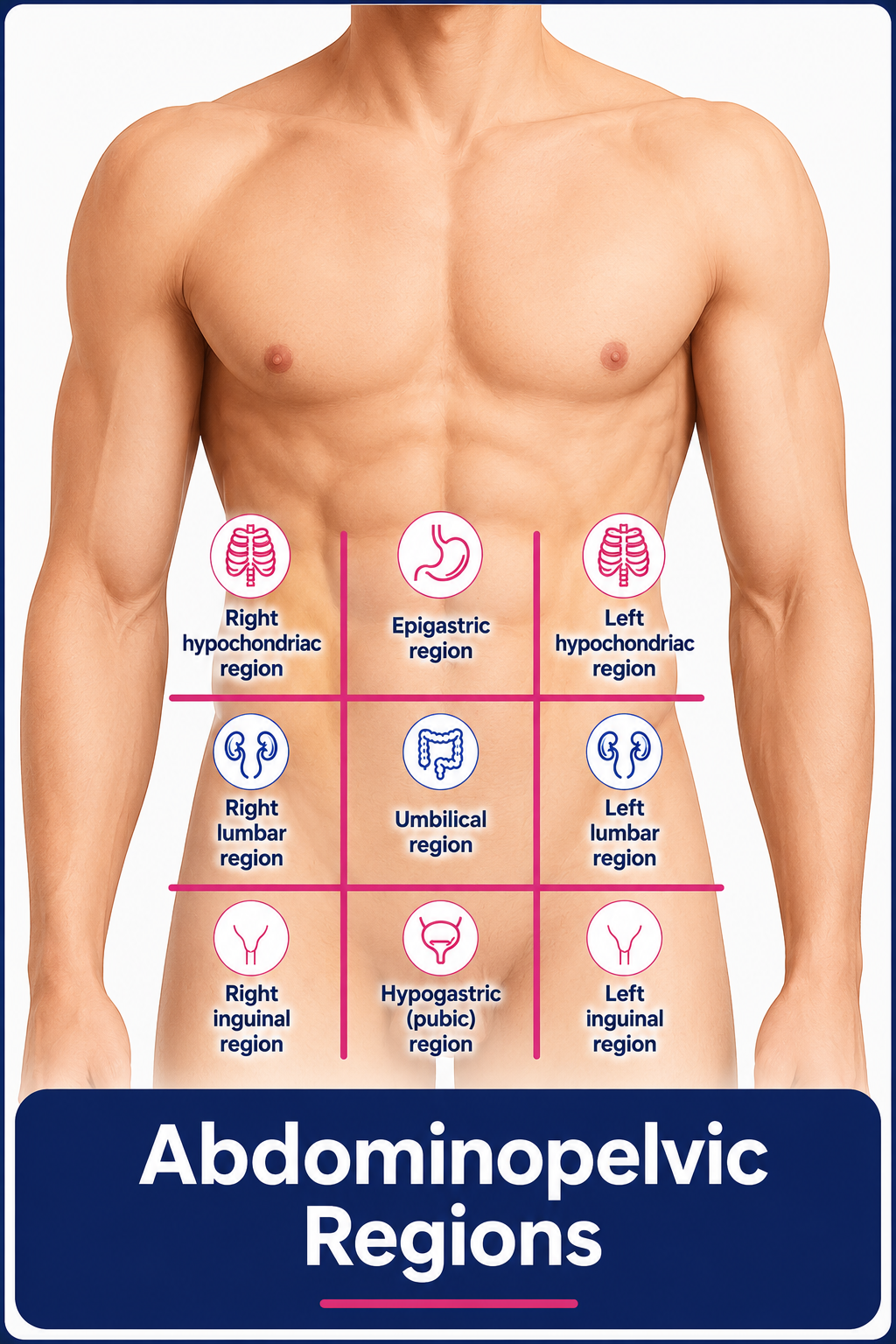
© Blausen.com staff (2014). "Medical gallery of Blausen Medical 2014". WikiJournal of Medicine 1 (2). DOI:10.15347/wjm/2014.010. ISSN 2002-4436., CC BY 3.0 , via Wikimedia Commons
Often nowadays, the abdomen is described in quadrants rather than using the nine areas. These are described as the right upper, right lower, left upper and left lower quadrants.
Abdominal mass symptoms
It is possible to feel a lump in the stomach (the mass in your own abdomen) before any other symptom but, much more frequently, it is first felt by a doctor examining the abdomen because of a different symptom, such as abdominal pain.
Therefore, it is more usual to become aware of a mass in the abdomen because of other symptoms such as:
A mass in the kidney may also cause Blut im Urin. Other symptoms will depend on the cause of the mass.
Abdominal mass causes
The possible cause of the abdominal mass will depend on where it is in the abdomen. The following lists are examples of the more common causes of an abdominal mass in each area. A lump (swelling) that can be seen and felt over the front of the abdomen (abdominal wall) may also be a skin lump, a lipoma (fatty lump) or a Hernie.
Rechter oberer Quadrant
Leber: enlarged liver (hepatomegaly), Leberkrebs. There are many causes of an enlarged liver, including Infektion, Herzinsuffizienz, liver cancer, Alkoholische Lebererkrankung und fatty liver disease.
Gallbladder: Cholezystitis, cancer of the bile duct in the liver (cholangiocarcinoma).
Epigastrium
Stomach: for example, Magenkrebs.
Pancreas: for example, a pancreatic Abszess oder Bauchspeicheldrüsenkrebs.
Ribcage: at the very bottom of the rib cage in the centre of the body, there is a small bone called the xiphisternum. In some people this bone sticks out and can feel like a lump. This is entirely normal and can be easily diagnosed by a doctor on clinical examination.
Linker oberer Quadrant
Spleen: enlarged spleen (splenomegaly). There are many causes of an enlarged spleen, including Leukämie, Lymphom, Thalassämie, Sichelzellenanämie, Malaria und Mumps.
Stomach: for example, Magenkrebs.
Pancreas: for example, an abscess or Bauchspeicheldrüsenkrebs.
Gut (bowel): for example, Darmkrebs.
Kidney: for example, kidney cancer.
Right loin
Kidney: for example, kidney cancer.
Periumbilical
Enlarged part of the major blood vessel (aorta): aortic aneurysm.
Left loin
Kidney: for example, kidney cancer.
Right lower quadrant
Bowel: for example, Darmkrebs.
Kidney: for example, kidney cancer.
Ovary: for example, cancer of the ovary.
Suprapubic and pelvis
Blase: for example, a distended bladder caused by a blockage preventing you from emptying the bladder - such as in Vergrößerung der Prostata in men.
Womb (uterus): for example, Schwangerschaft, fibroids.
Ovary: for example, Ovarialzyste, Eierstockkrebs.
Abdominal aorta: for example, a pulsatile mass due to an abdominal aortic aneurysm.
Left lower quadrant
Bowel: for example, constipation, Darmkrebs, Divertikelerkrankung.
Kidney: for example, kidney cancer.
Ovary: for example, cancer of the ovary.
Diagnosing an abdominal mass
Welche Tests sind erforderlich?
There are lots of different causes of an abdominal mass. Doctors will ask about various other symptoms and do a physical examination of the abdomen. Further tests depend on what they find, and what they think the cause might be.
Examples of tests that might be needed include:
Blood tests - for example, a CA-125 test to look for ovarian cancer.
Urine tests - to look for hidden blood in the urine which can be a sign of kidney cancer oder bladder cancer.
Stool tests - a qFIT test is a test to look for hidden blood in the stool which can be a sign of Darmkrebs.
Scans or other imaging, such as:
Ultraschalluntersuchungen; abdominal ultrasound and sometimes transvaginal ultrasound scans.
Depending on the scan results, sometimes a Biopsie (sample) of the mass is needed. This would be done in hospital. It might require an operation, depending on where the mass is.
Blood, stool and urine tests can be done by a GP; others need to be done by a hospital team.
If the GP suspects that the mass might be due to cancer, they are likely to make an urgent referral to the hospital - suspected cancer pathways mean that patients should have been seen and investigated within 28 days of referral. Often particular tests are needed before the hospital referral can be sent (for example, a qFIT result may be needed in advance).
Cancer is one cause of an abdominal mass, but there are many others. Most people referred to hospital for suspected cancer end up with normal or reassuring test results. For instance, Myome are a common cause of a pelvic mass in women, but are not cancerous.
Abdominal mass treatment
Treatment options will depend on the cause of the abdominal mass. If the mass isn't cancer, and isn't causing any problems, no treatment may be needed. Treatment for Krebs depends on the type of cancer and how advanced it is. Depending on what the mass is, an operation to remove it may be possible.
Complications of an abdominal mass
There are lots of different causes of an abdominal mass. Complications differ depending on the cause.
In general, masses can cause:
Pressure symptoms. A large mass in the abdomen can press on other organs. This might cause bloating, abdominal swelling, a reduced appetite, leg swelling and pain.
Other complications depend on the cause of the mass. For example:
Uterine (womb) Myome can cause starke Menstruationsblutung und Anämie.
Menschen mit polyzystische Nierenerkrankung, which causes enlarged kidneys with multiple fluid-filled cysts in them, can develop Bluthochdruck und Nierenprobleme.
Krebs can spread to other organs.
Patientenauswahl für Andere Verdauungsbeschwerden

Verdauungsgesundheit
Eosinophile Ösophagitis
Die Speiseröhre ist die Speiseröhre oder der Nahrungsschlauch, der den Mund mit dem Magen verbindet. Eine Entzündung der Speiseröhre wird als Ösophagitis bezeichnet. Häufig wird die Entzündung durch Säure verursacht, die aus dem Magen aufsteigt (ein Zustand, der als saurer Reflux bekannt ist). Bei einigen Menschen kann sie jedoch durch einen Zustand verursacht werden, der als eosinophile Ösophagitis bekannt ist. Bei der eosinophilen Ösophagitis sammeln sich bestimmte Arten von weißen Blutkörperchen (sogenannte Eosinophile) in großer Zahl in der Auskleidung der Speiseröhre und verursachen eine Entzündung. Sie tritt bei Kindern und Erwachsenen auf. Der Zustand kann durch Änderungen der Ernährung und/oder die Einnahme von Steroiden kontrolliert werden. Gelegentlich kann eine Operation erforderlich sein, um die Speiseröhre mit einem Teleskop (Endoskop) zu dehnen.
von Dr. Rachel Hudson, MRCGP

Verdauungsgesundheit
Barrett-Ösophagus
Beim Barrett-Ösophagus sind die Zellen, die die untere Speiseröhre (Ösophagus) auskleiden, abnormal. Die Hauptursache ist ein lang anhaltender Rückfluss von Magensäure in die Speiseröhre. Menschen mit Barrett-Ösophagus haben ein erhöhtes Risiko, an Speiseröhrenkrebs zu erkranken. Das Risiko ist gering. Es kann jedoch empfohlen werden, regelmäßige Endoskopien durchzuführen, um präkanzeröse Veränderungen der Zellen in der Speiseröhre zu erkennen. Wenn präkanzeröse Veränderungen auftreten, kann eine Behandlung zur Entfernung oder Zerstörung der präkanzerösen Zellen empfohlen werden.
von Dr. Colin Tidy, MRCGP
Häufig gestellte Fragen
If I feel a lump in my abdomen, does it mean it's serious?
Not necessarily. While an abdominal mass can be a symptom of a serious condition, there are many other causes that are not serious or cancerous. For instance, fibroids in women are a common cause of a pelvic mass and are not cancerous. Even if tests are done for suspected cancer, most people end up with normal or reassuring results.
What is the xiphisternum and why might it feel like a lump?
The xiphisternum is a small bone located at the very bottom of the rib cage in the centre of the body. In some individuals, this bone can stick out and be mistaken for a lump. This is considered entirely normal and can be easily identified by a doctor during a physical examination.
Can an abdominal mass affect my appetite or cause swelling in my legs?
Yes, a large abdominal mass can press on other organs, leading to various symptoms. These pressure symptoms can include bloating, general abdominal swelling, a reduced appetite, and swelling in the legs.
How soon will I get a diagnosis if my GP suspects cancer due to an abdominal mass?
If your GP suspects that an abdominal mass might be due to cancer, they are likely to make an urgent referral to the hospital. Suspected cancer pathways aim for patients to be seen and have investigations completed within 28 days of the referral. Sometimes, specific tests like a qFIT result may be needed before the hospital referral can be sent.
Can an abdominal mass be treated without surgery?
Treatment for an abdominal mass depends entirely on its underlying cause. If the mass is not cancerous and not causing any problems, no treatment may be needed. For other causes, treatment might involve medication, lifestyle changes, or other medical procedures, with surgery being one of the options depending on what the mass is and its location.
Weiterführende Literatur und Referenzen
- Verdacht auf Krebs: Erkennung und Überweisung; NICE-Richtlinie (2015 - zuletzt aktualisiert im April 2026)
Über den AutorVollständige Biografie anzeigen

Dr Philippa Vincent, MRCGP
Allgemeinmediziner, Medizinischer Autor
MB BS, Bsc, MRCGP (2000), DCH, DFSRH, DRCOG
Dr Philippa Vincent ist ein NHS-Arzt, der in Nordlondon arbeitet.
Über den RezensentenVollständige Biografie anzeigen

Dr Toni Hazell, FRCGP
MBBS, BSc, FRCGP, DFSRH, Dip GU med, DRCOG, DCH (London, UK, 2000)
Dr. Toni Hazell hat ihren Abschluss an der St. Mary’s Hospital Medical School gemacht und ihr VTS am Northwick Park Hospital absolviert.
Artikelverlauf
Die Informationen auf dieser Seite wurden von qualifizierten Klinikern verfasst und begutachtet.
Artikel auch verfügbar in Englisch, Deutsch, Spanisch, Französisch, Italienisch, Portugiesisch, Hindi, Hebräisch, Arabisch, und Schwedisch.
Nächste Überprüfung fällig: 29. Juli 2027
30. Jul 2024 | Neueste Version

Fragen, teilen, verbinden.
Durchsuchen Sie Diskussionen, stellen Sie Fragen und teilen Sie Erfahrungen zu Hunderten von Gesundheitsthemen.

Fühlen Sie sich unwohl?
Bewerten Sie Ihre Symptome online kostenlos
Abonnieren Sie den Patienten-Newsletter
Ihre wöchentliche Dosis klarer, vertrauenswürdiger Gesundheitsberatung - geschrieben, um Ihnen zu helfen, sich informiert, selbstbewusst und in Kontrolle zu fühlen.
Durch das Abonnieren akzeptieren Sie unsere Datenschutzrichtlinie. Sie können sich jederzeit abmelden. Wir verkaufen Ihre Daten niemals.
Mehr zur Verdauungsgesundheit
- Analfistel
- Barrett-Ösophagus
- Clostridioides difficile
- Zöliakie
- Durchfall
- Lebensmittelvergiftung bei Kindern
- Gastroenteritis
- Giardia
- Gilbert-Syndrom
- Entzündliche Darmerkrankung
- Juckender Po
- Abführmittel
- Lokale Präparate für Analleiden
- Nicht-alkoholische Fettlebererkrankung
- Hämorrhoiden
- Primär sklerosierende Cholangitis
- Protonenpumpenhemmer
- Salmonellen
- Kleinkind-Durchfall
- Eingeschlossene Luft, Gas und Blähungen