Leistenbrüche
Begutachtet von Dr Toni Hazell, FRCGPZuletzt aktualisiert von Dr Philippa Vincent, MRCGPZuletzt aktualisiert 1. Okt. 2026
Erfüllt die redaktionelle Richtlinien
- HerunterladenHerunterladen
- Teilen
- Language
- Diskussion
- Audio-Version
- Zu bevorzugten Quellen bei Google hinzufügen
Medizinische Fachkräfte
Fachartikel sind für die Nutzung durch Gesundheitsfachkräfte konzipiert. Sie werden von britischen Ärzten verfasst und basieren auf Forschungsergebnissen sowie britischen und europäischen Richtlinien. Sie finden möglicherweise die Hernie Artikel nützlicher oder einer unserer anderen Gesundheitsartikel.
Was ist ein Leistenbruch?
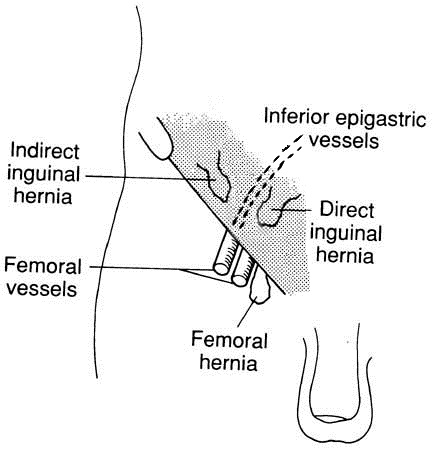
An abdominal hernia comprises a protrusion of abdominal contents through the fascia of the abdominal wall; an inguinal hernia is where this protrudes through the internal inguinal ring. Hernias contain a portion of peritoneal sac and may contain viscera, usually small bowel and omentum.
Leistenbruch
Epidemiologie der Leistenhernie
Inguinal hernias are common, making up 75% of all abdominal hernias.
Inguinal hernias are more common in men (the lifetime risk of an inguinal hernia is 27-43% in men and 3-6% in women).1 Although they are much more common in men, women with a groin hernia are still more likely to have an inguinal than a femoral hernia.2
As well as male sex, risk factors include increasing age (although there is also a significant spike in cases below the age of 5 years) and a genetic predisposition.2
Other risk factors are thought to include: smoking, chronic obstructive pulmonary disease, lower body mass index, high intrabdominal pressure, thoracic or abdominal aortic aneurysm, patent processes vaginalis, history of open appendectomy, peritoneal dialysis, and collagen vascular disease.2
Präsentation der Leistenhernie
An inguinal hernia will usually present as a swelling in the groin that may appear with lifting and be accompanied by sudden pain.
There may be a cough impulse. The hernia may not be visible when lying flat but may appear on standing.
The hernia may be reducible.
Indirect hernias can cause pain in the scrotum and cause a 'dragging sensation'.
Kongenitale Leistenbrüche werden normalerweise bei der Geburt festgestellt und erfordern alle eine dringende ambulante Überweisung zur chirurgischen Reparatur.
Inguinal hernias in older children and adults usually develop gradually but can occur suddenly with an episode of heavy lifting:
Bei erster Betrachtung ist ein Leistenbruch normalerweise leicht reduzierbar, wenn der Patient liegt. Allerdings kann eine manuelle Reposition erforderlich sein, wenn er groß ist.
Mit der Zeit vergrößert sich der Bruch und wird aufgrund der Bildung von fibrösen Verwachsungen schwieriger zu ersetzen.
Wenn es nicht mehr reduziert werden kann, ist es irreduzibel oder eingeklemmt. Dies kann jederzeit auftreten, ebenso wie eine Strangulation. Dies tritt auf, wenn die viszeralen Inhalte des Bruchs durch die enge Öffnung verdreht oder eingeklemmt werden. Dies beeinträchtigt die Blutversorgung, was zu Schwellungen und schließlich zu einem Infarkt führt. Eine Strangulation führt in der Regel zu einem Darmverschluss.
Es gibt zwei Arten von Leistenbruch:
Indirekt: a protrusion through the internal inguinal ring passes along the inguinal canal through the abdominal wall, running laterally to the inferior epigastric vessels. This is the more common form accounting for 80% of inguinal hernias, especially in children. It is associated with failure of the inguinal canal to close properly after passage of the testis in utero or during the neonatal period.
Direkt: Der Bruch tritt direkt durch eine Schwäche in der hinteren Wand des Leistenkanals hervor und verläuft medial zu den unteren epigastrischen Gefäßen. Er ist bei älteren Menschen häufiger und bei Kindern selten.
Bewertung3
Untersuchen Sie den Patienten sowohl im Stehen als auch im Liegen und bitten Sie ihn, zu husten oder zu pressen.
Führen Sie einen Finger durch die Oberseite des Hodensacks in den äußeren Leistenring ein und tasten Sie beim Husten nach einer Schwellung - Hustenimpuls.
Gleitbrüche sind bei großen Skrotalhernien wahrscheinlich.
Differentialdiagnose
Siehe auch das separate Knoten in der Leiste und im Hodensack Artikel.
Hydrozele (bei der Unterscheidung von einem inguinoskrotalen Hernie beachten Sie, dass es bei der Untersuchung möglich ist, über ein Hydrozele zu gelangen).
Hydrozele des Samenstrangs.
Lymphknotenschwellung.
Abszess.
Saphena varix.
Blutung.
Untersuchungen
Whilst most specialists agree that imaging is not necessary to make the diagnosis, in the UK there are often local constraints on referrals for hernia repair which mean that the diagnosis needs to be confirmed by imaging. Ultrasound scan is the imaging option of choice.34
Behandlung und Management von Leistenbruch
Erwachsene5 2
If the inguinal hernia is small, the patient may only need reassurance. There is good recent evidence that "watchful waiting" is a safe option for many adults with inguinal hernias. Long-term follow-up of these patients suggests that around 68% proceed to surgical management eventually, usually due to worsening pain or lifestyle limitations from progression.2
Patients with pain, reduced mobility or other symptoms should be offered surgical management. Many patients with chronically incarcerated hernias may be asymptomatic but patients with obstruction or strangulation are a surgical emergency.
However, there is always the chance of it becoming a surgical emergency through obstruction and incarceration. Episodes of pain and tenderness suggest the need for urgent treatment but when these become prolonged and severe then emergency surgery is indicated for possible strangulation. The fundamentals of indirect inguinal hernia treatment are the same regardless of the patient's age. Reduction or excision of the sac and closure of the defect with minimal tension are the essential steps in any hernia repair.
Surgical guidelines recommend tailoring the choice of surgery to individual patient factors. Surgical options include either an open (tissue- or mesh-based) procedure or a minimally invasive (laparoscopic or robotic) procedure.
An open repair with mesh is associated with a 50%-75% lower risk of hernia recurrence, lower risk of chronic pain post-operatively, and an earlier return to work compared with a sutured repair. A tissue (sutured) repair is usually used where mesh is contraindicated, for example where there may be potential for infection from a contaminated field. Laparoscopic repair is recommended for bilateral inguinal hernias as the same port sites can be used.
Studies have shown no significant difference between mesh, laparoscopic and robotic procedures in terms of post-operative haematoma, surgical site infection, urinary retention, or hospital length of stay. However post-operative chronic pain appears to be lower in patients who have undergone laparoscopic procedures, though studies have been of questionable quality.
Leistenbrüche bei Kindern
The incidence of incarcerated or strangulated hernias in paediatric patients is higher than in adults, at around 7-11%.6 It is higher in infants than in older children. The risk increases with waiting time from diagnosis to procedure.67
Surgical repair is usually recommended as early as possible in paediatric patients because of these risks.
Laparoscopic repair has been shown to have better outcomes than open repair though both have low risks of complications.8910
Komplikationen
Dazu gehören:
Post-operative chronic pain is reported to occur in between 8 and 16% of patients, though laparoscopic repair appears to reduce the risk.2
Rückfall: 1,0 % - die meisten treten innerhalb von fünf Jahren nach der Operation auf. Rückfallrate steigt:
Bei Kindern unter 1 Jahr.
Bei älteren Patienten.
Nach Inhaftierungen.
Bei Personen mit anhaltend erhöhtem intraabdominalem Druck.
Wo Wachstumsstörungen auftreten.
Mit Frühgeburtlichkeit.
Wo es chronische Atemwegsprobleme gibt.
Bei Mädchen mit Gleithernien.
Infarktierter Hoden oder Eierstock mit Atrophie.
Wundinfektion.
Blasenverletzung.
Darmverletzung.
Ein Hydrozele durch Flüssigkeitsansammlung im distalen Sack löst sich normalerweise spontan auf, erfordert aber manchmal eine Aspiration.
Prognose
Dies ist im Allgemeinen sehr gut, abhängig von der Komorbidität.
Exklusive Updates für medizinisches Fachpersonal
Bleiben Sie informiert mit den neuesten klinischen Updates, professionellen Einblicken und evidenzbasierten Leitlinien. Der Patient Pro-Newsletter stellt wesentliche Inhalte für Gesundheitsfachkräfte zusammen – direkt in Ihren Posteingang geliefert.
Durch das Abonnieren akzeptieren Sie unsere Datenschutzrichtlinie. Sie können sich jederzeit abmelden. Wir verkaufen Ihre Daten niemals.
Weiterführende Lektüre und Referenzen
- Jorgenson E, Makki N, Shen L, et al; Eine genomweite Assoziationsstudie identifiziert vier neue Anfälligkeitsloci, die einem Leistenbruch zugrunde liegen. Nat Commun. 2015 Dez 21;6:10130. doi: 10.1038/ncomms10130.
- Gudigopuram SVR, Raguthu CC, Gajjela H, et al; Leistenbruch-Netzreparatur: Die Faktoren, die bei der Entscheidung zwischen offener und laparoskopischer Reparatur zu berücksichtigen sind. Cureus. 2021 Nov 16;13(11):e19628. doi: 10.7759/cureus.19628. eCollection 2021 Nov.
- Tigora A, Radu PA, Garofil DN, et al; Modern Perspectives on Inguinal Hernia Repair: A Narrative Review on Surgical Techniques, Mesh Selection and Fixation Strategies. J Clin Med. 2025 Jul 9;14(14):4875. doi: 10.3390/jcm14144875.
- Current status of inguinal hernia management; P J McBee et al; International Journal of Abdominal Wall and Hernia Surgery
- Hassler KR, Saxena P, Baltazar-Ford KS; Open Inguinal Hernia Repair.
- LeBlanc KE, LeBlanc LL, LeBlanc KA; Leistenbrüche: Diagnose und Behandlung. Am Fam Physician. 15. Juni 2013;87(12):844-8.
- HerniaSurge Gruppe; Internationale Richtlinien für das Management von Leistenhernien. Hernie. 2018;22(1):1-165. doi:10.1007/s10029-017-1668-x
- Olesen CS, Mortensen LQ, Oberg S, et al; Risk of incarceration in children with inguinal hernia: a systematic review. Hernia. 2019 Apr;23(2):245-254. doi: 10.1007/s10029-019-01877-0. Epub 2019 Jan 12.
- Retrospective Cohort Study on Inguinal Hernia in Children: Infant Vulnerability to Incarceration and Pediatricians’ Awareness; A G Grewal et al; CHRISMED Journal of Health and Research
- Ma Q, Liu X, Zou Z, et al; Surgical methods and outcomes of inguinal hernia repair in children, adolescents and young adults in a retrospective cohort study. Sci Rep. 2025 Mar 17;15(1):9220. doi: 10.1038/s41598-025-93841-5.
- Morgado M, Holland AJ; Inguinal hernias in children: Update on management guidelines. J Paediatr Child Health. 2024 Nov;60(11):648-653. doi: 10.1111/jpc.16677. Epub 2024 Sep 25.
- A 10-year review of pediatric inguinal hernia management at a tertiary center; B Yu et al; Frontiers in Pediatrics
Über den AutorVollständige Biografie anzeigen
Aktualisiert von

Dr Philippa Vincent, MRCGP
Allgemeinmediziner, Medizinischer Autor
MB BS, Bsc, MRCGP (2000), DCH, DFSRH, DRCOG
Dr Philippa Vincent ist ein NHS-Arzt, der in Nordlondon arbeitet.
Über den RezensentenVollständige Biografie anzeigen

Dr Toni Hazell, FRCGP
MBBS, BSc, FRCGP, DFSRH, Dip GU med, DRCOG, DCH (London, UK, 2000)
Dr. Toni Hazell hat ihren Abschluss an der St. Mary’s Hospital Medical School gemacht und ihr VTS am Northwick Park Hospital absolviert.
Artikelverlauf
Artikel auch verfügbar in Englisch, Deutsch, Spanisch, Französisch, Italienisch, Portugiesisch, Hindi, Hebräisch, Arabisch, und Schwedisch.
Nächste Überprüfung fällig: 1. Apr. 2031
1. Okt. 2026 | Neueste Version

Fragen, teilen, verbinden.
Durchsuchen Sie Diskussionen, stellen Sie Fragen und teilen Sie Erfahrungen zu Hunderten von Gesundheitsthemen.

Fühlen Sie sich unwohl?
Bewerten Sie Ihre Symptome online kostenlos
Mehr in Geschichte und Untersuchung
- Brustschmerzen
- Komplexes regionales Schmerzsyndrom
- Erythema annulare centrifugum
- Horner-Syndrom
- Heiße geschwollene Gelenke
- Jugularvenendruck
- Schmerzen in der linken Fossa iliaca
- Neugeborenengelbsucht
- Oligurie
- Pädiatrische supraventrikuläre Tachykardie
- Peripheres Ödem
- Presbyakusis
- Pulsuntersuchung
- Geschichte und Untersuchung des Atmungssystems
- Haut- und subkutane Knoten
- Spinnennaevus
- Tenesmus
- Häufiger Harndrang
- Vaskulitis
- Vulvodynie