Farbenblindheit
Colour blindness
Fachlich geprüft von Dr Colin Tidy, MRCGPZuletzt aktualisiert von Dr Hayley Willacy, FRCGP Zuletzt aktualisiert 5. März 2025
Entspricht den Richtlinien für redaktionelle Inhalte
- HerunterladenHerunterladen
- Teilen
- Language
- Diskussion
- Audio-Version
- Zu bevorzugten Quellen bei Google hinzufügen
Farbsehstörung, auch Farbenblindheit genannt, liegt vor, wenn Sie bestimmte Farben nicht sehen können. Die häufigste Form der Erkrankung ist die Rot-Grün-Farbsehstörung.
Wichtige Punkte
Colour vision deficiency (colour blindness) means you find it hard to tell certain colours apart, most often reds, greens, and sometimes blues.
It’s usually inherited and present from birth, though it can also develop later due to eye disease, ageing, or certain medications.
There’s no cure, but most people adapt well by using special colour filters, tinted lenses, or apps that can help distinguish colours more easily.
Colour vision deficiency can be diagnosed from an eye test called the Ishihara test.
What is colour vision deficiency?
Colour vision deficiency, or colour blindness, is when you have difficulty seeing or telling the difference between certain colours.
There are different types of colour vision deficiency. For example, you may be unable to tell red from green or blue from yellow. Red-green colour blindness is by far the most common form.
The effects of colour vision deficiency can be variable - from mild to severe. Some people with colour vision deficiency don't even know they've got it. Others may have a lot of difficulty and be unable to work in certain jobs.
Wie sehen wir Farben?
Different colours are seen by special cells in the retina at the back of your eye. There are two types of cells, called rods and cones. Cones are concerned with colour vision. There are three types of cones: red cones, blue cones and green cones.
Seitenansicht der Struktur des Auges
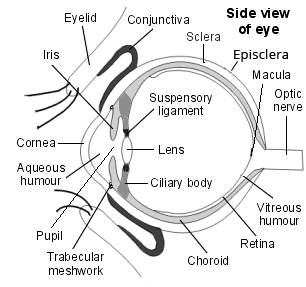
Each type of cone senses a different range of light. Therefore the combination of light sensed by the different cones allows you to know the colour you are looking at. For example, stimulation of green and red cones makes you see green. If all three types of cone are stimulated then you see white.
If you don't have any of the three types of cone then you will only be able to see black, white and shades of grey. But this severe form of colour blindness is very rare.
What are the causes of colour vision deficiency?
For most people with colour vision deficiency the cause is inherited (genetic) and the special code inside each cell in your body (the gene) is passed on from your parents. The most common type - red-green colour blindness - is caused by an abnormal gene on the X chromosome and is much more common in males.
Much more rarely colour vision deficiency can develop later in life as a result of conditions such as:
DNA, genes and chromosomes
In most cells of your body you have 46 chromosomes arranged in 23 pairs. 22 of the pairs are matching pairs. The 23rd pair of chromosomes are the sex chromosomes, which match exactly in women (who have two X chromosomes) but not in men - who have one X and one Y.
One chromosome from each pair comes from your mother and one from your father. Chromosomes are made of DNA, which stands for 'deoxyribonucleic acid'. This is your genetic material. It is found in the nucleus of every cell in your body.
Each of your 46 chromosomes carries hundreds of genes. A gene is the basic unit of your genetic material. It is made up of a piece (a sequence) of DNA and sits at a particular place on a chromosome. So, a gene is a small section of a chromosome.
A gene is effectively a coded set of instructions to the cells. Each gene has a particular function in your body. For example, a gene may be involved in dictating your eye colour or determining your height. Each gene has a matching 'paired' gene on the paired chromosome. So, as for chromosomes, one gene from each pair is inherited from your mother, the other from your father. Humans have between 20,000 and 25,000 genes.
How is colour vision deficiency diagnosed?
Colour vision deficiency is usually first diagnosed using special coloured pictures called Ishihara plates. The Ishihara plate has 16 different diagrams made up of dots to show a number. The Ishihara plate below is used to assess red-green colour vision. People with red-green colour vision deficiency will not be able to see the number clearly.
Ishahara plate
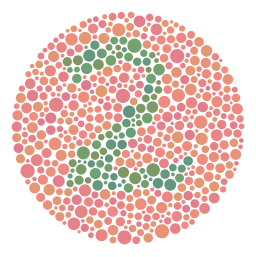
© Sakurambo, CC BY-SA 3.0, via Wikimedia Commons
(For more information see the link to 'Online colour vision tests' in Further reading below).
Can colour vision deficiency be treated?
There is no treatment that can correct or prevent inherited (genetic) colour vision deficiencies.
Colour blindness may be caused by an underlying condition such as thyroid disease or diabetes. The colour vision deficiency may improve with treatment for the underlying condition.
How common is colour vision deficiency?
Colour blindness affects about 1 in 12 men and 1 in 200 women. It is much more common in men because the most common form (red-green colour vision deficiency) is passed on in a gene on the X chromosome (see below for further explanation).
What problems can colour vision deficiency cause?
Nearly all people with colour blindness can see things as clearly as other people but they cannot see certain colours clearly. If you have red-green colour vision deficiency you will not be able to clearly see any colour which has some red or green as part of the whole colour. For example, you will confuse blue and purple (because red and blue make purple).
The effects of colour blindness can be variable, ranging from mild to severe. Some people with colour vision deficiency are unaware that they've got it.
Colour vision deficiency need not prevent someone from driving. Traffic lights can be distinguished by the position of the light.
Colour vision deficiency may cause difficulty at school. Colour vision deficiency can also affect the choice of certain jobs and careers. The list of careers that may not be possible for a person with colour vision deficiency includes:
Certain grades within the armed forces.
Civil aviation: pilots, engineers, technical and maintenance staff, air traffic controllers.
Customs and excise officers.
Railways: drivers, engineers and maintenance staff.
Fire service officers.
Hospital laboratory technicians and pharmacists.
Workers in paint, paper and textile manufacture, photography and fine art reproduction.
However, the restrictions vary. For example, Australian airlines do now allow people with colour vision deficiency to be pilots.
Häufig gestellte Fragen
Is colour vision deficiency a disability?
Colour vision deficiency is not usually classed as a disability in the UK, but it can affect certain jobs or activities that rely on accurate colour recognition. Most people with colour blindness can adapt well and live normal daily lives
How do you know if you are colour blind?
You might be colour blind if you struggle to tell certain colours apart, such as reds and greens or blues and yellows. The most reliable way to know is through a colour vision test, like the Ishihara test, which can confirm the type and severity of colour blindness.
Patientenauswahl für Augenkrankheiten

Augengesundheit
Netzhautvenenverschluss
Die Netzhautvenenverschluss tritt auf, wenn eine der kleinen Venen in der Netzhaut durch ein Blutgerinnsel blockiert wird.
von Dr. Toni Hazell, FRCGP
Augengesundheit
Sehprobleme
Die meisten Menschen sind besorgt, wenn sie Probleme mit ihren Augen entwickeln, insbesondere wenn dies ihre Fähigkeit beeinträchtigt, klar zu sehen. Dieses Faltblatt beschreibt die häufigsten Augenerkrankungen, die das Sehvermögen vorübergehend oder dauerhaft beeinträchtigen können. Es erklärt, welche Symptome auftreten können und was dagegen unternommen werden kann.
von Dr. Philippa Vincent, MRCGP
Weiterführende Literatur und Referenzen
- Simunovic MP; Colour vision deficiency. Eye (Lond). 2010 May;24(5):747-55. doi: 10.1038/eye.2009.251. Epub 2009 Nov 20.
- Online colour vision tests
- Pasmanter N, Munakomi S; Physiology, Color Perception.
Über den AutorVollständige Biografie anzeigen

Dr Hayley Willacy, FRCGP
Allgemeinmediziner, Medizinischer Autor
MBChB (1992), DRCOG, DFFP, MRCOG (Part 1) MRCGP (2007), DFSRH (2013), MSc - medical education (2020)
Dr. Hayley Willacy war eine NHS-Hausärztin, die in Nordwestengland arbeitete und 2022 nach 30 Jahren aus der klinischen Praxis ausschied.
Über den RezensentenVollständige Biografie anzeigen

Dr Colin Tidy, MRCGP
Allgemeinmediziner, Medizinischer Autor
MBBS, MRCGP, MRCP (Paediatrics), DCH
Dr. Colin Tidy ist ein NHS-Arzt mit Sitz in Oxfordshire.
Artikelverlauf
Die Informationen auf dieser Seite wurden von qualifizierten Klinikern verfasst und begutachtet.
Artikel auch verfügbar in Englisch, Deutsch, Spanisch, Französisch, Italienisch, Portugiesisch, Hindi, Hebräisch, Arabisch, und Schwedisch.
Nächste Überprüfung fällig: 4. März 2028
5. März 2025 | Neueste Version

Fragen, teilen, verbinden.
Durchsuchen Sie Diskussionen, stellen Sie Fragen und teilen Sie Erfahrungen zu Hunderten von Gesundheitsthemen.

Fühlen Sie sich unwohl?
Bewerten Sie Ihre Symptome online kostenlos
Abonnieren Sie den Patienten-Newsletter
Ihre wöchentliche Dosis klarer, vertrauenswürdiger Gesundheitsberatung - geschrieben, um Ihnen zu helfen, sich informiert, selbstbewusst und in Kontrolle zu fühlen.
Durch das Abonnieren akzeptieren Sie unsere Datenschutzrichtlinie. Sie können sich jederzeit abmelden. Wir verkaufen Ihre Daten niemals.
Mehr zur Augengesundheit
- Allergische Konjunktivitis
- Amblyopie (träges Auge)
- Astigmatismus
- Blepharitis
- Katarakte
- Hagelkorn
- Hornhautverletzungen und Fremdkörper
- Umgang mit Augenverletzungen
- Ektropium
- Episcleritis und Skleritis
- Augenflimmern, Blitze und Halos
- Augenprobleme
- Heuschnupfen
- Hausstaubmilben- und Tierallergie
- Idiopathische intrakranielle Hypertension
- Infektiöse Bindehautentzündung
- Kurzsichtigkeit
- Sjögren-Syndrom
- Uveitis
- Tränende Augen