Hallux valgus
Begutachtet von Dr Doug McKechnie, MRCGPZuletzt aktualisiert von Dr Colin Tidy, MRCGPZuletzt aktualisiert 15. Apr 2025
Erfüllt die Anforderungen des Patienten Richtlinien des Patienten
- HerunterladenHerunterladen
- Teilen
- Language
- Diskussion
- Audio-Version
- Zu bevorzugten Quellen bei Google hinzufügen
A bunion (hallux valgus) is a deformity of the base joint of the big toe. The cause is not clear in many cases. The deformity may cause the foot to rub on shoes, which may cause inflammation and pain. Good footwear is often all that is needed to ease symptoms. An operation to correct the deformity is an option if good footwear does not ease symptoms.
Auf einen Blick
A bunion is a bony lump at the base of the big toe, which angles towards the second toe.
The skin and tissues over the bunion can become inflamed, swollen, and painful.
Bunions can be painful and may make wearing shoes or walking difficult.
Wearing well-fitting shoes can help reduce pain and discomfort.
Painkillers like paracetamol or ibuprofen may help ease pain.
Surgery may be advised if other treatments do not ease symptoms.
What is a bunion?
When your big toe is angled towards the second toe, the deformity is called a bunion (hallux valgus). This causes a bony bump (fluid-filled sac) on the side at the base of the big toe. In addition there is often thickening of the skin and tissues next to the affected joint. The thickened skin and tissues may become inflamed, swollen and painful.
Sometimes a fluid-filled sac (bursa) develops over the joint.
What does a bunion look like?
Foot diagram showing bunion
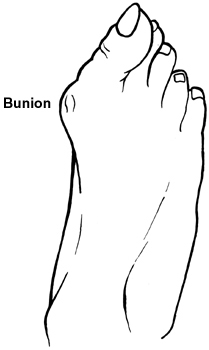
What causes bunions?
The underlying cause of bunions is a deformity of the joint at the base of the big toe. The deformity is called hallux valgus. In this deformity the joint develops a prominent sideways angle. Due to this deformity the foot bones and bones of the big toe are pushed towards the smaller toes.
The skin over the angled joint then tends to rub on the inside of shoes. This may cause thickening and inflammation of the overlying skin and tissues next to the bunion affected joint.
Are bunions hereditary?
In most cases it is not clear why people develop bunions. There may be some hereditary (genetic) tendency to have a weakness of this joint. In some cases it is associated with a joint problem such as osteoarthritis or rheumatoide Arthritis.
However, whatever the underlying cause of bunions, wearing tight or badly fitting shoes tends to make the problem worse. Wearing such shoes puts extra pressure on the big toe joint and causes friction on the overlying skin.
Are bunions painful?
Bunion pain is very common, often resulting in difficulty walking or wearing shoes. Other bunion complications can include:
Inflammation and swelling at the base of the toe. This sometimes becomes infected.
The foot may become so wide that it can be difficult to find wide enough shoes.
You may develop arthritis in the big toe.
The second toe can become deformed. In severe cases, the big toe can push your second toe up and out of place.
How are bunions treated?
Wearing shoes that are comfortable
Wearing good footwear does not cure bunions but may reduce pain and discomfort. Ideally, get footwear advice from a person qualified to diagnose and treat foot disorders (podiatrist - previously called a chiropodist) and choose shoes accordingly.
Advice may include:
Wear shoes, trainers or slippers that fit well and have room for your toes.
Don't wear high-heeled, pointed or tight shoes that put pressure on your bunions.
You might find that shoes with laces or straps are best, as they can be adjusted to the width of your foot.
Bunion pads or toe spacers may help, as may ice packs.
Devices which help to straighten the toe (orthoses) may be recommended. However, there is no evidence they improve the underlying condition or stop it getting worse. They may help reduce the pain, at least for a while.
Medication for bunions
Schmerzmittel wie Paracetamol oder Ibuprofen are a non-surgical treatment option that may help ease any pain. A course of Antibiotika may be needed if the skin and tissues over the deformity become infected.
Bunion surgery
An operation may be advised if a change of footwear does not ease symptoms of your bunions. The aim of the bunion surgery is to straighten the joint as much as possible and relieve pain. It is not usually done just to improve appearance of the bunion. It can be done using a local or a general anaesthetic and you are usually out of hospital the same day.
There are many different types of operation which are used to treat bunions. These range from operations to trim parts of the joint, to a total artificial replacement of the big toe joint (similar to a knee or a hip replacement). A common surgical procedure used is called a scarf osteotomy (osteotomy means a cut in the bone). In some cases the joint may be fused together so it no longer moves (arthrodesis). The exact operation chosen by the specialist depends on:
How severe the bunion is, and how deformed your foot.
The shape of your foot.
If you have wear and tear (Osteoarthritis) in the joint.
Their personal experience and expertise.
An operation is usually successful at easing symptoms of bunions but not in all cases. It is not always possible to relieve the pain completely or make the toe perfectly straight. Your specialist will be able to advise on the pros and cons of surgery and on the success rate of the chosen operation. Complications of the operation can include:
Continued pain.
Infektion.
The bunion returning (recurrence).
General risks of operations and anaesthetics.
You may need to wear a special shoe for six weeks after the bunion operation. Your hospital will give you specific information and advice. You may be given a leaflet with information about the procedures at your hospital and with advice for after the operation. See the Royal National Orthopaedic Hospital leaflet, in references below, for an example and further details.
Patientenauswahl für Fußprobleme

Fußpflege
Fußblasen
Blisters are small pockets of fluid that develop most often on the feet and are normally caused by a mixture of friction and pressure. They are very common and can be painful.
von Dr. Philippa Vincent, MRCGP

Fußpflege
Fußheberschwäche
Foot drop, which is also sometimes called a dropped foot, is a condition in which it is difficult to lift up the front part of the foot. As a result the forefoot and toes tend to catch or drag on the floor when walking. It can be temporary or permanent and most commonly affects one side only.
von Dr. Philippa Vincent, MRCGP
Häufig gestellte Fragen
Can I prevent bunions from forming?
While the exact cause of bunions isn't always clear and there can be a hereditary tendency, wearing appropriate footwear that fits well and doesn't put pressure on your big toe joint may help prevent them from worsening, or potentially delay their progression. Avoiding high-heeled, pointed, or tight shoes is recommended.
Will bunion pads or toe spacers correct the bunion deformity?
Bunion pads or toe spacers may help reduce pain and discomfort associated with bunions. However, there is no evidence to suggest that these devices improve the underlying condition or prevent the bunion from getting worse. They can provide temporary relief from symptoms.
What kind of shoes are best if I have bunions?
When you have bunions, it’s best to wear shoes, trainers, or slippers that offer ample room for your toes and fit well without being tight. Footwear with laces or straps can be beneficial as they allow for adjustment to accommodate the width of your foot. You should avoid high-heeled, pointed, or tight shoes that can put pressure on your bunions.
How long does it take to recover from bunion surgery?
After bunion surgery, you may need to wear a special shoe for about six weeks. Your specific recovery timeline will depend on the type of operation performed and individual factors. Your hospital will provide detailed post-operative information and advice regarding your recovery.
What are the long-term results of bunion surgery?
Bunion surgery is generally successful in easing symptoms, but it's important to understand that it may not completely relieve all pain or make the toe perfectly straight. Potential long-term complications can include continued pain, the return of the bunion (recurrence), or general risks associated with any operation. Your specialist can provide more specific information about the success rates and potential outcomes of the chosen surgical procedure.
Weiterführende Literatur und Referenzen
- Hallux valgus; NICE CKS, August 2021 (Nur UK-Zugang)
- A Patient’s Guide to Bunions (Hallux Valgus) and Lesser Toe Deformities; Royal National Orthopaedic Hospital, 2020
- Aebischer AS, Duff S; Bunions: A review of management. Aust J Gen Pract. 2020 Nov;49(11):720-723. doi: 10.31128/AJGP-07-20-5541.
- Park CH, Chang MC; Forefoot disorders and conservative treatment. Yeungnam Univ J Med. 2019 May;36(2):92-98. doi: 10.12701/yujm.2019.00185. Epub 2019 May 14.
- Ferrari J, Higgins JP, Prior TD; Interventions for treating hallux valgus (abductovalgus) and bunions. Cochrane Database Syst Rev. 2004;(1):CD000964.
- Klugarova J, Hood V, Bath-Hextall F, et al; Effectiveness of surgery for adults with hallux valgus deformity: a systematic review. JBI Database System Rev Implement Rep. 2017 Jun;15(6):1671-1710. doi: 10.11124/JBISRIR-2017-003422.
- Nair A, Bence M, Saleem J, et al; A Systematic Review of Open and Minimally Invasive Surgery for Treating Recurrent Hallux Valgus. Surg J (N Y). 2022 Dec 21;8(4):e350-e356. doi: 10.1055/s-0042-1759812. eCollection 2022 Oct.
Über den AutorVollständige Biografie anzeigen

Dr Colin Tidy, MRCGP
Allgemeinmediziner, Medizinischer Autor
MBBS, MRCGP, MRCP (Paediatrics), DCH
Dr. Colin Tidy ist ein NHS-Arzt mit Sitz in Oxfordshire.
Über den RezensentenVollständige Biografie anzeigen

Dr Doug McKechnie, MRCGP
Medizinischer Autor
MA, MBBS, MSc, DRCOG, MRCP(UK), MRCGP(2021), FHEA
Dr. Doug McKechnie ist ein NHS-Hausarzt, der in London arbeitet. Er arbeitet klinisch in Vollzeit und ist außerdem stellvertretender Leiter des Moduls für klinische und berufliche Praxis an der University College London Medical School.
Artikelverlauf
Die Informationen auf dieser Seite wurden von qualifizierten Klinikern verfasst und begutachtet.
Artikel auch verfügbar in Englisch, Deutsch, Spanisch, Französisch, Italienisch, Portugiesisch, Hindi, Hebräisch, Arabisch, und Schwedisch.
Nächste Überprüfung fällig: 14. Apr 2028
15. Apr 2025 | Neueste Version

Fragen, teilen, verbinden.
Durchsuchen Sie Diskussionen, stellen Sie Fragen und teilen Sie Erfahrungen zu Hunderten von Gesundheitsthemen.

Fühlen Sie sich unwohl?
Bewerten Sie Ihre Symptome online kostenlos
Abonnieren Sie den Patienten-Newsletter
Ihre wöchentliche Dosis klarer, vertrauenswürdiger Gesundheitsberatung - geschrieben, um Ihnen zu helfen, sich informiert, selbstbewusst und in Kontrolle zu fühlen.
Durch das Abonnieren akzeptieren Sie unsere Datenschutzrichtlinie. Sie können sich jederzeit abmelden. Wir verkaufen Ihre Daten niemals.
Mehr zur Fußpflege
- Achillessehnen-Tendinopathie
- Achillessehnenriss
- Knöchelverletzung
- Fußpilz
- Gebrochener Zeh
- Club foot
- Hühneraugen und Schwielen
- Diabetische Fußgeschwüre
- Diabetische Neuropathie
- Fußblasen
- Fußheberschwäche
- Pilzinfektion der Nägel
- Eingewachsener Zehennagel
- Mittelfußfrakturen
- Morton-Neurom
- Paronychie
- Plantarfasziitis
- Podologie
- Schwitzende Füße
- Warzen und Verrucas