Elektrokardiogramm
EKG
Begutachtet von Dr Hayley Willacy, FRCGP Zuletzt aktualisiert von Dr Colin Tidy, MRCGPZuletzt aktualisiert 20. Nov 2023
Erfüllt die Anforderungen des Patienten Richtlinien des Patienten
- HerunterladenHerunterladen
- Teilen
- Language
- Diskussion
- Audio-Version
An electrocardiogram (ECG) records the electrical activity of the heart. The heart produces tiny electrical impulses which spread through the heart muscle to make the heart contract.
These impulses can be detected by the ECG machine. An ECG may be used to help find the cause of symptoms such as the feeling of a 'thumping heart' (palpitations) or chest pain. Sometimes it is done as part of routine tests - for example, for high blood pressure, or before an operation.
The ECG test is painless and harmless. (The ECG machine records electrical impulses coming from the body - it does not put any electricity into the body.)
In diesem Artikel:
Videoauswahl für Herzuntersuchungen
Lesen Sie unten weiter
What does an electrocardiogram (ECG) show?
The electrodes placed on the different parts of the body detect electrical impulses coming from different directions within the heart. There are normal patterns for each electrode. Various heart disorders produce abnormal patterns. The heart disorders that can be detected include:
Unregelmäßige Herzrhythmen. If the heart rate is very fast, very slow, or irregular. There are various types of irregular heart rhythm with characteristic ECG patterns.
A heart attack (myocardial infarction) and if it was recent or some time ago. Heart attacks cause damage to heart muscle and it heals with scar tissue. These can be detected by abnormal ECG patterns.
An enlarged heart. Basically, this causes bigger impulses than normal.
What does a normal ECG look like?
Zurück zum InhaltWhen reviewing an ECG, the healthcare professional will look at several different aspects.
These include the rate (how fast the heart is beating), the rhythm (whether the heartbeat is regular or irregular), the cardiac axis (direction of electrical spread within the heart), and an analysis of the different parts of the electrical wave.
The points of interest may vary depending on the reason for an ECG - for example, a doctor reviewing an ECG done in the emergency department for acute Brustschmerzen will be looking for signs of a heart attack. In contrast, for a routine ECG arranged by a GP who has noticed an irregular heartbeat, they may be particularly looking for an irregularity and absent P waves. These are a sign of atrial fibrillation, a common cause of heartbeat irregularities.
In recent years we have become more aware of the importance of the QT interval, the distance between two parts of the electrical wave. Some drugs should not be used if the patient has a prolonged QT interval and therefore this will usually be looked at when interpreting an ECG.
Lesen Sie unten weiter
How is an ECG done?
Zurück zum InhaltSmall metal electrodes are stuck on to the chest. Wires from the electrodes are connected to the ECG machine. The machine detects and amplifies the electrical impulses that occur at each heartbeat and records them on to a paper or computer. A few heartbeats are recorded from different sets of electrodes.
How long does an ECG take?
The test takes about five minutes to do. Sometimes a small ECG machine can be worn for prolonged periods to see whether there is an irregular heart rhythm. This is called an ambulatory electrocardiogram.
Are there any risks with an ECG?
There are few, if any, risks related to an ECG. Some people may experience a skin rash where electrodes were placed, but this usually goes away without treatment.
An ECG only monitors the electrical activity of the heart. It does not emit any electricity and is therefore completely safe, even during pregnancy.
Is an ECG result always accurate?
Zurück zum InhaltAny test can have a false positive, or false negative result done. It is crucial that an ECG is read by a professional who has the skills to do so, so that they can interpret the trace in conjunction with the clinical history and examination. Some changes will have a significant impact on the need for future tests, or treatment, whereas others will be less important.
Patientenempfehlungen für Herzuntersuchungen
Tests und Untersuchungen
Belastungstest
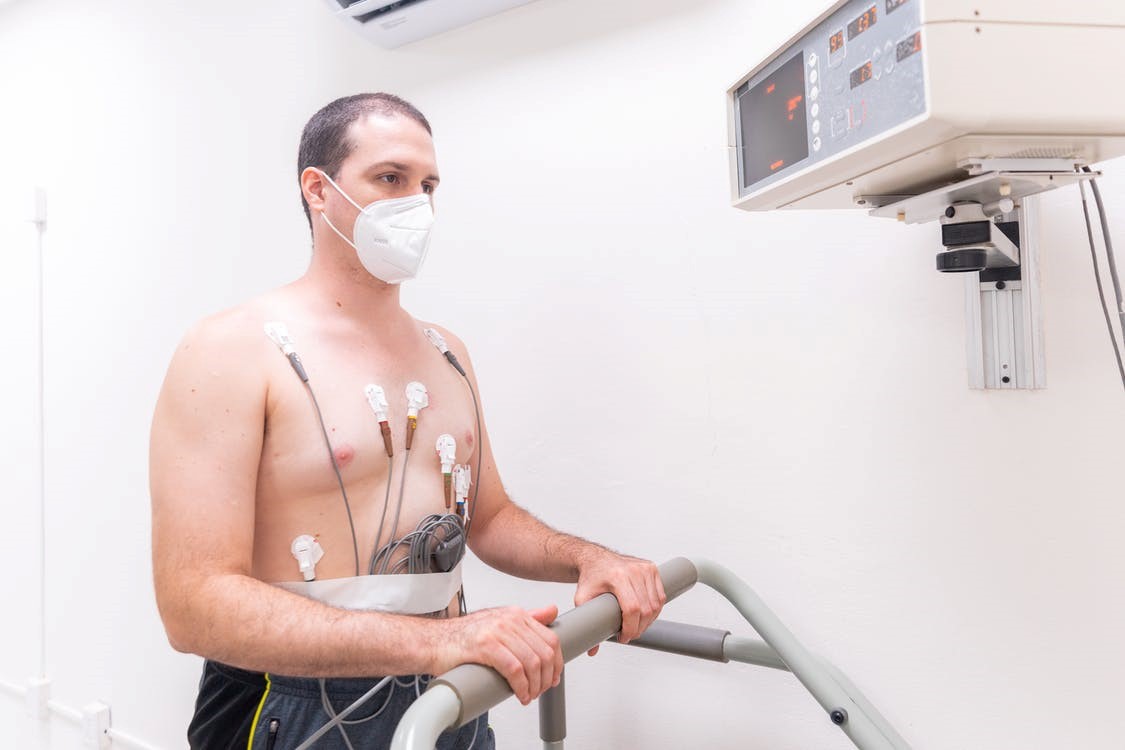
An exercise tolerance test (ETT) records the electrical activity of the heart whilst exercising. It is most useful in patients who experience chest pain on exertion. It is also used to detect whether heart rhythm abnormalities can be brought on by exercise.
von Dr. Philippa Vincent, MRCGP

Tests und Untersuchungen
Herzkatheteruntersuchung
Cardiac catheterisation is a way to find out detailed information about your heart and coronary arteries and it is also possible to provide treatment for some conditions at the same time.
von Dr. Colin Tidy, MRCGP
Weiterführende Lektüre und Referenzen
- EKG-Bibliothek
- Birnbaum Y, Wilson JM, Fiol M, et al; EKG-Diagnose und Klassifikation akuter Koronarsyndrome. Ann Noninvasive Electrocardiol. 2014 Jan;19(1):4-14. doi: 10.1111/anec.12130. Epub 2013 Dec 30.
- Attia ZI, Harmon DM, Behr ER, et al; Application of artificial intelligence to the electrocardiogram. Eur Heart J. 2021 Dec 7;42(46):4717-4730. doi: 10.1093/eurheartj/ehab649.
- Perez-Riera AR, Barbosa-Barros R, Daminello-Raimundo R, et al; Main artifacts in electrocardiography. Ann Noninvasive Electrocardiol. 2018 Mar;23(2):e12494. doi: 10.1111/anec.12494. Epub 2017 Sep 20.
Lesen Sie unten weiter
Artikelverlauf
Die Informationen auf dieser Seite wurden von qualifizierten Klinikern verfasst und begutachtet.
Nächste Überprüfung fällig: 18. Nov 2028
20. Nov 2023 | Neueste Version

Fragen, teilen, verbinden.
Durchsuchen Sie Diskussionen, stellen Sie Fragen und teilen Sie Erfahrungen zu Hunderten von Gesundheitsthemen.

Fühlen Sie sich unwohl?
Bewerten Sie Ihre Symptome online kostenlos
Abonnieren Sie den Patienten-Newsletter
Ihre wöchentliche Dosis klarer, vertrauenswürdiger Gesundheitsberatung - geschrieben, um Ihnen zu helfen, sich informiert, selbstbewusst und in Kontrolle zu fühlen.
Mit dem Abonnieren akzeptieren Sie unsere Datenschutzrichtlinie. Sie können sich jederzeit abmelden. Wir verkaufen Ihre Daten niemals.