Reibeisenhaut
Begutachtet von Dr Toni Hazell, FRCGPVerfasst von Dr Philippa Vincent, MRCGPUrsprünglich veröffentlicht 3 Aug 2026
Erfüllt die redaktionelle Richtlinien
- HerunterladenHerunterladen
- Teilen
- Language
- Diskussion
- Ask Patient
- Audio-Version
- Zu bevorzugten Quellen bei Google hinzufügen
Keratosis pilaris is a very common skin condition which affects children and teenagers more than adults. It causes rough skin, particularly over the upper arms, outer legs and buttocks.
Explore moisturisers for dry skin
Erhalten Sie fachkundige medizinische Beratung bequem von zu Hause aus. Füllen Sie eine kurze Online-Konsultation aus, die rund um die Uhr verfügbar ist. Ihre Anfrage wird von einer in Großbritannien registrierten medizinischen Fachkraft geprüft. Für ausgewählte Behandlungen ist eine Lieferung am nächsten Tag möglich.

Wichtige Punkte
Keratosis pilaris is a harmless, very common skin condition caused by a build-up of keratin.
It causes rough, small bumps, usually on the upper arms, thighs, face, or buttocks.
Moisturisers and gentle exfoliation can improve its appearance, but there's no cure.
Keratosis pilaris usually improves over time. It often gets worse during colder weather, better in warmer weather.
What is keratosis pilaris?
Keratosis pilaris is a very common skin condition which causes rough skin with raised red bumps. It is caused by "keratin" - the protein that makes your hair, nails, and the outer layer of your skin - building up in the pores of your skin, instead of shedding as normal.
Who gets keratosis pilaris?
Keratosis pilaris is very common. Between five and eight in ten of all teenagers have keratosis pilaris but it is also common in babies and younger children. It tends to settle down after your teenage years; about four in ten adults have keratosis pilaris.
People with all skin types get keratosis pilaris but it seems to be more common in girls and women than in boys and men.
If you have another skin condition, such as eczema or dry skin, you are more likely to get keratosis pilaris. You are also more likely to have keratosis pilaris if other people in your family have it as well.
Can I catch keratosis pilaris?
Keratosis pilaris cannot be caught from someone else. No one knows why it develops or what makes some people get keratosis pilaris and others not.
What does keratosis pilaris look like?
Keratosis pilaris is often described as being like "chicken skin" or "goosebumps". There are lots of tiny bumps over the surface of the skin which feels rough if you run your hand over it. In white or pale skin, these usually look red but in darker skin they can look dark brown or black.
It is most common on the upper arms but it can also occur on:
Face and neck.
Legs, especially thighs.
Zurück.
Brust.
Gesäß.
Forearms.
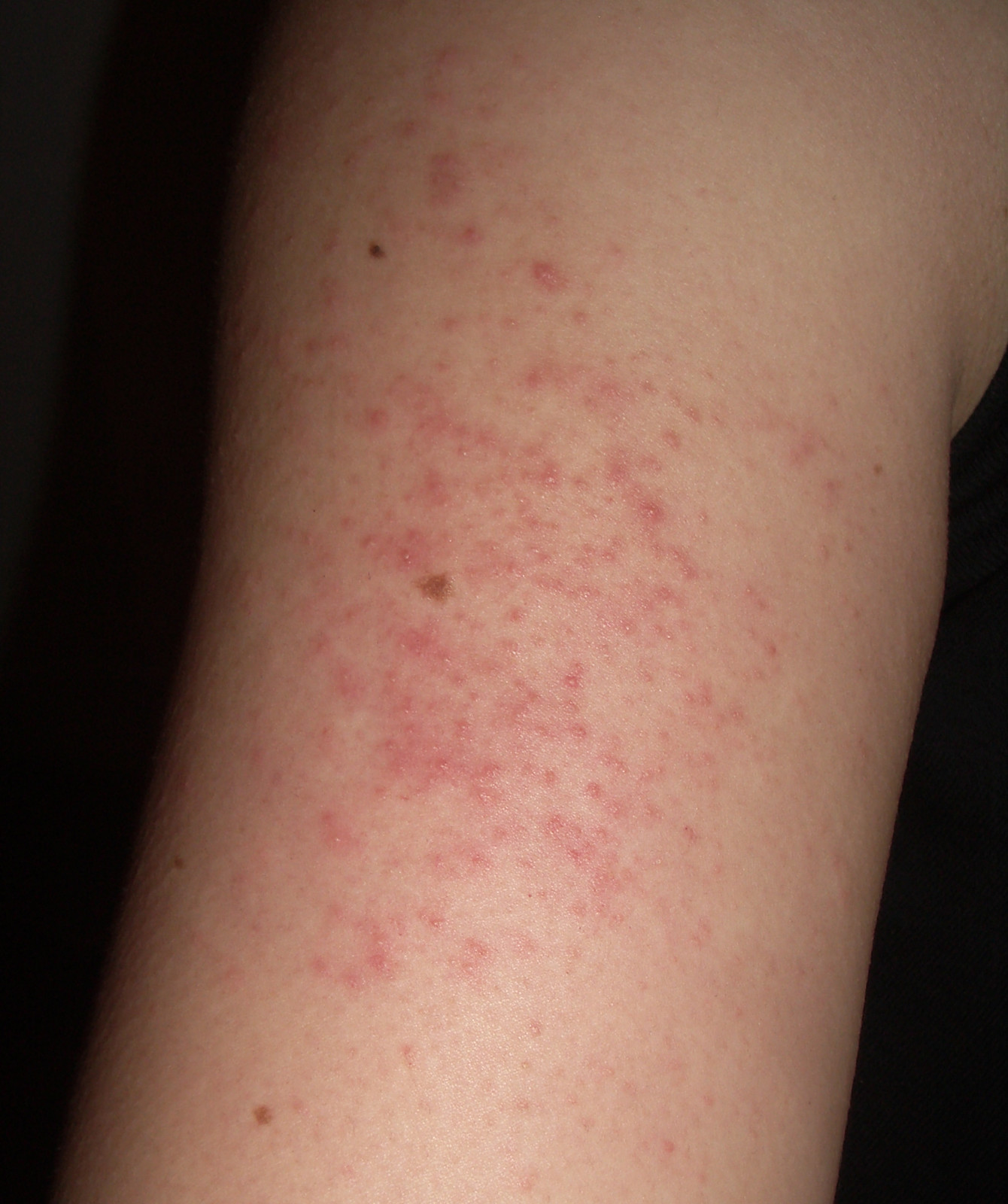
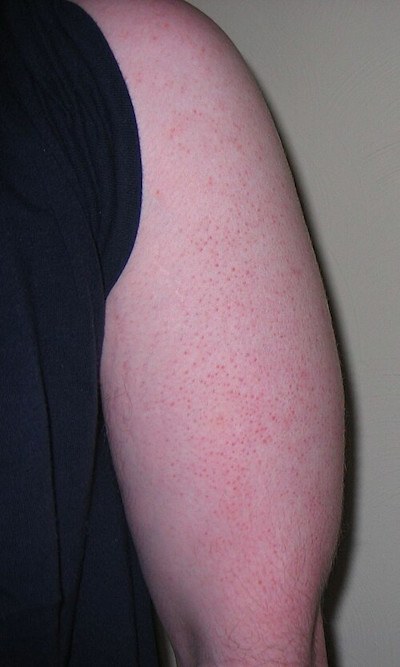
How is keratosis pilaris diagnosed?
There are no tests for keratosis pilaris. You don't need to see a doctor but, if you do, then they will diagnose keratosis pilaris by looking at it.
Treatment of keratosis pilaris
Keratosis pilaris is not harmful. It does not need to be treated. It often gets better in warmer weather and worse in colder weather.
However, some people find that keratosis pilaris makes them feel self-conscious and they want to try and reduce the appearance of it. Although keratosis pilaris can't be cured, there are some treatments which can help.
Some things that can help the appearance of keratosis pilaris include:
Verwendung emollients or moisturisers regularly to try and soften the skin (but avoid scented products).
Using creams that contain urea, salicylic acid, or lactic acid to try and flatten the bumps.
Using exfoliating pads or mittens.
Having lukewarm showers and avoiding hot baths.
Using a humidifier in winter to stop your skin drying out.
Laser treatment has been shown to be beneficial but is not available on the NHS.
Treatments that have nicht been shown to help include:
Expensive cosmetics which are sold specifically to help with keratosis pilaris.
Vitamin creams.
Scratching or picking at your skin can make keratosis pilaris worse.
How long does it take for keratosis pilaris to get better?
When the treatments above work, it usually takes around six to eight weeks for the skin to start improving. However, even without treatments, it usually gets better with time and is usually much better after the age of 30.
Explore moisturisers for dry skin
Erhalten Sie fachkundige medizinische Beratung bequem von zu Hause aus. Füllen Sie eine kurze Online-Konsultation aus, die rund um die Uhr verfügbar ist. Ihre Anfrage wird von einer in Großbritannien registrierten medizinischen Fachkraft geprüft. Für ausgewählte Behandlungen ist eine Lieferung am nächsten Tag möglich.
Patientenauswahl für Andere Hauterkrankungen

Haut-, Nagel- und Haargesundheit
Hidradenitis suppurativa
Hidradenitis suppurativa ist eine lang anhaltende (chronische) Hauterkrankung, die zu schmerzhaften und wiederholten Eiterhügeln (Abszessen oder Furunkeln) führt. Die genaue Ursache ist unbekannt. Suppuration bedeutet die Bildung oder den Austritt von Eiter. Diese Bereiche (häufig die Achselhöhlen und die Leistengegend) lecken Eiter ab und sind schwer zu heilen. Schließlich entstehen Narben. Behandlungen umfassen antibiotische Salben oder Medikamente oder eine Operation zur Entfernung des betroffenen Hautbereichs. Eine neuere Behandlung wirkt, indem sie eine chemische Substanz des Immunsystems blockiert, die Entzündungen im Körper verursacht.
von Dr. Colin Tidy, MRCGP

Haut-, Nagel- und Haargesundheit
Erfrierungen
Erfrierungen sind Verletzungen, die durch die Einwirkung von Kälte auf Körperteile verursacht werden. Es gibt verschiedene Grade von Erfrierungen. Bei oberflächlichen Erfrierungen kann die Haut bei schneller Behandlung vollständig heilen. Bei tiefen Erfrierungen können die Gewebeschäden dauerhaft sein und Gewebeverlust auftreten. Der wichtigste Weg, Erfrierungen zu verhindern, besteht darin, der Kälte zu entkommen. Wenn Sie der Kälte ausgesetzt sind, stellen Sie sicher, dass Sie ausreichend Schutzkleidung tragen.
von Dr. Toni Hazell, FRCGP
Weiterführende Lektüre und Referenzen
- Reibeisenhaut; British Association of Dermatologists
- Keratosis Pilaris; DermNet
Über den AutorVollständige Biografie anzeigen
Verfasst von

Dr Philippa Vincent, MRCGP
Allgemeinmediziner, Medizinischer Autor
MB BS, Bsc, MRCGP (2000), DCH, DFSRH, DRCOG
Dr Philippa Vincent ist ein NHS-Arzt, der in Nordlondon arbeitet.
Über den RezensentenVollständige Biografie anzeigen

Dr Toni Hazell, FRCGP
MBBS, BSc, FRCGP, DFSRH, Dip GU med, DRCOG, DCH (London, UK, 2000)
Dr. Toni Hazell hat ihren Abschluss an der St. Mary’s Hospital Medical School gemacht und ihr VTS am Northwick Park Hospital absolviert.
Artikelverlauf
Artikel auch verfügbar in Englisch, Deutsch, Spanisch, Französisch, Italienisch, Portugiesisch, Hindi, Hebräisch, Arabisch, und Schwedisch.
Next review due: 2 Feb 2031
3 Aug 2026 | Ursprünglich veröffentlicht
Verfasst von:
Dr Philippa Vincent, MRCGPBegutachtet von
Dr Toni Hazell, FRCGP
Teilen Sie Ihre Gedanken oder Erfahrungen mit anderen in unserem Patientengemeinschaften.
Einfacher Zugang zu vertrauenswürdigen Behandlungen und Gesundheitsdiensten online.
Common conditions
Get help with common conditions through the NHS, without a GP appointment.





Abonnieren Sie den Patienten-Newsletter
Ihre wöchentliche Dosis klarer, vertrauenswürdiger Gesundheitsberatung - geschrieben, um Ihnen zu helfen, sich informiert, selbstbewusst und in Kontrolle zu fühlen.
Durch das Abonnieren akzeptieren Sie unsere Datenschutzrichtlinie. Sie können sich jederzeit abmelden. Wir verkaufen Ihre Daten niemals.