Windpocken bei Erwachsenen und Jugendlichen
Begutachtet von Dr Doug McKechnie, MRCGPZuletzt aktualisiert von Dr Colin Tidy, MRCGPZuletzt aktualisiert 15. Apr 2025
Erfüllt die Anforderungen des Patienten für redaktionelle Inhalte
- HerunterladenHerunterladen
- Teilen
- Language
- Diskussion
- Audio-Version
- Zu bevorzugten Quellen bei Google hinzufügen
In dieser Serie:Virale AusschlägeMasernWindpocken bei KindernScharlachHand-Fuß-Mund-KrankheitSchulausschluss bei Infektionen
Chickenpox causes spots (a rash) and can make you feel unwell. Symptoms tend to be worse in adults than in children. Treatments can ease the symptoms until the illness goes. An antiviral medicine may limit the severity of the illness if the medicine is started within 24 hours of the rash first starting.
Full recovery is usual. Serious complications are rare, but are more common in adults than in children. They are more likely to occur in pregnant women and in people with a weakened immune system, such as those on chemotherapy. If you are pregnant and have not had chickenpox (or been immunised) and come into contact with a person with chickenpox - see your doctor urgently, as treatment may prevent chickenpox from developing.
Auf einen Blick
Windpocken sind eine Infektion, die durch das Varizella-Zoster-Virus verursacht wird.
Symptoms in adults can include a high temperature, aches, headache, and an itchy spotty rash.
Treatments include paracetamol for fever and pain, and soothing creams for itching.
Antiviral medication may be used if started within 24 hours of the rash developing.
Adults are more likely to have complications from chickenpox than children.
You should seek medical advice if you develop worrying symptoms like breathing problems or severe pain.
Certain groups, including pregnant women and those with poor immune systems, should see a doctor urgently if they get chickenpox.
Was ist Windpocken?
Was ist Windpocken?
Chickenpox on an adult's back
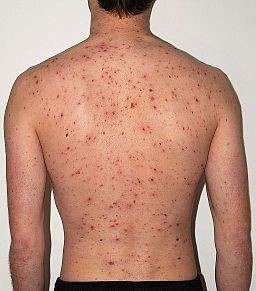
© F malan, CC BY-SA 3.0, via Wikimedia Commons
The chickenpox infection is caused by the varicella-zoster virus (VZV). The immune system makes proteins called antibodies during the infection. These fight the virus and then provide lifelong protection against it (immunity). Therefore, it is uncommon to have more than one bout of chickenpox in a lifetime.
Most people have chickenpox as a child. Most children get chickenpox before the age of 10 years. About 9 in 10 people have had it by the age of 15 years. It is uncommon for adults to have chickenpox.
What are the symptoms of chickenpox in adults?
Chickenpox symptoms are usually more severe in adults than in children. Expect to have a few uncomfortable days.
High temperature (fever), aches and headache
This will often start a day or so before a rash starts.
Spots (a rash)
Spots appear in crops. The spots develop into small blisters and are itchy. They can be anywhere on the body and sometimes also in the mouth. Several crops may develop over several days. Some people are covered in spots; others have only a few.
Loss of appetite and tiredness
Übelkeit is common as well. The fever and generally feeling unwell can last several days. The blisters gradually dry up and scab. They slowly fade over a week or so, but may take 2-3 weeks to go completely.
How to treat chickenpox in adults
Treatments to help adult chickenpox symptoms
Adult chickenpox treatments that may ease symptoms whilst your immune system deals with the virus include the following:
< b>Viel zu trinken haben< /b> to avoid a lack of fluid in the body (dehydration).
Taking Paracetamol to ease high temperature (fever), headaches, and aches and pains. Ibuprofen und andere nicht-steroidale Antirheumatika should be avoided unless advised by a doctor.
Soothing creams (emollients) put on the spots (rash) may ease itching. Calamine lotion is the most used, although it is not known how effective it is.
Antihistamin-Tabletten taken at bedtime may help you to sleep if itch is a problem at night. You can buy these at pharmacies, or get them on prescription.
Antiviral medication for adult chickenpox
Antiviral pills such as Aciclovir can limit the severity of chickenpox. These pills do not kill the virus, but stop the virus from multiplying. Adults or teenagers over the age of 14 with chickenpox may be advised to take an antiviral medicine - but only if it can be started within 24 hours of the rash first developing. If it is started after this time it is not likely to have much of an effect. So, if started on time, an antiviral medicine may help to reduce the severity of the illness.
Antiviral medication is especially useful in situations where chickenpox in adults can be more serious. For example, for people who have a poor immune system, for newborn babies and for pregnant women. (Hinweis: antiviral medication is not normally advised for healthy children who develop chickenpox.)
Is chickenpox dangerous in adults?
Adults are more likely than children to have complications from chickenpox.
The spots do not usually scar unless they are badly scratched.
In some cases of chickenpox, some spots become infected with germs (bacteria). If this occurs, the surrounding skin becomes red and sore. Antibiotic medication may then be needed.
Inflammation of the lung (pneumonia) is a complication affecting about 1 in 10 adults with chickenpox. People who smoke are more likely to get this.
Entzündung des Gehirns (Enzephalitis) and ataxia (problems co-ordinating movements) are very rare complications.
Vary rarely, other serious complications develop. For example:
Inflammation of joints (arthritis).
Inflammation of various parts of the eye.
Therefore, although serious complications are rare, it is best to be watchful. Seek medical advice if you develop any worrying symptoms that you are unsure about, such as:
Atemprobleme.
Schwäche.
Schläfrigkeit.
Convulsions.
Pains or headaches which become worse despite paracetamol or ibuprofen.
Being unable to take fluids, due to a severe rash in the mouth.
A very severe rash, or a rash which bruises or bleeds into the skin ('haemorrhagic rash').
Becoming generally more and more unwell.
In general, complications are uncommon. However, some people have a higher risk of developing complications from chickenpox in adults. Anyone in the following groups should see a doctor urgently if they have symptoms of adult chickenpox:
Schwangere Frauen.
People with a poor immune system. For example, people with Leukämie, with HIV/AIDS, taking Steroidmedikation or having Chemotherapie.
People with heart or lung disease.
People with severe skin conditions.
Very young babies - especially those less than 1 month old (neonates).
How do you get shingles?
Shingles is caused by the same virus that causes chickenpox and so is a delayed complication of chickenpox. Anyone who has had chickenpox in the past may develop shingles. Shingles is an infection of a nerve and the area of skin supplied by the nerve. It causes a rash and pain in a band-like local area along the affected nerve. About 1 in 5 people have shingles at some time in their lives. It can occur at any age, but it is most common in people over the age of 50.
The reason why shingles may occur is because the virus does not completely go after you have chickenpox. Some virus particles remain inactive in the nerve roots next to your spinal cord. They do no harm there, and cause no symptoms. For reasons that are not clear, the virus may begin to multiply again (reactivate). This is often years later. The reactivated virus travels along the nerve to the skin to cause shingles. See the separate leaflet called Shingles (Herpes zoster) for details.
Hinweis: you can catch chickenpox from being exposed to a person with shingles if you have not had chickenpox yourself. However, you cannot catch shingles from a person with chickenpox, or catch shingles from a person with shingles.
Adult chickenpox and pregnancy
If you are pregnant and have not had chickenpox (or been immunised) and come into contact with a person with chickenpox - see your doctor urgently. Chickenpox can be more serious if you develop chickenpox whilst pregnant. However, a treatment with a product called human varicella-zoster immunoglobulin (VZIG) may prevent chickenpox from developing. See the separate leaflet that deals with this in more detail, called Chickenpox contact in pregnancy.
Is chickenpox in adults contagious?
A person with chickenpox is very infectious. The virus spreads in the air from person to person. For example, if you have not already had chickenpox, you stand a good chance of catching it if:
You are in the same room as someone with chickenpox for more than 15 minutes; oder
You have any face-to-face contact with someone with chickenpox, such as a conversation.
Nine in ten people who have not had chickenpox would catch it after being exposed in this way.
It takes between 7 and 21 days (most commonly 10-14 days) to develop symptoms after catching the virus (the incubation period).
Protecting others from adult chickenpox
A person with adult chickenpox is infectious from two days before the rash and spots first appear until they have all crusted over (commonly about five days after the onset of the illness). You can usually return to work after this time if you feel well enough. (A child with chickenpox should stay off school for five days from the onset of the rash.) Whilst you are infectious, keep away from people who have an increased chance of having a severe illness if they get chickenpox. These people are listed above under 'Are there any complications?'.
Healthy people who have not had chickenpox as a child may also want to avoid catching it. So, friends and family who have not had chickenpox may wish avoid you whilst you are infectious. However, most adults and many children have already had chickenpox, and so are immune.
Hinweis: people with adult chickenpox should not travel by air until the spots have all crusted.
Treatment can also be provided to protect those at high risk of suffering from severe chickenpox and those who may pass on infection to those at high risk (for example, healthcare workers).
Aciclovir for recommended for those at high risk, except neonates, who may be given human varicella-zoster immunoglobulin (VZIG).
Are you a healthcare worker?
Healthcare workers come into contact with people with poor immune systems, pregnant women and newborn babies. They should be aware that if they catch chickenpox, they can be infectious for two days before a rash or illness appears, and be a risk to patients. So, if you are a healthcare worker and come into contact with someone who has chickenpox (or who develops it within the next two days), then:
If you have been immunised against chickenpox, or have definitely had chickenpox in the past, you are likely to be immune. You should continue working but contact your occupational health department if you feel unwell or develop a rash.
If you are uncertain about whether you have had chickenpox or been immunised, you should have a test to see if you are immune. If you are not immune you should:
Avoid contact with high-risk patients for 8-21 days after contact with chickenpox.
Report to occupational health before patient contact if you feel unwell or develop a high temperature (fever) or itchy rash.
Get immunised against the varicella-zoster virus (chickenpox virus).
Whether you have been exposed to chickenpox or not, if you are a healthcare worker and you have never had chickenpox you should have a test to see if you are immune. If you are not immune you may need to be immunised.
Is there a vaccine against chickenpox in adults?
Yes - there is an effective vaccine (sometimes known as the varicella vaccine) that protects against the virus that causes chickenpox. It has become part of the routine childhood immunisation programme in certain countries such as the United States, Canada and Australia.
Currently, there are no plans to make immunisation against chickenpox routine for children in the UK. In the UK, the vaccine is offered by the NHS to certain special groups. For example, to healthcare workers who are not immune to chickenpox. Also, to people who are not immune to chickenpox and who are in close contact with people with a poor immune system - for example, brothers and sisters of children who are on chemotherapy. The vaccine is widely available privately in the UK.
Patientenauswahl für Hautinfektionen

Infektionen
Furunkel, Karbunkel und Furunkulose
Ein Abszess (Furunkel) ist eine Infektion eines Haarfollikels. Ein Karbunkel tritt auf, wenn eine Gruppe von Haarfollikeln nebeneinander infiziert wird. Es ist wie ein mehrfacher Abszess. Chronische Furunkulose ist ein Zustand, bei dem Sie über einen längeren Zeitraum hinweg immer wieder Abszesse bekommen.
von Dr. Colin Tidy, MRCGP

Infektionen
Katzenkratzkrankheit
Katzenkratzkrankheit ist eine bakterielle Infektion, die durch Katzenkratzer oder -bisse verursacht wird. Sie führt zu geschwollenen Lymphknoten und anderen Symptomen wie Fieber. Sie verschwindet normalerweise ohne Behandlung, aber Antibiotika werden oft verwendet, um die Infektion schneller zu beseitigen.
von Dr. Doug McKechnie, MRCGP
Häufig gestellte Fragen
Can adults get chickenpox even if they had it as a child?
No, it is uncommon to get chickenpox more than once. Once you've had chickenpox, your immune system develops antibodies that provide lifelong protection against the virus.
How long does chickenpox typically last in adults?
In adults, the fever and general unwell feeling can last several days. The blisters gradually dry up and scab over about a week or so, but may take 2-3 weeks to completely disappear.
What's the best way to handle severe itching from adult chickenpox?
To help with severe itching, you can try soothing creams like calamine lotion. If itching is interfering with your sleep, antihistamine tablets taken at bedtime may help. These can be purchased from pharmacies or obtained with a prescription.
Are there any specific activities or environments to avoid if I have adult chickenpox?
If you have adult chickenpox, you should not travel by air until all the spots have crusted over. You should also keep away from people who have a higher risk of severe illness if they catch chickenpox, such as pregnant women, those with poor immune systems, or very young babies.
When can a healthcare worker return to work after being exposed to chickenpox or developing symptoms?
If a healthcare worker has been exposed to chickenpox and is immune (either through vaccination or previous infection), they can continue working but should contact occupational health if they feel unwell or develop a rash. If they are not immune, they should avoid contact with high-risk patients for 8-21 days after contact and report to occupational health before patient contact if they feel unwell or develop a fever or itchy rash.
Weiterführende Literatur und Referenzen
- Chickenpox: public health management and guidance; UK Health Security Agency. July 2014, last updated April 2022.
- Impfung gegen Infektionskrankheiten - das Grüne Buch (neueste Ausgabe); UK Gesundheitsbehörde für Sicherheit.
- Leitfaden zur Infektionskontrolle in Schulen und anderen Kinderbetreuungseinrichtungen; UK Health Security Agency (September 2017 - zuletzt aktualisiert Februar 2023)
- Windpocken; NICE CKS, November 2023 (nur für UK-Zugang)
Über den AutorVollständige Biografie anzeigen

Dr Colin Tidy, MRCGP
Allgemeinmediziner, Medizinischer Autor
MBBS, MRCGP, MRCP (Paediatrics), DCH
Dr. Colin Tidy ist ein NHS-Arzt mit Sitz in Oxfordshire.
Über den RezensentenVollständige Biografie anzeigen

Dr Doug McKechnie, MRCGP
Medizinischer Autor
MA, MBBS, MSc, DRCOG, MRCP(UK), MRCGP(2021), FHEA
Dr. Doug McKechnie ist ein NHS-Hausarzt, der in London arbeitet. Er arbeitet klinisch in Vollzeit und ist außerdem stellvertretender Leiter des Moduls für klinische und berufliche Praxis an der University College London Medical School.
Artikelverlauf
Die Informationen auf dieser Seite wurden von qualifizierten Klinikern verfasst und begutachtet.
Artikel auch verfügbar in Englisch, Deutsch, Spanisch, Französisch, Italienisch, Portugiesisch, Hindi, Hebräisch, Arabisch, und Schwedisch.
Nächste Überprüfung fällig: 14. Apr 2028
15. Apr 2025 | Neueste Version

Fragen, teilen, verbinden.
Durchsuchen Sie Diskussionen, stellen Sie Fragen und teilen Sie Erfahrungen zu Hunderten von Gesundheitsthemen.

Fühlen Sie sich unwohl?
Bewerten Sie Ihre Symptome online kostenlos
Abonnieren Sie den Patienten-Newsletter
Ihre wöchentliche Dosis klarer, vertrauenswürdiger Gesundheitsberatung - geschrieben, um Ihnen zu helfen, sich informiert, selbstbewusst und in Kontrolle zu fühlen.
Durch das Abonnieren akzeptieren Sie unsere Datenschutzrichtlinie. Sie können sich jederzeit abmelden. Wir verkaufen Ihre Daten niemals.
Mehr zu Infektionen
- Akute Bronchitis
- Aspirationspneumonie
- Blepharitis
- Zellulitis
- Clostridioides difficile
- Eczema herpeticum
- Epiglottitis
- Augeninfektion (Herpes simplex)
- Gastroenteritis
- Genitalherpes
- Giardia
- Lyme-Borreliose
- Nicht-gonorrhoische Urethritis
- Septische Arthritis
- Sexuell übertragbare Infektionen
- Ringelröteln
- Soor bei Männern
- Zika-Virus