Pilzinfektion der Nägel
Tinea unguium
Begutachtet von Dr Colin Tidy, MRCGPZuletzt aktualisiert von Dr Philippa Vincent, MRCGPZuletzt aktualisiert 19. Mai 2023
Erfüllt die redaktionelle Richtlinien
- HerunterladenHerunterladen
- Teilen
- Language
- Diskussion
- Audio-Version
- Zu bevorzugten Quellen bei Google hinzufügen
Pilzinfektionen der Nägel (Tinea unguium) sind häufig, insbesondere bei älteren Menschen an den Zehennägeln. Die Infektion führt zu verdickten und unansehnlichen Nägeln, die manchmal schmerzhaft werden. Medikamente wirken oft gut, um die Infektion zu beseitigen, aber es kann notwendig sein, die Medikamente über mehrere Monate oder länger einzunehmen.
Auf einen Blick
Pilzinfektionen der Nägel führen oft zu verdickten, verfärbten und manchmal bröckelnden Nägeln.
Es ist in der Regel schmerzlos und betrifft normalerweise die Zehennägel mehr als die Fingernägel.
Die Diagnose wird bestätigt, indem ein Arzt eine Nagelprobe zur Laboruntersuchung einsendet.
Behandlungsoptionen umfassen antimykotischen Nagellack, antimykotische Medikamente oder selten die Entfernung des Nagels.
Die Behandlung kann mehrere Monate dauern und stellt das Aussehen des Nagels nicht immer wieder her.
Kurze Nägel und die Behandlung von Fußpilz können helfen, Infektionen zu verhindern.
Suchen Sie ärztlichen Rat, wenn Sie Diabetes oder ein geschwächtes Immunsystem haben oder wenn die Symptome störend sind.
Explore fungal nail treatments
Erhalten Sie fachkundige medizinische Beratung bequem von zu Hause aus. Füllen Sie eine kurze Online-Konsultation aus, die rund um die Uhr verfügbar ist. Ihre Anfrage wird von einer in Großbritannien registrierten medizinischen Fachkraft geprüft. Für ausgewählte Behandlungen ist eine Lieferung am nächsten Tag möglich.

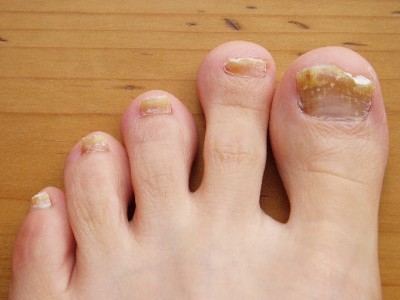
What does a fungal nail infection look like?
This photo shows the typical appearance of fungal infection of the toenails:
Tinea unguium
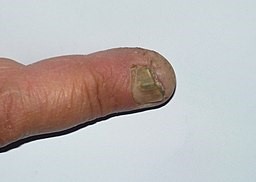
This photo shows fingernail fungal infection, which is less common than toenail fungal infection:
Tinea unguium
Fungal nail infection symptoms
Often the infection is just in one nail but several may be affected. It is usually painless. The most common symptoms are:
Thickened nail.
Discoloured nail (often a yellowish colour).
Commonly, this is all that occurs and fungal nail infections often cause no other symptoms. The main reason people see their doctor is because the appearance is unsightly.
Sometimes the infection becomes worse and additional symptoms occur. These include:
The nail becoming soft and crumbling.
White or yellow patches appearing where the nail has come away from the skin.
The skin next to the nail becoming inflamed or scaly.
Sometimes the whole nail comes away. If left untreated, the infection may eventually destroy the nail and the nail bed, and may become painful. Walking may become uncomfortable if a toenail is affected.
Who develops fungal nail infection?
Between 3 and 8 out of 100 people in the UK will develop a fungal nail infection (tinea unguium) at some stage of their lives. Toenails are more commonly affected than fingernails. It is more common in people aged over 60 and in younger people who share communal showers, such as swimmers or athletes.
What causes fungal nail infections?
Spread from a fungal skin infection. For example, athlete's foot (tinea pedis) is a fungal skin infection of the toes. This may spread to the toenails if the skin infection is not treated early. See the separate leaflet called Athlete's Foot (Tinea Pedis).
Fingernail infection may occur after a toenail infection has become established. The fungus may spread to a finger after scratching itchy toes and toenails.
Fingernail infections are also more likely to occur in someone who washes their hands frequently or has them in water a lot, for example, cooks or cleaners. Constant washing may damage the protective skin at the base of the nail. This may allow fungi to enter.
A nail that has recently been damaged is also more likely to become infected.
There is an increased risk of developing a fungal nail infection with various other conditions - for example:
Poor circulation.
A weakened immune system (for example, if you have AIDS or are on Chemotherapie).
A general poor state of health such as heavy alcohol consumption.
Nail infections are more common in people who live in hot or humid climates.
Smoking also increases the risk of developing a nail infection.
In some cases there is no apparent reason. Fungal germs are common and an infection can occur 'out of the blue'.
Fungal nail infection diagnosis
Other nail conditions can sometimes look like a fungal infection (typically "trauma" to the nails from shoes). Therefore, to confirm the diagnosis, a doctor will usually request that a nail clipping is sent to the laboratory for testing.
Fungal nail infection treatment
Keine Behandlung
This is an option if the infection is mild or causing no symptoms. For example, a single small toenail may be infected and remain painless and of little concern. Some people may prefer not to take treatment because:
Treatment does not always cure the infection. Cure rates are about 60-80%.
Treatment that clears the infection does not always restore the nail's appearance to normal.
The antifungal medicines used for treatment need to be taken for several months - sometimes longer.
Although rare, unpleasant side-effects sometimes occur with antifungal medicines.
You can read more about these treatments in the separate leaflet called Antifungal Medicines.
The option to treat can be reviewed at a later date if the infection becomes worse.
However, treatment is usually advised if:
Symptoms are troublesome. For example, if walking is uncomfortable due to an affected nail.
Abnormal-looking nails cause distress.
You have diabetes, vascular disease or a connective tissue disorder (because of a higher risk factor for secondary bacterial infections and cellulitis).
The nail infection is thought to be the source of a fungal skin infection on your body.
There are problems with the immune system, for example, someone having chemotherapy.
Antifungal nail paint (nail lacquer)
A nail lacquer that contains the antifungal medicine amorolfine is an alternative for most (but not all) types of fungi that infect nails. You can buy amorolfine nail lacquer from pharmacies as well as obtaining it on prescription.
This takes longer to work than medication taken by mouth but has fewer side effects and risks. This treatment does not tend to work so well if the infection is near the skin, or involves the skin around the nail.
The nail lacquer has to be put on exactly as prescribed for the best chance of success. It can take six months of nail lacquer treatment for fingernails and up to a year for toenails.
Tioconazole is another solution that can be applied to the nail. It is available on prescription, although research trials suggest it does not work as well as amorolfine.
Antimykotische Medikamente
Antimykotische Tabletten will often clear a fungal nail infection. The medication will also clear any associated fungal skin infection, such as athlete's foot (tinea pedis).There are two main medications:
The one chosen may depend on the type of fungus causing the infection. Both of these medicines cause side-effects in a small number of people, so read the packet that comes with the medicine for a full list of cautions and possible side-effects. The side effects can be very severe, including liver failure, so blood tests are usually required before starting them.
Terbinafin tablets. The usual adult dose is 250 mg once a day; for between six weeks and three months for fingernails, and for three to six months for toenails. Visible improvement should be expected after a month of treatment, although treatment will then need to be completed for the recommended duration.
Itraconazole Tabletten. This is usually given as pulsed treatment. That is, for an adult: 200 mg twice a day for one week, with subsequent courses repeated after a further 21 days. Fingernail infections require two pulsed courses and toenail infections require at least three pulsed courses.
Studies suggest that in about 5 in 10 cases the nail will look fully normal again after treatment. In about a further 2 in 10 cases the fungus will be cleared from the nail after treatment but the nail does not look fully normal again. Fingernails tend to respond better to treatment than toenails do. One reason for treatment to fail is because some people stop their medication too early.
Nail removal
If other treatments have failed, an option is to have the nail surgically removed by a small operation done under local anaesthetic. This is combined with treatment with antifungal medication.
Newer options
Research is looking at newer methods of treating fungal nail infections. These include laser treatment and ultrasound. Initial results are positive but more evidence is needed about the long-term results of the treatments.
How to tell the nail is recovering
Nail during treatment for fungal nail infection
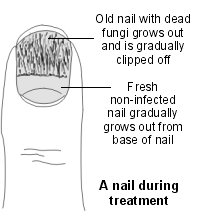
The fungi that are killed with treatment remain in the nail until the nail grows out. Fresh healthy nail growing from the base of the nail is a sign that treatment is working. After finishing a course of treatment, it will take several months for the old infected part of the nail to grow out and be clipped off. The non-infected fresh new nail continues growing forward. When it reaches the end of the finger or toe, the nail will often look normal again.
Fingernails grow faster than toenails, so it may appear they are quicker to get back to normal. It may take up to a year after starting treatment before toenails look completely normal again and six months for fingernails to look completely normal.
However, the infection can still respond to treatment even after finishing a course of medication. This is because the antifungal medication stays in the nail for about nine months after stopping taking medication.
How to manage a fungal nail infection
Medication needs to be taken as directed.
Tips on nail care with a fungal nail infection, with or without taking medication, include the following:
Keeping the nails cut short and file down any thickened nail.
Using a separate pair of scissors to cut the infected nail(s) to prevent contaminating the other nails and not sharing nail scissors with anyone else (for the same reason).
Avoiding injury and irritants to the nails, for example, wearing gloves for manual work.
If the toenails are affected, wearing properly fitted shoes with a wide toe box.
Keeping the feet as cool and dry as possible.
Preventing fungal nail infections
Studies suggest that in about 1 in 4 cases where the fungal nail infection (tinea unguium) has been cleared from the nail, the infection returns within three years. One way to help prevent a further bout of nail infection is to treat athlete's foot (tinea pedis) as early as possible to stop the infection spreading to the nail.
Athlete's foot is common and may recur from time to time. It is easy to treat with an antifungal cream which can be bought from pharmacies. The first sign of athlete's foot is itchy and scaling skin between the toes. See the separate leaflet called Athlete's Foot (Tinea Pedis) for more details. Also:
Try to avoid injury to nails, which may increase the risk of developing a nail infection.
Wear footwear such as flip-flops in public places, such as communal bathing/shower places, locker rooms, etc.
Avoid towel sharing.
Consider replacing old footwear, as this could be contaminated with fungal spores.
Explore fungal nail treatments
Erhalten Sie fachkundige medizinische Beratung bequem von zu Hause aus. Füllen Sie eine kurze Online-Konsultation aus, die rund um die Uhr verfügbar ist. Ihre Anfrage wird von einer in Großbritannien registrierten medizinischen Fachkraft geprüft. Für ausgewählte Behandlungen ist eine Lieferung am nächsten Tag möglich.
Patientenauswahl für Nail disorders
Haut-, Nagel- und Haargesundheit
Nagelpsoriasis
Psoriasis ist eine hartnäckige (chronische) Hauterkrankung, die dazu neigt, von Zeit zu Zeit aufzuflammen. Etwa die Hälfte der Menschen mit Psoriasis hat auch Veränderungen, die ihre Nägel betreffen. Die psoriatische Nagelerkrankung ist in Aussehen und Schweregrad sehr variabel. Psoriasis, die die Nägel betrifft, kann mild sein und keine Behandlung erfordern. Schwerere Nagelpsoriasis ist oft schwer zu behandeln, aber moderne Behandlungen können wirksam sein.
von Dr. Doug McKechnie, MRCGP

Haut-, Nagel- und Haargesundheit
Paronychie
Paronychie ist eine häufige Infektion der Haut um die Nägel der Finger oder Zehen. Sie kann akut oder chronisch sein. Eine Behandlung ist nicht immer erforderlich, beinhaltet jedoch normalerweise Antibiotika für bakterielle Infektionen. Gelegentlich werden Antimykotika für Infektionen durch einen Hefepilz (Candida) eingesetzt. Gelegentlich können Steroidcremes für die Haut um den Nagel verwendet werden. Selten ist ein kleiner Eingriff erforderlich, um den angesammelten Eiter abzulassen.
von Dr. Philippa Vincent, MRCGP
Häufig gestellte Fragen
Ist Nagelpilz gefährlich?
Pilzinfektionen der Nägel sind in der Regel schmerzlos und verursachen oft nur kosmetische Bedenken. Wenn sie jedoch unbehandelt bleiben, kann die Infektion schließlich den Nagel und das Nagelbett zerstören und schmerzhaft werden. Dies kann zu Gehschwierigkeiten führen, wenn ein Zehennagel betroffen ist. Für Personen mit bestimmten Gesundheitszuständen wie Diabetes, Gefäßerkrankungen oder einem geschwächten Immunsystem besteht ein höheres Risiko für sekundäre bakterielle Infektionen und Zellulitis.
Wie viele Menschen im Vereinigten Königreich sind von Nagelpilzinfektionen betroffen?
Zwischen 3 und 8 von 100 Menschen im Vereinigten Königreich werden irgendwann in ihrem Leben eine Pilzinfektion der Nägel erleben. Zehennägel sind häufiger betroffen als Fingernägel.
Wie breitet sich eine Nagelpilzinfektion aus?
Pilzinfektionen der Nägel können sich auf verschiedene Weise ausbreiten. Sie beginnen oft mit einer Pilzinfektion der Haut, wie Fußpilz, die sich auf die Zehennägel ausbreiten kann, wenn sie nicht behandelt wird. Fingernagelinfektionen können nach einer Zehennagelinfektion auftreten und sich nach dem Kratzen auf den Finger ausbreiten. Häufiges Händewaschen oder häufiges Eintauchen der Hände in Wasser kann auch die Haut an der Basis des Nagels schädigen und Pilzen das Eindringen ermöglichen. Außerdem ist ein beschädigter Nagel anfälliger für Infektionen.
Können Nagelpilzinfektionen dauerhaft geheilt werden?
Die Behandlung von Nagelpilzinfektionen führt nicht immer zu einer dauerhaften Heilung; die typischen Heilungsraten liegen bei etwa 60-80%. Selbst wenn die Infektion beseitigt ist, kehrt das Aussehen des Nagels möglicherweise nicht vollständig zur Normalität zurück. Die Infektion kann auch wieder auftreten, wobei Studien darauf hindeuten, dass in etwa 1 von 4 Fällen die Infektion innerhalb von drei Jahren nach der Heilung zurückkehrt.
Wie lange dauert die typische Erholungszeit nach der Behandlung einer Nagelpilzinfektion?
Nach Abschluss einer Behandlung dauert es eine Weile, bis der alte infizierte Nagel herausgewachsen ist und abgeschnitten werden kann. Frisches, gesundes Nagelwachstum zeigt an, dass die Behandlung wirkt. Fingernägel wachsen schneller, sodass sie innerhalb von sechs Monaten normal aussehen können. Zehennägel hingegen können bis zu einem Jahr nach Beginn der Behandlung benötigen, um wieder vollständig normal auszusehen. Das Antimykotikum kann etwa neun Monate nach Beendigung der Behandlung im Nagel verbleiben und weiterhin helfen, die Infektion zu beseitigen.
Weiterführende Lektüre und Referenzen
- Del Rosso JQ; The role of topical antifungal therapy for onychomycosis and the emergence of newer agents. J Clin Aesthet Dermatol. 2014 Jul;7(7):10-8.
- Pilzinfektion der Nägel; NICE CKS, März 2018 (nur für UK-Zugang)
- Fungal infections of the nails; British Association of Dermatologists, 2017
Über den AutorVollständige Biografie anzeigen
Aktualisiert von

Dr Philippa Vincent, MRCGP
Allgemeinmediziner, Medizinischer Autor
MB BS, Bsc, MRCGP (2000), DCH, DFSRH, DRCOG
Dr Philippa Vincent ist ein NHS-Arzt, der in Nordlondon arbeitet.
Über den RezensentenVollständige Biografie anzeigen

Dr Colin Tidy, MRCGP
Allgemeinmediziner, Medizinischer Autor
MBBS, MRCGP, MRCP (Paediatrics), DCH
Dr. Colin Tidy ist ein NHS-Arzt mit Sitz in Oxfordshire.
Artikelverlauf
Artikel auch verfügbar in Englisch, Deutsch, Spanisch, Französisch, Italienisch, Portugiesisch, Hindi, Hebräisch, Arabisch, und Schwedisch.
Nächste Überprüfung fällig: 12. Mai 2028
19. Mai 2023 | Neueste Version
Nehmen Sie an der Diskussion teil
Teilen Sie Ihre Gedanken oder Erfahrungen mit anderen in unserem Patientengemeinschaften.

Fragen, teilen, verbinden.
Durchsuchen Sie Diskussionen, stellen Sie Fragen und teilen Sie Erfahrungen zu Hunderten von Gesundheitsthemen.

Fühlen Sie sich unwohl?
Bewerten Sie Ihre Symptome online kostenlos
Abonnieren Sie den Patienten-Newsletter
Ihre wöchentliche Dosis klarer, vertrauenswürdiger Gesundheitsberatung - geschrieben, um Ihnen zu helfen, sich informiert, selbstbewusst und in Kontrolle zu fühlen.
Durch das Abonnieren akzeptieren Sie unsere Datenschutzrichtlinie. Sie können sich jederzeit abmelden. Wir verkaufen Ihre Daten niemals.