Erythema nodosum
Fachlich geprüft von Dr Colin Tidy, MRCGPZuletzt aktualisiert von Dr Hayley Willacy, FRCGP Zuletzt aktualisiert 10 Apr 2025
Entspricht den redaktionellen Richtlinien
- HerunterladenHerunterladen
- Teilen
- Language
- Diskussion
- Audio-Version
- Zu bevorzugten Quellen bei Google hinzufügen
Das Erythema nodosum ist eine Erkrankung, bei der sich rote, runde Knoten (Noduli) direkt unter der Haut bilden, meist an den Schienbeinen. Bei den meisten Menschen kann keine spezifische Ursache oder Auslöser gefunden werden. Bei manchen Menschen kann jedoch ein Auslöser (häufig eine Streptokokkeninfektion oder Sarkoidose) festgestellt werden. In der Regel heilen die Knoten innerhalb von sechs bis acht Wochen ohne Behandlung ab. Es ist jedoch wichtig, nach einem möglichen zugrunde liegenden Auslöser zu suchen, da dieser behandelt werden muss.
Auf einen Blick
Erythema nodosum is an inflammation of the fat layer under the skin.
It causes tender red lumps, most commonly on the shins.
Over half of cases have no known cause, but triggers can include infections, medicines, and other conditions.
Symptoms can include flu-like feelings and painful lumps that may resemble bruises as they fade.
Diagnosis is often based on appearance, and tests may be done to find an underlying trigger.
Treatment for the lumps can include painkillers, rest, and supportive bandages.
The lumps usually resolve on their own within six weeks without scarring.
Was ist Erythema nodosum?
Erythema nodosum is a type of panniculitis. Panniculitis occurs when there is inflammation of subcutaneous fat (the layer of fat lying underneath the skin). The inflammation causes rounded, tender red bumps (nodules) to form just below the skin surface. Erythema nodosum most commonly affects both shins.
What causes erythema nodosum?
In over half of people who develop erythema nodosum, no cause for the inflammation is found. Doctors call this idiopathic erythema nodosum (as idiopathic means of unknown cause).
However, in some people there may be something that triggers the inflammation. In such cases it is thought that erythema nodosum is caused by the immune system over-reacting (becoming hypersensitive) to the trigger. Such triggers include various infections and other conditions. So, sometimes erythema nodosum may be the first sign of a serious underlying condition that needs to be identified and treated.
Some of the more common triggers for erythema nodosum include:
A streptococcal infection. This is a type of germ (bacterial) infection. It is the most common trigger for erythema nodosum in children. A streptococcal sore throat is the usual infection. Streptococcal infections are also a common trigger for erythema nodosum in adults.
Sarkoidose. This is a condition where inflammation causes tiny lumps of cells to form in various organs in your body, most commonly in the lungs and lymph glands. The lumps are called granulomas. Sarcoidosis is another common trigger for erythema nodosum in adults. See the separate leaflet called Sarcoidosis for more details.
Tuberkulose (TB). This is a bacterial infection that usually affects the lungs. In addition to causing the symptoms of infection, TB can also trigger erythema nodosum. See the separate leaflet called Tuberculosis for more details.
Andere Infektionen. Infections such as chlamydia, Mycoplasma pneumoniae, Yersinia enterocolitica (a bacterial infection that causes diarrhoea and tummy (abdominal) pain), Salmonella spp. and Campylobacter spp., are other, less common, triggers.
Certain medicines. A reaction to certain medicines may trigger erythema nodosum in some people - for example, reactions to some antibiotics or the combined oral contraceptive pill.
Entzündliche Darmerkrankung (IBD). People with an inflammatory bowel condition such as ulcerative colitis and Crohn's disease may also develop erythema nodosum. See the separate leaflets called Colitis ulcerosa und Morbus Crohn für weitere Details.
Schwangerschaft. Occasionally, pregnancy (particularly the later stages) can trigger erythema nodosum.
Certain cancers, including lymphoma and leukaemia, can also be triggers.
Who develops erythema nodosum?
Erythema nodosum is rare. It affects between 2 and 3 in every 10,000 people per year. It is most common in women between the ages of 20 and 40 years but it can occur at any age. In children, it affects boys and girls equally.
What are the symptoms of erythema nodosum?
Grippeähnliche Symptome
Before the rounded lumps (nodules) appear, you may feel generally unwell for a few weeks. You may have a high temperature (fever), a cough and may lose weight during this time. You may also have aching joints, stiffness and general aches and pains. Your joints may become swollen. Ankle, knee and wrist joints are most commonly affected but any joint can be painful. Aching legs and joints can last for a number of weeks, or even months, after the nodules have appeared.
Painful nodules
The nodules that occur in erythema nodosum can measure between 2-6 cm across. The outlines (margins) of the nodules are not very well defined. The shins are the most common site. Other common sites are on the arms, thighs and trunk but nodules can occur anywhere on the body.
Erythema nodosum an den Beinen
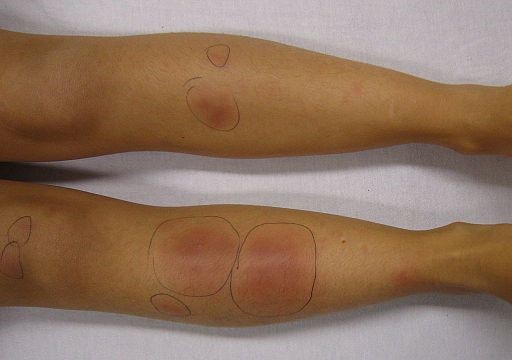
© James Heilman, MD, CC BY-SA 3.0, über Wikimedia Commons
Each nodule tends to last for about two weeks but new nodules can continue to appear for up to six weeks. When the nodule first appears it is usually red, hot and firm to the touch. It then becomes squashy (fluctuant). As the nodule begins to fade, it looks more like a bruise, turning blue and then yellowish. It usually takes some weeks for the nodules to heal completely. They do not leave any scarring.
You may have as few as two nodules, or as many as 50 or more.
Symptoms due to the underlying trigger
These depend on the trigger. For example, the nodules of erythema nodosum can appear two to three weeks after a streptococcal throat infection. People with inflammatory bowel disease may have tummy (abdominal) pain and diarrhoea. People with TB may have a cough and breathing problems.
How is erythema nodosum diagnosed?
Diagnosis of erythema nodosum is through its typical appearance. However, if they are unsure, your doctor may suggest that they refer you to a specialist for a Biopsie. During a biopsy, a small sample of tissue is taken from one of the rounded lumps (nodules). The tissue sample is then sent to the laboratory to be examined under a microscope. Erythema nodosum has a typical appearance under a microscope and the diagnosis can usually be confirmed.
Investigations to look for any underlying trigger
If your doctor diagnoses erythema nodosum, they will usually suggest some tests to look for an underlying trigger. The tests that they suggest may depend on any other symptoms that you may have. Tests may include:
Tests for streptococcal infection. For example, a sample (swab) may be taken from your throat. The swab is then sent to the laboratory to see if infection is present. A special blood test can also show if you have had a recent streptococcal infection.
Röntgenaufnahme des Brustkorbs. If your doctor suspects that you may have TB or sarcoidosis, they may suggest that you have a chest X-ray.
Other investigations for TB. Your doctor may suggest a special test called a tuberculin skin test. The test involves having a small injection into your arm. It is used to see if you have TB. If you have a cough, your doctor may suggest that a sample of your phlegm (sputum) be sent to the laboratory to look for TB infection.
Other investigations for sarcoidosis. If your doctor suspects that you may have sarcoidosis, they may refer you to a lung specialist for further investigations. These may include special tests that look at your breathing (respiratory function tests). They may also include a CT-Scan oder MRT-Scan of your lungs or a Bronchoskopie. During a bronchoscopy a special camera is inserted through your nose and mouth to look at your airways and lungs.
Stool (faeces) specimens. These can detect infections such as Salmonella spp. and Campylobacter spp. Your doctor may suggest these tests if you have erythema nodosum and diarrhoea or tummy (abdominal) pain.
Bowel investigations. If your doctor suspects that you may have underlying inflammatory bowel disease such as ulcerative colitis or Crohn's disease, they may suggest that you have investigations to look for this. For example, you may have an examination of your bowel with a camera (a colonoscopy).
What is the treatment for erythema nodosum?
Treatment for the nodules of erythema nodosum
The rounded lumps (nodules) of erythema nodosum tend to go away by themselves and often do not need any treatment. However, they may be very tender or painful and certain treatments may be suggested to help relieve these symptoms.
So, treatments may include:
Painkiller medication. Nichtsteroidale entzündungshemmende Medikamente (NSAIDs) - zum Beispiel, Ibuprofen - are commonly used to help relieve pain. Sometimes stärkere Schmerzmittel are needed.
Bed rest and keeping your legs raised above the level of your heart may help with pain relief.
Wearing firm, supportive bandages or stockings on your legs is another option. You can ask your doctor to advise about this.
Cool wet compresses over the nodules may also help to relieve pain.
Potassium iodide. In some people with erythema nodosum, this liquid taken by mouth may help relieve the pain in the nodules and also the joint pains. It is not certain exactly how this works and it is not effective in everyone.
Steroide. Steroid tablets are sometimes used provided erythema nodosum is not thought to have been triggered by an infection or a cancer. Steroids work by reducing inflammation. However, most of the time steroid treatment is not needed.
Treatment of any underlying trigger
If an underlying trigger for erythema nodosum has been found, this may need to be treated. The treatment depends on the trigger.
How long does erythema nodosum last?
For most people with erythema nodosum the rounded lumps (nodules) tend to resolve spontaneously and heal with no scarring, within six weeks. However, in some people with idiopathic erythema nodosum, nodules may last for up to six months or more.
What is the outlook (prognosis) for erythema nodosum?
Generally, the outlook for erythema nodosum is very good and most people do not have further problems. Persistent (chronic) or repeated (recurrent) erythema nodosum can occur in some people but this is rare.
As mentioned above, erythema nodosum may be the first sign of an underlying condition such as inflammatory bowel disease or sarcoidosis that needs specific treatment. Each of these conditions has a different outlook.
Patientenauswahl für Andere Hauterkrankungen
Haut-, Nagel- und Haargesundheit
Druckgeschwüre
Wundliegen, auch bekannt als 'Dekubitus' oder 'Druckgeschwür', ist eine offene oder geschädigte (ulzerierte) Hautstelle, die durch Reizung und anhaltenden Druck auf einen Teil Ihres Körpers verursacht wird. Druckgeschwüre treten häufiger an Stellen auf, an denen Ihre Knochen nahe an der Haut liegen (Knochenvorsprünge), wie Ihre Fersen, der untere Rückenbereich und Ihr Gesäß. Verschiedene Faktoren können Ihr Risiko erhöhen, ein Druckgeschwür zu entwickeln. Besonders steigt das Risiko, wenn Ihre Mobilität aus irgendeinem Grund eingeschränkt ist und Sie längere Zeit im Bett liegen oder in einem Stuhl sitzen. Es gibt verschiedene Maßnahmen, die Sie ergreifen können, um die Entstehung der meisten Druckgeschwüre zu verhindern. Dazu gehört, Ihre Position so oft wie möglich zu wechseln, sowie die Verwendung druckentlastender Geräte.
von Dr. Hayley Willacy, FRCGP
Haut-, Nagel- und Haargesundheit
Hühneraugen und Schwielen
Hühneraugen und Schwielen an den Füßen sind verdickte Hautstellen, die schmerzhaft werden können. Sie entstehen durch übermäßigen Druck oder Reibung (Friction) auf die Haut und können zu Fußproblemen führen, insbesondere beim Gehen. Die häufigste Ursache ist das Tragen von schlecht sitzenden Schuhen. Ein Facharzt, der Fußbeschwerden diagnostizieren und behandeln kann (Podologe), kann Hühneraugen und Schwielen entfernen und Ratschläge zu Schuhwerk, Einlagen und Polstern geben, um ein Wiederauftreten zu verhindern.
von Dr. Colin Tidy, MRCGP
Häufig gestellte Fragen
Can erythema nodosum leave a scar?
No, the nodules associated with erythema nodosum typically heal without leaving any scarring on the skin.
Is erythema nodosum dangerous?
Erythema nodosum itself is generally not dangerous and the nodules tend to resolve on their own. However, in some cases, it can be a sign of a more serious underlying condition that needs to be identified and treated, such as specific infections, inflammatory bowel disease, sarcoidosis, or rarely, certain cancers. The outlook is usually very good once any underlying cause is addressed.
How quickly do the nodules of erythema nodosum appear?
You may experience flu-like symptoms for a few weeks before the rounded lumps, or nodules, appear. After their initial appearance, each nodule typically lasts for about two weeks, but new ones can continue to develop for up to six weeks.
Can erythema nodosum return after it has cleared up?
While the outlook for erythema nodosum is generally very good and most people do not have further problems, it is possible for some individuals to experience persistent (chronic) or repeated (recurrent) erythema nodosum. However, this is considered rare.
Do I always need tests if I am diagnosed with erythema nodosum?
If you are diagnosed with erythema nodosum, your doctor will usually suggest some tests. These investigations aim to look for any potential underlying trigger for the condition, especially since erythema nodosum can sometimes be the first sign of another issue that requires treatment. The specific tests will depend on any other symptoms you might have.
Weiterführende Literatur und Referenzen
- Hafsi W, Badri T; Erythema Nodosum.
- Dermnetz; Erythema Nodosum
- Perez-Garza DM, Chavez-Alvarez S, Ocampo-Candiani J, et al; Erythema nodosum: Ein praktischer Ansatz und diagnostischer Algorithmus. Am J Clin Dermatol. 2021 Mai;22(3):367-378. doi: 10.1007/s40257-021-00592-w. Epub 2021 Mär 8.
Über den AutorVollständige Biografie anzeigen

Dr Hayley Willacy, FRCGP
Allgemeinmediziner, Medizinischer Autor
MBChB (1992), DRCOG, DFFP, MRCOG (Part 1) MRCGP (2007), DFSRH (2013), MSc - medical education (2020)
Dr. Hayley Willacy war eine NHS-Hausärztin, die in Nordwestengland arbeitete und 2022 nach 30 Jahren aus der klinischen Praxis ausschied.
Über den RezensentenVollständige Biografie anzeigen

Dr Colin Tidy, MRCGP
Allgemeinmediziner, Medizinischer Autor
MBBS, MRCGP, MRCP (Paediatrics), DCH
Dr. Colin Tidy ist ein NHS-Arzt mit Sitz in Oxfordshire.
Artikelverlauf
Die Informationen auf dieser Seite wurden von qualifizierten Klinikern verfasst und begutachtet.
Artikel auch verfügbar in Englisch, Deutsch, Spanisch, Französisch, Italienisch, Portugiesisch, Hindi, Hebräisch, Arabisch, und Schwedisch.
Next review due: 9 Apr 2028
10 Apr 2025 | Neueste Version

Fragen, teilen, verbinden.
Durchsuchen Sie Diskussionen, stellen Sie Fragen und teilen Sie Erfahrungen zu Hunderten von Gesundheitsthemen.

Fühlen Sie sich unwohl?
Bewerten Sie Ihre Symptome online kostenlos
Abonnieren Sie den Patienten-Newsletter
Ihre wöchentliche Dosis klarer, vertrauenswürdiger Gesundheitsberatung - geschrieben, um Ihnen zu helfen, sich informiert, selbstbewusst und in Kontrolle zu fühlen.
Durch das Abonnieren akzeptieren Sie unsere Datenschutzrichtlinie. Sie können sich jederzeit abmelden. Wir verkaufen Ihre Daten niemals.
Mehr über Haut-, Nagel- und Haargesundheit
- Aktinische Keratose
- Fußpilz
- Atopisches Ekzem
- Morbus Bowen
- Frostbeulen
- Kontaktekzem
- Hühneraugen und Schwielen
- Ekzem-Auslöser und Reizstoffe
- Nesselsucht
- Keloid
- Laser-Haarentfernung
- Nagelpsoriasis
- Pflastertest für Kontaktdermatitis
- Vorbeugung von Hautkrebs
- Ringelflechte
- Seborrhoische Dermatitis
- Telogenes Effluvium
- Krampfaderneurodermitis