Seborrhoische Warzen
Begutachtet von Dr Doug McKechnie, MRCGPZuletzt aktualisiert von Dr Colin Tidy, MRCGPZuletzt aktualisiert 19 Jul 2024
Erfüllt die Anforderungen des Patienten Richtlinien des Patienten
- HerunterladenHerunterladen
- Teilen
- Language
- Diskussion
- Audio-Version
- Zu bevorzugten Quellen bei Google hinzufügen
In dieser Serie:Warzen und Verrucas
Seborrhoische Warzen sind gutartige (benigne) warzenartige Wucherungen, die auf der Haut auftreten. In der Regel sind keine Behandlung erforderlich.
Auf einen Blick
Seborrhoeic warts (also called seborrhoeic keratoses) are greasy, crusty spots that look stuck on the skin.
They are usually dark brown or black, round or oval, and vary in size.
They often appear after age 40, can run in families, and usually grow slowly over time.
They are always benign and not infectious.
They can be removed if they itch, interfere with clothing, or are unsightly.
See a doctor if you notice sudden changes in a seborrhoeic wart or many new ones appear.
In diesem Artikel:
Videoauswahl für Andere Hautprobleme
Lesen Sie unten weiter
What are seborrhoeic warts?
Seborrhoeic warts are also known as seborrhoeic keratoses or basal cell papillomas. In the past they were also called senile warts.
They usually look like greasy or crusty spots which seem to be stuck on to the skin. The colour varies but usually they are darkish brown or black. Seborrhoeic warts can occur almost anywhere on the body, but particularly on the face, chest, scalp, back and groin.
Dermatosis papulosa nigra are multiple, small, 1–5 mm diameter, smooth, firm, black or dark brown papules on face and neck. They common in people with darker skin tones. Their appearance is identical to small seborrhoeic warts.
What do seborrhoeic warts look like?
Zurück zum InhaltThey are usually round although they can also be oval in shape. Some seborrhoeic warts have an irregular shape. Their size can vary from around one centimetre to several centimetres in diameter.
Black pigmented verrucous lesion
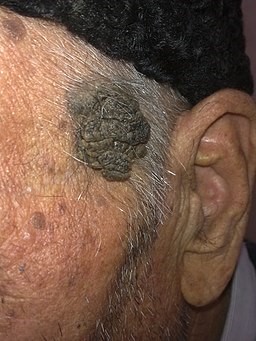
© Alborz Fallah, CC BY-SA 3.0, via Wikimedia Commons
Seborrhoische Keratose
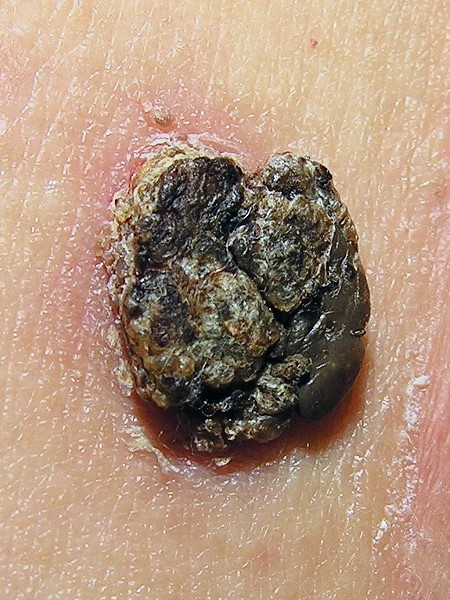
© Lmbuga, Public domain, via Wikimedia Commons
Lesen Sie unten weiter
What causes seborrhoeic warts?
Zurück zum InhaltSeborrhoeic warts tend first to appear around the age of 40. They can sometimes run in families. The actual cause of seborrhoeic warts is unknown. It can be common to develop several seborrhoeic warts as you become older. Also, as time goes by, each wart tends to grow slightly and become darker. They can occur anywhere on your body, other than on your palms or soles, and there may be multiple lesions.
Are seborrhoeic warts serious?
Zurück zum InhaltNo. Seborrhoeic warts are always benign. That means they do not spread and they are not cancerous. The main problem is that they can sometimes look unsightly, particularly if they develop on your face.
However, rarely, seborrhoeic warts may be associated with various cancers. The Leser-Trélat sign is rare and refers to the sudden appearance of multiple seborrhoeic warts. This sign is associated with a number of different cancers, particularly bowel, breast, or stomach, and has also been associated with cancers of the liver, kidney and pancreas.
Very rare cases have been reported of a type of skin cancer called melanoma developing within a seborrhoeic wart. It is not known if this is just a coincidence or whether it represents a true cancer change in the seborrhoeic wart. If you do notice a change in a seborrhoeic wart, it is worth asking your doctor to examine it.
Hinweis: although they are called warts, they are not caused by the wart virus. They are not infectious.
Lesen Sie unten weiter
How are seborrhoeic warts diagnosed?
Zurück zum InhaltDoctors can often diagnose seborrhoeic warts by their appearance. However, if there is any doubt about the diagnosis, especially if the possibility of a more serious diagnosis such as skin cancer is suspected, then dermatoscopy may be used for a closer look at the structure of the lesion.
Dermatoscopy is a technique to examine the skin with a magnifying lens and a light. It can help diagnose skin lesions by accurate assessment of their colour, structures, patterns and borders.
Sometimes a biopsy or removal of the lesion may be needed so that the diagnosis can be confirmed by the detailed structure of the lesion (histology).
What is the treatment for seborrhoeic warts?
Zurück zum InhaltIf they do not cause any problems then it is best that they be left alone. Without treatment, they usually continue to grow and can become darker and more crusty. However, they do increase in size very slowly.
If required, however, they can be removed quite easily. Seborrhoeic warts are usually removed because they itch, they interfere with clothing or jewellery or they are unsightly.
Two commonly used methods to remove them are:
By using a curette. This involves 'freezing' the surrounding skin with local anaesthetic. The seborrhoeic warts are then scraped off with a sharp surgical instrument called a curette.
Flüssigstickstoffbehandlung. Liquid nitrogen is very cold and anything it touches is killed by the cold. Small amounts of liquid nitrogen can be sprayed on to small seborrhoeic warts. The seborrhoeic warts are killed and drop off a few days later. Normal skin replaces the area left behind. Liquid nitrogen is not suitable for larger warts.
Once seborrhoeic warts have been removed, they usually do not return.
Complications of seborrhoeic warts
Zurück zum InhaltSeborrhoeic warts do not become cancerous and are benign, unless there is a sudden appearance of multiple seborrhoeic warts, which may be associated with various cancers (see Leser-Trélat sign above).
Seborrhoeic warts way cause minor local complications such as infection, bleeding or surrounding dermatitis (eczema).
Patientenauswahl für Andere Hautprobleme

Haut-, Nagel- und Haargesundheit
Erythema nodosum
Das Erythema nodosum ist eine Erkrankung, bei der sich rote, runde Knoten (Noduli) direkt unter der Haut bilden, meist an den Schienbeinen. Bei den meisten Menschen kann keine spezifische Ursache oder Auslöser gefunden werden. Bei manchen Menschen kann jedoch ein Auslöser (häufig eine Streptokokkeninfektion oder Sarkoidose) festgestellt werden. In der Regel heilen die Knoten innerhalb von sechs bis acht Wochen ohne Behandlung ab. Es ist jedoch wichtig, nach einem möglichen zugrunde liegenden Auslöser zu suchen, da dieser behandelt werden muss.
by Dr Hayley Willacy, FRCGP
Haut-, Nagel- und Haargesundheit
Akne
Akne (auch 'Pickel', Flecken oder Pusteln genannt) ist eine häufige Erkrankung, insbesondere bei Jugendlichen. Sie kann gelegentlich auch bei Erwachsenen mittleren Alters und Babys auftreten. Sie verursacht oft viel Sorgen und Unruhe, lässt sich aber in der Regel mit der richtigen Behandlung beseitigen oder zumindest deutlich verbessern. Die Behandlung kann etwa einen Monat dauern, bis sie wirkt, und muss möglicherweise noch eine Weile fortgesetzt werden, auch nachdem die Flecken verschwunden sind.
von Dr. Colin Tidy, MRCGP
Häufig gestellte Fragen
Can seborrhoeic warts be confused with other skin conditions?
Yes, doctors often diagnose seborrhoeic warts by their appearance. However, if there's any uncertainty, especially if a more serious condition like skin cancer is suspected, a dermatoscopy or even a biopsy might be used to confirm the diagnosis by closely examining the lesion's structure.
If I have seborrhoeic warts, should I worry about them becoming cancerous?
Generally, no. Seborrhoeic warts are benign, meaning they are not cancerous and do not spread. Very rarely, a type of skin cancer called melanoma has been reported to develop within a seborrhoeic wart, though it's unclear if this is coincidental. The main concern is a sudden appearance of multiple warts, known as the Leser-Trélat sign, which can be associated with internal cancers. If you notice any changes in a seborrhoeic wart, it's wise to have your doctor examine it.
Is there a specific age when seborrhoeic warts are most likely to appear?
Seborrhoeic warts commonly begin to appear around the age of 40. As people get older, it's common to develop several of these warts, and each one tends to grow slightly and become darker over time.
Are seborrhoeic warts contagious?
No, seborrhoeic warts are not contagious. Although they are called 'warts', they are not caused by the wart virus and cannot be spread from person to person.
What kind of problems can seborrhoeic warts cause if left untreated?
If left alone, seborrhoeic warts usually continue to grow slowly, becoming darker and more crusty. They are always benign, but can cause minor local issues such as infection, bleeding, or localised eczema (dermatitis) in the surrounding skin. People often choose to have them removed if they itch, interfere with clothing or jewellery, or are considered unsightly.
What is dermatosis papulosa nigra?
Dermatosis papulosa nigra refers to multiple, small (1-5 mm), smooth, firm, black or dark brown spots that appear on the face and neck. They are particularly common in individuals with darker skin tones and look identical to small seborrhoeic warts.
If my seborrhoeic warts are removed, will they typically grow back?
Once seborrhoeic warts have been removed, they usually do not return. The treatments, such as scraping them off with a curette or using liquid nitrogen, are generally effective at permanently removing the individual warts.
Weiterführende Literatur und Referenzen
- Seborrheic Keratosis; DermIS (Dermatologisches Informationssystem)
- Seborrhoeic Keratoses; DermNet NZ
- Seborrhoische Keratose; Gesellschaft für Dermatologie in der Primärversorgung
Lesen Sie unten weiter
Über den AutorVollständige Biografie anzeigen

Dr Colin Tidy, MRCGP
Allgemeinmediziner, Medizinischer Autor
MBBS, MRCGP, MRCP (Paediatrics), DCH
Dr. Colin Tidy ist ein NHS-Arzt mit Sitz in Oxfordshire.
Über den RezensentenVollständige Biografie anzeigen

Dr Doug McKechnie, MRCGP
Medizinischer Autor
MA, MBBS, MSc, DRCOG, MRCP(UK), MRCGP(2021), FHEA
Dr. Doug McKechnie ist ein NHS-Hausarzt, der in London arbeitet. Er arbeitet klinisch in Vollzeit und ist außerdem stellvertretender Leiter des Moduls für klinische und berufliche Praxis an der University College London Medical School.
Artikelverlauf
Die Informationen auf dieser Seite wurden von qualifizierten Klinikern verfasst und begutachtet.
Nächste Überprüfung fällig: 18. Juli 2027
19 Jul 2024 | Neueste Version

Fragen, teilen, verbinden.
Durchsuchen Sie Diskussionen, stellen Sie Fragen und teilen Sie Erfahrungen zu Hunderten von Gesundheitsthemen.

Fühlen Sie sich unwohl?
Bewerten Sie Ihre Symptome online kostenlos
Abonnieren Sie den Patienten-Newsletter
Ihre wöchentliche Dosis klarer, vertrauenswürdiger Gesundheitsberatung - geschrieben, um Ihnen zu helfen, sich informiert, selbstbewusst und in Kontrolle zu fühlen.
Durch das Abonnieren akzeptieren Sie unsere Datenschutzrichtlinie. Sie können sich jederzeit abmelden. Wir verkaufen Ihre Daten niemals.