Spulwürmer
Begutachtet von Dr Colin Tidy, MRCGPZuletzt aktualisiert von Dr Toni Hazell, MRCGPLast updated 10. Feb 2023
Erfüllt die Anforderungen des Patienten Richtlinien des Patienten
- HerunterladenHerunterladen
- Teilen
- Language
- Diskussion
- Audio-Version
- Add to preferred sources on Google
Spulwürmer (auch Nematoden genannt) sind Würmer mit einem langen, runden Körper. Sie variieren in der Länge von mehreren Millimetern bis zu zwei Metern. Spulwürmer sind in warmen tropischen Ländern verbreitet, und die meisten Infektionen, die im Vereinigten Königreich beobachtet werden, wurden im Ausland erworben. Kinder sind häufiger betroffen als Erwachsene. Die Behandlung ist in der Regel sehr effektiv, aber die Ausrottung von Spulwurminfektionen hat sich als sehr schwierig erwiesen.
In diesem Artikel:
Video picks for Travel related infections
Lesen Sie unten weiter
Can humans get roundworms?
Spulwurm Ascaris lumbricoides
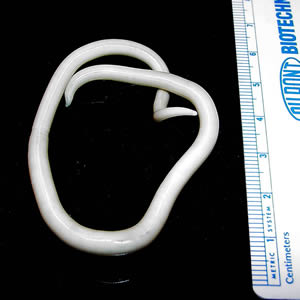
© CDC, Public Domain, über Wikimedia Commons
About 60 types (species) of roundworm can live in (are parasites of) humans. They usually live in the human gut. However, some species can travel from the gut to live in different parts of the body.
Roundworm eggs and tiny young worms (larvae) live in the soil. They most commonly get into the body when a person gets them on his or her hands and then transfers them to the mouth. Some can also get into the body through the skin.
Examples of roundworms
Zurück zum InhaltAscaris lumbricoides (also called human roundworm), which is the most common roundworm infection, and affects as many as one billion people worldwide.
Hookworm infections.
Guinea worm disease (dracunculiasis).
Filariasis, which is caused by thread-like filarial nematodes (roundworms) in the family Filarioidea (also known as filariae). There are eight known filarial nematodes which use humans as the host. These are divided into three groups:
Lymphatic filariasis - caused by the worms Wuchereria bancrofti, Brugia malayi, and Brugia timori.
Cutaneous filariasis - caused by Loa loa (the African eye worm), Mansonella streptocerca und Onchocerca volvulus.
Body cavity filariasis - caused by the worms Mansonella perstans und Mansonella ozzardi.
Threadworm (pinworm) - see the separate leaflet called Threadworms for more detail.
Trichuriasis (whipworm).
Trichinellose.
Angiostrongyliasis.
Strongyloidiasis.
Toxocariasis.
Gnathostomiasis.
Anisakiasis.
Cutaneous larva migrans is a skin infection that causes a rash. It can be caused by the larvae of various nematodes that get into the skin.
The number of roundworm infections throughout the world is generally increasing but varies according to levels of poverty, natural disasters and human conflicts. The spread of infection is also increasing in line with increased travel and mobility. In areas where roundworms are common, children can be continuously infected. As some worms die and are passed out in the stools (faeces), others may be growing to take their place.
Lesen Sie unten weiter
Where do roundworms come from?
Zurück zum InhaltThe life cycle of roundworms varies between types (species).
Soil and water supplies may become contaminated with roundworm eggs in areas of poor sanitation. Many roundworms have a complicated life cycle that includes both main hosts (large mammals such as humans or pigs) and intermediate hosts (small animals such as snails). Therefore, some roundworm infections occur as a result of eating uncooked contaminated food.
The eggs may survive for years in moist soil. In the soil the eggs develop into tiny young worms (larvae). Larvae can get into the human gut if you eat them with contaminated food. They pass into the bloodstream and are carried to other parts of the body - such as the lungs.
Larvae develop further and then often travel back to the gut, where the larvae then grow into adult worms. If you have worms in your gut, the female worm lays many tiny eggs. You pass these out with the stools (faeces).
Roundworm symptoms
Zurück zum InhaltThe symptoms depend on the types (species) of roundworm causing the infection. Many affected people have no symptoms. Heavy roundworm infection in children can cause nutritional problems resulting in poor growth and poor general well-being.
Some affected people may develop one or more of the following:
Hohe Temperatur (Fieber).
Müdigkeit.
Allergic rash (urticaria).
Abdominal (tummy) pains.
Feeling sick (nausea), being sick (vomiting) and/or diarrhoea.
Nerve problems.
Cough, wheeze, fever and coughing up blood (haemoptysis) - this combination of symptoms due to roundworm larvae is called Löffler's syndrome and gets better by itself within two weeks.
The larvae in the lungs can sometimes cause symptoms such as wheeze, cough and other chest problems.
Other symptoms are specific to the different species of roundworm. For example, onchocerciasis can cause eye lesions, which may cause total loss of vision.
Occasionally, roundworms cause a severe illness. For example, large numbers of worms can cause a blockage in the gut. In some people, roundworms cause serious infections to the liver or pancreas, or serious allergy symptoms.
Lesen Sie unten weiter
Roundworm treatment
Zurück zum InhaltControl of roundworm infections is based on treatment with medication, improved sanitation and health education. Treatments usually work well but wiping out (eradication of) roundworm infections from tropical countries presents a major challenge. However, some eradication programmes (notably for guinea worm disease) have been effective in reducing the burden of infection.
How to get rid of roundworms
Mebendazol is the usual medicine used for children aged over 1 year, and for adults who are not pregnant or breastfeeding. It comes as a tablet or drink. You take a dose twice a day for three days. (Hinweis: mebendazole is recommended in UK guidelines for treatment from the age of 1 year. However, strictly speaking, it is not licensed for use in children younger than 2 years of age and so specialist advice should be sought for children in this age group.)
Other medicines such as albendazole, levamisole, and ivermectin are used in countries where roundworms are common. They are not often used in the UK unless under the advice of a specialist.
Diethylcarbamazine or ivermectin is used for people with infection with filariasis.
For pregnant or breastfeeding women and newborn babies - your doctor will advise.
Abdominal (tummy) pain, nausea or loose stools (diarrhoea) may briefly get worse with treatment but will then improve.
Can roundworms be prevented?
Zurück zum InhaltHygiene
In countries where roundworms are common, roundworms may be prevented by eating only cooked food and by avoiding green vegetables and salads. It is best if children do not play in areas of poor sanitation, or where human stool (faeces) is used as fertiliser. Always wash hands before eating or preparing food, and after going to the toilet or changing nappies.
Medikation
If there is a high risk of infection, taking preventative medicine may be advised. For example, if you stay in an area known to be contaminated, or if you travel abroad to at-risk areas.
Patient picks for Travel related infections

Reisen und Impfungen
Typhus und Paratyphus
Typhus und Paratyphus sind Infektionen, die durch verwandte, aber unterschiedliche Bakterienstämme verursacht werden. Die beiden Krankheiten sind ähnlich und werden beide als Darmtyphus bezeichnet, obwohl Paratyphus weniger schwerwiegend ist. Sie werden in der Regel durch den Verzehr von kontaminierten Lebensmitteln oder Wasser übertragen. Diese Infektionen treten am häufigsten in Ländern mit schlechter sanitärer Versorgung auf. Erste typische Symptome sind hohes Fieber und Kopfschmerzen, aber wenn sie nicht behandelt werden, können ernstere Probleme auftreten. Die Behandlung mit Antibiotika ist in der Regel wirksam. Ohne Behandlung sterben etwa 1 von 5 Menschen mit Typhus, während Paratyphus normalerweise nicht tödlich verläuft. Gründliches Händewaschen und das Trinken von Flaschenwasser können helfen, eine Ansteckung mit Typhus zu verhindern. Außerdem sollten Sie in Gebieten, in denen Typhus häufig vorkommt, Lebensmittel vor dem Verzehr kochen, schälen oder abkochen. Impfungen können ebenfalls helfen, Typhus vorzubeugen, daher ist es sinnvoll, sich vor einer Reise in ein Gebiet mit erhöhtem Typhusrisiko impfen zu lassen.
von Dr. Colin Tidy, MRCGP
Reisen und Impfungen
Malariaprophylaxe
Es ist sinnvoll herauszufinden, ob in dem Gebiet, das Sie besuchen, ein Malariarisiko besteht. Wenn ein Risiko besteht, können Sie Malaria vermeiden, indem Sie Maßnahmen ergreifen, um Mückenstiche zu vermeiden, und in einigen Fällen durch die Einnahme von Antimalariamitteln. Malaria kann eine lebensbedrohliche Krankheit sein, daher ist es äußerst wichtig, Präventionsmaßnahmen zu erwägen, bevor Sie in ein Risikogebiet reisen.
by Dr Hayley Willacy, FRCGP
Weiterführende Literatur und Referenzen
- About Parasites; Zentren für Krankheitskontrolle und Prävention
- Parasiten A-Z; Zentren für Krankheitskontrolle und Prävention
- Bethony J, Brooker S, Albonico M, et al; Bodenübertragene Helmintheninfektionen: Ascariasis, Trichuriasis und Hakenwurm. Lancet. 6. Mai 2006;367(9521):1521-32.
- Spulwurm; NICE CKS, März 2018 (nur für UK-Zugang)
Lesen Sie unten weiter
About the author

Dr Toni Hazell, MRCGP
MBBS, BSc, MRCGP, DFSRH, Dip GU med, DRCOG, DCH (London, UK, 2000)
Dr. Toni Hazell qualified from St. Mary’s Hospital Medical School and did her VTS at Northwick Park Hospital.
About the reviewerView full bio

Dr Colin Tidy, MRCGP
Allgemeinmediziner, Medizinischer Autor
MBBS, MRCGP, MRCP (Paediatrics), DCH
Dr. Colin Tidy ist ein NHS-Arzt mit Sitz in Oxfordshire.
Artikelverlauf
Die Informationen auf dieser Seite wurden von qualifizierten Klinikern verfasst und begutachtet.
Nächste Überprüfung fällig: 9. Feb 2028
10. Feb 2023 | Neueste Version

Fragen, teilen, verbinden.
Durchsuchen Sie Diskussionen, stellen Sie Fragen und teilen Sie Erfahrungen zu Hunderten von Gesundheitsthemen.

Fühlen Sie sich unwohl?
Bewerten Sie Ihre Symptome online kostenlos
Abonnieren Sie den Patienten-Newsletter
Ihre wöchentliche Dosis klarer, vertrauenswürdiger Gesundheitsberatung - geschrieben, um Ihnen zu helfen, sich informiert, selbstbewusst und in Kontrolle zu fühlen.
By subscribing you accept our Datenschutzrichtlinie. Sie können sich jederzeit abmelden. Wir verkaufen Ihre Daten niemals.