Radionuclide scan
Isotope scan
Peer reviewed by Dr Krishna Vakharia, MRCGPLast updated by Dr Rachel Hudson, MRCGPLast updated 24 Aug 2023
Meets Patient’s editorial guidelines
- DownloadDownload
- Share
- Language
- Discussion
- Audio Version
- Add to preferred sources on Google
A radionuclide scan is a way of imaging bones, organs and other parts of the body by using a small dose of a radioactive chemical. There are different types of radionuclide chemical. The one used depends on which organ or part of the body is to be scanned.
Note: the information below is a general guide only. The arrangements, and the way tests are performed, may vary between different hospitals. Always follow the instructions given by your doctor or local hospital.
At a glance
A radionuclide scan uses a small amount of a radioactive chemical to create images of inside your body.
It can help detect conditions like cancer, infection, blood clots, or assess organ function.
The chemical usually enters your body by injection or by swallowing, and a special camera detects its signals.
Preparation may involve drinking fluids or pausing certain medications.
The amount of radiation used is small and generally considered safe.
Tell your doctor if you are pregnant or might be, as pregnant women should not have these scans.
Why do you have a radionuclide scan?
A radionuclide scan may be done for all sorts of reasons. For example:
A bone scan is a common type. A radionuclide is used which collects in areas where there is a lot of bone activity (where bone cells are breaking down or repairing parts of the bone). So a bone scan is used to detect areas of bone where there is cancer, infection, or damage. These areas of activity are seen as 'hot spots' on the scan picture. See the separate leaflet called Bone Scan for more details.
A kidney scan can assess how well a kidney is working (as the radionuclide chosen is taken up by kidney cells and passes into the urine). So, the scan can detect scars on the kidney and how well urine drains from the kidney to the bladder. See the separate leaflet called DMSA Scan for more details.
Lung perfusion scan (also called a 'VQ scan') can detect blood clots in the lungs (pulmonary embolism).
A heart scan can assess blood flow to the heart muscle. Areas of poor blood flow to the heart muscle do not 'take up' the radionuclide very well and this will be shown in the picture.
A thyroid scan may be done to assess cases of overactive thyroid (hyperthyroidism). For example, some nodules (small 'lumps') are sometimes a focus of overactivity and will show as 'hot spots' on the picture. See the separate leaflet called Thyroid Scans and Uptake Tests for more details.
Lacrimal scintigraphy is done to test the function of tear ducts (lacrimal ducts.) The radionuclide is given as eye drops.
Lymphoscintigraphy is done to check the drainage of the lymph nodes in people with a type of swelling of the legs, called lymphoedema.
There are various other types of radionuclide tests.
What preparation do I need?
The preparation needed is usually very little. It will depend on which type of scan you are having. Your local hospital should give you specific information to help you prepare for these tests.
For some types of scan, you may be asked to have lots to drink to help to flush the radionuclide through your body.
For some types of scan you may also be asked to empty your bladder of urine before the scanning begins.
For some scans, such as thyroid scans, you may be instructed to stop certain medications for some time before the scan.
As these tests involve a small amount of radiation, pregnant women should not have them.
Note: let your doctor know if you are, or think you could be, pregnant. You should also let your doctor know if you are breastfeeding.
What happens during a radionuclide scan?
The procedures for the different types of radionuclide scans are different. Information about your scan should be sent to you with the appointment.
Depending on the type of scan you have, you usually either swallow a small quantity of radionuclide, or it is injected into a vein in your arm.
It then takes some time - sometimes several hours (depending on what is being scanned) - for the radionuclide to travel to the target organ or tissue, and to be 'taken' into the active cells.
So, after receiving the radionuclide you may have a wait of a few hours. You may be able to go out and come back to the scanning room later in the day.
When it is time to do the scanning, you usually lie on a couch while the gamma camera detects the gamma rays coming from your body.
Gamma camera
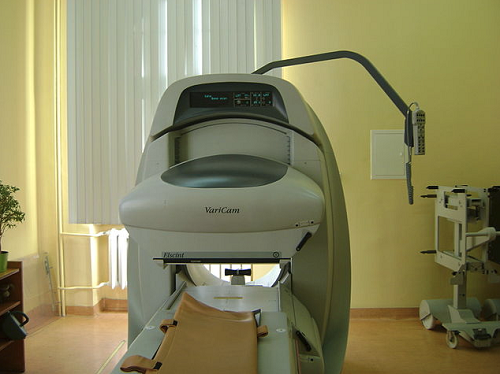
© By Arturo 1299 (Own work) via Wikimedia Commons
The computer turns the information into a picture. You need to lie as still as possible whilst each picture is taken (so it is not blurred). Some pictures can take 20 minutes or more to expose.
The number of pictures taken and the time interval between each picture vary depending on what is being scanned. Sometimes only one picture is needed. However, for some scans (such as bone scans or heart scans), two or more pictures are needed. Each picture may be taken several hours apart. So, the whole process can take several hours.
What happens after a radionuclide scan?
Radionuclide scans do not generally cause any side-effects.
Uncommon side-effects from radionuclides may include flushing, racing heart and nausea but these are short-lived because they are flushed out of your system quickly.
Through the natural process of radioactive decay, the small amount of radioactive chemical in your body will lose its radioactivity over time. It may also pass out of your body through your urine or poo during the first few hours or days following the test.
You may be instructed to take special precautions after urinating, to flush the toilet twice and to wash your hands thoroughly. You may be advised to drink plenty of water to help flush the chemicals out of your system.
If you have contact with children or pregnant women you should let your doctor know. Although the levels of radiation used in the scan are small, they may advise special precautions. Your hospital should give you more advice on this.
Are there risks with radionuclide scans?
The term 'radioactivity' may sound alarming. But, the radioactive chemicals used in radionuclide scans are considered to be safe, and they leave the body quickly in the urine. The dose of radiation that your body receives is very small.
In many cases, the level of radiation involved is not much different to a series of a few normal X-rays. However:
As with any other types of radiation (such as X-ray), there is a small risk that the gamma rays may affect an unborn child. So, tell your doctor if you are pregnant or if you may be pregnant.
Rarely, some people have an allergic reaction to the injected chemical. Tell your doctor if you are allergic to iodine.
Theoretically, it is possible to receive an overdose when the chemical is injected. This is very rare.
How does a radionuclide scan work?
A radionuclide (sometimes called a radioisotope or isotope) is a chemical which emits a type of radioactivity called gamma rays. A tiny amount of radionuclide is put into the body, usually by an injection into a vein. Sometimes it is breathed in, or swallowed, or given as eye drops, depending on the test.
There are different types of radionuclides. Different ones tend to collect or concentrate in different organs or tissues. So, the radionuclide used depends on which part of the body is to be scanned.
For example, if radioactive iodine is injected into a vein it is quickly taken up into the tissues of the thyroid gland. So, it is used to scan the thyroid gland.
Cells which are most 'active' in the target tissue or organ will take up more of the radionuclide. So, active parts of the tissue will emit more gamma rays than less active or inactive parts.
Gamma rays are similar to X-rays and are detected by a device called a gamma camera. The gamma rays which are emitted from inside the body are detected by the gamma camera, are converted into an electrical signal and sent to a computer.
The computer builds a picture by converting the differing intensities of radioactivity emitted into different colours or shades of grey. This is seen below in a lung perfusion scan.
Lung perfusion scan
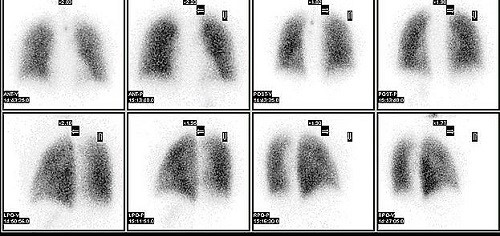
© By Myohan (Own work) via Wikimedia Commons
Alternatively areas of the target organ or tissue which emit lots of gamma rays may be shown as red spots ('hot spots') on the picture on the computer monitor.
Areas which emit low levels of gamma rays may be shown as blue ('cold spots'). Various other colours may be used for 'in between' levels of gamma rays emitted.
Patient picks for Imaging
Tests and investigations
Gallium scan
A gallium scan uses a radioactive chemical to help create pictures which can show areas of possible infection, injury, inflammation or cancer. It does this by looking for areas where there is rapid cell division within the body. Note: the information below is a general guide only. The arrangements, and the way tests are performed, may vary between different hospitals. Always follow the instructions given by your doctor or local hospital.
by Dr Mary Harding, MRCGP

Tests and investigations
Bone scan
A bone scan is a special type of nuclear medicine procedure that uses radionuclides to create a picture of the bones. Radionuclides are chemicals which emit radioactivity that can be detected by special scanners. A bone scan is different to a bone density scan (DEXA). See the DEXA Scan leaflet for more information on this bone density test. A DEXA scan is also known as a DXA scan. Note: the information below is a general guide only. The arrangements, and the way tests are performed, may vary between different hospitals. Always follow the instructions given by your doctor or local hospital.
by Dr Doug McKechnie, MRCGP
Frequently asked questions
What is a radionuclide?
A radionuclide, also known as a radioisotope or isotope, is a chemical that gives off gamma rays. A small amount of this chemical is introduced into the body to allow a gamma camera to create images of internal organs or tissues. Different radionuclides are used depending on the specific organ or tissue being scanned.
Are there specific radionuclides for different body parts?
Yes, there are various types of radionuclides, and each tends to gather in specific organs or tissues. The choice of radionuclide depends on which part of the body needs to be scanned. For instance, radioactive iodine is used for thyroid gland scans because it's readily absorbed by thyroid tissues.
How are the images from a radionuclide scan interpreted?
The gamma camera detects the gamma rays emitted from inside your body and converts them into electrical signals for a computer. The computer then creates a picture, using different colours or shades of grey to represent varying intensities of radioactivity. "Hot spots" (often shown in red) indicate areas with high gamma ray emission, meaning high activity, while "cold spots" (often in blue) indicate low emission or activity. Other colours might be used for intermediate levels.
Can I have a radionuclide scan if I am breastfeeding?
If you are breastfeeding, you should inform your doctor before having a radionuclide scan. They will be able to advise you on any special precautions that may be necessary.
What happens if I have an allergic reaction to the chemical injected during the scan?
Allergic reactions to the injected chemical are rare. However, if you have any known allergies, especially to iodine, you should inform your doctor beforehand.
Will I experience any discomfort during the scan procedure itself?
During the scanning itself, you usually lie still on a couch while the gamma camera takes pictures. You'll need to remain as still as possible to prevent blurring of the images. Some pictures can take 20 minutes or longer to expose.
Further reading and references
- Myocardial perfusion scintigraphy for the diagnosis and management of angina and myocardial infarction; NICE Technology Appraisal Guidance, November 2003 (last updated July 2011)
- Nuclear Medicine; Radiology.info.org (American College of Radiology and Radiological Society of North America)
- Guidelines; British Nuclear Medicine Society
- Gruning T, Drake BE, Freeman SJ; Single-photon emission CT using (99m)Tc-dimercaptosuccinic acid (DMSA) for characterization of suspected renal masses. Br J Radiol. 2014 Jul;87(1039):20130547. doi: 10.1259/bjr.20130547. Epub 2014 May 16.
- Radionuclide bone scans/bone scintigraphy; Cancer Research UK
- Myocardial perfusion scans; British Heart Foundation
About the authorView full bio

Dr Rachel Hudson, MRCGP
General Practitioner and Medical Author
MBChB, MRCGP (2008), BSc (Medical Science), DFSRH, DRCOG, DCH
Dr Rachel Hudson, is an NHS GP working in the North West of England.
About the reviewerView full bio

Dr Krishna Vakharia, MRCGP
Chief Medical Officer for Health, Optum UK
MBChB, MRCGP(2013), BMedSci (hons), DFSRH, DRCOG, PGDipDerm (Distn)
Dr Krishna Vakharia is an NHS GP. She is also a regular examiner for the postgraduate Diploma in Practical Dermatology at Cardiff University as well as being the Chief Medical Officer for health at Optum UK.
Article history
The information on this page is written and peer reviewed by qualified clinicians.
Article also available in English, German, Spanish, French, Italian, Portuguese, Hindi, Hebrew, Arabic, and Swedish.
Next review due: 22 Aug 2028
24 Aug 2023 | Latest version
Join the conversation
Share your thoughts or experiences with others in our patient communities.

Ask, share, connect.
Browse discussions, ask questions, and share experiences across hundreds of health topics.

Feeling unwell?
Assess your symptoms online for free
Sign up to the Patient newsletter
Your weekly dose of clear, trustworthy health advice - written to help you feel informed, confident and in control.
By subscribing you accept our Privacy Policy. You can unsubscribe at any time. We never sell your data.
More in tests and investigations
- Amniocentesis
- Blood tests
- BRCA genes
- Bronchoscopy
- Colonoscopy
- Coronary angiography
- CT scan
- Down's syndrome screening
- Estimated glomerular filtration rate
- Fine-needle aspiration
- Intravenous urography
- Nasoendoscopy
- Nerve conduction studies
- Newborn screening test
- NHS screening programme
- PET scan
- Routine kidney function blood test
- Skin prick allergy test
- Spirometry
- Urine dipstick test